
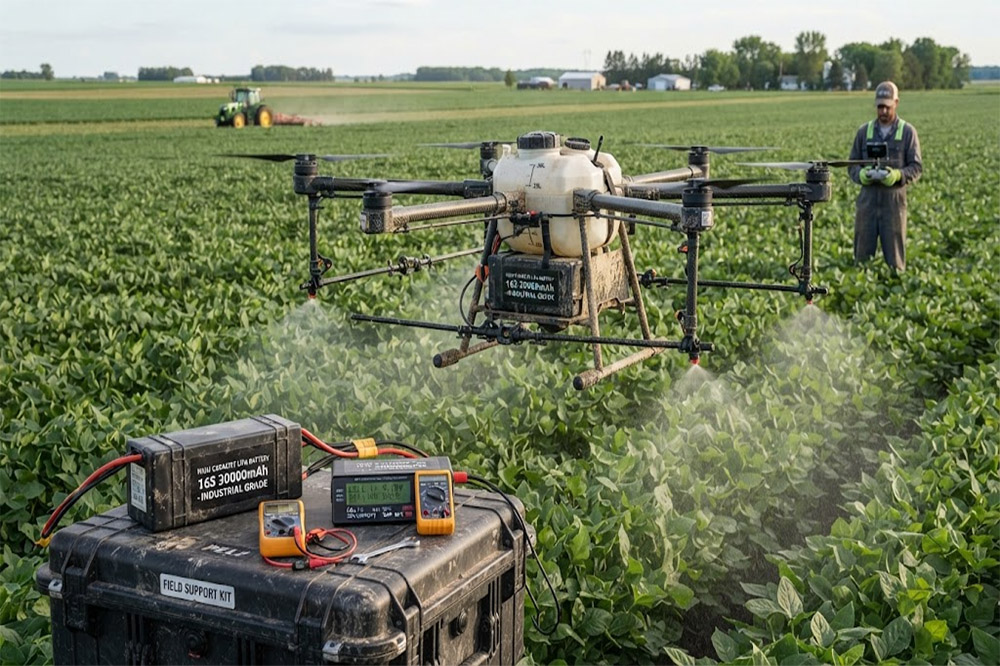
An agriculture drone has a very different working day from a normal camera drone.
It may take off with a full tank, fly low over a field, spray for several minutes, return to refill, and then do it again. Sometimes this cycle continues for hours.
That puts a lot of pressure on the battery.
For an agriculture drone manufacturer or distributor, choosing a battery is therefore not just about finding the biggest mAh number. The battery has to provide enough power, fit the aircraft, survive repeated working cycles and, importantly, avoid adding unnecessary weight.
A battery that looks impressive on a datasheet can behave very differently once the drone is carrying a full liquid tank.
Agriculture drones place unusually high demands on their batteries because of payload and repeated operation. For a broader look at LiPo battery selection for different UAV applications, see our LiPo Battery for Drone: Complete Guide for UAV Manufacturers and Buyers.
Start With the Drone, Not the Battery
Before choosing an agriculture drone battery, I would first look at the aircraft itself.
A useful starting list is:
- Maximum takeoff weight
- Empty drone weight
- Payload capacity
- Motor and ESC specifications
- Required voltage
- Average current
- Peak current
- Target flight time
- Battery compartment size
This matters because agricultural drones vary considerably.
A small spraying UAV may use a relatively compact battery, while a larger commercial platform can require a much higher-capacity pack.
There is no single battery specification that fits every farming drone.
The Payload Changes Everything
This is probably the biggest difference between agricultural drones and many other UAVs.
Imagine a spraying drone carrying 20 liters of liquid.
At the beginning of the flight, it is carrying:
Drone + battery + 20kg payload
Later, after spraying, much of that liquid is gone.
The aircraft becomes lighter.
The battery, however, weighs almost exactly the same from takeoff to landing.
So the battery needs to provide enough power for the most demanding part of the flight while still being light enough not to become unnecessary weight.
This is why battery selection and payload design should ideally be considered together.

Capacity Is Important, But Bigger Is Not Automatically Better
A larger battery stores more energy.
That sounds like an easy way to increase flight time.
But a larger battery also adds weight.
Suppose a manufacturer increases the battery capacity by 30%, but the battery weight increases significantly at the same time.
The drone now has more energy available, but the motors also have more weight to lift.
The final flight-time improvement may be smaller than expected.
For agricultural UAVs, I would look at usable energy per kilogram rather than capacity alone.
This is where energy density becomes useful.
High Discharge Capability Matters During Takeoff
Agriculture drones can be power-hungry, particularly when carrying a heavy payload.
The battery needs to handle high current during:
- Takeoff
- Climbing
- Acceleration
- Wind resistance
- Heavy payload operation
A battery with insufficient discharge capability can experience significant voltage drop under load.
The pilot may notice slower response or reduced power when the drone is carrying a full tank.
For this reason, a high-discharge farming drone battery is often more important than simply choosing a high-capacity pack.
The exact requirement depends on the motor and ESC system, though. There is little value in paying for extreme discharge capability if the aircraft never actually uses it.

LiPo Is Common for Agriculture Drones
High-discharge LiPo batteries are widely used in heavy-lift and agriculture UAV applications.
The main attraction is straightforward:
high power output without an extremely complicated battery system.
A well-designed LiPo pack can provide substantial current for takeoff and heavy-load flight.
For a spraying drone, this can be useful because the aircraft may need strong thrust when the liquid tank is full.
However, battery weight still needs to be controlled.
A heavier battery means the drone has to work harder throughout the flight.
Battery Voltage Must Match the Power System
Voltage is another specification that should be confirmed before requesting quotations.
The battery voltage must match the drone’s:
- Motors
- ESCs
- Power distribution system
- Charger
- Battery management or monitoring system
A higher-voltage pack is not automatically better.
Changing from one voltage configuration to another can affect motor speed, current and overall power-system behavior.
For an OEM customer, it is usually better to provide the battery supplier with the existing motor and ESC specifications rather than simply saying:
“I need a high-voltage agriculture battery.”
That gives the manufacturer something concrete to work with.
What About Brazil?
Brazil is an interesting market for agricultural UAVs because large-scale farming operations can involve extensive fields and long working distances.
For operators, battery turnaround becomes important.
A drone that can only complete a short flight before waiting for a recharge may not be very productive, even if the battery itself performs well.
In practice, many commercial operators may need several battery packs per aircraft so that one pack is flying while another is being charged or prepared.
For distributors, this creates a different purchasing question:
How many batteries does the customer actually need for one working drone?
Selling a single battery is one thing.
Building a practical battery package for a fleet is another.

Middle East Conditions Can Be Hard on Batteries
Heat is another factor worth considering for agricultural UAV operations in the Middle East.
High ambient temperatures can increase battery temperature during operation and charging.
The actual effect depends on the battery design, current load, aircraft cooling and operating environment.
For buyers in hot regions, I would not focus only on rated capacity.
It is worth asking suppliers about:
- Operating temperature
- Charging temperature
- Discharge temperature
- Thermal management
- Storage requirements
- Testing conditions
A battery that performs well in a cool factory environment still needs to be tested under realistic field conditions.
Southeast Asia: Humidity and Frequent Operation
Southeast Asian agriculture can present a different combination of challenges.
High humidity, heat, frequent rain and intensive farming schedules can all affect how equipment is handled.
The battery itself should be stored and charged properly, but the entire UAV system also needs to be designed for the working environment.
For commercial buyers, battery connectors and pack construction deserve attention too.
It is not just the cells.
The wiring, connector, enclosure and mechanical protection all become part of the finished battery pack.
One Battery Specification Does Not Fit Every Farm
A distributor selling agriculture drones across different countries may run into this problem quite quickly.
A battery suitable for a lightweight spraying drone may not work for a larger aircraft.
Likewise, a battery designed for a hot operating environment may need different testing and thermal considerations from one used in a cooler climate.
The customer’s actual UAV model should always be part of the quotation process.
For example:
| Requirement | Why It Matters |
|---|---|
| Capacity | Determines stored energy |
| Voltage | Must match power system |
| Discharge current | Supports high-power operation |
| Weight | Directly affects payload and endurance |
| Dimensions | Must fit battery compartment |
| Cycle life | Important for fleet operating cost |
| Temperature | Important in hot farming regions |
| Connector | Must match aircraft system |
Battery Cycle Life Matters for Commercial Farming
An agriculture drone may fly much more frequently than a recreational drone.
That means the battery can accumulate cycles quickly.
For a commercial operator, battery replacement becomes part of the operating cost.
A battery that provides good performance but loses capacity quickly may not be attractive over a full season.
This is why fleet operators should track battery condition rather than treating every pack as identical.
Capacity testing, internal resistance checks and flight-time records can help identify batteries that are beginning to perform differently.
When Should You Consider a Custom Farming Drone Battery?
Custom battery development makes sense when the standard packs do not quite fit the aircraft.
Typical requirements might include:
- Custom voltage
- Larger capacity
- Specific dimensions
- Maximum weight limit
- High discharge capability
- Special connector
- Longer cable
- Custom housing
- Fleet-specific battery configuration
For example, an agriculture drone manufacturer may have a narrow battery compartment but require a relatively high-capacity pack.
Instead of forcing a standard battery into the available space, the pack can be designed around the aircraft.
For larger OEM projects, this can be a much more practical approach.
Apsenx provides customized UAV battery solutions for commercial drone applications. You can view the UAV Battery product category for available battery configurations and OEM/ODM options.
Buying Agriculture Drone Batteries in Bulk
For distributors in Brazil, the Middle East or Southeast Asia, sample testing should happen before a large purchase.
I would suggest testing the battery on the actual agriculture drone and checking:
- Takeoff current
- Full-load flight performance
- Battery temperature
- Voltage under load
- Actual flight time
- Charging time
- Capacity after repeated cycles
This gives a much better picture than a product sheet alone.
For wholesale orders, consistency between batches becomes important as well.
If the first shipment performs differently from the second, the distributor has a problem even if both batteries technically meet the same printed specifications.
Which Agriculture Drone Battery Should You Choose?
For most commercial agriculture UAV projects, the battery should be selected around the aircraft’s payload, power demand and operating environment.
A high-discharge LiPo can be a strong option for heavy spraying drones where takeoff and climbing require substantial power.
A higher-energy-density pack may be more attractive for lighter agricultural UAVs where endurance is the bigger concern.
And for OEM manufacturers, a custom battery can make sense when weight, dimensions or voltage requirements are difficult to meet with standard products.
The right battery is usually the one that works well with the whole aircraft—not simply the one with the largest capacity printed on the label.
FAQ
What is the best battery for an agriculture drone?
It depends on the drone’s weight, payload, voltage and current requirements. High-discharge LiPo batteries are commonly considered for heavy agricultural UAVs.
How long does an agriculture drone battery last?
Flight time varies considerably depending on payload, battery capacity, aircraft weight, wind and spraying conditions. A full payload generally requires more power than an empty or partially loaded tank.
Are LiPo batteries suitable for farming drones?
Yes. High-discharge LiPo batteries are widely used for agriculture UAVs because they can provide substantial power for heavy-load operation.
Can agriculture drone batteries be customized?
Yes. Capacity, voltage, dimensions, connectors, wiring and other pack specifications can be customized for OEM agriculture drone projects.


Leave a Reply