
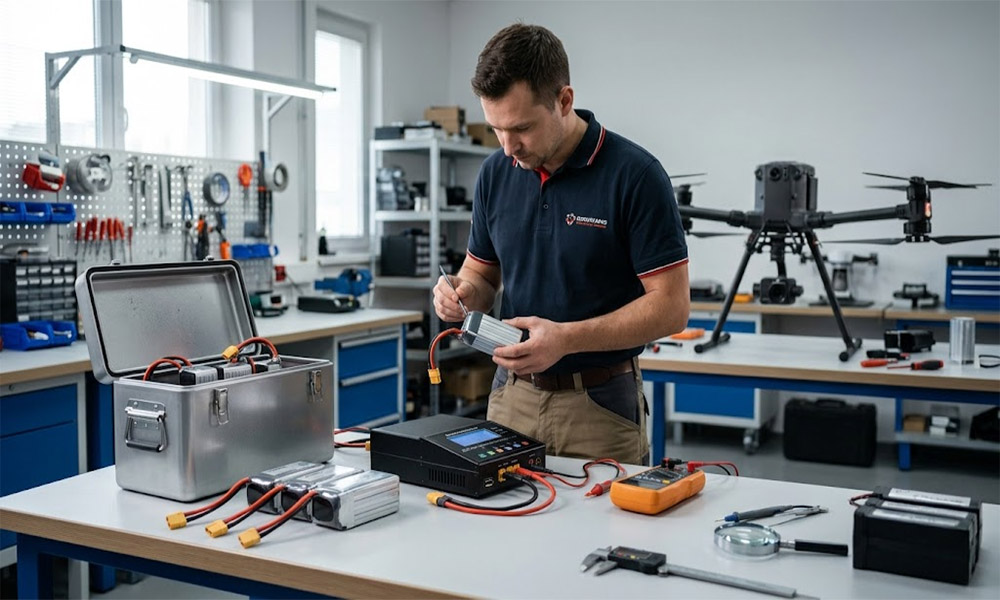
A drone battery can look like one of the simplest parts of a UAV.
Connect it, take off, fly, recharge.
In reality, the battery deserves considerably more attention, especially when the drone is used frequently or the batteries are being handled by several people.
This becomes even more important for commercial operators and distributors. A hobby pilot may have two or three batteries. A commercial drone company might have dozens, or even hundreds, moving between charging stations, aircraft and storage shelves.
Good drone battery safety is therefore less about one complicated rule and more about developing a routine.
Check the battery.
Charge it correctly.
Store it properly.
And don’t ignore small changes in its condition.
Battery safety is only one part of choosing the right UAV power system. For a broader guide to LiPo chemistry, capacity, voltage, discharge performance and battery selection, see our LiPo Battery for Drone: Complete Guide for UAV Manufacturers and Buyers.
Start With the Battery Before You Start the Drone
Before installing a LiPo battery into a UAV, take a quick look at it.
You do not need a laboratory for this.
Look for:
- Swelling
- Damaged casing
- Cut or loose wires
- Burn marks
- Damaged connectors
- Unusual odor
- Physical deformation
- Signs of leakage
A battery that looks different from the others in the same batch deserves attention.
Swelling is particularly important with LiPo packs. If a pack has visibly expanded, it should not simply be put back into service because “it still works.”
A battery can continue to power a drone while already showing signs of damage.
That is not a good trade.

Charging Is Where Good Habits Matter Most
For LiPo battery safety, charging deserves particular attention.
Use a charger designed for the battery chemistry and configuration.
For example, a LiPo pack should be charged using a charger with the appropriate LiPo charging mode and correct cell count.
If the battery is a 6S pack, the charger needs to recognize and support a 6S configuration.
It is also important to use the appropriate balance charging function when required by the battery and charger system.
The basic idea is simple: the individual cells should remain within their intended voltage range.
Do not guess the settings.
If a battery label says 6S, 22.2V nominal, the charging system should be configured accordingly rather than manually selecting a random voltage.
Don’t Leave Charging Battery Unattended
This sounds obvious, but it is still worth mentioning.
A charging LiPo battery should not be treated like a phone charging overnight.
If something unusual happens during charging, someone needs to be there to notice it.
For commercial operations, a dedicated charging area is much better than having batteries charging randomly around an office or workshop.
Keep the charging area:
- Dry
- Clean
- Well ventilated
- Away from flammable materials
- Organized enough to identify each battery
For larger fleets, it can also help to record which battery is being charged and how many cycles it has completed.

Battery Temperature Tells You Something
Temperature is an easy thing to overlook.
After a demanding flight, the battery may feel warm.
Some temperature increase during operation can be normal, depending on the battery and application.
But if one battery consistently becomes much hotter than similar batteries under the same conditions, I would investigate it.
Possible causes include:
- Excessive current
- High internal resistance
- Damaged cells
- Poor connections
- Overloading
- Inadequate cooling
The same applies during charging.
If one pack behaves noticeably differently from the others, don’t just put it back into the charging queue.
Storage Is Not the Same as Charging
A battery that will not be used for several days does not necessarily need to remain fully charged.
LiPo batteries are generally stored at a suitable storage charge level rather than being left fully charged for long periods.
The exact recommended storage voltage depends on the battery chemistry and manufacturer’s instructions, so follow the battery supplier’s specifications.
For fleet operators, this becomes surprisingly important.
Imagine 50 batteries sitting at full charge for several weeks because a project was postponed.
That is very different from storing a few batteries for a weekend.
A simple storage routine can help avoid unnecessary battery aging.

Keep Batteries Away From Heat and Moisture
The storage environment matters.
Avoid storing batteries:
- In direct sunlight
- Next to heaters
- Inside a hot vehicle for extended periods
- In damp areas
- Near flammable materials
This can be especially relevant in hot markets.
For example, a drone operator working in the Middle East may finish a flight and leave the battery case inside a vehicle.
The outside temperature might already be high, and the interior of the vehicle can become significantly hotter.
That is not an ideal storage environment for lithium batteries.
In Southeast Asia, humidity is another consideration.
A dry, controlled storage area is preferable to an exposed workshop.
Don’t Ignore the Battery After a Hard Landing
Commercial drones do not always have perfect landings.
A battery can be damaged even when the aircraft itself appears fine.
After a hard landing, collision or crash, inspect the battery before using it again.
Check the casing, wiring and connectors.
If the pack has been crushed or badly deformed, don’t assume it is safe simply because the voltage still looks normal.
Electrical readings cannot always tell you everything about physical damage.
This is one area where being conservative is usually the better choice.
Battery Maintenance for Commercial UAV Fleets
For a commercial operation, I would recommend giving every battery some form of identification.
It could be:
Battery #001
Battery #002
Battery #003
Then record basic information such as:
- Number of charge cycles
- Date purchased
- Flight hours
- Capacity test results
- Maintenance history
- Abnormal temperature events
You do not necessarily need an expensive software system.
Even a simple spreadsheet can be useful when managing a small fleet.
The advantage becomes obvious when one battery starts performing differently.
Instead of asking, “Which battery is this?”, the operator can see its history.
Safety becomes even more important when batteries are used repeatedly in commercial fleets. Our guide to industrial UAV battery solutions for commercial drones covers agriculture, inspection and mapping applications.

When Should Drone Battery Be Replaced?
There is no single number of cycles that applies to every battery.
Battery life depends on:
- Cell chemistry
- Discharge rate
- Charging method
- Operating temperature
- Depth of discharge
- Storage conditions
- Battery construction
- Actual workload
A battery used gently in a mapping drone may age differently from a battery repeatedly pushed hard in an FPV racing drone.
Look for changes in behavior.
For example:
- Noticeably reduced flight time
- Increasing internal resistance
- Excessive voltage sag
- Unusual heating
- Swelling
- Physical damage
- Significant capacity loss
If several warning signs appear together, replacement should be considered.
Don’t Mix Batteries Carelessly
Commercial drone operators sometimes use batteries from different suppliers or batches.
This is not automatically a problem, but the batteries should still meet the aircraft’s required specifications.
Avoid assuming that two batteries are interchangeable simply because both say:
6S 22000mAh
They may have different discharge capabilities, dimensions, connectors, weights and internal resistance.
For a professional UAV, battery specifications should be checked against the aircraft requirements.
This becomes particularly important when replacing the original battery with a third-party pack.
Choosing Safer Battery Supplier
Battery safety does not begin after the battery arrives.
It starts with battery design and manufacturing.
For B2B buyers, it is worth asking suppliers about:
- Cell source
- Cell matching
- Pack construction
- Protection and monitoring
- Capacity testing
- Discharge testing
- Quality-control procedures
- Batch consistency
- Relevant transport and product certifications
A low price is attractive, but a commercial drone battery is not a component where the cheapest quotation should automatically win.
A battery problem can ground an aircraft, damage other equipment or create a much bigger operational headache.

LiPo Battery Safety for Different Drone Applications
Safety requirements also change somewhat depending on how the battery is used.
FPV racing
High current, frequent acceleration and aggressive discharge can generate more heat.
Agriculture drones
Heavy payloads can push the battery hard during takeoff and climbing.
Mapping drones
Longer missions can place emphasis on temperature, capacity retention and consistent performance.
Power inspection UAVs
High-value sensors and long flight missions make battery reliability particularly important.
The battery should be tested under the actual operating conditions rather than only under light bench testing.
High-discharge applications need additional attention because aggressive current demand can increase battery temperature and voltage sag. See our guide to high discharge LiPo batteries for FPV drone racing.
For Battery Buyers: Test Before Ordering in Bulk
If you are a distributor or UAV manufacturer, I would not place a large battery order based only on a product specification sheet.
Start with samples.
Test them on the actual aircraft.
Check:
- Flight time
- Voltage under load
- Battery temperature
- Charging behavior
- Physical fit
- Connector quality
- Actual capacity
Then compare the results.
Once the battery passes testing, the supplier should be able to maintain the same specification during production.
This is especially important for private-label and OEM projects.
Apsenx provides customized UAV battery solutions for commercial and industrial drone applications. You can review the UAV Battery product category when looking for battery packs for different UAV platforms.
A Simple Drone Battery Safety Routine
Before flight:
Inspect → Check voltage → Check physical condition → Install correctly
After flight:
Check temperature → Inspect the pack → Record abnormal behavior
Before storage:
Use the recommended storage charge → Keep batteries in a suitable environment → Separate damaged packs
Before the next flight:
Check the battery again.
It takes only a few minutes.
For a commercial UAV fleet, those few minutes can save considerably more time later.
FAQ
How should I store a LiPo drone battery?
Store it according to the battery manufacturer’s recommended storage charge level, in a cool, dry and controlled environment away from heat and flammable materials.
Is it safe to leave a LiPo battery charging overnight?
It is not recommended to leave LiPo batteries charging unattended. Use a compatible charger and follow the battery manufacturer’s charging instructions.
What should I do if my drone battery is swollen?
Do not continue normal use or charging. Isolate the damaged battery in accordance with your battery supplier’s safety and disposal procedures.
How often should drone batteries be checked?
They should be visually inspected before use. Commercial operators should also track battery condition, cycles and performance over time.


Leave a Reply