
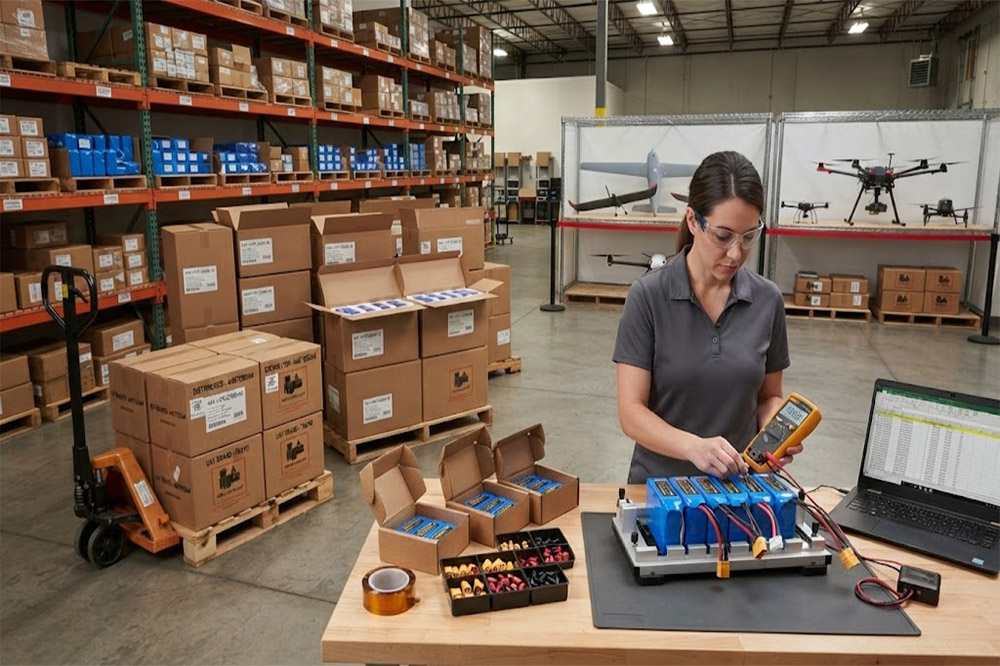
Buying one drone battery is easy.
Buying 500 is a different conversation.
Once you are purchasing batteries for resale, a drone brand, or a commercial UAV fleet, the battery itself is only part of the decision. You also need to think about MOQ, certification, delivery time, batch consistency, packaging and what happens when you need the same battery six months later.
This is where choosing a drone battery supplier carefully can save a lot of trouble.
A supplier might offer a very attractive price on the first quotation. But if the second production batch is different, delivery keeps moving, or the supplier cannot provide the required documents, the original saving may not mean much.
For distributors and UAV brands, I would look at the whole supply chain rather than just the unit price.
Start With the Actual Battery Requirement
Before asking for a wholesale price, get the battery specification reasonably clear.
You should know at least:
- Battery chemistry
- Nominal voltage
- Capacity
- Cell configuration
- Continuous discharge requirement
- Dimensions
- Weight
- Connector
- Cable length
- Intended drone model
If you are buying a replacement battery for an existing drone, sending the original battery label and photos can make the initial discussion much easier.
If it is a new UAV project, provide the aircraft power requirements instead.
This distinction matters.
A supplier cannot recommend a suitable battery very accurately from “10,000mAh drone battery” alone.
If you are still deciding which battery chemistry and capacity are suitable for your UAV products, start with our LiPo Battery for Drone: Complete Guide for UAV Manufacturers and Buyers before comparing wholesale suppliers.
MOQ Can Affect the Price More Than Expected
MOQ means Minimum Order Quantity.
For distributors, this is usually one of the first commercial questions.
But MOQ is not always a fixed number that applies to every battery.
A standard battery may have a lower MOQ because the manufacturer already produces it regularly.
A completely custom OEM battery may require a higher initial quantity because the supplier needs to purchase specific cells, materials, housings or connectors.
For example, a distributor might want:
100 standard battery packs
while a UAV brand developing a new battery may ask for:
20 prototypes + 1,000 production packs
Those are very different projects.
It is worth asking whether the supplier has different MOQ levels for samples, pilot production and mass production.
Don’t Look at MOQ Alone
A low MOQ sounds attractive.
But imagine Supplier A offers a MOQ of 50 packs at a higher unit price, while Supplier B requires 500 packs at a much lower price.
If you are a new distributor, ordering 500 batteries may tie up too much cash.
There is also the risk of slow inventory turnover.
Batteries are not ordinary plastic accessories sitting in a warehouse forever. Their condition and storage environment matter, and your customers may also expect recent production.
So sometimes a slightly higher unit price with a manageable MOQ is actually the better business decision.

Certification Should Be Checked Before the Order
For lithium batteries, documentation is not something I would leave until after production.
Ask the drone battery supplier what certification and transport documents are available for the specific battery you are buying.
Depending on the market and battery type, buyers may need documentation such as:
- UN38.3
- MSDS/SDS
- IEC-related test reports
- CE
- UL-related certification or testing
- Other market-specific documents
The exact requirements depend on the product, destination and application.
One important point: don’t assume that a supplier’s certificate for one battery automatically covers another battery.
Check the actual model and specification.
This becomes particularly important when importing batteries across borders.
Delivery Time Is Part of the Cost
A battery supplier can offer a great price and still create problems if the shipment arrives too late.
For a distributor, delayed batteries can mean:
No stock → no sales → customer waits → customer looks elsewhere
For a UAV manufacturer, it can be even worse.
If the drone assembly line is waiting for batteries, other components may already be sitting in the factory.
When discussing delivery, ask about:
- Sample lead time
- Production lead time
- Packaging time
- Shipping method
- Export documentation
- Expected production schedule
- Peak-season delays
Don’t only ask, “How many days?”
Ask whether the stated lead time starts after payment, after specification approval, or after the final sample is confirmed.
That small detail can make the quoted schedule look very different.

Quality Control Is More Important Than the First Sample
This is probably one of the biggest differences between buying a few batteries and building a long-term supply relationship.
A sample can be excellent.
The question is whether production batch #10 will still look the same.
For wholesale drone batteries, quality control should cover areas such as:
- Cell consistency
- Capacity
- Voltage
- Internal resistance
- Welding quality
- BMS function
- Connector installation
- Pack dimensions
- Weight
- Charge/discharge performance
For larger orders, ask the supplier how finished packs are tested before shipment.
A basic capacity check is useful, but it is only one part of the picture.

Cell Consistency Matters
Two battery packs can have exactly the same label:
22.2V 20Ah
and still perform differently.
The cells inside the packs, their matching, internal resistance and assembly quality can influence the result.
For distributors, inconsistent batteries create customer complaints.
One customer may report excellent flight time while another says the battery loses voltage too quickly.
That becomes difficult to explain if you do not have proper batch control.
This is one reason I would ask a potential supplier about the source and consistency of the cells, not just the finished pack capacity.
For endurance-focused UAV products, distributors can also consider Li-ion solutions such as 21700 packs. See our guide to 21700 battery packs for drones for more information.
Packaging and Labeling Are Easy to Forget
For wholesale orders, packaging should be discussed early.
You may need:
- Individual battery boxes
- Protective packaging
- Product labels
- Serial numbers
- Warning labels
- Barcodes
- Private-label branding
- Carton markings
A UAV brand may want its own logo and model number.
A distributor may need packaging that fits its local sales channel.
These details sound minor during the quotation stage.
They become much less minor when 1,000 batteries are sitting in front of you with the wrong labels.

What Makes Good Drone Battery Supplier?
I would look for a supplier that can answer technical questions without constantly giving vague replies.
For example, if you ask about a battery’s maximum current, the answer should not simply be:
“Very high discharge.”
You should be able to discuss actual specifications.
Likewise, when asking about production, you should understand how samples, approval and mass production are connected.
A good supplier should be able to discuss:
Cell → Pack Design → BMS → Assembly → Testing → Packaging → Shipping
rather than treating the battery as a simple finished commodity.
Wholesale Drone Batteries for Different Markets
The right battery also depends on your customer base.
FPV Distributors
Usually need batteries with strong discharge capability and consistent performance.
Agriculture Drone Distributors
May focus more on high-capacity, high-power packs for heavy payload applications.
Mapping UAV Brands
Often care about energy density, weight and endurance.
Inspection Drone Companies
May need a balance between flight time, payload and reliability.
Consumer Drone Accessories
May place more emphasis on compatibility, packaging, price and repeat availability.
This is why a supplier with several battery platforms can be useful to distributors.
If your customers are involved in agriculture, inspection or mapping, our guide to industrial UAV battery solutions covers several commercial drone applications.
Don’t Forget Repeat Orders
The first order proves that a supplier can produce a battery.
The second and third orders tell you whether you have a reliable supply chain.
Before committing to a long-term relationship, ask:
- Can the same cell model be maintained?
- Can specifications remain consistent?
- How are engineering changes communicated?
- Can production continue if demand increases?
- Can the supplier support private labeling?
- What happens if a quality issue appears?
These questions are not meant to make the purchasing process complicated.
They are simply part of buying batteries in volume.
Sample Testing Before Wholesale Orders
For a new drone battery supplier, I would recommend testing samples before placing a large order.
Test them on the actual drone if possible.
Check:
- Flight time
- Voltage under load
- Temperature
- Charging behavior
- Physical fit
- Connector performance
- Capacity
- Weight
For distributors, it is also useful to keep one or two approved samples as a reference.
When the next production batch arrives, you have something to compare against.
That is much easier than relying on memory.

What About OEM and Private Label?
If you already have your own UAV brand, OEM can make more sense than selling another company’s standard battery.
The battery can be customized in areas such as:
- Capacity
- Dimensions
- Connector
- Cable
- Housing
- BMS
- Label
- Packaging
Apsenx supports OEM battery development for UAV companies, including cell selection, BMS, connectors, housing and prototypes.
For distributors, private-label packaging can also help create a more consistent product line.
You can learn more about the process in our guide to custom drone battery pack manufacturing.
For UAV brands that need more than a standard battery, our guide to custom drone battery pack manufacturing and OEM solutions explains how cell selection, BMS, connectors, housing and prototypes fit into the development process.
Buying Wholesale Is Really About Risk
Price still matters.
Of course it does.
But if one supplier is $1 cheaper per battery and creates twice as many quality problems, the calculation changes quickly.
A distributor should consider:
Unit price + shipping + documentation + defect rate + delivery risk + after-sales cost
The cheapest quotation is not necessarily the lowest total cost.
This is particularly true for lithium batteries because shipping, certification and handling can already add meaningful cost to the product.
What to Ask Drone Battery Supplier
Before requesting a wholesale quotation, prepare a short list:
- What is the MOQ?
- What is the sample price?
- What is the production lead time?
- Which certifications are available?
- Which cells are used?
- How are cells matched?
- What tests are performed before shipment?
- Can the battery be customized?
- Can you provide private labeling?
- What is the repeat-order lead time?
If the supplier can give clear answers to these questions, you have a much better starting point.
Wholesale Drone Batteries from Apsenx
For distributors and UAV brands looking for a long-term drone battery supplier, Apsenx can support standard and customized UAV battery requirements.
The product range can be developed around different UAV applications, including LiPo and Li-ion battery solutions.
For OEM projects, the process can start with the required voltage, capacity, current, dimensions and quantity.
For wholesale customers, the discussion can focus on MOQ, production schedule, quality requirements, packaging and documentation.
You can view the UAV Battery product category and send your requirements for a quotation.
Request a Wholesale Drone Battery Quote
Buying drone batteries in bulk?
Send us your battery specifications, target quantity, destination market and application. We can discuss MOQ, certification, lead time and OEM options based on your project.
Request UAV Battery Quote
FAQ
What is the typical MOQ for wholesale drone batteries?
MOQ depends on whether you are buying a standard battery or a customized OEM pack. Sample orders, pilot production and mass production may have different quantity requirements.
What certifications should I ask for?
Requirements depend on the battery and destination market. Common documents may include UN38.3 and SDS/MSDS, along with applicable product certifications or test reports.
How long does wholesale drone battery production take?
Lead time depends on the battery model, quantity, cell availability and customization. Always confirm whether the quoted lead time begins after payment, specification approval or sample confirmation.
Can wholesale drone batteries be private labeled?
Yes. Depending on the project, packaging, labels, connectors, housing and other battery specifications may be customized.
How should I test a supplier before placing a large order?
Start with samples and test them on the actual drone when possible. Compare capacity, flight time, temperature, voltage behavior, physical dimensions and charging performance.


Leave a Reply