
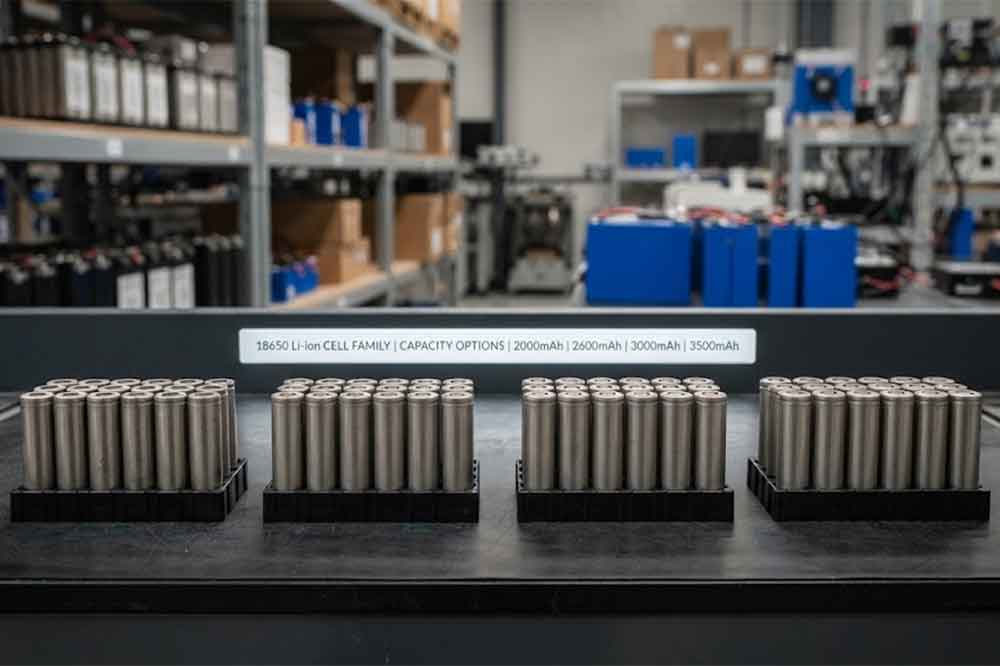
Choosing 18650 battery is not only about finding the highest mAh rating.
A 2000mAh, 2600mAh, 3000mAh, or 3500mAh cell can fit the same 18 × 65 mm format. However, the cells may behave very differently in a battery pack.
Capacity affects runtime and energy. Discharge capability affects how much current the pack can deliver. Cell quality, internal resistance, cycle life, and availability also matter.
For OEM buyers, the right choice depends on the complete battery design.
2000mAh vs 2600mAh vs 3000mAh vs 3500mAh at a Glance
The basic difference is capacity.
| 18650 Cell Capacity | Nominal Voltage | Typical Energy* | Main Consideration |
|---|---|---|---|
| 2000mAh | 3.6V–3.7V | 7.2–7.4Wh | Lower capacity, current-focused options |
| 2600mAh | 3.6V–3.7V | 9.36–9.62Wh | Balanced capacity and size |
| 3000mAh | 3.6V–3.7V | 10.8–11.1Wh | Common balance for many packs |
| 3500mAh | 3.6V–3.7V | 12.6–12.95Wh | Higher energy per cell |
*Actual usable energy depends on the cell model, discharge conditions, cutoff voltage, and application.
The calculation is simple:
Energy (Wh) ≈ Voltage (V) × Capacity (Ah)
For example, a 3000mAh cell is 3.0Ah.
At 3.6V nominal voltage:
3.6V × 3.0Ah = 10.8Wh
This gives buyers a quick way to compare cells.
However, energy is only one part of the selection.
What Does 2000mAh Mean?
A 2000mAh 18650 cell has a nominal capacity of 2.0Ah.
Compared with a 3500mAh cell, it stores less energy per cell. Therefore, a pack may need more parallel cells to reach the same capacity.
That does not automatically make a 2000mAh cell a poor choice.
Some lower-capacity 18650 cells are designed around higher current output. This can make them useful for applications where power demand matters more than maximum runtime.
For example, consider a device with a relatively high continuous current requirement.
The buyer may need a cell with a strong discharge specification rather than simply choosing the highest mAh rating.
This is why OEM buyers should check the datasheet instead of comparing capacity alone.
What Does 2600mAh Mean?
A 2600mAh 18650 cell provides approximately 2.6Ah.
This capacity sits between 2000mAh and 3000mAh. It can be useful when the battery design needs a balance between energy, current capability, cost, and cell availability.
For example, a 10S4P pack using 2600mAh cells has:
10 × 3.6V = 36V nominal
And:
4 × 2.6Ah = 10.4Ah
The approximate energy is:
36V × 10.4Ah = 374.4Wh
The actual pack energy will depend on the selected cell and operating conditions.
The same S/P structure can therefore produce different pack capacities simply by changing the cell capacity.

What Does 3000mAh Mean?
A 3000mAh 18650 cell provides approximately 3.0Ah.
This is a useful middle ground for many battery pack designs.
It offers more energy per cell than a 2000mAh or 2600mAh cell. At the same time, some 3000mAh cells can still provide useful discharge performance.
For example:
10S4P × 3000mAh
means 10 cells in series and four cells in parallel.
The pack contains:
10 × 4 = 40 cells
Nominal voltage is approximately:
10 × 3.6V = 36V
Capacity is:
4 × 3.0Ah = 12Ah
Approximate nominal energy:
36V × 12Ah = 432Wh
This example shows why cell capacity matters when designing a battery pack.
What Does 3500mAh Mean?
A 3500mAh 18650 cell provides approximately 3.5Ah.
It offers more capacity per cell than the other three options.
That can be useful when the battery enclosure has limited space. A higher-capacity cell may help the designer reach the required pack capacity with fewer parallel cells.
However, this does not mean 3500mAh is always the correct choice.
Higher capacity can come with different discharge characteristics.
The buyer should check:
- Continuous discharge current
- Peak discharge current
- Internal resistance
- Cycle life
- Operating temperature
- Cell dimensions
- Manufacturer specifications
- Actual test conditions
The highest capacity number should not be the only selection criterion.
2000mAh vs 2600mAh vs 3000mAh vs 3500mAh: Energy Comparison
The easiest way to compare these cells is to convert capacity into approximate energy.
Using 3.6V as the nominal voltage:
| Cell | Capacity | Approx. Nominal Energy |
|---|---|---|
| 2000mAh | 2.0Ah | 7.2Wh |
| 2600mAh | 2.6Ah | 9.36Wh |
| 3000mAh | 3.0Ah | 10.8Wh |
| 3500mAh | 3.5Ah | 12.6Wh |
The difference becomes important when many cells are used.
For example, 100 cells with a nominal capacity of 3000mAh contain approximately:
100 × 10.8Wh = 1080Wh
Using 3500mAh cells under the same nominal-voltage assumption:
100 × 12.6Wh = 1260Wh
That is a difference of about 180Wh.
For large battery systems, this difference can affect runtime and pack design.

Does Higher mAh Always Mean Better?
No.
Capacity tells you how much charge the cell can store under specified test conditions.
It does not tell you how much current the cell can safely deliver.
A 3500mAh cell may have a lower discharge rating than a lower-capacity high-power cell.
For example, an application may require high current for motors, tools, or other demanding loads.
In this situation, the designer should compare:
Capacity + continuous current + peak current + internal resistance
rather than capacity alone.
There is another issue.
A high-capacity cell may require a different parallel configuration than a lower-capacity cell. The physical layout can change as a result.
So, higher mAh can be useful. It simply needs to fit the complete design.
2000mAh vs 2600mAh: When Does the Difference Matter?
The difference between 2000mAh and 2600mAh is 600mAh.
That represents a 30% increase compared with 2000mAh.
For a single cell, the difference may look small.
For a battery pack, however, it becomes much more noticeable.
Consider a 10S4P configuration.
With 2000mAh cells:
4 × 2.0Ah = 8Ah
With 2600mAh cells:
4 × 2.6Ah = 10.4Ah
Both packs use 40 cells.
The series count remains the same. Therefore, the nominal voltage also remains approximately the same.
The main difference is pack capacity.
This is one reason cell capacity is important for OEM pack design.
2600mAh vs 3000mAh: A Common OEM Comparison
The difference between 2600mAh and 3000mAh is 400mAh per cell.
For a 4P configuration:
- 2600mAh × 4 = 10.4Ah
- 3000mAh × 4 = 12Ah
The 3000mAh configuration provides about 15.4% more capacity than the 2600mAh configuration.
However, the final choice still depends on current requirements.
A 2600mAh cell with suitable discharge performance may be more appropriate for one application.
A 3000mAh cell may be more suitable for another.
The datasheet should always be checked before making the final decision.
3000mAh vs 3500mAh: Is the Extra Capacity Worth It?
The difference is 500mAh per cell.
With four cells in parallel:
3000mAh × 4 = 12Ah
3500mAh × 4 = 14Ah
So the same 4P arrangement can provide different pack capacities.
This can be useful when enclosure space is limited.
However, the designer should also check discharge performance and thermal behavior.
A cell with more capacity may not have the same current capability as a high-power cell.
Therefore, the question is not simply:
“Which cell has more mAh?”
A better question is:
“Which cell meets the required energy and current within the available space?”
How Capacity Changes an 18650 Battery Pack
Capacity becomes especially important when several cells are connected in parallel.
For a basic battery pack:
Pack Capacity = Cell Capacity × Parallel Count
For example:
| Configuration | Cell Capacity | Pack Capacity |
|---|---|---|
| 10S2P | 2000mAh | 4Ah |
| 10S2P | 2600mAh | 5.2Ah |
| 10S2P | 3000mAh | 6Ah |
| 10S2P | 3500mAh | 7Ah |
The series count controls voltage.
The parallel count controls capacity.
Therefore, changing the cell capacity can change the final pack capacity without changing the series count.
For more information, see our guide on [18650 Battery Series and Parallel: Understanding S and P Configurations].

How Many Cells Are Needed for the Same Pack Capacity?
This is an important question for OEM battery design.
Suppose the target is approximately 12Ah.
Using 2000mAh cells:
12Ah ÷ 2Ah = 6P
Using 2600mAh cells:
12Ah ÷ 2.6Ah ≈ 4.62P
A real pack cannot use 4.62 cells in parallel.
The designer needs a whole-number configuration.
Therefore, 5P would provide:
2.6Ah × 5 = 13Ah
Using 3000mAh cells:
12Ah ÷ 3Ah = 4P
Using 3500mAh cells:
12Ah ÷ 3.5Ah ≈ 3.43P
Again, the configuration must use a whole number.
A 4P configuration would provide:
3.5Ah × 4 = 14Ah
This simple calculation can affect the total cell count, pack size, weight, and cost.
Cell Capacity and Battery Pack Size
Higher-capacity cells can sometimes reduce the number of parallel cells needed.
That can simplify the pack layout.
For example, reaching around 12Ah with 3000mAh cells requires 4P.
A 2000mAh cell requires 6P for the same nominal capacity.
The difference is two parallel cells per series group.
For a 10S pack:
- 10S6P = 60 cells
- 10S4P = 40 cells
That is a significant difference in cell count.
However, the physical size of the cells is not the only consideration.
The pack also needs space for:
- BMS
- Nickel or busbar connections
- Insulation
- Temperature sensors
- Connectors
- Wires
- Mechanical protection
- Enclosure
Therefore, the final design should be checked as a complete assembly.
Capacity Is Not the Same as Discharge Current
This point is easy to overlook.
mAh measures capacity.
Amps measure current.
They describe different characteristics.
For example, a 2000mAh cell may be designed for higher discharge current than a 3500mAh cell.
The exact values depend on the cell model.
Therefore, a buyer should request the manufacturer’s discharge specifications.
Check both:
Continuous discharge current
and
Peak or pulse discharge current
The actual application profile also matters.
A motor may have a short startup current that is much higher than its normal operating current.
A battery pack designed only around average current may therefore be undersized.
Internal Resistance Also Matters
Internal resistance affects voltage drop and heat generation.
When current increases, a cell with higher internal resistance can experience a larger voltage drop.
It can also generate more heat.
A simplified relationship is:
Voltage Drop ≈ Current × Internal Resistance
For example, at 10A:
- 20mΩ → about 0.20V
- 40mΩ → about 0.40V
These are simplified examples.
Actual battery behavior depends on temperature, state of charge, test method, and cell characteristics.
This is why OEM buyers should not compare cells by mAh alone.
For more information, see [18650 Battery Cell Matching: Why Capacity and Resistance Matter].
Should You Choose 2000mAh, 2600mAh, 3000mAh, or 3500mAh?
There is no universal capacity that fits every application.
A practical selection process starts with the load.
Choose Based on the Application
A portable device with modest current demand may benefit from higher capacity.
A high-current application may need a cell with stronger discharge capability.
A compact enclosure may favor higher energy per cell.
A cost-sensitive design may need a different balance.
For OEM projects, the cell should be selected after the following information is clear:
- Required voltage
- Required capacity
- Continuous current
- Peak current
- Runtime target
- Available space
- Operating temperature
- Expected cycle life
- BMS requirements
- Target production quantity
This approach is more reliable than selecting the largest mAh number.
2000mAh, 2600mAh, 3000mAh, or 3500mAh for OEM Packs?
For OEM battery packs, cell selection should also consider supply stability.
A prototype may work well with one cell model.
However, mass production can continue for months or years.
The selected cell should therefore have a stable supply.
Buyers should confirm:
- Exact manufacturer
- Exact cell model
- Datasheet
- Production availability
- Batch consistency
- Cell matching
- Testing method
- Replacement rules
- MOQ
- Lead time
The supplier should not substitute another cell simply because the mAh rating looks similar.
A 3000mAh cell from one model is not automatically equivalent to another 3000mAh cell.
Physical size, resistance, discharge capability, chemistry, and testing conditions can differ.
How to Compare Four 18650 Cells for a Bulk Order
For wholesale purchasing, use the same specification when comparing suppliers.
A useful comparison table can include:
| Item | Supplier A | Supplier B | Supplier C |
|---|---|---|---|
| Cell model | Exact model | Exact model | Exact model |
| Capacity | Test value | Test value | Test value |
| Voltage | Nominal | Nominal | Nominal |
| Continuous current | Datasheet | Datasheet | Datasheet |
| Internal resistance | Test value | Test value | Test value |
| Production date | Batch data | Batch data | Batch data |
| MOQ | Confirm | Confirm | Confirm |
| Lead time | Confirm | Confirm | Confirm |
| Documents | Confirm | Confirm | Confirm |
This makes supplier comparison much easier.
It also prevents a common mistake.
A buyer may compare a cheap 3500mAh cell with a more expensive 3000mAh cell without checking the actual specifications.
That is not an apples-to-apples comparison.
What Should OEM Buyers Ask for Before Ordering?
Before placing a bulk order, request the complete cell specification.
At minimum, ask for:
- Exact cell model
- Nominal voltage
- Rated capacity
- Capacity test conditions
- Continuous discharge current
- Peak discharge information
- Internal resistance
- Dimensions
- Weight
- Operating temperature
- Datasheet
- Sample availability
- Production lead time
- MOQ
- Quality and shipping documents
For a custom battery pack, also provide the supplier with your pack requirements.
A simple RFQ can include:
Target voltage: 36V
Target capacity: 12Ah
Continuous current: 10A
Peak current: 20A
Available space: 200 × 100 × 70mm
Quantity: 500 packs
Application: Portable equipment
This gives the supplier enough information to recommend a suitable configuration.
Common Mistakes When Comparing 18650 Capacity
Mistake 1: Choosing the Highest mAh
Higher capacity does not automatically mean better performance.
Always check discharge capability.
Mistake 2: Comparing Different Test Conditions
Capacity results can change with discharge current, cutoff voltage, temperature, and test method.
Compare cells under comparable conditions.
Mistake 3: Ignoring Internal Resistance
Two cells with the same capacity can behave differently under load.
Internal resistance is an important specification.
Mistake 4: Ignoring Cell Matching
A battery pack contains multiple cells.
Matching becomes increasingly important as the cell count increases.
Mistake 5: Designing Around an Impossible P Configuration
A calculation may produce 4.6P or 3.4P.
That is only a mathematical result.
The final design must use a practical whole-number parallel configuration.
Mistake 6: Ignoring Long-Term Supply
A prototype cell may be available today.
That does not guarantee stable supply for future production.
For long-term OEM projects, supply continuity should be part of the cell selection process.
2000mAh vs 2600mAh vs 3000mAh vs 3500mAh: Quick Comparison
| Factor | 2000mAh | 2600mAh | 3000mAh | 3500mAh |
|---|---|---|---|---|
| Capacity per cell | Lower | Medium | Higher | Highest |
| Energy per cell | Lower | Medium | Higher | Highest |
| Potential parallel count | Higher | Medium | Lower | Lower |
| Space efficiency | Lower | Medium | Higher | Higher |
| Current capability | Model dependent | Model dependent | Model dependent | Model dependent |
| OEM suitability | Application dependent | Application dependent | Application dependent | Application dependent |
| Main selection factor | Current/availability | Balance | Energy/balance | Energy/space |
The table is a starting point.
It should not replace the actual cell datasheet.
Final Selection: Look Beyond the mAh Number
The difference between 2000mAh, 2600mAh, 3000mAh, and 3500mAh becomes important when designing a complete battery pack.
Higher capacity can increase pack energy.
It can also reduce the number of parallel cells needed for a target capacity.
However, capacity is only one specification.
For an OEM battery pack, also check discharge current, internal resistance, cell matching, dimensions, temperature, BMS requirements, testing, and long-term supply.
The best technical choice is the cell that fits the complete application.
For bulk buyers, the same rule applies.
Compare exact cell models under the same test conditions. Then evaluate samples before moving into mass production.
Apsenx supports standard 18650 cells and custom battery pack projects for OEM and wholesale buyers. Buyers can provide the target voltage, capacity, current, dimensions, and application requirements for a pack configuration review.
FAQ
Is a 3500mAh 18650 battery better than a 3000mAh battery?
Not necessarily. A 3500mAh cell stores more charge, but the 3000mAh cell may offer different discharge or resistance characteristics. The application determines which specification is suitable.
What is the difference between 2000mAh and 3500mAh 18650 batteries?
A 2000mAh cell stores 2.0Ah, while a 3500mAh cell stores 3.5Ah under their specified test conditions. The 3500mAh cell therefore provides more capacity per cell.
How many 18650 cells do I need for 12Ah?
It depends on cell capacity and the parallel configuration. For example, four 3000mAh cells in parallel provide about 12Ah. Six 2000mAh cells provide about 12Ah.
Does higher mAh mean higher discharge current?
No. Capacity and discharge current are different specifications. Always check the manufacturer’s continuous and peak discharge ratings.
Which 18650 capacity is best for an OEM battery pack?
There is no single capacity for every OEM pack. The selection should consider voltage, capacity, current, space, temperature, BMS, cell matching, and long-term supply.
Can I replace a 3000mAh cell with a 3500mAh cell?
Not automatically. The replacement must match the pack’s electrical, mechanical, thermal, and BMS requirements. The cell’s discharge characteristics and dimensions should also be checked.
-

12V 4400 mah Lithium ion 3S2P 18650 Battery Pack
-

18650 2000mAh 3.7 volt Lithium-ion Battery
-

18650 20V 3.0Ah Cordless Drill battery
-

18650 22.2V 7.8Ah 2600Mah 6S3P Rechargeable Battery Pack
-

18650 2600mAh Rechargeable Lithium-Ion Battery 3.7V
-

18650 3.7V 10Ah Li-Ion Power Battery Pack
-

18650 3.7V 3300mah Rechargeable Lithium ion Battery
-

18650 7S7P 24V 14Ah Lithium ion Electric Scooter Battery Pack
-

18650 battery 3.7V 1500mAh Lithium-Ion Battery
-

18650 Battery 3500 mah Rechargeable Battery Cells
-

18650 Electric Scooter 48V 13000mAh Lithium Battery
-

2600mAh 3S1P 11.1V 18650 Battery Packs
-

3.7V Li ion Rechargeable 3000mah 18650 Battery Cell
-

36V 5200mAh 10S2P 18650 Battery Pack
-

48v 4400mah 13S2P 18650 Rechargeable Battery Pack
-

7S2P 24V 18650 Lithium Battery Pack
-

Electric Scooter 36V 4400mAH 10S2P 18650 Battery Pack
-

ICR 18650 Battery 2200mah 3.7V
Leave a Reply