
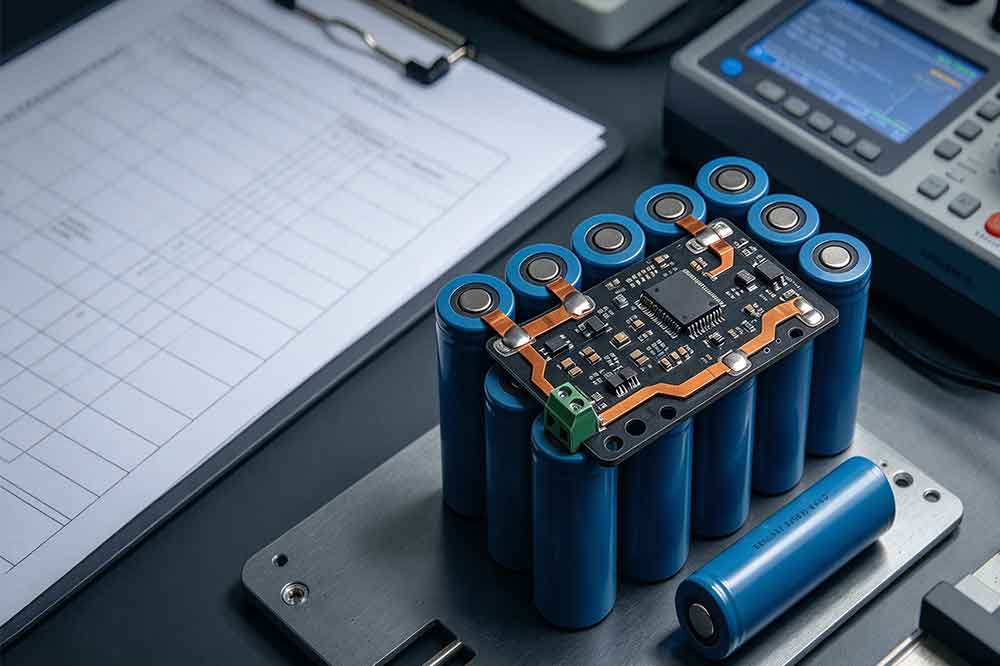
When comparing protected 18650 batteries, capacity is often the first specification buyers notice. A 2000mAh cell may look less attractive than a 3000mAh or 3500mAh option, especially when longer runtime is a selling point. However, the highest capacity is not always the best choice for an OEM product.
The right battery depends on the device’s energy consumption, discharge current, available space, protection circuit, expected service life, and target cost. A capacity rating should be evaluated alongside these requirements rather than treated as a stand-alone performance measure.
This guide compares 2000mAh, 2600mAh, 3000mAh, and 3500mAh protected 18650 battery options and explains how to choose a suitable specification for your application.
What Do These 18650 Capacity Ratings Mean?
The mAh rating describes the amount of electric charge a battery can deliver under specified test conditions. A 2000mAh battery is rated at 2Ah, while 2600mAh, 3000mAh, and 3500mAh correspond to 2.6Ah, 3Ah, and 3.5Ah.
These ratings provide a useful starting point, but they do not tell you everything about battery performance. Actual runtime depends on the cell design, load current, operating temperature, cutoff voltage, battery age, and other system conditions.
Understanding mAh and Wh
Milliamp-hours are convenient for comparing cells with similar nominal voltage. Watt-hours provide another useful way to compare energy.
The basic calculation is:
Nominal energy (Wh) = Nominal voltage (V) × Capacity (Ah)
Using 3.6V as an example, the nominal energy estimates are:
- 2000mAh: approximately 7.2Wh
- 2600mAh: approximately 9.36Wh
- 3000mAh: approximately 10.8Wh
- 3500mAh: approximately 12.6Wh
These figures are calculations, not guarantees of usable energy. Always use the actual cell datasheet and test conditions when specifying a battery for a commercial product.
Rated capacity versus usable capacity
A battery’s rated capacity is determined under defined conditions. The capacity available in your device may be lower because of voltage limits, high current demand, low temperature, conversion losses, or aging.
A protected 18650 battery also includes a protection circuit. Depending on its design, this circuit may disconnect the battery when a specified electrical limit is reached. That behavior can affect how much energy the device can use before shutting down.
When comparing suppliers, check whether the capacity refers to the cell itself or the finished protected product, and ask how the capacity was measured.
2000mAh vs 2600mAh vs 3000mAh vs 3500mAh
The four ratings represent different nominal charge capacities. They should not be treated as four universal performance grades because cell chemistry, discharge capability, manufacturing quality, and protection circuit design can vary between models.

When a 2000mAh battery makes sense
A 2000mAh protected 18650 battery may suit products with modest runtime requirements, intermittent operation, or tight energy budgets. It may also be worth evaluating when purchase cost, availability, or a specific cell’s discharge characteristics matter more than maximum capacity.
However, do not assume that every 2000mAh cell is cheaper, smaller, or capable of higher current than every higher-capacity model. These characteristics depend on the actual product specification.
For an OEM device that runs only for short periods between charging cycles, a higher capacity may add cost without providing enough practical value to justify the change.
Where 2600mAh may fit
A 2600mAh option can be a practical candidate for general-purpose equipment that needs more capacity than a 2000mAh cell offers but does not require the highest available rating.
For example, a portable instrument that operates for several hours each day may benefit from a moderate capacity increase. The final choice still depends on its average current, peak current, voltage range, and required runtime.
For bulk procurement, ask suppliers to confirm the exact cell model and whether the quoted capacity is a minimum guaranteed value or a typical specification. This distinction matters when planning product performance across multiple production batches.
Why consider 3000mAh?
A 3000mAh protected 18650 battery provides more nominal charge capacity than a 2600mAh option. Under comparable test conditions and at the same voltage, it may support longer runtime.
It can be a candidate for portable electronics, monitoring equipment, and other products where runtime is important. Yet capacity alone does not prove that the battery is suitable for a high-current load or a demanding operating environment.
Check the cell’s continuous discharge specification and the protection circuit’s operating limits. If the device has a motor, radio transmitter, or other load with startup surges, confirm that the complete battery assembly can handle those demands.
What to check before choosing 3500mAh
A 3500mAh option offers the highest nominal capacity among the four ratings in this comparison. It may be attractive for equipment that needs longer operating time between charges.
The key question is whether the actual model can deliver the required capacity while meeting the device’s discharge current, voltage, size, and temperature requirements. A high capacity label is not enough to establish those details.
For some applications, a higher-capacity cell may be a good fit. For others, the required current capability, physical construction, or cost target may lead to a different choice.
Do not assume that every 3500mAh protected cell has the same dimensions or protection board as a 2000mAh product. Compare the finished battery specifications before approving the design.
How Much Runtime Can Each Capacity Provide?
Runtime is not determined by capacity alone. It depends on how much current the device consumes and how much of the battery’s rated capacity is usable in the actual application.
For a simple constant-current load, a preliminary estimate is:
Runtime (hours) ≈ Capacity (Ah) ÷ Average current (A)
For illustration, if a device draws an average of 0.5A, the idealized estimates are:
| Nominal capacity | Basic runtime estimate at 0.5A |
|---|---|
| 2000mAh | 4 hours |
| 2600mAh | 5.2 hours |
| 3000mAh | 6 hours |
| 3500mAh | 7 hours |
These values are mathematical estimates based on nominal capacity. They are not guaranteed operating times. Real runtime may be shorter because of the usable voltage range, protection cutoff, temperature, load variation, battery condition, and system losses.
For an OEM product, test the selected battery in the actual device. Record the load profile and the point at which the device stops operating. If the product must meet a minimum runtime after months or years of use, include a defined aging allowance in the design.
Does Higher Capacity Mean Higher Discharge Current?
No. Capacity and discharge current are separate specifications.
Capacity describes how much charge a battery can deliver under defined conditions. Discharge current describes the rate at which it supplies that charge. A higher-capacity cell is not automatically suitable for a higher-current device.
The cell’s datasheet should specify its permitted discharge conditions. The protection circuit must also be rated for the required continuous load and any short peak demand. Its overcurrent trip threshold should not be confused with its recommended continuous operating current.
Wiring, connectors, contacts, and thermal conditions also affect the finished assembly. If your device draws high current, review the complete electrical design rather than selecting a battery based on mAh alone.

Check Dimensions and Protection Circuit Compatibility
The familiar 18650 format describes the general cylindrical cell size, but the finished protected product may have different dimensions because of the protection circuit, insulation, terminals, or additional construction.
This is important when the battery must fit into an existing enclosure. Confirm the complete length, diameter, terminal arrangement, connector, polarity, and wire length before approving samples.
Also verify the nominal voltage, full-charge voltage, lower operating voltage, and charger compatibility against the exact cell specification. If the device has a narrow voltage range, check whether its electronics can use the battery’s full operating range.
The protection circuit must match the cell and application. For multi-cell battery packs, do not assume that an individual protected cell replaces a properly designed pack-level battery management system.
Which Capacity Is Best for Your Application?
Start with the required runtime, average load, and peak current. Then compare candidate cell specifications against physical space, voltage limits, temperature, and budget.
A 2000mAh model may be sufficient for a product with modest energy needs. A 2600mAh or 3000mAh option may provide a useful capacity increase. A 3500mAh model may be worth considering when longer runtime is a priority and the specific cell meets the application’s electrical requirements.
These are evaluation starting points, not universal application rules. Two cells with the same rated capacity may differ in discharge capability, dimensions, cycle life, and supplier specifications.
For OEM and wholesale projects, request datasheets and representative samples. Compare the candidates under the same test conditions, then validate runtime in the target device before confirming a production specification.
What OEM Buyers Should Confirm Before Ordering
Before placing a bulk order, provide the battery supplier with the device’s required runtime, average and peak current, voltage range, maximum battery dimensions, charging method, connector details, and operating temperature.
Ask the supplier to confirm the exact cell model, rated capacity, test conditions, protection circuit limits, finished dimensions, and relevant quality documentation. For custom products, also agree on sample testing, acceptance criteria, labeling, packaging, and batch traceability.
If no single protected 18650 cell meets the energy or electrical requirements, discuss a custom battery pack rather than forcing an unsuitable cell into the design.
You can review available 18650 lithium battery options and share your project requirements to identify a suitable standard or customized solution.

Final Thoughts
The difference between 2000mAh and 3500mAh is meaningful on paper, but the best protected 18650 battery is not necessarily the one with the highest number.
Compare capacity under equivalent conditions, estimate runtime, verify discharge current, and confirm the protection circuit and finished dimensions. Then test the complete battery in the device under realistic conditions.
For OEM and bulk buyers, this approach leads to a more reliable specification than selecting a battery by capacity rating alone.
FAQs
1. Is a 3500mAh protected 18650 battery always better than a 2000mAh battery?
No. A 3500mAh cell has a higher nominal capacity, but suitability also depends on discharge current, voltage range, dimensions, protection circuit, temperature, and cost.
2. How much longer can a 3500mAh battery run than a 2600mAh battery?
Under idealized, comparable conditions, the capacity ratio suggests approximately 35% more nominal charge. Actual runtime improvement depends on usable capacity, load behavior, cutoff voltage, and cell performance.
3. Does a 3000mAh protected 18650 battery support high-current devices?
Not necessarily. Check the exact cell’s discharge rating and the protection circuit’s continuous-current and peak-current behavior. Capacity alone does not establish current capability.
4. Do protected 18650 batteries with different capacities have the same dimensions?
Not always. Protection circuits, terminals, insulation, and construction can change the finished dimensions. Confirm the complete product drawing before designing the battery compartment.
5. How should OEM buyers compare different 18650 battery capacities?
Compare rated capacity under equivalent test conditions, then evaluate runtime, current capability, voltage range, finished dimensions, protection circuit, temperature limits, documentation, and total project cost. Validate samples in the target device before bulk production.
-

12V 4400 mah Lithium ion 3S2P 18650 Battery Pack
-

18650 2000mAh 3.7 volt Lithium-ion Battery
-

18650 20V 3.0Ah Cordless Drill battery
-

18650 22.2V 7.8Ah 2600Mah 6S3P Rechargeable Battery Pack
-

18650 2600mAh Rechargeable Lithium-Ion Battery 3.7V
-

18650 3.7V 10Ah Li-Ion Power Battery Pack
-

18650 3.7V 3300mah Rechargeable Lithium ion Battery
-

18650 7S7P 24V 14Ah Lithium ion Electric Scooter Battery Pack
-

18650 battery 3.7V 1500mAh Lithium-Ion Battery
-

18650 Battery 3500 mah Rechargeable Battery Cells
-

18650 Electric Scooter 48V 13000mAh Lithium Battery
-

2600mAh 3S1P 11.1V 18650 Battery Packs
-

3.7V Li ion Rechargeable 3000mah 18650 Battery Cell
-

36V 5200mAh 10S2P 18650 Battery Pack
-

48v 4400mah 13S2P 18650 Rechargeable Battery Pack
-

7S2P 24V 18650 Lithium Battery Pack
-

Electric Scooter 36V 4400mAH 10S2P 18650 Battery Pack
-

ICR 18650 Battery 2200mah 3.7V
Leave a Reply