
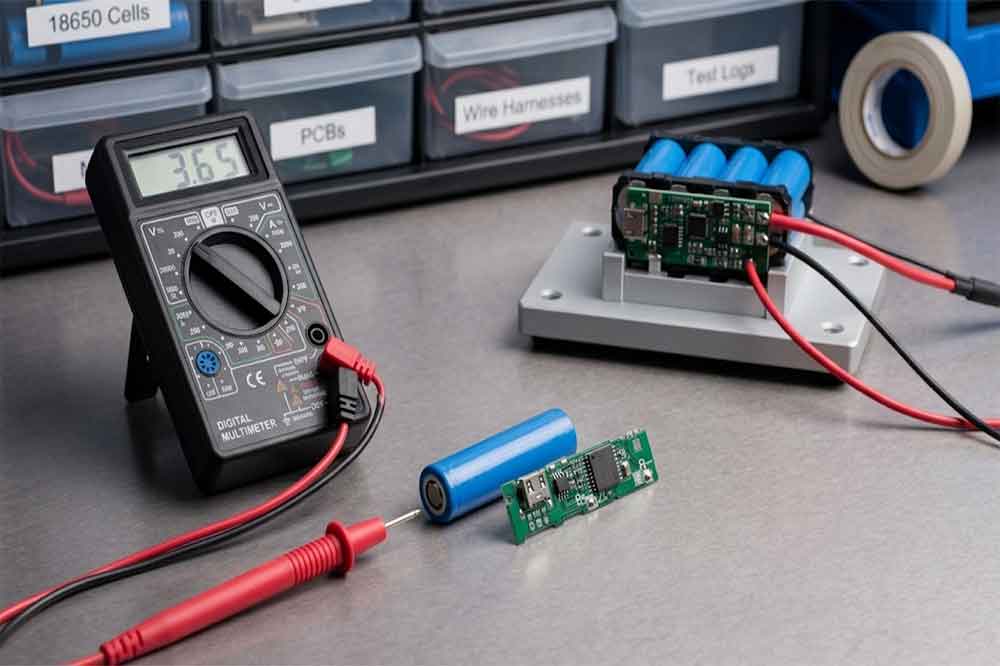
A protection circuit can improve the safety of an 18650 lithium-ion battery by responding to certain electrical faults. It can help limit risks associated with overcharging, excessive discharge, overcurrent, and short circuits, provided the circuit is correctly selected and operates as designed.
However, a protected battery is not automatically a safe battery in every situation. A protection circuit cannot correct every cell defect, prevent all forms of physical damage, or replace a suitable charger and a well-designed battery enclosure.
For OEM manufacturers and wholesale buyers, the important question is not simply whether a battery includes a protection PCB. It is whether the cell, circuit, charging system, mechanical design, and production controls are appropriate for the intended application.
What a Protection Circuit Can Do
A protection circuit monitors selected electrical conditions and disconnects a current path when a defined threshold or fault condition is detected. Its actual capabilities depend on the circuit design, components, thresholds, and operating conditions.
For a single-series 18650 battery, a compact protection PCB may provide several basic protective functions. These functions help manage specific electrical risks, but they do not eliminate every possible failure mode.
Overcharge and Over-Discharge Protection
Overcharge protection is intended to interrupt charging when the monitored voltage reaches a specified limit. This can help reduce the risk of charging a cell beyond its permitted voltage.
Over-discharge protection works in the opposite direction. It disconnects the load when the monitored cell voltage falls below a specified threshold. This helps prevent the battery from being discharged beyond its intended operating range.
Both functions depend on correct threshold selection and a compatible charging system. A protection PCB should not be treated as the normal charging controller. The charger must still follow the cell manufacturer’s charging requirements.
For example, using a board designed for an incompatible cell chemistry may produce unsuitable voltage limits. Even when a board is advertised for a 3.7V battery, the exact cell specification and protection thresholds still need to be checked.
Overcurrent and Short-Circuit Protection
An overcurrent protection function can disconnect the battery when current exceeds a specified condition. Short-circuit protection is intended to respond to a fault that creates an unusually low-resistance path and potentially very high current.
These functions can help reduce the energy delivered during certain faults. However, their response depends on the circuit’s detection threshold, response time, MOSFET characteristics, wiring, and the nature of the fault.
A protection circuit may not prevent every transient current event or eliminate heating that occurs before the circuit disconnects. The complete design must also use appropriate conductors, connectors, insulation, and mechanical protection.
For more information about individual functions, read our guide to 18650 protection circuit functions.

What a Protection Circuit Cannot Guarantee
A protection PCB is one layer of battery protection, not a guarantee against every hazardous event. Its functions are limited to the faults it is designed to detect and the conditions under which it can respond.
A board may be correctly specified yet still be unsuitable for a particular assembly if the cell, charger, load, wiring, or enclosure is poorly matched.
Cell Defects and Physical Damage
A protection circuit cannot repair an internally damaged cell. Manufacturing defects, internal short circuits, contamination, severe mechanical damage, or deterioration can create problems that a basic PCB may not detect in time.
Cells can also be damaged by crushing, puncturing, excessive vibration, or improper installation. The metal can of a cylindrical 18650 cell must be protected from accidental contact with conductive parts and from mechanical forces beyond its design limits.
Cell quality and traceability are therefore important. OEM buyers should identify the exact cell model, review the manufacturer’s specifications, and establish incoming inspection and handling procedures appropriate to the project.
Do not assume that adding a protection board makes a damaged, counterfeit, or unsuitable cell acceptable for use.
Charger, Temperature, and Assembly Risks
A protection PCB does not replace a compatible charging circuit. An unsuitable charger may cause abnormal operation, and repeated reliance on the protection cutoff is not a substitute for proper charge control.
Temperature is another important consideration. Excessive heat can arise from high current, poor electrical connections, a tightly enclosed assembly, or an unsuitable operating environment. A basic board may not include temperature sensing, and even a board with a temperature input only provides the functions supported by its design.
Assembly quality matters as well. Poor welds, damaged insulation, incorrect polarity, loose connectors, and inadequate spacing can introduce risks that the protection circuit may not detect.
For these reasons, battery safety should be considered during cell selection, circuit design, mechanical design, assembly, and product validation—not added as a final component choice.
Why Battery Safety Depends on the Whole System
A battery is a system of interacting components. The cell stores energy, the protection circuit monitors selected electrical conditions, the charger controls the charging process, and the enclosure protects the assembly in its operating environment.
If one component is incompatible with the others, the complete product may not behave as expected.
Consider a portable device with a motor. Its startup current may be much higher than its normal running current. A protection circuit with an unsuitable threshold may disconnect during startup. Increasing that threshold without checking the cell and wiring could introduce another problem rather than solve the original one.
A better approach is to review the device’s actual load profile, the cell’s permitted discharge current, the protection circuit’s specifications, and the thermal behavior of the finished assembly.
Multi-cell packs require additional attention. A multi-series battery may need individual series-group voltage monitoring and, depending on the design, balancing, temperature sensing, or communication features. A simple single-cell protection board should not be treated as a complete management system for a multi-series pack.
See our guide to 18650 BMS vs PCB protection for a comparison of these architectures.

How OEM Buyers Can Evaluate Protection Circuit Safety
For a B2B battery project, start with documented requirements rather than a generic claim that a battery is “protected.”
Check Specifications and Traceability
Ask the supplier to identify the cell model, chemistry, nominal voltage, charging limits, discharge capability, and relevant datasheet. Confirm which protection functions the board supports and request its applicable voltage thresholds, current ratings, operating temperature, and response specifications.
Also ask about component and production traceability. The exact documentation needed depends on the application, destination market, and product category, so verify requirements for the finished product rather than assuming one certificate covers every configuration.
Where applicable, request relevant test reports, safety documentation, and transport-related documents. Documentation should correspond to the actual battery design and model being supplied.
A protection circuit’s presence alone does not establish that a battery complies with every regulatory or customer requirement.
Validate the Complete Battery Assembly
Before moving into mass production, test representative samples in the intended device or enclosure. The engineering plan should address normal charging and discharging, expected load conditions, startup current, temperature rise, mechanical fit, and appropriate protective responses.
Fault testing should be performed using a controlled procedure by qualified personnel with suitable equipment. Do not improvise destructive short-circuit or overcharge tests on an open workbench.
For repeated production, establish incoming inspection, assembly checks, polarity verification, and end-of-line electrical testing. The appropriate controls depend on the battery design and risk assessment.
If the application has special environmental or performance requirements, identify them before finalizing the design. Temperature extremes, vibration, moisture exposure, and restricted installation space may affect the selection and validation process.
Common Misunderstandings About Protected 18650 Batteries
One common misunderstanding is that all protected 18650 cells offer the same level of protection. In reality, circuit functions, thresholds, current ratings, and quality controls can differ significantly.
Another is that a protection PCB eliminates the need for a proper charger. It does not. The charger and battery must be designed to work together under the cell manufacturer’s specified conditions.
Some buyers also assume that a protected cell can be used in any device that accepts an 18650 battery. Physical fit is not enough. Voltage requirements, current demand, cell length, terminal design, and the device’s charging method all need to be compatible.
Finally, a protection circuit should not be used to compensate for poor cell quality or weak assembly controls. Protection works best as one part of a complete and verified design.
Choosing a Protected 18650 Battery for OEM Applications
When sourcing batteries for a commercial product, share the application details with the supplier early. Useful information includes the device model, battery dimensions, cell configuration, operating current, charging method, connector, enclosure constraints, and expected annual quantity.
A supplier can then assess whether a standard protected cell is suitable or whether a custom battery assembly is more appropriate. Customization may involve the protection circuit, wiring, connectors, insulation, casing, and other mechanical or electrical requirements.
The final choice should be based on verified specifications, sample testing, and the requirements of the finished product—not solely on the presence of a PCB or a low purchase price.
Explore our 18650 lithium battery options when planning an OEM sourcing project. A well-designed battery combines suitable cells, compatible protection, appropriate charging, sound assembly, and documented validation.
A protection circuit can meaningfully improve 18650 battery safety when selected and integrated correctly. Its greatest value comes from working alongside the other measures that make the complete battery system suitable for its intended use.

FAQ
Does a protection circuit make an 18650 battery completely safe?
No. It can help reduce certain electrical risks, but it cannot eliminate every failure mode. Cell quality, charger compatibility, insulation, mechanical design, and correct assembly remain important.
What risks can an 18650 protection circuit help reduce?
Depending on the design, it may provide overcharge, over-discharge, overcurrent, and short-circuit protection. The exact functions and thresholds should be confirmed from the board specification.
Can a protected 18650 battery use any charger?
No. The charger must be compatible with the cell chemistry and charging specifications. A protection circuit is not a substitute for a properly designed charging system.
What should OEM buyers check before purchasing protected 18650 batteries?
Confirm the cell model, protection functions, voltage and current limits, physical dimensions, charger compatibility, documentation, and intended operating environment. Validate samples in the finished application before mass production.
-

12V 4400 mah Lithium ion 3S2P 18650 Battery Pack
-

18650 2000mAh 3.7 volt Lithium-ion Battery
-

18650 20V 3.0Ah Cordless Drill battery
-

18650 22.2V 7.8Ah 2600Mah 6S3P Rechargeable Battery Pack
-

18650 2600mAh Rechargeable Lithium-Ion Battery 3.7V
-

18650 3.7V 10Ah Li-Ion Power Battery Pack
-

18650 3.7V 3300mah Rechargeable Lithium ion Battery
-

18650 7S7P 24V 14Ah Lithium ion Electric Scooter Battery Pack
-

18650 battery 3.7V 1500mAh Lithium-Ion Battery
-

18650 Battery 3500 mah Rechargeable Battery Cells
-

18650 Electric Scooter 48V 13000mAh Lithium Battery
-

2600mAh 3S1P 11.1V 18650 Battery Packs
-

3.7V Li ion Rechargeable 3000mah 18650 Battery Cell
-

36V 5200mAh 10S2P 18650 Battery Pack
-

48v 4400mah 13S2P 18650 Rechargeable Battery Pack
-

7S2P 24V 18650 Lithium Battery Pack
-

Electric Scooter 36V 4400mAH 10S2P 18650 Battery Pack
-

ICR 18650 Battery 2200mah 3.7V
Leave a Reply