
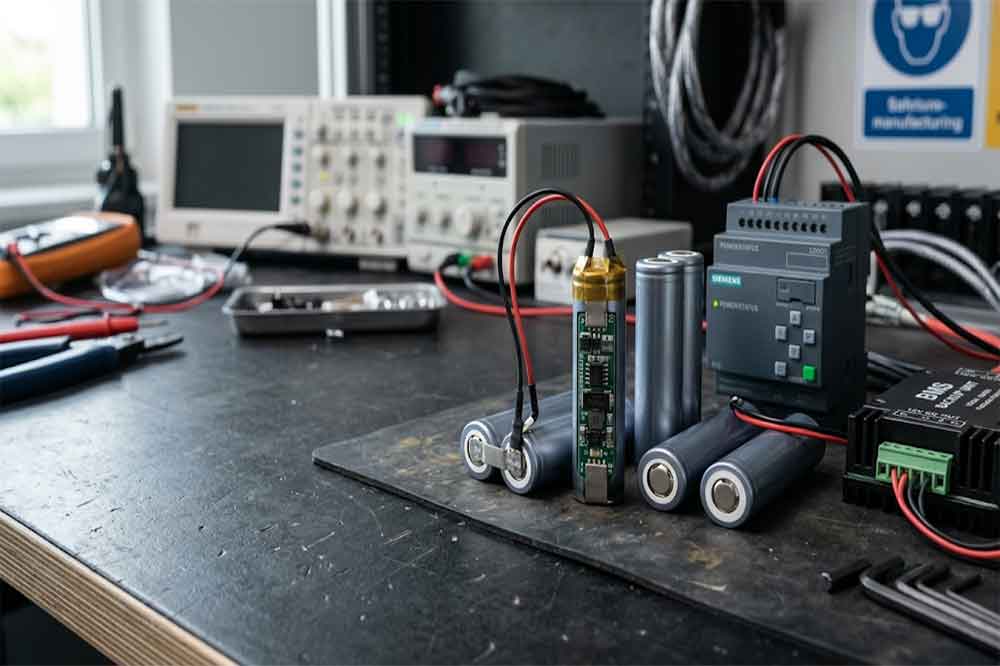
When the main power supply fails, a backup battery needs to do more than simply deliver electricity. It must provide enough energy for the required operating time, respond properly to the connected load, and remain within safe operating limits during charging and discharging.
A protected 18650 battery backup solution can be suitable for compact electronic equipment, industrial monitoring devices, communication terminals, and other applications that need a rechargeable secondary power source. The right choice depends on the equipment’s voltage, current demand, backup duration, and charging method.
For equipment manufacturers, choosing a battery based only on its capacity rating can lead to problems later. Protection circuit specifications, temperature limits, physical dimensions, and compatibility with the main power system also need attention.
Protection requirements vary with the device, charging method, and expected load. For a broader overview of cell protection and selection, read our guide to protected 18650 batteries.
Why Backup Power Systems Use Protected 18650 Batteries
The 18650 lithium-ion cell is widely used in rechargeable battery packs because of its cylindrical design, established manufacturing processes, and useful energy capacity in a relatively compact size.
In a backup power application, the battery normally stays connected to a charging or power-management system while the main supply operates the equipment. When external power becomes unavailable, the battery provides energy to keep selected functions running.
These functions might include maintaining communication, preserving settings, keeping a controller active, or allowing a monitoring device to complete its current operation.
A protected 18650 battery adds an electronic protection circuit to help prevent certain abnormal electrical conditions. Depending on the design, this circuit may interrupt charging or discharging when a preset limit is reached.
However, the battery itself does not determine how a complete backup system behaves. The charger, power-path circuit, voltage regulator, battery management electronics, and connected load all affect performance.
For example, a controller that draws only a small standby current may work well with a compact protected battery. A device that drives a motor, powers a radio transmitter at high output, or switches on a high-current load may require a different battery configuration.
“Industrial backup systems may need to keep controllers and monitoring equipment operating during a power interruption. For other demanding equipment applications, see our guide to protected 18650 batteries for medical and industrial devices.
What Protection Does 18650 Battery Need?
Protection requirements should be matched to the equipment and the expected operating conditions. A protected cell is not automatically suitable for every battery-powered device.

Overcharge and Over-Discharge Protection
Overcharge protection helps interrupt charging when the cell voltage exceeds the protection circuit’s specified threshold. Over-discharge protection disconnects the load when the cell voltage falls below its configured limit.
Both functions matter in backup systems. A battery may remain connected to a charger for long periods, then discharge when the main power supply fails.
The system designer should confirm that the charger uses the correct charging profile for the selected cell chemistry. A protection circuit is a safety layer, not a substitute for a compatible charger or proper charge termination.
Low-voltage cutoff also deserves attention. If the protected battery disconnects before the equipment reaches its own minimum operating voltage, the system may shut down earlier than expected. The equipment’s shutdown behavior and the battery’s protection thresholds should therefore be checked together.
Overcurrent and Short-Circuit Protection
Backup equipment does not always draw a constant current. A wireless device may transmit in short bursts, while a controller or access device may experience a temporary current increase during startup.
The protection circuit must tolerate normal operating and startup currents without unnecessary interruptions. At the same time, it needs appropriate protection against excessive current and short circuits.
Check both the continuous discharge rating and the permitted pulse current. The cell’s advertised discharge capability does not necessarily equal the capability of the complete protected battery, because the protection board, interconnections, and thermal conditions can impose additional limits.
For industrial designs, current testing should cover normal operation, startup, and foreseeable load changes.
Common Backup Power Applications
Industrial Controllers and Communication Equipment
Industrial controllers, data loggers, remote monitoring terminals, and communication modules may need temporary power during an outage. The battery can help maintain selected functions, support an orderly shutdown, or bridge a short interruption while another power source becomes available.
The required runtime varies considerably. A controller that needs to preserve its state for several minutes has different requirements from a remote terminal expected to continue communicating for several hours.
Before selecting a battery, determine which functions must remain active during the outage. Powering an entire device continuously may consume far more energy than maintaining only its essential control and communication functions.
Emergency Lighting and Monitoring Devices
Some compact emergency lighting systems and monitoring products use rechargeable lithium-ion batteries as secondary power sources. A protected 18650 battery may be considered where its voltage, capacity, temperature range, and mechanical dimensions match the design.
The battery must support the intended discharge current and operating duration. Lighting equipment with high output requirements may need a larger pack or a configuration capable of delivering more power.
Applications subject to emergency lighting, fire safety, or other regulated requirements may also need specific product approvals and system-level testing. A protected cell alone does not establish compliance for the finished device.
Embedded Electronics and Memory Backup
Embedded equipment may use a rechargeable battery to maintain a real-time clock, preserve selected settings, or keep a low-power circuit operating during an interruption.
In these applications, standby current can be more important than peak power. Even a small continuous load consumes energy over time, and the battery may also lose some charge through self-discharge and the connected electronics.
A low-power design should account for the current consumed by voltage regulators, monitoring circuits, and any protection electronics. These loads can affect actual backup duration even when the main device appears to use very little power.
When selecting cells for a multi-cell backup battery, consider whether individual cell protection circuits are compatible with the complete pack design. Read our guide to using protected 18650 cells in a battery pack before finalizing the configuration.

How to Calculate Backup Runtime
Runtime calculations provide a useful starting point, but they should be checked against actual operating conditions.
For a simple estimate:
Backup runtime (hours) = usable battery energy (Wh) ÷ average load power (W)
Battery energy can be estimated from nominal voltage and rated capacity:
Battery energy (Wh) = nominal voltage (V) × capacity (Ah)
Consider a nominal 3.6 V, 2.5 Ah 18650 battery. Its theoretical energy is approximately 9 Wh.
If the equipment consumes an average of 1 W, dividing 9 Wh by 1 W gives a theoretical runtime of 9 hours. This is not a guaranteed operating time.
The usable energy will be lower in practice because of conversion losses, cutoff thresholds, temperature, cell aging, and variations in load. The actual runtime may also be affected by the protection circuit and the equipment’s minimum operating voltage.
For a preliminary engineering estimate, a designer might assume that 80% of the nominal energy is usable after allowing for system losses and operating margins. Under that assumption, the example provides about 7.2 Wh of usable energy, corresponding to approximately 7.2 hours at a constant 1 W load.
The 80% figure is an illustrative planning assumption, not a universal specification. The correct value should come from testing the intended battery and power system.
Where the load varies over time, calculate energy consumption across the full operating cycle. A device that sleeps most of the time but occasionally transmits data may have a very different average power demand from its peak current rating.
Choosing the Right Protected 18650 Battery Configuration
A single 18650 cell may be sufficient for a low-voltage application. Other systems require multiple cells connected in series, parallel, or a combination of both.
A series configuration increases nominal voltage. A parallel configuration increases available capacity and can support higher current when the cells, interconnections, and protection system are properly designed.
For example, two suitable 3.6 V cells connected in series provide a nominal pack voltage of 7.2 V. Their amp-hour capacity remains the same as that of one cell. Two matching cells connected in parallel provide a nominal voltage of 3.6 V while increasing the combined amp-hour capacity.
These examples describe basic electrical relationships. A practical multi-cell lithium-ion pack needs an appropriate protection and monitoring arrangement, and series-connected cells require suitable voltage supervision and charging control.
Before choosing a configuration, confirm the following:
- Voltage: Check nominal voltage, fully charged voltage, and the equipment’s permitted input range.
- Capacity: Estimate energy consumption over the required backup period.
- Discharge current: Include continuous current, startup peaks, and pulse loads.
- Dimensions: Allow space for insulation, wiring, the protection board, connectors, and the enclosure.
- Temperature: Confirm charging and discharging limits for the installation environment.
- Charging method: Verify compatibility with the cell chemistry and the complete pack configuration.
When the standard 18650 format cannot meet the runtime, current, or packaging requirements, a custom battery pack may be a better option than selecting a protected cell in isolation.

Charging, Storage, and Reliability Considerations
Backup batteries can spend most of their service life connected to external power. This makes charging design and long-term storage conditions important.
The charger must use the appropriate charging method and voltage limits for the selected lithium-ion chemistry. The battery should not be continuously overcharged in the expectation that its protection circuit will manage every charging condition.
Temperature also affects battery performance. High temperatures can accelerate aging, while low temperatures can reduce available capacity and increase voltage drop under load. Charging limits may be more restrictive than discharging limits, particularly at low temperatures.
For equipment that remains in storage before installation, define the required storage temperature, charge level, inspection interval, and maintenance procedure. The appropriate schedule depends on the cell manufacturer’s recommendations and the product’s storage conditions.
Reliability testing should reflect the actual application. Useful checks include backup runtime, power interruption and recovery, charging behavior, low-voltage cutoff, startup current, and operation at the expected temperature extremes.
If the battery must support a critical industrial or emergency function, the complete equipment should also be evaluated for applicable safety and regulatory requirements.
Once the voltage, capacity, and protection requirements are defined, compare available cell and battery options in our 18650 lithium battery product range. For OEM projects, confirm the complete battery specifications before selecting a model.
What OEM Buyers Should Confirm Before Ordering
A battery specification sheet should describe the intended operating conditions clearly enough for engineering and purchasing teams to evaluate the same requirements.
For an OEM backup power project, prepare the following information before requesting a quotation:
- Required nominal voltage and maximum charged voltage.
- Target capacity and minimum backup duration.
- Average load current, peak current, and expected discharge profile.
- Available battery compartment dimensions.
- Connector type, cable length, and polarity.
- Charging method and operating temperature range.
- Required protection functions and any communication interface.
- Expected annual volume, prototype quantity, and applicable certifications.
A battery manufacturer can then assess whether a standard protected 18650 battery is suitable or whether a custom pack is needed. Customization may include series-parallel configuration, protection board selection, wiring, connectors, insulation, labels, and enclosure integration.
For a new product, prototype evaluation should happen before the battery specification is frozen. Testing a representative sample in the actual equipment can reveal voltage compatibility issues, unexpected current peaks, or runtime shortfalls that are difficult to identify from cell capacity alone.
A well-specified backup battery is not simply the one with the largest capacity. It is the one that supplies the required energy and power, fits the equipment, charges correctly, and performs reliably under the conditions the finished product will encounter.
For OEMs and industrial equipment manufacturers, defining these requirements early makes battery selection more predictable and reduces avoidable changes during product validation.
FAQ
1. What is a protected 18650 battery for backup power?
A protected 18650 battery is a rechargeable lithium-ion cell fitted with an electronic protection circuit. It can help prevent overcharge, over-discharge, overcurrent, and short-circuit conditions, depending on its design. It is used in compatible backup power applications where voltage, current, and runtime requirements can be met.
2. How long can a protected 18650 battery provide backup power?
Backup duration depends on battery energy, average load power, conversion efficiency, temperature, and the battery’s usable discharge range. Estimate runtime by dividing usable battery energy in watt-hours by average load power in watts, then validate the result through testing.
3. Can a protected 18650 battery remain connected to a charger?
It can remain connected when the complete charging system is specifically designed for that operating mode. The charger must use the correct charging profile and voltage limits for the selected cell chemistry. A protection circuit alone does not replace proper charging control.
4. Can one protected 18650 battery power industrial equipment?
Yes, if its voltage, usable capacity, discharge current, and temperature range meet the equipment’s requirements. Devices with higher voltage or longer runtime requirements may need a multi-cell battery pack and a suitable battery management or protection system.
5. What should OEM buyers specify when ordering backup batteries?
Provide the required voltage, capacity, backup duration, continuous and peak current, battery dimensions, connector, charging method, operating temperature, and protection requirements. These details help the manufacturer assess whether a standard cell or a custom battery pack is appropriate.
Related Products
-

12V 4400 mah Lithium ion 3S2P 18650 Battery Pack
-

18650 2000mAh 3.7 volt Lithium-ion Battery
-

18650 20V 3.0Ah Cordless Drill battery
-

18650 22.2V 7.8Ah 2600Mah 6S3P Rechargeable Battery Pack
-

18650 2600mAh Rechargeable Lithium-Ion Battery 3.7V
-

18650 3.7V 10Ah Li-Ion Power Battery Pack
-

18650 3.7V 3300mah Rechargeable Lithium ion Battery
-

18650 7S7P 24V 14Ah Lithium ion Electric Scooter Battery Pack
-

18650 battery 3.7V 1500mAh Lithium-Ion Battery
-

18650 Battery 3500 mah Rechargeable Battery Cells
-

18650 Electric Scooter 48V 13000mAh Lithium Battery
-

2600mAh 3S1P 11.1V 18650 Battery Packs
-

3.7V Li ion Rechargeable 3000mah 18650 Battery Cell
-

36V 5200mAh 10S2P 18650 Battery Pack
-

48v 4400mah 13S2P 18650 Rechargeable Battery Pack
-

7S2P 24V 18650 Lithium Battery Pack
-

Electric Scooter 36V 4400mAH 10S2P 18650 Battery Pack
-

ICR 18650 Battery 2200mah 3.7V
Leave a Reply