
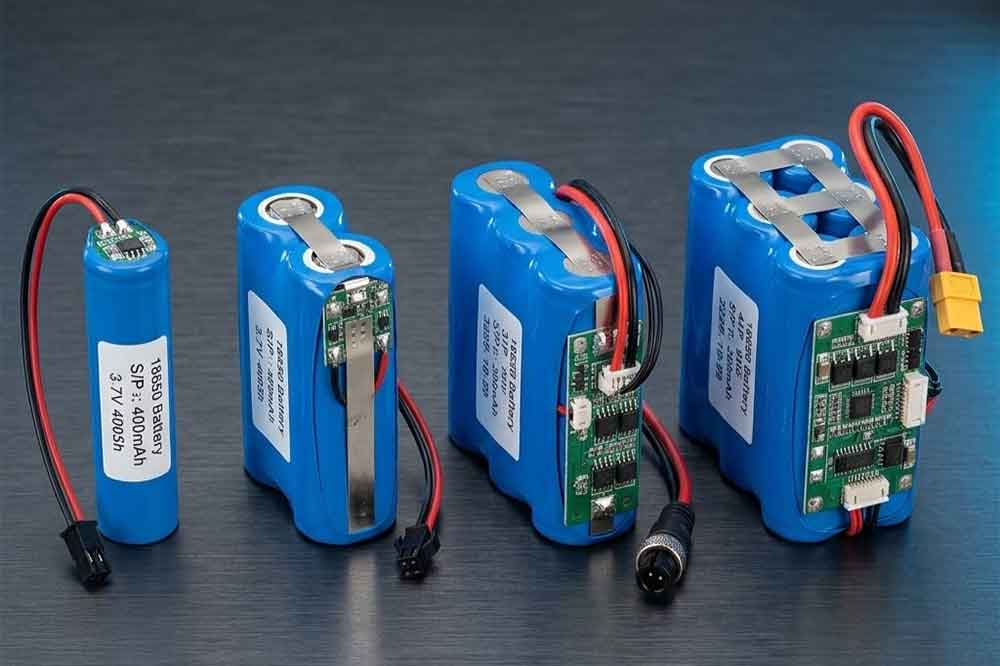
When choosing 18650 battery pack, one of the first specifications buyers come across is the S configuration. A supplier may offer 1S, 2S, 3S or 4S battery packs, sometimes with the same cell capacity but different output voltages.
For someone developing an electronic device, this difference is important. A battery pack with the wrong series configuration may not provide enough voltage to operate the equipment. In some cases, the voltage can exceed the limits of the device’s input circuit.
The S number describes how many battery cells are connected in series within each parallel group. It determines the pack’s voltage, while the number of parallel cells mainly determines its capacity.
Understanding these configurations makes it easier to compare battery quotations, select a suitable protection circuit and communicate technical requirements to a battery manufacturer.
What Does S Mean in 18650 Battery Pack?
In battery specifications, S stands for series connection.
When lithium-ion 18650 cells are connected in series, their voltages add together. However, the capacity in ampere-hours (Ah) does not increase simply because more cells are connected in series.
A standard 18650 lithium-ion cell typically has:
- Nominal voltage: 3.6V or 3.7V
- Fully charged voltage: 4.2V
- Discharge cut-off voltage: commonly around 2.5V–3.0V, depending on the cell specification
For example, connecting two identical cells in series produces a nominal voltage of approximately 7.2V or 7.4V. Connecting four cells in series produces approximately 14.4V or 14.8V.
The actual operating voltage changes during charging and discharging.
This is why buyers should not select a battery pack based only on its nominal voltage. The fully charged voltage and the equipment’s acceptable input range also need to be checked.
Understanding 1S, 2S, 3S and 4S Configurations
1S Protected 18650 Battery Pack
A 1S battery pack contains one cell or one parallel group of cells connected in a single series group.

Its typical voltage specifications are:
- Nominal voltage: 3.6V or 3.7V
- Maximum charging voltage: 4.2V
- Discharge voltage: determined by the selected cell and protection design
A 1S configuration is commonly used in portable electronics, compact wireless devices, small lighting equipment and certain monitoring products.
If higher capacity is required without increasing voltage, multiple cells can be connected in parallel. For example, a 1S2P pack contains two cells connected in parallel. Its nominal voltage remains around 3.7V, but its capacity is approximately twice that of one cell, assuming identical cells.
A protection circuit can monitor the parallel group for overcharge, over-discharge and overcurrent conditions.
2S Protected 18650 Battery Pack
A 2S pack connects two 18650 cells in series.
Typical electrical specifications include:
- Nominal voltage: 7.2V or 7.4V
- Maximum charging voltage: 8.4V
- Capacity: the same Ah rating as one series-connected cell group
This configuration is suitable for equipment designed around a 7.4V nominal lithium-ion supply.
Examples include certain portable instruments, small electronic equipment, handheld devices and wireless products.
A 2S pack requires protection suitable for two series-connected groups. The protection circuit must monitor the individual cell-group voltages, rather than relying only on the total pack voltage.
For applications requiring longer operating time, a 2S2P or 2S3P configuration can be considered. This increases the available capacity while maintaining the same nominal voltage.
3S Protected 18650 Battery Pack
A 3S battery pack connects three cells or three parallel groups in series.
Its typical specifications are:
- Nominal voltage: 10.8V or 11.1V
- Maximum charging voltage: 12.6V
- Capacity: determined by the number of parallel cells
3S configurations are found in portable equipment, selected industrial instruments, electronic control systems and other devices designed for a nominal 11.1V lithium-ion supply.
One detail worth checking is the equipment’s minimum operating voltage. A device that requires a stable 12V input may not operate reliably across the entire discharge range of a standard 3S lithium-ion pack.
In such cases, a DC-DC converter or a different battery configuration may be necessary.
The BMS should support three series groups and provide suitable cell-level voltage monitoring and balancing where required by the design.
4S Protected 18650 Battery Pack
A 4S battery pack contains four series-connected cell groups.
Typical voltage specifications are:
- Nominal voltage: 14.4V or 14.8V
- Maximum charging voltage: 16.8V
- Capacity: determined by the parallel arrangement
4S battery packs are commonly considered for industrial instruments, portable power equipment, control systems and other applications requiring a higher lithium-ion battery voltage.
However, a 4S battery should not automatically be treated as a direct replacement for every 12V power source. Its voltage reaches 16.8V when fully charged, which may be too high for equipment with a strict 12V input limit.
A suitable BMS must monitor all four series groups. Depending on the application, the design may also require temperature monitoring, balancing, short-circuit protection and communication functions.
1S vs 2S vs 3S vs 4S: Voltage Comparison
The following table provides a quick reference for standard 3.6V/3.7V nominal lithium-ion 18650 cells.
| Configuration | Nominal Voltage | Full Charge Voltage |
|---|---|---|
| 1S | 3.6V–3.7V | 4.2V |
| 2S | 7.2V–7.4V | 8.4V |
| 3S | 10.8V–11.1V | 12.6V |
| 4S | 14.4V–14.8V | 16.8V |
These values assume conventional lithium-ion cells with a 4.2V charging limit. Other lithium chemistries, including LiFePO4, have different voltage characteristics and require a different protection and charging design.
When reviewing a quotation, buyers should also confirm whether the stated voltage is nominal, fully charged or measured under a particular operating condition.
How Protection Circuits Work in Different S Configurations
A protected battery pack needs more than the correct number of cells.
The protection circuit, often called a BMS or PCM depending on its functions and design, helps prevent operation outside specified electrical limits.

For series-connected 18650 packs, the protection system generally needs to address:
- Overcharge protection for individual series groups.
- Over-discharge protection to prevent excessive cell depletion.
- Overcurrent protection during heavy loads.
- Short-circuit protection.
- Temperature monitoring when required by the application.
- Cell balancing where supported and needed.
A common mistake is assuming that a protection board designed for 1S can also be used for a 2S, 3S or 4S pack. It cannot. The board must match the number of series groups and the electrical characteristics of the cells.
Another important point concerns protected 18650 cells. A cell with an individual protection PCB is not automatically suitable for series connection with other protected cells. The individual protection circuits may interact in unexpected ways, particularly during abnormal conditions.
For multi-series battery packs, it is generally better to have the manufacturer evaluate the cell selection, pack-level BMS and protection coordination as one complete design.
For more detail, see our guide on how protection is designed in a protected 18650 battery pack.
Does Series Connection Increase Battery Capacity?
No. Series connection increases voltage, not ampere-hour capacity.
Consider a 18650 cell rated at 3.7V and 2500mAh.
- 1S1P: 3.7V, 2500mAh
- 2S1P: 7.4V, 2500mAh
- 3S1P: 11.1V, 2500mAh
- 4S1P: 14.8V, 2500mAh
The energy capacity in watt-hours increases as the series voltage increases.
For example, a 4S1P pack using four 2500mAh cells has approximately:
14.8V × 2.5Ah = 37Wh.
Parallel connection works differently. A 4S2P pack uses eight cells, with two cells in parallel in each of four series groups. With the same 2500mAh cells, its nominal specifications become approximately 14.8V, 5Ah and 74Wh.
This distinction is particularly important when a customer requests both a specific voltage and a certain operating time. The series configuration determines voltage, while the parallel configuration helps meet capacity and current requirements.

How to Choose the Right Configuration
The correct S configuration should start with the equipment’s electrical requirements.
1. Check the input voltage range
Find out the minimum and maximum voltage the equipment can accept. Do not rely only on a label showing 7.4V, 11.1V or 14.8V.
2. Calculate the required capacity
Estimate operating time and power consumption. A higher-capacity parallel arrangement may be necessary if the device operates for long periods between charges.
3. Confirm the continuous discharge current
A battery pack may have the correct voltage and capacity but still fail to support the equipment’s actual current demand. Motor startup, wireless transmission and other load peaks should be considered.
4. Select the appropriate BMS
The BMS must match the series configuration, current requirements, cell characteristics and protection functions.
5. Check the physical dimensions
The available installation space can limit the number of cells and their arrangement. Connector position, wiring, enclosure structure and heat management should also be considered.
Common Mistakes When Selecting Protected 18650 Packs
In practical battery projects, several problems appear repeatedly.
One is confusing nominal voltage with charging voltage. A 4S pack is commonly described as 14.8V, but its charging voltage reaches 16.8V. This difference must be acceptable to the connected equipment.
Another problem is comparing battery packs using only mAh. A 2500mAh 3S pack and a 2500mAh 4S pack have different energy capacities because their voltages differ.
Buyers sometimes specify a 4S configuration before checking whether the device actually needs it. A higher voltage does not automatically mean better performance. The motor controller, charging circuit and electronic components must all be compatible.
Finally, protection board selection should not be left until after the battery pack has been assembled. BMS requirements affect wiring, cell arrangement, pack dimensions and sometimes the overall cost.
Custom 18650 Battery Pack Design Considerations
For OEM and industrial projects, the final battery specification usually involves more than choosing between 1S and 4S.
A manufacturer needs to evaluate cell chemistry, capacity, discharge performance, series-parallel arrangement, protection functions and installation conditions together.
For example, a customer may request a 14.8V battery with 5000mAh capacity. This could be designed as a 4S2P configuration using suitable 2500mAh cells. But the final design still depends on the continuous current, peak current, operating temperature, enclosure space and charging requirements.
Other customization details may include:
- Custom battery dimensions and cell layout.
- BMS current rating and protection thresholds.
- Temperature sensors and communication interfaces.
- Connector type and cable length.
- PVC wrapping or a rigid battery enclosure.
- Labels, wiring diagrams and project-specific testing.
Before ordering samples or moving into production, it is worth providing the manufacturer with the equipment voltage range, load current, required runtime and available battery compartment dimensions.
For more information about when protected cells are appropriate, read When Should You Use Protected 18650 Cells in a Battery Pack?.
A properly specified battery pack should fit the equipment electrically and mechanically. Getting the series configuration right is only the starting point.
4. Frequently Asked Questions
Q1: What is the difference between 1S and 2S 18650 battery packs?
A 1S pack has one series group and a nominal voltage of approximately 3.7V. A 2S pack has two series groups and a nominal voltage of approximately 7.4V. Their capacity depends on the parallel cell arrangement.
Q2: Is a 4S 18650 battery pack a 12V battery?
Not exactly. A standard 4S lithium-ion pack has a nominal voltage of 14.4V or 14.8V and reaches 16.8V when fully charged. It should not replace a 12V supply unless the equipment supports this voltage range.
Q3: Can I connect protected 18650 cells in series?
Not all protected cells are suitable for series connection. Individual protection circuits may interact. The cell manufacturer should confirm compatibility and evaluate the complete pack protection design.
Q4: Does a 4S battery pack have more capacity than a 1S pack?
Not necessarily. Series connection increases voltage, not Ah capacity. A 4S1P pack using identical cells has approximately the same Ah rating as a 1S1P pack, but four times the nominal voltage.
Q5: Which BMS should I use for a 3S or 4S battery pack?
Choose a BMS specifically designed for the required series count, cell chemistry, charge current, discharge current and protection functions. Its voltage monitoring and balancing capabilities must suit the application.
Related Articles: Protected 18650 Battery Pack
Knowing the differences between 1S, 2S, 3S, and 4S configurations helps with battery selection, but OEM development involves more than choosing the right number of cells. Learn [how to build a protected 18650 battery pack for OEM applications], including BMS selection, physical design, and prototype testing.
Preparing an OEM battery project? Review the specifications needed for custom protected 18650 battery packs before submitting your RFQ.
Understanding battery configurations is only one part of the purchasing process. Buyers should also know how to evaluate the factory behind the product. Read our guide on [choosing a reliable protected 18650 battery pack manufacturer] before placing a bulk order.
Related Products
-

12V 4400 mah Lithium ion 3S2P 18650 Battery Pack
-

18650 2000mAh 3.7 volt Lithium-ion Battery
-

18650 20V 3.0Ah Cordless Drill battery
-

18650 22.2V 7.8Ah 2600Mah 6S3P Rechargeable Battery Pack
-

18650 2600mAh Rechargeable Lithium-Ion Battery 3.7V
-

18650 3.7V 10Ah Li-Ion Power Battery Pack
-

18650 3.7V 3300mah Rechargeable Lithium ion Battery
-

18650 7S7P 24V 14Ah Lithium ion Electric Scooter Battery Pack
-

18650 battery 3.7V 1500mAh Lithium-Ion Battery
-

18650 Battery 3500 mah Rechargeable Battery Cells
-

18650 Electric Scooter 48V 13000mAh Lithium Battery
-

2600mAh 3S1P 11.1V 18650 Battery Packs
-

3.7V Li ion Rechargeable 3000mah 18650 Battery Cell
-

36V 5200mAh 10S2P 18650 Battery Pack
-

48v 4400mah 13S2P 18650 Rechargeable Battery Pack
-

7S2P 24V 18650 Lithium Battery Pack
-

Electric Scooter 36V 4400mAH 10S2P 18650 Battery Pack
-

ICR 18650 Battery 2200mah 3.7V
Leave a Reply