
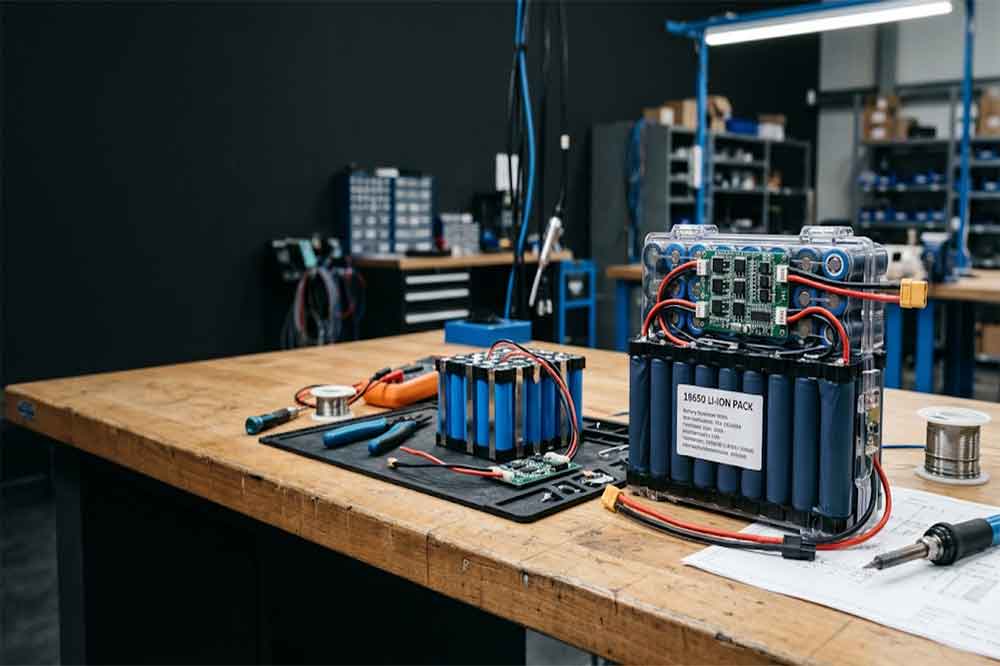
Ordering a custom protected 18650 battery pack usually starts with a simple question: What battery do you need?
However, a battery manufacturer cannot produce an accurate design from a voltage and capacity requirement alone. Two battery packs with the same nominal voltage may have completely different dimensions, discharge capabilities, protection circuits, connectors and charging requirements.
This becomes particularly important for OEM projects. The battery must fit the equipment, support its actual power consumption and work reliably with the customer’s charging system.
Before requesting a quotation or sample, it is worth preparing a complete set of technical specifications. This guide explains which details a battery manufacturer needs and why each one matters.
Why Accurate Specifications Matter Before Custom Battery Production
A custom battery pack is designed around the equipment it powers. The available installation space, operating current, charging method and working environment all influence the final design.
For example, a portable medical instrument may require a compact battery with moderate discharge current and accurate battery-level monitoring. An industrial device may need a higher current output, stronger mechanical protection and a wider operating temperature range.
Providing incomplete information can lead to several problems:
- The battery fits electrically but does not fit inside the enclosure.
- The protection circuit disconnects during equipment startup.
- The charging voltage is incompatible with the battery pack.
- The connector or cable position does not match the device.
- The actual operating time is shorter than expected.
These problems are easier to address during the design stage than after mass production.
Required Electrical Specifications
Electrical parameters are the starting point for any custom protected 18650 battery pack.
Nominal Voltage and Maximum Charging Voltage
First, specify the required nominal voltage and the maximum charging voltage.
A standard lithium-ion 18650 cell generally has a nominal voltage of 3.6V or 3.7V, depending on the cell specification. Its full-charge voltage is commonly 4.2V.
When multiple cells are connected in series, the voltage increases.

| Configuration | Nominal Voltage | Full-Charge Voltage |
|---|---|---|
| 1S | 3.6–3.7V | 4.2V |
| 2S | 7.2–7.4V | 8.4V |
| 3S | 10.8–11.1V | 12.6V |
| 4S | 14.4–14.8V | 16.8V |
These are typical values for conventional 4.2V-per-cell lithium-ion chemistry. Other chemistries require different voltage limits.
Do not simply tell the manufacturer that your device needs a 12V battery. Provide the equipment’s acceptable input voltage range and charging requirements. This helps determine whether a direct battery connection or an additional voltage conversion circuit is needed.
Battery Pack Capacity and Energy
Capacity is normally specified in ampere-hours (Ah) or milliampere-hours (mAh).
For example, a 3S2P battery pack made from 3,000mAh cells has a nominal capacity of approximately 6,000mAh.
Energy is another important parameter:
Wh = Nominal Voltage × Capacity (Ah)
A 3S2P pack using 3.7V, 3,000mAh cells has approximately:
11.1V × 6Ah = 66.6Wh.
For OEM applications, capacity should be based on actual operating time and equipment power consumption rather than simply selecting the largest available cell.
Also clarify whether the required capacity is a minimum value, typical value or target value. The final specification should identify the cell model, discharge conditions and testing method used to verify capacity.
Series and Parallel Configuration
The series-parallel arrangement determines the battery pack’s voltage and capacity.
- 1S: One cell group connected in series.
- 2S: Two cell groups connected in series.
- 3S: Three cell groups connected in series.
- 4S: Four cell groups connected in series.
- 1P, 2P or 3P: The number of cells connected in parallel within each series group.
For example, a 3S2P pack contains six cells. Three groups are connected in series, with two cells in parallel in each group.
If you already have a preferred configuration, include it in your RFQ. If not, provide the required voltage, capacity, output current and available space so the manufacturer can evaluate a suitable arrangement.
Discharge and Charging Requirements
Voltage and capacity do not tell the whole story. A battery pack must also deliver sufficient current under real operating conditions.
Continuous and Peak Discharge Current
Continuous discharge current is the current the battery can supply during normal operation.
Peak discharge current refers to a temporary higher current demand, such as when a motor starts or an electronic device performs a high-power operation.
For example, equipment may normally consume 2A but briefly require 6A during startup.
If the battery protection circuit is designed only for the normal current, it may disconnect when the equipment starts.
When requesting a custom pack, provide:
- Normal operating current.
- Maximum continuous discharge current.
- Peak discharge current.
- Duration of peak current.
- Startup or surge current, if applicable.
The selected cells, parallel configuration, wiring and BMS must all support the required load.
Charging Current and Charging Time
The charging system must match the battery pack’s chemistry, series configuration and protection design.
Specify the charger output voltage, recommended charging current and expected charging time.
For example, a 3S conventional lithium-ion pack normally requires a 12.6V CC/CV charging system. A different series configuration will require a different charging voltage.
Do not assume that a higher charging current is always better. The allowable charging current depends on the selected cell’s datasheet, temperature conditions and battery protection design.
If your equipment uses an existing charger, provide its specifications to the battery manufacturer before sample production.
Battery Protection and BMS Requirements
A protected 18650 battery pack needs an appropriate protection circuit. The protection design should reflect the cell characteristics and actual equipment requirements.
Overcharge and Over-Discharge Protection
Overcharge protection prevents the cells from exceeding their permitted charging voltage.
Over-discharge protection disconnects the load when the cell voltage reaches its specified lower limit.
The protection thresholds should be selected according to the cell manufacturer’s recommendations rather than using arbitrary values.
Overcurrent and Short-Circuit Protection
Overcurrent protection helps prevent excessive current from damaging the battery pack.
Short-circuit protection is particularly important for equipment used in environments where cables or connectors may become damaged.
The BMS current rating must be coordinated with the battery’s normal and peak load requirements. A protection board with an unnecessarily low current limit may cause unexpected shutdowns.
Temperature Monitoring and Communication
Some applications require additional BMS functions, including:
- Cell or pack temperature monitoring.
- Charging and discharging temperature protection.
- Battery voltage monitoring.
- State-of-charge reporting.
- Fuel gauge functionality.
- SMBus, I2C, UART or CAN communication, when required.
Not every project needs these functions. A basic battery pack may only require standard protection, while medical, industrial and intelligent electronic equipment may need more detailed battery information.
Clearly distinguish between essential functions and optional features when submitting your requirements.

Physical Dimensions and Mechanical Design
A battery pack can meet every electrical requirement and still fail an OEM project if it does not fit the equipment.
Battery Pack Size and Weight
Provide the maximum available length, width and thickness.
If possible, send a mechanical drawing or a 3D model of the battery compartment.
Remember that the final pack dimensions include more than the cells. The BMS, wiring, insulation, connectors and protective materials also occupy space.
It is useful to specify whether the dimensions are maximum external dimensions or target dimensions.
Housing, Insulation and Mounting
Tell the manufacturer how the battery will be installed.
Possible requirements include:
- PVC heat-shrink wrapping.
- ABS or other suitable plastic housing.
- Metal enclosure, where appropriate.
- Custom insulation.
- Mounting brackets or fixing holes.
- Cable exit position.
- Required protection against vibration or mechanical impact.
The housing design should be considered together with heat dissipation, insulation and access for maintenance.
Wire Length and Connector Type
Connector details are often overlooked during early quotations.
Provide the connector manufacturer or model, pin configuration, wire gauge, cable length and polarity.
If the equipment uses a custom connector, a photograph, drawing or physical sample can help avoid misunderstandings.
Also specify whether the cable exits from the left, right, top or bottom of the battery pack.

Battery Cell Selection and Application Environment
Not all 18650 cells have the same characteristics.
Cell selection depends on capacity, discharge performance, internal resistance, operating temperature and expected service life.
For a low-power monitoring device, a high-capacity cell may be suitable. For equipment with a motor or other demanding load, a cell designed for higher discharge current may be a better choice.
You should also explain where the battery will operate.
Consider the following:
- Operating temperature range.
- Storage temperature.
- Humidity exposure.
- Vibration and shock.
- Indoor or outdoor use.
- Expected charge and discharge cycles.
For example, a battery installed inside industrial equipment may experience higher temperatures than one used in a handheld consumer device. The enclosure and thermal design should account for this difference.
If the equipment has specific environmental or reliability requirements, include them before the manufacturer selects the cells.
Certifications, Testing and Documentation
For commercial and industrial projects, compliance requirements should be discussed before production.
Depending on the destination market and application, buyers may request:
- UN38.3 test documentation for lithium battery transport.
- MSDS or SDS documentation.
- CE-related compliance documentation, where applicable.
- RoHS documentation.
- UL-related cell or battery certifications, where required.
- ISO 9001 quality management information from the manufacturer.
These documents are not interchangeable. A buyer should identify the exact certification or test report required for the battery pack, cell or finished equipment.
You should also discuss sample testing, capacity verification, protection function testing, insulation checks and final inspection criteria.
For larger OEM orders, agree on the testing requirements and acceptance standards before mass production.
What Information Should You Send to a Battery Manufacturer?
A practical RFQ should contain enough information for the manufacturer to evaluate the battery design without repeatedly asking for missing details.
The following checklist can be used when preparing a custom protected 18650 battery pack inquiry.
| Specification | Information to Provide |
|---|---|
| Application | Equipment name and usage |
| Battery chemistry | Li-ion or other chemistry |
| Nominal voltage | Required pack voltage |
| Capacity | Required Ah or mAh |
| Configuration | Series and parallel arrangement |
| Discharge current | Continuous and peak current |
| Charging | Charger voltage and current |
| BMS | Required protection and communication |
| Dimensions | Maximum length, width and thickness |
| Connector | Model, polarity and wire length |
| Housing | PVC, plastic or custom enclosure |
| Environment | Temperature, vibration and humidity |
| Certifications | Required documents and standards |
| Quantity | Prototype and estimated annual demand |
If you do not know every technical parameter, that does not mean the project cannot move forward.
Send the equipment specifications, photographs, available battery compartment dimensions and existing battery information. An experienced battery manufacturer can review these details and recommend a suitable configuration.
Common Mistakes When Requesting Custom 18650 Battery Packs
Several issues appear repeatedly in custom battery projects.
Only providing voltage and capacity: These two values are not enough to determine the cells, BMS, wiring and mechanical structure.
Ignoring peak current: A pack may operate normally under light loads but shut down when the equipment starts.
Using estimated dimensions: Even a small difference in battery thickness or connector position can prevent installation.
Not checking charger compatibility: The charging voltage must match the battery configuration and chemistry.
Choosing cells only by capacity: Higher capacity does not automatically mean better performance. Discharge capability and operating conditions also matter.
Discussing certifications too late: Required testing and documentation can affect the design, schedule and project cost.
Providing these details early makes the quotation more meaningful and reduces unnecessary sample revisions.
Conclusion
Custom protected 18650 battery packs require more than a simple voltage and capacity specification. Electrical performance, BMS functions, mechanical dimensions, charging conditions and application environment all influence the final design.
For OEM buyers, the most effective approach is to prepare an RFQ around the actual equipment requirements. Even when some technical details are not yet confirmed, sharing drawings, photographs and existing battery information gives the manufacturer a practical starting point.
A complete specification at the beginning of the project helps reduce design changes, improve sample accuracy and establish a clearer path toward mass production.
For custom 18650 battery pack projects, Apsenx can evaluate cell selection, series-parallel configuration, protection circuits, connectors, housing and OEM requirements based on the application.
Contact the engineering team with your battery specifications or equipment drawings to discuss a suitable custom solution.
FAQs
Q1: What information is required to customize a protected 18650 battery pack?
At minimum, provide the required voltage, capacity, discharge current, dimensions, charging requirements and application. Connector, BMS and certification requirements should also be included when available.
Q2: Can I customize the voltage and capacity of an 18650 battery pack?
Yes. Voltage is determined mainly by the series configuration, while capacity is determined by the cells and parallel configuration. The final design must also meet current and space requirements.
Q3: How do I choose the right BMS for a custom 18650 battery pack?
The BMS should match the series configuration, cell voltage limits, continuous and peak current, charging requirements and necessary protection functions.
Q4: Can a battery manufacturer customize the size and connector?
Yes. OEM battery packs can be designed with different dimensions, cable lengths, connector types, mounting structures and housing materials, subject to technical feasibility.
Q5: Do I need a complete technical drawing before requesting a quotation?
No. An equipment drawing is helpful, but photographs, existing battery samples, electrical specifications and compartment measurements can also provide a starting point for evaluation.
Related Articles: Protected 18650 Battery Pack
Choosing the right protection system is only one part of developing a reliable 18650 battery pack. Cell configuration, battery specifications, and application requirements also need to be considered.
Explore these related guides to learn more:
“If you are still comparing different battery pack configurations, our guide to 1S, 2S, 3S and 4S protected 18650 battery packs explains how series and parallel connections affect voltage and capacity.”
“For a closer look at the engineering side of battery protection, read our guide on how protection is designed in a protected 18650 battery pack.”
“Not every application needs the same protection arrangement. Our article explaining when to use protected 18650 cells in a battery pack discusses the situations where cell-level protection becomes important.”
“For a broader look at the complete OEM design and manufacturing process, see our guide to building a protected 18650 battery pack for OEM applications.”
Once the battery specifications have been confirmed, the next step is to evaluate potential suppliers. Our article explains [what buyers should check when choosing a protected 18650 battery pack manufacturer], including cell quality, BMS protection, testing, and production capacity.
Related Products
-

12V 4400 mah Lithium ion 3S2P 18650 Battery Pack
-

18650 2000mAh 3.7 volt Lithium-ion Battery
-

18650 20V 3.0Ah Cordless Drill battery
-

18650 22.2V 7.8Ah 2600Mah 6S3P Rechargeable Battery Pack
-

18650 2600mAh Rechargeable Lithium-Ion Battery 3.7V
-

18650 3.7V 10Ah Li-Ion Power Battery Pack
-

18650 3.7V 3300mah Rechargeable Lithium ion Battery
-

18650 7S7P 24V 14Ah Lithium ion Electric Scooter Battery Pack
-

18650 battery 3.7V 1500mAh Lithium-Ion Battery
-

18650 Battery 3500 mah Rechargeable Battery Cells
-

18650 Electric Scooter 48V 13000mAh Lithium Battery
-

2600mAh 3S1P 11.1V 18650 Battery Packs
-

3.7V Li ion Rechargeable 3000mah 18650 Battery Cell
-

36V 5200mAh 10S2P 18650 Battery Pack
-

48v 4400mah 13S2P 18650 Rechargeable Battery Pack
-

7S2P 24V 18650 Lithium Battery Pack
-

Electric Scooter 36V 4400mAH 10S2P 18650 Battery Pack
-

ICR 18650 Battery 2200mah 3.7V
Leave a Reply