
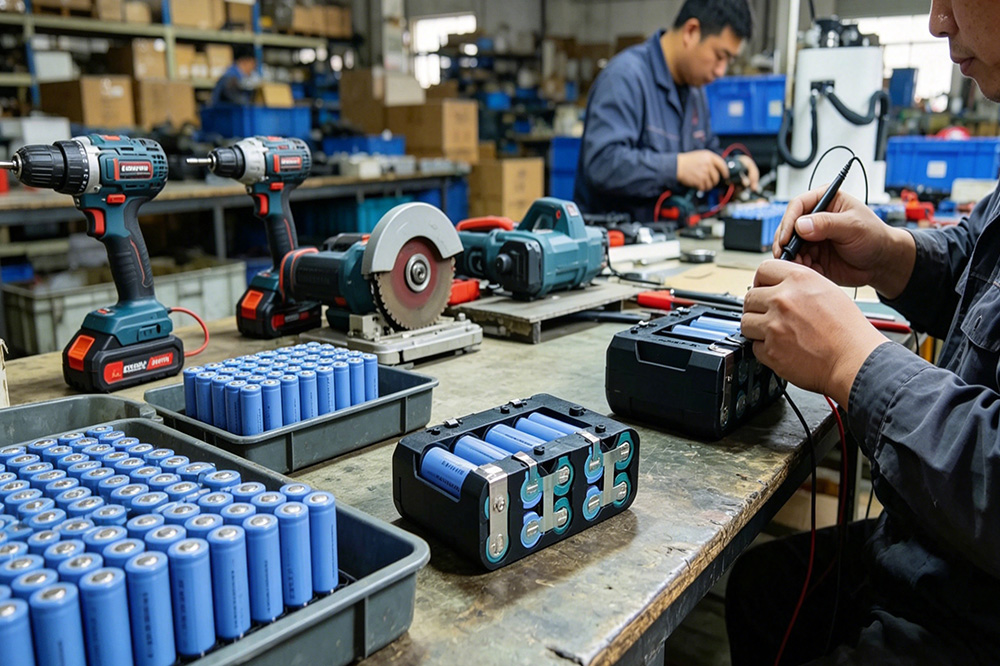
There’s a strange thing about 18650 cells used in power tools. On paper, they look almost boring — same cylinder, same voltage, similar capacity numbers across different suppliers. But once you step into an OEM factory floor, or even talk to manufacturers working on cordless tools, the conversation shifts quickly.
It’s rarely about “best battery” in a general sense. It becomes more like: can this cell survive repeated high current bursts without dropping performance halfway through production? That’s usually where factory supply 18650 cells start to matter.
Factory supply is not just “bulk purchase”
When manufacturers talk about factory supply 18650 cells for power tool battery packs, they are usually not talking about simple wholesale cartons.
It’s more like controlled sourcing:
- Same batch consistency
- Stable internal resistance range
- Matching cells for pack assembly
- Less variation across thousands of units
One thing that often gets underestimated is how much mismatch inside a battery pack affects real tool behavior. A drill that feels strong in the morning might start feeling “soft” after a few minutes if cell balance is not stable. It doesn’t always show up in spec sheets.
Some OEM factories quietly reject entire batches just because discharge curves don’t align tightly enough, even if capacity looks fine on paper.
High-drain performance is where everything becomes real
In theory, most 18650 cells can power a tool. In practice, it’s the high discharge behavior that decides whether the pack feels professional or cheap.
Power tools like:
- cordless electric drills
- angle grinders
- impact wrenches
These don’t pull steady current. They spike. Hard.
That’s where high-rate 18650 cells are usually selected, especially those designed for:
- strong continuous discharge
- low voltage sag under load
- stable heat control
Manufacturers often test cells not just by mAh, but by how the voltage behaves after repeated stress cycles. And this part is where datasheets can be slightly misleading — or at least not telling the full story.

OEM thinking is different from retail thinking
Retail buyers usually ask: “How long does it last?”
OEM manufacturers ask something closer to: “How predictable is it when 10,000 units go into the field at once?”
That difference changes everything.
In OEM/ODM production, 18650 cells are selected based on:
- pack structure compatibility (series/parallel behavior)
- discharge curve alignment
- thermal stability under enclosure conditions
- long-term cycle consistency
It’s not uncommon that two cells with similar capacity are treated completely differently in production planning.
Where these cells actually end up
If you look at how factories and manufacturers deploy wholesale 18650 battery packs, the applications are usually very practical — not experimental.
Cordless electric drills
In assembly lines or construction sites, drills often run in bursts. Workers don’t care about battery theory, but they notice immediately if torque drops mid-use.
Angle grinders
These are more brutal on batteries. The load changes constantly depending on material contact. Cells that handle drills well may behave differently here.
Impact wrenches
Short bursts, high peak current. The battery has to respond instantly, not “warm up.”
Portable saws
Here, runtime stability matters more than peak burst. A slight voltage drop can change cutting performance noticeably.
Industrial maintenance tools
This is where things get interesting. Maintenance teams often mix usage patterns — sometimes idle, sometimes sudden load. Batteries here need to be forgiving.

Manufacturers rarely talk about this part openly
Something you only really hear from factories: not all 18650 cells behave the same once they are packed tightly into enclosure systems.
Heat buildup, spacing, welding quality — all of these start influencing performance after assembly. That’s why some manufacturers prefer slightly conservative capacity choices if it improves long-term stability.
It’s not always about pushing maximum specs. Sometimes it’s about avoiding unpredictable returns months later.
Wholesale OEM supply is more about control than price
People often assume “factory supply” just means cheaper cost. In reality, most OEM buyers care more about control:
- consistent batch sourcing
- stable discharge behavior
- predictable assembly outcomes
- fewer field failures
Price still matters, of course, but it usually comes after stability is confirmed.
A small observation from production behavior
In some battery pack factories, engineers don’t start with full specification sheets. They start with sample cycling tests. Cells are run through repeated charge-discharge cycles under load conditions similar to drills or grinders.
If the curve starts drifting too early, the cell is quietly removed from consideration — even if it looks fine on paper.
That part is rarely mentioned in product pages, but it shapes almost every OEM decision.
Closing direction
For companies building cordless power tool systems, choosing factory supply 18650 cells is less about finding a “perfect cell” and more about reducing uncertainty in production.
Drills, grinders, saws, impact tools — they all behave differently in real use, and the battery pack has to survive those differences without becoming the weak point.
That’s usually why OEM manufacturers stick with controlled sourcing instead of random bulk purchasing. It’s not just scale. It’s predictability.
-

12V 4400 mah Lithium ion 3S2P 18650 Battery Pack
-

18650 2000mAh 3.7 volt Lithium-ion Battery
-

18650 20V 3.0Ah Cordless Drill battery
-

18650 22.2V 7.8Ah 2600Mah 6S3P Rechargeable Battery Pack
-

18650 2600mAh Rechargeable Lithium-Ion Battery 3.7V
-

18650 3.7V 10Ah Li-Ion Power Battery Pack
-

18650 3.7V 3300mah Rechargeable Lithium ion Battery
-

18650 7S7P 24V 14Ah Lithium ion Electric Scooter Battery Pack
-

18650 battery 3.7V 1500mAh Lithium-Ion Battery
-

18650 Battery 3500 mah Rechargeable Battery Cells
-

18650 Electric Scooter 48V 13000mAh Lithium Battery
-

2600mAh 3S1P 11.1V 18650 Battery Packs
-

3.7V Li ion Rechargeable 3000mah 18650 Battery Cell
-

36V 5200mAh 10S2P 18650 Battery Pack
-

48v 4400mah 13S2P 18650 Rechargeable Battery Pack
-

7S2P 24V 18650 Lithium Battery Pack
-

Electric Scooter 36V 4400mAH 10S2P 18650 Battery Pack
-

ICR 18650 Battery 2200mah 3.7V
Leave a Reply