
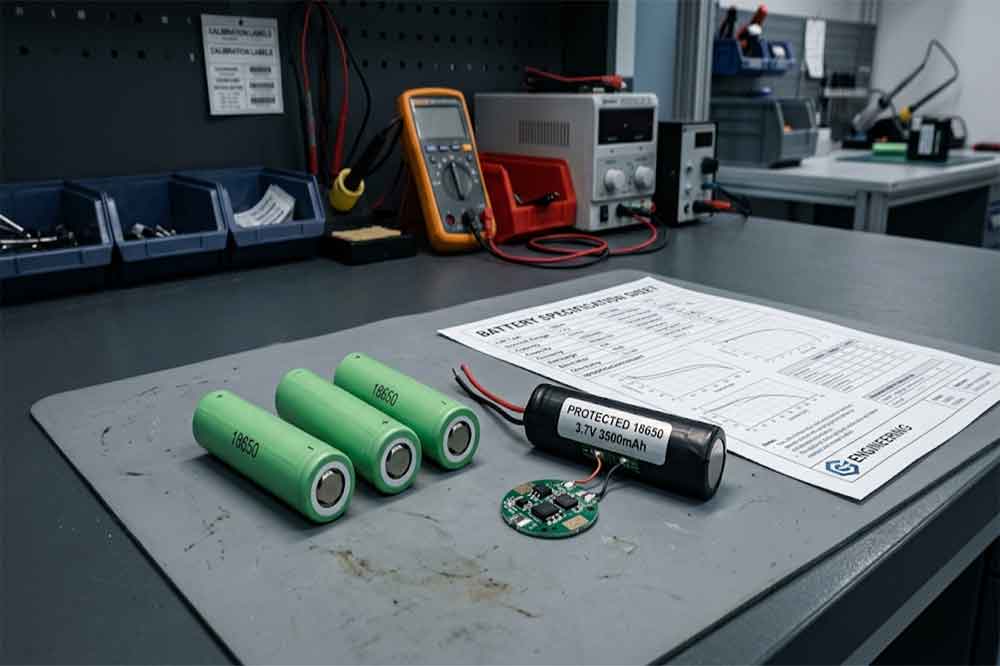
Choosing a protected 18650 battery is not simply a matter of buying the cell with the highest mAh rating. A battery with greater capacity may offer longer runtime, but it must also match the device’s voltage, discharge current, available space, charging method, and operating environment.
For OEM manufacturers and bulk buyers, these details affect more than battery life. They can influence product dimensions, operating reliability, sourcing consistency, and the cost of the finished device.
The right selection starts with the application. Before comparing battery models, determine how much energy the device needs, how long it must operate, and whether the selected protected cell can supply the required current.
What Does Capacity Mean in a Protected 18650 Battery?
Battery capacity is usually expressed in milliamp-hours (mAh). It describes how much electric charge a battery can deliver under specified test conditions.
For example, a 3000mAh cell has a nominal capacity of 3Ah. However, the actual runtime depends on the load, discharge conditions, temperature, battery age, and the usable capacity available before the device or protection circuit stops operation.
A higher capacity does not automatically mean a battery is suitable for every device.
mAh and Wh measure different things
Milliamp-hours are useful when comparing cells with similar voltage and chemistry. Watt-hours (Wh) are often more useful when evaluating energy requirements.
A simple nominal energy estimate is:
Watt-hours (Wh) = Nominal voltage (V) × Capacity (Ah)
For example, a nominal 3.6V, 3Ah cell stores approximately 10.8Wh of nominal energy. This is a theoretical calculation, not a promise that all 10.8Wh will be available to the device.
When comparing different battery configurations, use watt-hours alongside voltage and capacity. Two batteries with the same mAh rating but different nominal voltages do not store the same amount of energy.
The protection circuit does not create extra capacity
A protected 18650 battery generally combines a cylindrical lithium-ion cell with a protection circuit. Depending on its design, the circuit may help disconnect the battery during conditions such as overcharge, over-discharge, overcurrent, or a short circuit.
The circuit does not increase the cell’s underlying capacity. It may also affect the available operating range because the circuit has its own voltage thresholds, current limits, and electrical characteristics.
When comparing protected and unprotected cells, check the actual cell specification and the complete protected product specification. Do not assume that two cells with the same printed capacity will behave identically in every application.

Start With the Device’s Actual Power Consumption
Before choosing a capacity, understand how the device uses energy. A product that draws power continuously has different requirements from one that operates for short periods and then enters standby mode.
Estimate the average load
If the device operates at a relatively stable current, a first estimate can use the following formula:
Required capacity (Ah) = Average current (A) × Required runtime (hours)
Suppose a device draws an average of 0.5A and must operate for six hours. Its basic charge requirement is:
0.5A × 6 hours = 3Ah, or 3000mAh.
This is only a starting point. It does not include reserve capacity, conversion losses, temperature effects, battery aging, or protection cutoffs.
If the device has several operating modes, estimate the energy used in each mode. For example, a portable instrument may consume more power during measurement and much less while waiting for the next reading.
Account for startup current and operating cycles
Average current alone does not tell the whole story. Motors, wireless transmitters, pumps, lighting systems, and other electronic loads may draw brief bursts of current above their normal operating level.
A battery can have enough nominal capacity but still fail to run the device if its cell or protection circuit cannot support the required peak current.
For duty-cycled products, record how long the device stays active, how long it remains in standby, and how often high-power functions operate. A realistic operating profile gives a better estimate than a single current reading.
Calculate the Battery Capacity Needed for Runtime
Once the energy requirement is understood, estimate how much nominal capacity the application needs.
For a simple constant-current load, the basic calculation is:
Nominal capacity needed (Ah) ≈ Average current (A) × Runtime (h) ÷ Usable-capacity fraction
The usable-capacity fraction is the portion of nominal capacity expected to be available under the actual operating conditions. It is an engineering assumption that should be validated through testing, not a universal fixed value.
For example, if a device averages 0.5A for six hours, the load requires approximately 3Ah. If the design team assumes that only 80% of nominal capacity will be usable, the preliminary capacity target becomes:
3Ah ÷ 0.8 = 3.75Ah.
This does not mean a protected 18650 cell rated at 3750mAh will necessarily meet the requirement. The chosen cell must actually offer the required capacity under the specified discharge conditions, and the protection circuit must remain compatible with the load.
If the required capacity exceeds the practical range of available cells, consider a different cell format or a custom battery pack. Do not assume that several cells can simply be connected together without an appropriate electrical and mechanical design.
Allow for usable capacity and system losses
The device may stop operating before the cell reaches its full discharge limit. A voltage converter may also lose some energy during conversion. Low temperatures, higher discharge rates, and cell aging can reduce the energy available in practice.
For this reason, validate runtime using the actual device, battery, protection circuit, charger, and enclosure whenever possible.
If the product must operate for a guaranteed number of hours, specify the test conditions clearly. Include the load profile, ambient temperature, cutoff voltage, and whether the battery is new or has undergone a defined aging cycle.

Check Discharge Current Before Choosing a Higher Capacity
Capacity and discharge current are different specifications. Capacity describes stored charge, while discharge current describes how quickly the battery can supply that charge.
A cell with a high mAh rating is not necessarily designed for a high-current application. The permissible continuous and peak discharge currents depend on the specific cell model and its datasheet.
The protection circuit must also support the application. Check its continuous operating current, overcurrent threshold, peak-current behavior, and thermal conditions. A protection board’s trip threshold is not the same as its recommended continuous operating current.
For OEM evaluation, review the entire electrical path. Cell, protection circuit, wiring, connectors, and contacts must all be suitable for the expected load.
If the device draws a brief startup surge, confirm that the battery can support it without an unwanted cutoff. Increasing capacity alone may not solve a current-limit problem.
Confirm Voltage, Physical Size, and Protection Circuit Compatibility
Capacity is only one part of battery selection. The nominal voltage and operating voltage range must match the device’s electrical design.
A standard lithium-ion 18650 cell is commonly specified at a nominal voltage around 3.6V or 3.7V, depending on the manufacturer and chemistry. Its fully charged voltage and permitted lower operating voltage must be taken from the actual datasheet.
Check that the device can operate across the battery’s voltage range. If a regulator or DC-DC converter is used, verify its input range, efficiency, and low-voltage behavior.
Physical dimensions also matter. A protected 18650 assembly may be longer than a bare cell because of the protection board and additional construction. The final dimensions can vary with the circuit, insulation, terminals, and packaging.
For equipment with a tight battery compartment, confirm the complete protected-cell dimensions rather than relying on the standard 18650 format alone. Also verify connector type, polarity, wire length, and mounting requirements.
Consider Temperature, Aging, and Real-World Conditions
Battery capacity is measured under specified conditions. Actual performance may differ when the device operates in a cold warehouse, a warm enclosure, or a location with limited airflow.
Low temperatures can reduce available capacity and increase voltage drop under load. Elevated temperatures may accelerate aging and can create safety concerns if the battery operates outside its specified limits.
A product intended for several years of service should not be designed around the performance of a brand-new cell alone. The engineering team should establish a reasonable end-of-life runtime target and validate the battery under representative conditions.
Do not use a larger nominal capacity as a substitute for a proper thermal assessment. Confirm the selected cell’s permitted charging and discharging temperature ranges, and ensure the charger and protection design are appropriate for the intended environment.
What OEM Buyers Should Confirm Before Ordering
Before requesting samples or placing a bulk order, prepare a clear battery specification. This helps the supplier evaluate whether a standard protected cell is suitable or whether a custom solution is needed.
At a minimum, provide:
- Required runtime and the device’s average and peak current.
- Nominal voltage and acceptable operating voltage range.
- Target capacity and the conditions under which it must be achieved.
- Maximum battery-compartment dimensions.
- Protection functions and continuous-current requirements.
- Charging method, connector, wire length, and polarity.
- Operating temperature, expected service life, and testing requirements.
- Required documentation, traceability, packaging, and order quantity.
Ask the supplier to confirm the exact cell model, protection circuit specification, finished dimensions, and test conditions used for the capacity rating. For custom projects, evaluate a representative sample in the actual device before finalizing the production specification.
A sample that works for a few minutes on a workbench does not necessarily prove that it will meet a full-shift runtime requirement. Runtime testing should reflect the actual operating cycle, cutoff behavior, temperature, and peak load.
If the application requires more energy than one protected 18650 cell can provide, discuss a purpose-designed battery pack with the supplier. Multi-cell packs require suitable series or parallel configuration, a compatible battery management approach, and appropriate mechanical and electrical safeguards.
For sourcing and customization, review the available 18650 lithium battery options and provide your project requirements before selecting a final model.

Final Thoughts
The best protected 18650 battery capacity is the one that meets the device’s runtime target under real operating conditions while remaining compatible with the cell’s discharge limits, protection circuit, voltage range, and available space.
Start with the load profile, calculate the energy requirement, allow for usable capacity and aging, and then confirm current capability and physical fit. Finally, validate the complete battery system in the target device.
For OEM and wholesale buyers, a clear specification is more useful than choosing a battery based on mAh alone. It helps suppliers recommend a suitable standard cell or develop a custom battery solution that fits the product’s actual requirements.
FAQs
How do I calculate the capacity needed for a protected 18650 battery?
Multiply the device’s average current by its required runtime, then divide by the expected usable-capacity fraction. Validate the estimate against discharge conditions, voltage cutoff, temperature, and battery aging.
2. Does a higher mAh rating always provide longer runtime?
Not necessarily. Runtime also depends on load current, cell characteristics, usable voltage range, temperature, and the protection circuit. Compare capacity ratings under equivalent test conditions.
3. Can a protected 18650 battery provide high discharge current?
Only if both the specific cell and its protection circuit support the required continuous and peak current. Check their datasheets and confirm performance under the intended thermal conditions.
4. Is a protected 18650 battery physically larger than an unprotected cell?
It can be. The protection circuit and additional construction may increase the finished length or affect the overall dimensions. Confirm the complete product drawing before designing the battery compartment.
5. What information should I send a battery supplier for an OEM project?
Provide the required runtime, average and peak current, voltage range, target capacity, installation dimensions, connector details, charging method, operating temperature, and expected service life. These details help the supplier assess whether a standard cell or custom pack is appropriate.
-

12V 4400 mah Lithium ion 3S2P 18650 Battery Pack
-

18650 2000mAh 3.7 volt Lithium-ion Battery
-

18650 20V 3.0Ah Cordless Drill battery
-

18650 22.2V 7.8Ah 2600Mah 6S3P Rechargeable Battery Pack
-

18650 2600mAh Rechargeable Lithium-Ion Battery 3.7V
-

18650 3.7V 10Ah Li-Ion Power Battery Pack
-

18650 3.7V 3300mah Rechargeable Lithium ion Battery
-

18650 7S7P 24V 14Ah Lithium ion Electric Scooter Battery Pack
-

18650 battery 3.7V 1500mAh Lithium-Ion Battery
-

18650 Battery 3500 mah Rechargeable Battery Cells
-

18650 Electric Scooter 48V 13000mAh Lithium Battery
-

2600mAh 3S1P 11.1V 18650 Battery Packs
-

3.7V Li ion Rechargeable 3000mah 18650 Battery Cell
-

36V 5200mAh 10S2P 18650 Battery Pack
-

48v 4400mah 13S2P 18650 Rechargeable Battery Pack
-

7S2P 24V 18650 Lithium Battery Pack
-

Electric Scooter 36V 4400mAH 10S2P 18650 Battery Pack
-

ICR 18650 Battery 2200mah 3.7V
Leave a Reply