
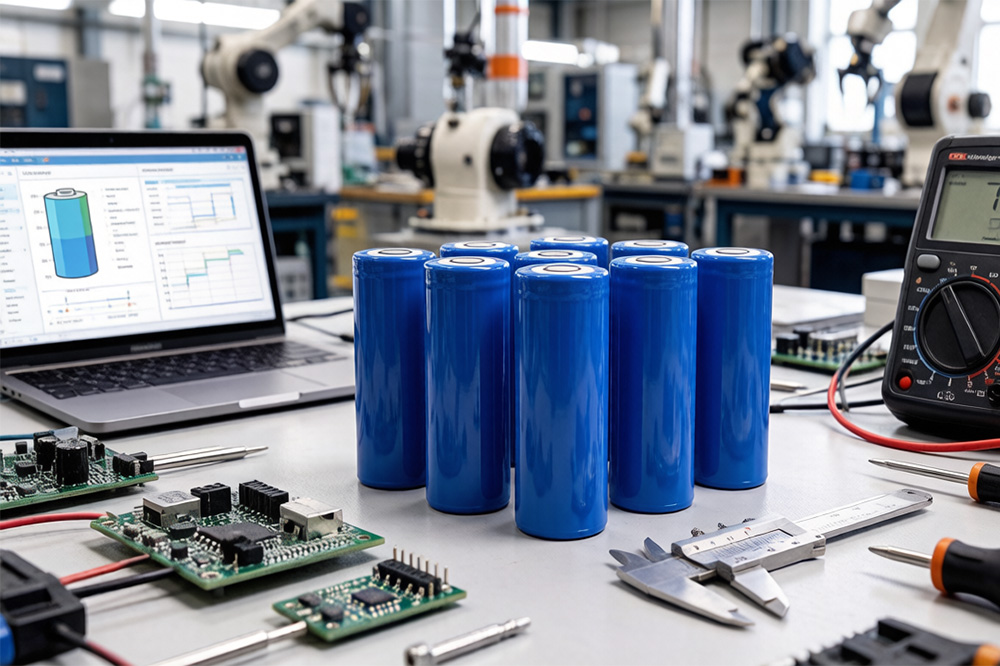
If you spend any time around flashlights, portable electronics, or custom battery packs, you’ll eventually run into the 18500 battery.
It isn’t nearly as common as the 18650 anymore, which is probably why a lot of people assume it’s outdated. But that’s not really the case. The 18500 still fills a gap that larger cells can’t always fill.
For some device designs, an 18650 is simply too long. A 14500 doesn’t provide enough runtime. That’s where the 18500 tends to make sense.
What Exactly Is 18500 Battery?
The naming is pretty straightforward.
The cell is about 18 mm in diameter and roughly 50 mm long. Same width as an 18650, just shorter.
That shorter body is the whole reason the format still exists.
Engineers working with tight internal layouts sometimes need every millimeter they can save. Losing 15 mm compared to an 18650 may not sound like much on paper, but inside a flashlight tube or handheld device, it can completely change the design.
Of course, nothing comes for free. A shorter battery also means less room for active material, which translates into lower capacity.
What Makes a 18500 High Drain Battery?
This is where people often focus on the wrong specification.
Many buyers immediately compare mAh ratings. That’s understandable, but capacity isn’t always the most important number.
Imagine a device that suddenly demands a lot of current. A battery with a huge capacity but poor discharge performance can struggle under that load. Voltage drops faster, output becomes inconsistent, and performance suffers.
A high-drain 18500 is built differently. The goal isn’t necessarily maximum runtime. The goal is delivering power efficiently when the device asks for it.
That’s why some high-drain cells actually have lower capacities than their high-capacity counterparts.
On paper that seems backwards.
In real-world use, especially with high-output flashlights and similar electronics, it often works better.
Where Are 18500 Batteries Still Being Used?
Flashlights are probably the first thing most enthusiasts think about.
A lot of users like the balance. You get a noticeably smaller light than an 18650 model, but without sacrificing as much runtime as you would with smaller battery formats.

Beyond flashlights, 18500 cells still appear in:
- Portable test equipment
- Measurement devices
- Specialty electronics
- Medical instruments
- Custom battery pack projects
In some of these applications, the battery choice isn’t about getting maximum runtime. It’s about fitting into a very specific amount of space.
That’s why the format continues to survive even though larger cells dominate the market.
18500 vs 18650
This comparison comes up all the time.
Honestly, if physical size isn’t a concern, most people end up choosing an 18650.
The market is bigger.
There are more options.
Capacity is usually higher.
Pricing is often better because of production scale.
But if a device was designed around an 18500, the discussion is over before it starts. An 18650 simply won’t fit.
That’s one reason why many manufacturers continue sourcing 18500 cells despite the popularity of larger formats.

A Common Mistake When Buying 18500 Batteries
One thing that catches buyers off guard is assuming all 18500 batteries share the same dimensions.
Technically they should.
In practice, protected versions can be longer because of the protection circuit attached to the cell.
That extra length may only be a few millimeters, but sometimes that’s enough to prevent installation.
Before placing a bulk order, it’s worth checking:
- Actual cell length
- Continuous discharge rating
- Internal resistance
- Cycle life data
- Safety certifications
A specification sheet usually tells a much more complete story than the capacity rating printed on the wrapper.
Is the 18500 Battery Becoming Obsolete?
Not really.
It’s definitely a niche format compared to what it was years ago, but niche doesn’t mean obsolete.
There are still products being designed around it, and there are still users who prefer the balance between size and performance.
What has changed is the range of alternatives available today.
Many OEM manufacturers that once relied on 18500 cells now evaluate 18650 batteries first because they offer more capacity and broader availability.
For new product development, it’s often worth comparing both options before committing to a battery platform.
Related Reading
If you’re evaluating battery options for a new device or battery pack project, it can be helpful to compare 18500 cells against modern 18650 solutions.
Many manufacturers choose 18650 batteries when runtime becomes the primary concern, while others stay with 18500 cells to maintain compact product dimensions. Explore available options here:18650 battery cells
You’ll find a wider range of capacities, discharge rates, and custom battery pack possibilities that may fit different project requirements.
-

12V 4400 mah Lithium ion 3S2P 18650 Battery Pack
-

18650 2000mAh 3.7 volt Lithium-ion Battery
-

18650 20V 3.0Ah Cordless Drill battery
-

18650 22.2V 7.8Ah 2600Mah 6S3P Rechargeable Battery Pack
-

18650 2600mAh Rechargeable Lithium-Ion Battery 3.7V
-

18650 3.7V 10Ah Li-Ion Power Battery Pack
-

18650 3.7V 3300mah Rechargeable Lithium ion Battery
-

18650 7S7P 24V 14Ah Lithium ion Electric Scooter Battery Pack
-

18650 battery 3.7V 1500mAh Lithium-Ion Battery
-

18650 Battery 3500 mah Rechargeable Battery Cells
-

18650 Electric Scooter 48V 13000mAh Lithium Battery
-

2600mAh 3S1P 11.1V 18650 Battery Packs
-

3.7V Li ion Rechargeable 3000mah 18650 Battery Cell
-

36V 5200mAh 10S2P 18650 Battery Pack
-

48v 4400mah 13S2P 18650 Rechargeable Battery Pack
-

7S2P 24V 18650 Lithium Battery Pack
-

Electric Scooter 36V 4400mAH 10S2P 18650 Battery Pack
-

ICR 18650 Battery 2200mah 3.7V
Leave a Reply