
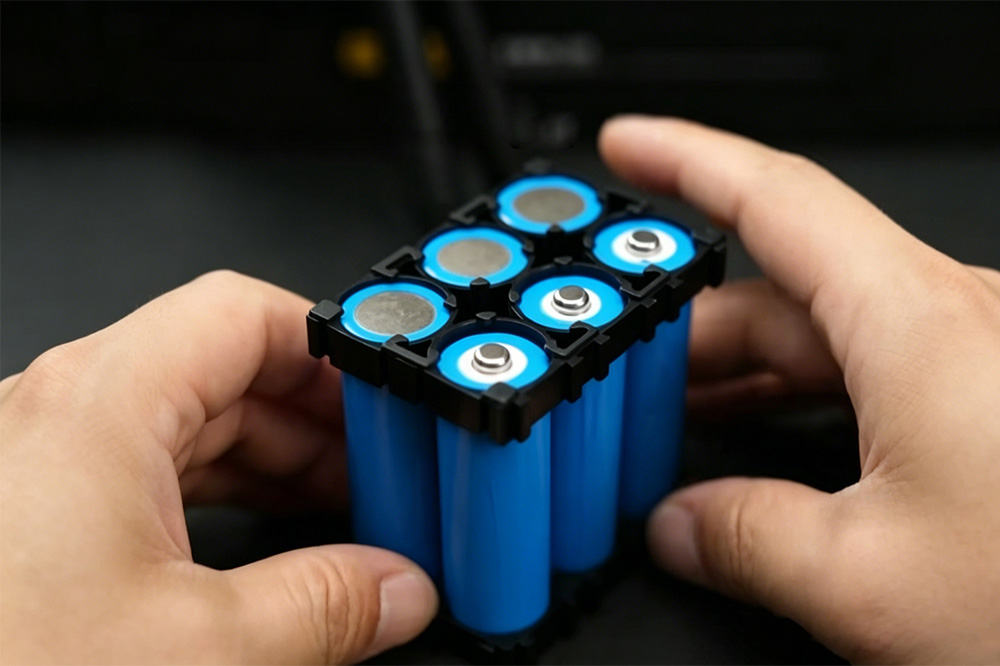
Spend enough time around battery-powered equipment and you’ll start noticing a pattern. Whether it’s a portable monitoring device, an emergency lighting system, a mobile router, or even certain industrial tools, many of them rely on a 12V lithium battery pack built from 18650 cells.
What’s interesting is that the 18650 isn’t exactly new technology anymore. Newer cell formats get plenty of attention, yet manufacturers continue to use 18650-based packs in thousands of products. There are good reasons for that, and most of them come down to flexibility, availability, and cost.
For buyers sourcing battery packs, the bigger question is usually not “What is an 18650?” but rather “How do I choose the right 12V pack for my application?”
The answer isn’t always straightforward.
Most People Think “12V” Means 12 Volts Exactly
It doesn’t.
This is probably one of the most common misunderstandings when people first start looking into lithium battery packs.
A single 18650 lithium-ion cell typically has a nominal voltage of 3.6V or 3.7V. Fully charged, that same cell reaches 4.2V.
To create a battery that behaves like a 12V power source, manufacturers usually connect three cells in series. This arrangement is known as a 3S configuration.
The result is:
- Nominal voltage: 11.1V
- Fully charged voltage: 12.6V
That may seem odd at first. If it’s 11.1V, why call it 12V battery?
In practice, most devices designed for 12V systems can operate across a voltage range rather than at one fixed number. That’s why 3S lithium packs have become the standard solution in so many portable products.
The Voltage Debate: 3S or 4S?
If you’ve ever browsed battery forums, you’ve probably seen people arguing about this.
Some users suggest using four cells in series because the nominal voltage comes closer to certain lead-acid battery operating ranges. Others strongly recommend sticking with three cells.
The truth is that both approaches can work, depending on the equipment.
A 4S lithium pack operates at roughly 14.8V nominal and can reach 16.8V when fully charged. For some electronics, that’s completely acceptable. For others, it’s enough to create problems.
We’ve seen projects where engineers initially chose a 4S design to gain additional runtime, only to discover later that voltage regulators inside the device were running hotter than expected.
That’s why battery pack selection often starts with the device, not the battery.
Capacity Is Usually What Buyers Care About
Voltage gets most of the attention, but capacity is where things become interesting.
Imagine you’re designing a portable inspection device used by field technicians. The equipment only draws a small amount of power, but it needs to operate for an entire workday without recharging.

Three cells connected in series will provide the voltage.
To increase runtime, additional cells are connected in parallel.
For example:
| Configuration | Cells | Typical Capacity |
|---|---|---|
| 3S1P | 3 | Single-cell capacity |
| 3S2P | 6 | Double capacity |
| 3S3P | 9 | Triple capacity |
| 3S4P | 12 | Four times capacity |
This is why two battery packs can both be labeled “12V” while having completely different runtimes.
A compact security camera may only need a small 3S1P pack. An industrial monitoring system running continuously could require something much larger.
One Part People Tend to Ignore
Ask someone building their first battery pack what matters most, and they’ll usually mention cell capacity.
Ask an engineer who has repaired failed battery packs, and the answer is often different.
The BMS.
Short for Battery Management System, the BMS is responsible for monitoring voltage, current, charging conditions, and cell protection.
In many cases, cells don’t fail because they were poor quality. Problems often begin when cells become unbalanced, overcharged, excessively discharged, or subjected to currents beyond their intended limits.
A well-designed BMS helps prevent those situations before they become expensive failures.
For OEM projects, the protection system is often discussed just as much as the cells themselves.
Building 12V Pack Is Easier on Paper Than in Reality
On paper, the process seems simple.
Connect cells.
Add nickel strips.
Install a BMS.
Attach output leads.
Done.
Real-world manufacturing tends to be more complicated.
Cell matching matters.
Internal resistance differences matter.
Heat management matters.
Even connector selection can create unexpected issues later.
One detail that’s often overlooked is assembly technique. Commercial battery packs generally rely on spot welding rather than soldering directly to cells. Excessive heat exposure during assembly can affect long-term cell performance, which is why professional manufacturers rarely solder directly onto battery terminals.
Where 12V 18650 Battery Packs Show Up
The list is longer than most people expect.
You’ll find them in:
- Security and surveillance systems
- Portable medical devices
- Wireless communication equipment
- Robotics projects
- Emergency lighting
- Marine electronics
- GPS tracking devices
- Inspection instruments
- Smart monitoring systems
- Backup power equipment
In fact, many users interact with 12V lithium battery packs every day without realizing what’s inside the enclosure.
The battery disappears into the product, which is exactly what good battery design is supposed to do.

When Standard Battery Packs Stop Being Enough
This is usually where OEM conversations begin.
A standard battery pack might meet voltage requirements, but then other questions start appearing:
Will it fit inside the enclosure?
Can it survive outdoor temperatures?
Does the connector match the existing design?
What certifications are required?
Can it communicate with the device controller?
Can charging be optimized for the application?
At that point, customization often makes more sense than trying to force a standard battery into a specialized product.
We’ve seen customers initially search for an off-the-shelf solution only to realize later that a custom battery pack reduces installation complexity and improves reliability.
A Practical Example
One of the most common configurations requested for portable electronics is a 3S2P design.
Using six 18650 cells, this setup provides 12V-class output while maintaining a relatively compact size.
If you’re evaluating battery options for a project, this example offers a useful reference point:
12V 4400mAh Lithium-Ion 3S2P 18650 Battery Pack
Even if the exact specifications aren’t what you need, it gives a good idea of how manufacturers balance voltage, capacity, dimensions, and portability in real-world designs.
Questions Buyers Often Ask
How many 18650 cells are needed for a 12V battery pack?
A basic 12V lithium pack typically uses three cells connected in series. Additional cells can be added in parallel to increase capacity and runtime.
Can a 12V lithium battery replace a lead-acid battery?
Often yes, but not always. Device voltage tolerance, charging systems, and load characteristics should be checked before replacement.
How long does a 12V 18650 battery pack last?
There’s no single answer. Runtime depends on battery capacity, operating temperature, and how much power the connected equipment consumes.
Is a BMS really necessary?
For almost every lithium battery pack, yes. The protection system is one of the key factors affecting both safety and battery lifespan.
What configuration is most common?
For portable electronics and industrial devices, 3S configurations remain the most widely used because they provide a practical balance between voltage, size, and compatibility.
-

12V 4400 mah Lithium ion 3S2P 18650 Battery Pack
-

18650 2000mAh 3.7 volt Lithium-ion Battery
-

18650 20V 3.0Ah Cordless Drill battery
-

18650 22.2V 7.8Ah 2600Mah 6S3P Rechargeable Battery Pack
-

18650 2600mAh Rechargeable Lithium-Ion Battery 3.7V
-

18650 3.7V 10Ah Li-Ion Power Battery Pack
-

18650 3.7V 3300mah Rechargeable Lithium ion Battery
-

18650 7S7P 24V 14Ah Lithium ion Electric Scooter Battery Pack
-

18650 battery 3.7V 1500mAh Lithium-Ion Battery
-

18650 Battery 3500 mah Rechargeable Battery Cells
-

18650 Electric Scooter 48V 13000mAh Lithium Battery
-

2600mAh 3S1P 11.1V 18650 Battery Packs
-

3.7V Li ion Rechargeable 3000mah 18650 Battery Cell
-

36V 5200mAh 10S2P 18650 Battery Pack
-

48v 4400mah 13S2P 18650 Rechargeable Battery Pack
-

7S2P 24V 18650 Lithium Battery Pack
-

Electric Scooter 36V 4400mAH 10S2P 18650 Battery Pack
-

ICR 18650 Battery 2200mah 3.7V
Leave a Reply