
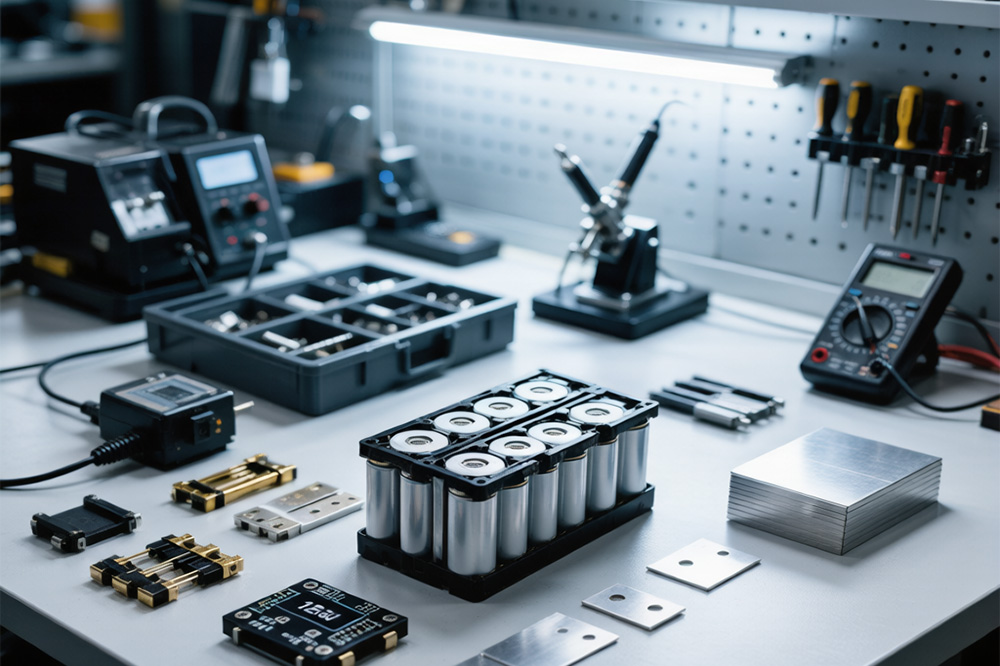
Ask someone what they need to build 18650 battery pack and they’ll usually answer with one word:
“Batteries.”
Technically, they’re right.
But after spending a little time around battery builders, DIY enthusiasts, or battery pack manufacturers, you quickly realize the cells themselves are only part of the project.
In fact, many first-time builders discover that the easiest thing to buy is the battery. The real challenge is gathering all the small parts and tools that make a safe, reliable pack possible.
That’s usually when the shopping list starts getting longer than expected.

The Cells Are Just the Beginning
Most people start by selecting the 18650 cells they want to use.
Capacity gets most of the attention.
Sometimes discharge ratings become the deciding factor.
Either way, builders often spend hours comparing cells while giving very little thought to everything else required to connect them together.
Unfortunately, a pile of batteries sitting on a workbench isn’t a battery pack.
A functioning pack needs electrical connections, insulation, protection circuitry, and a method of keeping the cells securely positioned during use.
That’s where the rest of the supplies come in.
Nickel Strip Is One of the Most Important Materials
If you’ve ever opened a commercial battery pack, you’ve probably seen thin metal strips connecting the cells.
Those strips are usually nickel or nickel-plated materials used to create electrical connections between cells.
For most builders, nickel strip becomes one of the first supplies purchased after the batteries themselves.
The thickness and width can vary depending on current requirements, but the purpose remains the same: creating reliable connections while keeping resistance as low as possible.
Experienced builders tend to pay close attention to strip quality because poor connections can cause voltage drop, heat buildup, and performance issues later.

Cell Holders Make Assembly Easier
Some battery packs are assembled without holders.
Many are not.
Plastic cell holders help maintain spacing between cells and create a cleaner overall structure.
They also simplify assembly, especially for larger battery packs containing dozens of cells.
Beyond organization, proper spacing can improve airflow and reduce the chances of accidental contact between cell casings.
For beginners, holders often make the entire project far easier to manage.
Spot Welders Usually Replace Soldering Irons
One of the most common discussions in battery-building communities revolves around soldering versus spot welding.
Technically, both methods can connect cells.
In practice, spot welding is generally preferred.
The reason is simple.
Excessive heat can damage lithium-ion cells.
Spot welders create fast, localized connections without exposing the cell to prolonged heating.
That’s why commercial battery manufacturers rely almost exclusively on spot welding equipment for pack assembly.
For anyone planning to build battery packs regularly, a spot welder often becomes one of the most valuable tools in the workshop.

Battery Management Systems Are Not Optional
Many first-time builders focus on physical assembly and leave protection circuitry until later.
That approach rarely ends well.
A Battery Management System, commonly called a BMS, serves as the pack’s protection layer.
Depending on the design, it can help manage:
- Overcharging
- Over-discharging
- Overcurrent conditions
- Short circuits
- Cell balancing
Without a suitable BMS, even a well-built battery pack can experience serious reliability and safety problems.
For most modern lithium-ion packs, protection electronics are considered a basic requirement rather than an optional upgrade.

Don’t Overlook Insulation Materials
Insulation isn’t the most exciting part of battery building.
It also happens to be one of the easiest things to underestimate.
Fish paper rings, insulating sheets, heat-resistant barriers, and heat shrink materials all serve important purposes during assembly.
A battery pack may spend years experiencing vibration, movement, charging cycles, and temperature changes.
Good insulation helps prevent accidental shorts and protects critical areas inside the pack.
Many experienced builders will tell you that insulation materials are among the cheapest supplies you’ll buy and among the most important.
The Small Parts That Keep Everything Together
When people calculate project costs, they often forget about the small accessories.
Connectors.
Wiring.
Fuse holders.
Switches.
Balance leads.
Heat shrink tubing.
Mounting hardware.
None of these components seem expensive individually, but together they form an important part of the finished battery system.
A battery pack is only as reliable as its weakest connection.
Sometimes that weak point isn’t the cell. It’s a poorly chosen connector or undersized wire.

Why Professional Builders Spend More Time Planning Than Assembling
Videos often make battery pack construction look fast.
Arrange the cells.
Weld the strips.
Install the BMS.
Wrap the pack.
Finished.
The reality is usually different.
Professional builders often spend more time planning the layout than physically assembling the pack.
Cell configuration, current paths, thermal management, serviceability, protection strategy, and mechanical support all require consideration before the first weld is made.
The assembly process itself may take a few hours.
The design decisions behind it can take days.
A Better Way to Think About Battery Building Supplies
Many newcomers view battery building supplies as a shopping list.
Experienced builders tend to see them as a system.
The cells store energy.
Nickel strips carry current.
The BMS protects the pack.
Insulation prevents failures.
Connectors deliver power.
Every component has a job.
When all of those parts work together properly, the result is a battery pack that performs reliably for years rather than months.
And that’s usually the difference between a successful battery project and one that ends up back on the workbench.
-

12V 4400 mah Lithium ion 3S2P 18650 Battery Pack
-

18650 2000mAh 3.7 volt Lithium-ion Battery
-

18650 20V 3.0Ah Cordless Drill battery
-

18650 22.2V 7.8Ah 2600Mah 6S3P Rechargeable Battery Pack
-

18650 2600mAh Rechargeable Lithium-Ion Battery 3.7V
-

18650 3.7V 10Ah Li-Ion Power Battery Pack
-

18650 3.7V 3300mah Rechargeable Lithium ion Battery
-

18650 7S7P 24V 14Ah Lithium ion Electric Scooter Battery Pack
-

18650 battery 3.7V 1500mAh Lithium-Ion Battery
-

18650 Battery 3500 mah Rechargeable Battery Cells
-

18650 Electric Scooter 48V 13000mAh Lithium Battery
-

2600mAh 3S1P 11.1V 18650 Battery Packs
-

3.7V Li ion Rechargeable 3000mah 18650 Battery Cell
-

36V 5200mAh 10S2P 18650 Battery Pack
-

48v 4400mah 13S2P 18650 Rechargeable Battery Pack
-

7S2P 24V 18650 Lithium Battery Pack
-

Electric Scooter 36V 4400mAH 10S2P 18650 Battery Pack
-

ICR 18650 Battery 2200mah 3.7V
Leave a Reply