
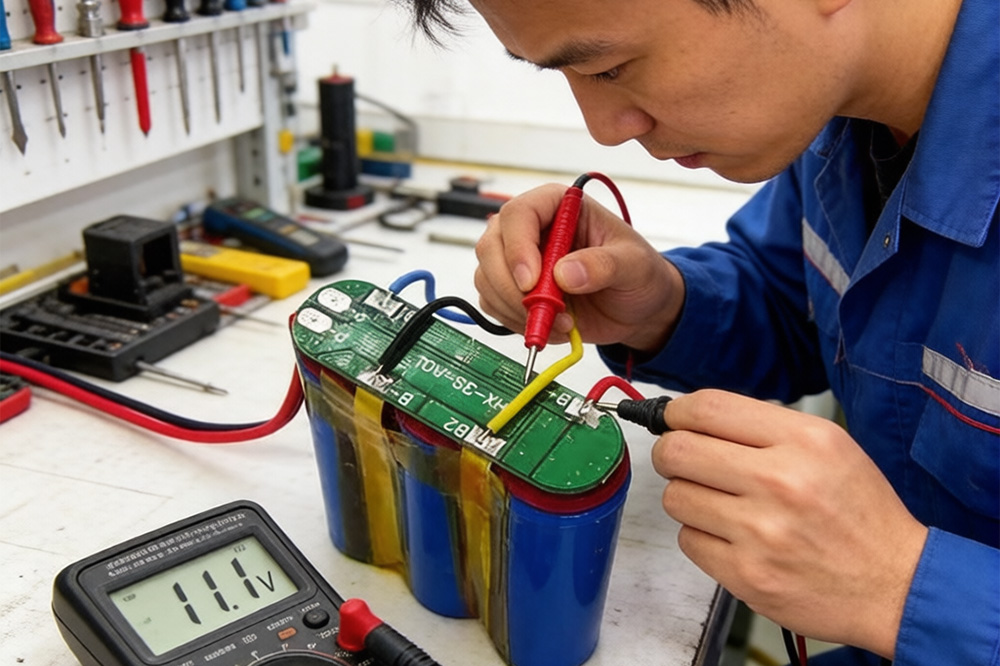
A lot of buyers start with a simple request.
“We need 11.1V battery pack.”
At first glance, that sounds straightforward.
Three lithium-ion cells connected in series produce a nominal voltage of 11.1V. Problem solved.
Except it usually isn’t.
Once discussions begin, suppliers start asking questions that many first-time buyers weren’t expecting.
How much capacity do you need?
How much space is available?
What’s the peak current draw?
Will the battery operate indoors or outdoors?
Does it require a specific connector?
Suddenly, a simple battery becomes a much bigger engineering discussion.
And that’s because two battery packs can both be labeled “11.1V” while being completely different products.

Why 11.1V Is Such a Common Battery Configuration
If you’ve worked around portable electronics, robotics, medical equipment, monitoring systems, or industrial devices, you’ve probably encountered 11.1V battery packs before.
The reason is practical.
Three lithium-ion cells connected in series create a voltage range that works well for many electronic systems. Fully charged, the pack reaches approximately 12.6V. During normal operation, the nominal voltage remains around 11.1V.
That voltage level has become a comfortable middle ground for countless applications.
It’s high enough to power demanding equipment while remaining relatively compact and lightweight.
The Same Voltage Doesn’t Mean the Same Battery
One of the biggest misconceptions among new buyers is assuming voltage tells the whole story.
It doesn’t.
A small 3S battery pack designed for a handheld device may contain only three cells.
A larger battery built for extended runtime could contain six, nine, or even twelve cells while still maintaining the same 11.1V output.
The voltage remains unchanged because the series arrangement stays the same.
What changes is capacity.
That’s why experienced suppliers usually ask about runtime requirements before discussing battery specifications.
Knowing the voltage is only the starting point.

Why Capacity Requirements Drive Most Custom Designs
Many projects begin with a target operating time.
Perhaps a medical device needs to run for eight hours.
Maybe a monitoring system must operate continuously throughout a work shift.
In other cases, a robotic platform may require maximum runtime between charging cycles.
These goals often determine the final battery design.
If runtime expectations increase, more cells are added in parallel. The battery becomes larger, heavier, and more expensive, but it can store more energy.
This balancing act appears in almost every battery development project.
The challenge isn’t simply producing 11.1V.
The challenge is producing enough energy within the available space.
What Good Suppliers Ask Before Providing a Quote
Some suppliers will provide pricing based on voltage and capacity alone.
The better ones usually ask far more questions.
For example:
- What equipment will use the battery?
- What is the continuous current requirement?
- What is the peak current demand?
- What are the maximum dimensions?
- Which connector is required?
- Is a specific charging method planned?
- What operating temperatures are expected?
These questions aren’t sales tactics.
They’re often the difference between a battery that performs properly and one that creates problems after deployment.
Connectors and Protection Circuits Matter More Than Most Buyers Expect
Many purchasing teams focus entirely on cells.
Engineers tend to focus on everything surrounding the cells.
The Battery Management System, wiring, connectors, fuse protection, and mechanical packaging all influence overall reliability.
In fact, field failures are often traced to supporting components rather than the cells themselves.
A poorly selected connector can cause intermittent power loss.
An undersized wire can create unwanted heat.
An inadequate protection circuit can shorten battery life.
That’s why experienced battery manufacturers view the battery pack as a complete system rather than a collection of cells.
Industries Using 11.1V 18650 Battery Packs
One reason 11.1V battery packs remain so popular is their versatility.
They can be found in:
- Medical devices
- Robotics systems
- Inspection equipment
- Portable monitoring devices
- Industrial instruments
- Security products
- Communication equipment
- Testing and measurement devices
Although these industries share similar voltage requirements, their battery specifications can be dramatically different.
That’s why customization has become increasingly common.

Why Battery Pack Customization Continues to Grow
Ten years ago, many products relied on standard battery packs.
Today, manufacturers are developing equipment that is smaller, lighter, and more specialized.
As a result, battery requirements have become more application-specific.
Some customers need unusual dimensions.
Others need higher discharge rates.
Some prioritize runtime.
Others prioritize weight reduction.
Very few projects fit perfectly into an off-the-shelf solution.
For many manufacturers, custom battery development is now part of the product design process rather than an afterthought.
Choosing an 11.1V Battery Supplier
Price always matters.
But experienced buyers rarely stop there.
They also look at engineering support, quality control procedures, testing capabilities, documentation, and long-term supply stability.
A supplier that understands the application can often identify potential issues before production begins.
That expertise can save far more money than choosing the lowest quotation.
When sourcing 11.1V 18650 battery packs, the goal isn’t simply finding someone who can assemble cells.
It’s finding a supplier capable of delivering a battery that performs consistently throughout the life of the product.
-

12V 4400 mah Lithium ion 3S2P 18650 Battery Pack
-

18650 2000mAh 3.7 volt Lithium-ion Battery
-

18650 20V 3.0Ah Cordless Drill battery
-

18650 22.2V 7.8Ah 2600Mah 6S3P Rechargeable Battery Pack
-

18650 2600mAh Rechargeable Lithium-Ion Battery 3.7V
-

18650 3.7V 10Ah Li-Ion Power Battery Pack
-

18650 3.7V 3300mah Rechargeable Lithium ion Battery
-

18650 7S7P 24V 14Ah Lithium ion Electric Scooter Battery Pack
-

18650 battery 3.7V 1500mAh Lithium-Ion Battery
-

18650 Battery 3500 mah Rechargeable Battery Cells
-

18650 Electric Scooter 48V 13000mAh Lithium Battery
-

2600mAh 3S1P 11.1V 18650 Battery Packs
-

3.7V Li ion Rechargeable 3000mah 18650 Battery Cell
-

36V 5200mAh 10S2P 18650 Battery Pack
-

48v 4400mah 13S2P 18650 Rechargeable Battery Pack
-

7S2P 24V 18650 Lithium Battery Pack
-

Electric Scooter 36V 4400mAH 10S2P 18650 Battery Pack
-

ICR 18650 Battery 2200mah 3.7V
Leave a Reply