
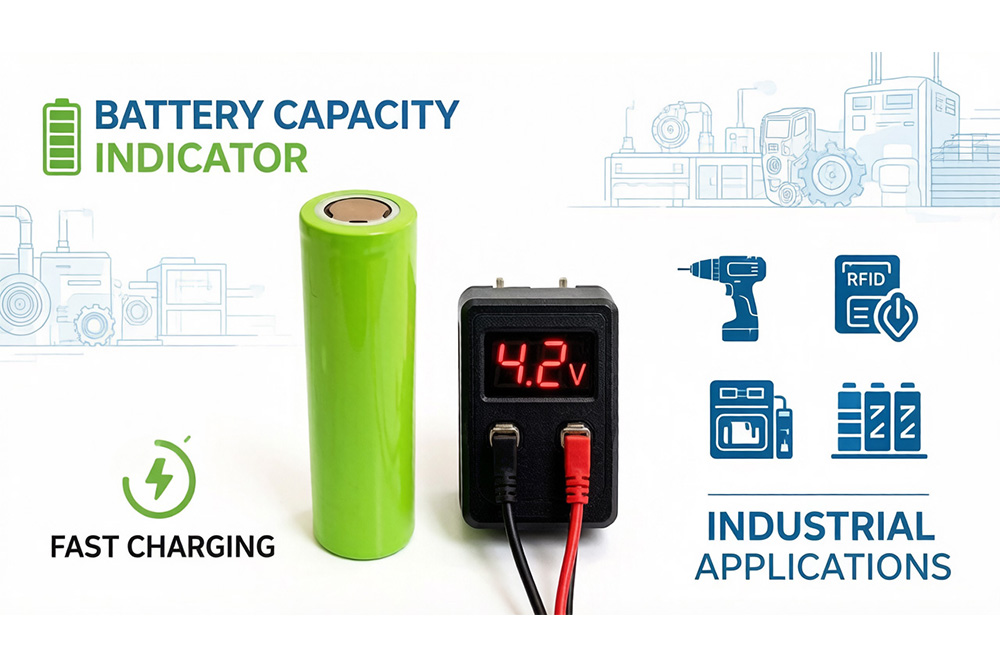
The 18650 Li-ion rechargeable battery is everywhere.
You’ll find it inside RFID equipment, portable medical devices, handheld scanners, emergency lighting systems, power banks, and even some energy storage solutions. Despite its popularity, there’s still a surprising amount of confusion around how these batteries actually work and what separates a good cell from a disappointing one.
Part of the problem is that many batteries look almost identical from the outside.
Same cylindrical shape.
Same dimensions.
Sometimes even similar specifications.
Yet once they’re installed in a real product, the differences can become obvious very quickly.
A battery that performs well in a flashlight may not be the best choice for an industrial RFID reader. Likewise, a cell designed for maximum capacity may not be ideal for applications that require high discharge currents.
That’s why experienced buyers rarely judge a battery by one specification alone.
The Number “18650” Doesn’t Tell You as Much as You Think
Many first-time buyers assume the number 18650 refers to battery performance.
It doesn’t.
The designation simply describes the physical size of the cell:
- Approximately 18mm in diameter
- Approximately 65mm in length
That’s all it means.
Two batteries can both be 18650 cells and still have very different capacities, cycle lives, discharge rates, and safety characteristics.
This becomes especially important when products move from prototype stage into volume production. A battery that works perfectly in one test sample may not perform the same if consistency between manufacturing batches is poor.
Understanding Voltage Before You Choose a Battery
Voltage is one of the most misunderstood aspects of lithium-ion batteries.
Many people see “3.7V” printed on a battery and assume that’s the voltage used during charging.
Not quite.

A typical 18650 lithium-ion cell usually operates within the following range:
| Battery Condition | Typical Voltage |
|---|---|
| Fully Charged | 4.2V |
| Nominal Voltage | 3.6V–3.7V |
| Nearly Empty | Around 3.0V |
| Over-Discharge Zone | Below 2.5V |
Think of the nominal voltage as an average working voltage rather than a fixed number.
When the battery comes off the charger, it’s usually close to 4.2V. As energy is consumed, voltage gradually declines until the protection circuit or battery management system cuts power to prevent excessive discharge.
In practice, voltage behavior matters more than many buyers realize because it directly affects device performance, runtime calculations, and battery pack design.
Bigger Capacity Numbers Don’t Always Mean Better Performance
One thing I’ve noticed over the years is that capacity tends to dominate battery discussions.
It’s easy to understand why.
A 3500mAh battery sounds better than a 2600mAh battery.
Sometimes it is.
Sometimes it isn’t.
Imagine a warehouse worker using an RFID scanner throughout an entire shift. The scanner may demand short bursts of relatively high current. In that situation, a battery’s discharge capability can be just as important as its capacity.
A higher-capacity cell that struggles under load may actually deliver a poorer user experience than a lower-capacity cell designed for higher current applications.
This is why engineers often evaluate several specifications together:
- Capacity (mAh)
- Continuous discharge current
- Internal resistance
- Cycle life
- Temperature performance
Looking at only one number rarely tells the whole story.
The Problem With Cheap 18650 Batteries
Anyone who has spent time browsing online marketplaces has probably seen batteries claiming extremely high capacities.
6000mAh.
8000mAh.
Even higher.
Those numbers can be tempting.
The reality is that current lithium-ion technology has practical limits. Extremely high capacity claims in standard 18650 formats should always be evaluated carefully.
Many industrial buyers learn this lesson after testing samples.
The battery works.
Technically.
But runtime falls short of expectations, voltage drops under load, or capacity degrades much sooner than anticipated.
A low purchase price can sometimes become expensive when product reliability is affected.
Charging Sounds Simple Until Multiple Cells Are Involved

For a single cell, charging is relatively straightforward.
Modern lithium-ion chargers typically use a two-stage charging process:
First, constant current charging increases the battery voltage.
Once the cell approaches 4.2V, the charger switches to constant voltage mode while current gradually decreases.
Sounds simple enough.
However, things become more complicated when several cells are connected together in a battery pack.
Three cells.
Four cells.
Ten cells.
Now balancing becomes critical.
Battery management systems become important.
Protection circuits become essential rather than optional.
A surprising number of battery failures aren’t caused by the cells themselves. They often originate from poor charging system design.
Heat Is the Factor Many People Ignore
If there is one topic that battery engineers consistently pay attention to, it’s temperature.
Heat.
Not flashy specifications.
Not marketing claims.
Heat.
Lithium-ion batteries generally dislike excessive temperatures. Elevated heat accelerates chemical aging and can reduce long-term capacity retention.
Consider two identical batteries.
One operates indoors inside a climate-controlled environment.
The other spends its life inside outdoor equipment exposed to summer temperatures.
After a year or two, the difference in performance can be significant.
That’s one reason temperature requirements are often discussed early during industrial battery selection.
So How Long Does an 18650 Battery Last?
There isn’t a universal answer.
And honestly, that’s probably not the answer most people want to hear.
Battery lifespan depends on several variables:
- Charge and discharge habits
- Operating temperature
- Storage conditions
- Charge current
- Depth of discharge
- Cell quality
Under favorable conditions, many quality 18650 cells can remain useful for hundreds or even thousands of charge cycles.
Under harsh conditions, degradation happens much faster.
In other words, lifespan is influenced just as much by usage patterns as by the battery itself.
Why OEM Buyers Focus on Consistency
Consumers usually buy one battery.
Manufacturers buy thousands.
The priorities are completely different.
A consumer might never notice small variations between cells.
A manufacturer definitely will.
During large-scale production, consistency often becomes more important than chasing the highest advertised capacity.
Procurement teams frequently evaluate factors such as:
- Capacity consistency
- Internal resistance variation
- Voltage stability
- Cycle life performance
- Manufacturing traceability
These details may not attract attention in marketing materials, but they often determine whether a battery performs reliably across an entire product line.
Where 18650 Batteries Continue to Be Used
Battery technology keeps evolving, yet the 18650 format remains widely used.
Part of the reason is familiarity.
Engineers understand its strengths and limitations.
Replacement options are widely available.
Performance characteristics are well documented.
Today, 18650 rechargeable batteries continue to power:
- RFID devices
- Portable medical equipment
- Security products
- Flashlights
- Industrial handheld terminals
- IoT devices
- Robotics systems
- Power banks
- Portable energy storage systems
For many applications, they still provide a practical balance between energy density, cost, reliability, and availability.

Before Requesting a Battery Quote
Before comparing suppliers, it’s worth taking a step back and looking at the application itself.
Questions such as these often help narrow down suitable options:
- How much runtime is required?
- What is the peak current demand?
- Will the battery operate outdoors?
- Is weight a critical factor?
- Does the project require certifications?
- Will the cells be assembled into battery packs?
The answers frequently eliminate unsuitable products long before pricing discussions begin.
In many cases, selecting the right battery isn’t about finding the highest number on a specification sheet. It’s about matching the battery to the actual operating environment.
For distributors, OEM manufacturers, and battery pack integrators looking for wholesale supply options, reviewing multiple configurations early in the project can simplify the design process and reduce future revisions.
You can explore available models and specifications here:18650 lithium battery
A little extra research at the beginning often saves a lot of trouble later.
FAQ
Are all 18650 batteries rechargeable?
No. Most modern 18650 cells are rechargeable lithium-ion batteries, but users should always verify the specifications before attempting to recharge a battery.
What is the normal voltage of 18650 battery?
A typical 18650 battery has a nominal voltage of 3.6V–3.7V and reaches approximately 4.2V when fully charged.
How many times can an 18650 battery be recharged?
Quality 18650 batteries can often provide several hundred to more than one thousand charge cycles, depending on operating conditions and charging practices.
Can I use any charger for 18650 battery?
No. Lithium-ion batteries require chargers designed specifically for lithium-ion chemistry and appropriate charging voltage limits.
What should I look for when buying 18650 batteries in bulk?
Key considerations include capacity consistency, discharge capability, cycle life, certifications, batch traceability, and supplier reliability rather than simply choosing the highest advertised mAh rating.
-

12V 4400 mah Lithium ion 3S2P 18650 Battery Pack
-

18650 2000mAh 3.7 volt Lithium-ion Battery
-

18650 20V 3.0Ah Cordless Drill battery
-

18650 22.2V 7.8Ah 2600Mah 6S3P Rechargeable Battery Pack
-

18650 2600mAh Rechargeable Lithium-Ion Battery 3.7V
-

18650 3.7V 10Ah Li-Ion Power Battery Pack
-

18650 3.7V 3300mah Rechargeable Lithium ion Battery
-

18650 7S7P 24V 14Ah Lithium ion Electric Scooter Battery Pack
-

18650 battery 3.7V 1500mAh Lithium-Ion Battery
-

18650 Battery 3500 mah Rechargeable Battery Cells
-

18650 Electric Scooter 48V 13000mAh Lithium Battery
-

2600mAh 3S1P 11.1V 18650 Battery Packs
-

3.7V Li ion Rechargeable 3000mah 18650 Battery Cell
-

36V 5200mAh 10S2P 18650 Battery Pack
-

48v 4400mah 13S2P 18650 Rechargeable Battery Pack
-

7S2P 24V 18650 Lithium Battery Pack
-

Electric Scooter 36V 4400mAH 10S2P 18650 Battery Pack
-

ICR 18650 Battery 2200mah 3.7V

Leave a Reply