
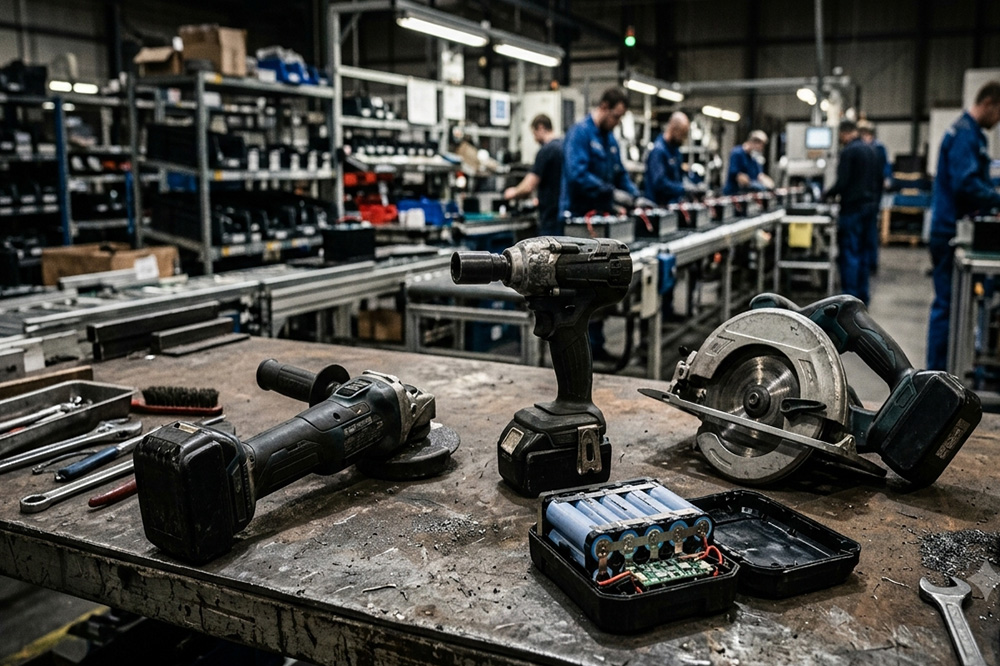
Walk onto almost any construction site and you’ll quickly notice one thing: heavy-duty cordless tools ask much more from a battery than most people expect.
An angle grinder cutting steel, an impact wrench removing rusted bolts, or a circular saw slicing through thick timber can all pull high current in a matter of seconds. Under these conditions, battery performance is no longer measured only by capacity. Stable power delivery, heat management and long-term reliability become far more important.
That’s one reason 18650 lithium-ion cells remain a popular choice for cordless power tool battery packs. Even as newer cell formats appear, many OEM manufacturers continue to build products around the mature and proven 18650 platform.
Heavy-duty tools create different battery demands
Not every cordless tool uses energy the same way.
A cordless screwdriver typically works in short bursts, while an angle grinder may stay under heavy load for several minutes. Impact wrenches create repeated spikes in current every time the hammer mechanism engages. Portable circular saws combine continuous cutting with sudden acceleration.
These different working patterns explain why battery engineers rarely evaluate a cell using capacity alone. They also consider discharge capability, voltage stability and operating temperature.
From a user’s perspective, these details aren’t visible. What they notice is whether the tool maintains its power from the first cut to the last.

Battery packs matter more than individual cells
One misconception is that choosing a good 18650 cell automatically guarantees a good battery pack.
In practice, the pack design plays an equally important role.
A reliable battery pack depends on:
- Proper cell matching
- Stable Battery Management System (BMS)
- High-quality spot welding
- Efficient thermal design
- Consistent quality inspection
I’ve visited factories where every incoming cell is tested before assembly. It may seem like extra work, but that consistency helps reduce warranty claims and improves long-term performance, especially for wholesale customers managing large projects.
Why OEM manufacturers still choose 18650
For factories producing thousands of battery packs each month, manufacturing stability is just as valuable as technical performance.
The 18650 platform offers several practical advantages:
- Mature global supply chain
- Flexible battery pack configurations
- Proven production processes
- Broad compatibility across cordless tool platforms
- Reliable sourcing for large-volume orders
These factors help manufacturers control production costs while giving distributors confidence in long-term supply.

Real applications tell the real story
Imagine a maintenance technician working inside a manufacturing plant.
In the morning, they use a cordless drill to install equipment. Later, an impact wrench removes heavy bolts from a conveyor system. Before the shift ends, a grinder cuts replacement steel brackets.
Each task places different demands on the battery, yet users expect the same thing every time—consistent power without unexpected interruptions.
That expectation is exactly why battery pack design has become just as important as the cells inside it.
What wholesale buyers should look for
When sourcing battery packs for industrial power tools, experienced buyers usually look beyond basic specifications.
Useful questions include:
- Does the factory perform cell grading?
- Are battery packs tested before shipment?
- Can the supplier provide OEM or ODM customization?
- Is long-term production capacity stable?
- Are certifications and technical documentation available?
The answers often reveal more about product quality than a simple capacity rating.

Final thoughts
Heavy-duty cordless tools push batteries harder than many other portable devices. A dependable 18650 battery pack isn’t defined by the biggest capacity figure on the label but by its ability to deliver stable power, manage heat and maintain consistent performance over hundreds of charging cycles.
For OEM manufacturers, distributors and wholesale buyers, choosing a reliable production partner is just as important as choosing the right battery specification. A well-designed battery pack helps reduce maintenance costs, improve customer satisfaction and support long-term business growth.
-

12V 4400 mah Lithium ion 3S2P 18650 Battery Pack
-

18650 2000mAh 3.7 volt Lithium-ion Battery
-

18650 20V 3.0Ah Cordless Drill battery
-

18650 22.2V 7.8Ah 2600Mah 6S3P Rechargeable Battery Pack
-

18650 2600mAh Rechargeable Lithium-Ion Battery 3.7V
-

18650 3.7V 10Ah Li-Ion Power Battery Pack
-

18650 3.7V 3300mah Rechargeable Lithium ion Battery
-

18650 7S7P 24V 14Ah Lithium ion Electric Scooter Battery Pack
-

18650 battery 3.7V 1500mAh Lithium-Ion Battery
-

18650 Battery 3500 mah Rechargeable Battery Cells
-

18650 Electric Scooter 48V 13000mAh Lithium Battery
-

2600mAh 3S1P 11.1V 18650 Battery Packs
-

3.7V Li ion Rechargeable 3000mah 18650 Battery Cell
-

36V 5200mAh 10S2P 18650 Battery Pack
-

48v 4400mah 13S2P 18650 Rechargeable Battery Pack
-

7S2P 24V 18650 Lithium Battery Pack
-

Electric Scooter 36V 4400mAH 10S2P 18650 Battery Pack
-

ICR 18650 Battery 2200mah 3.7V
Leave a Reply