
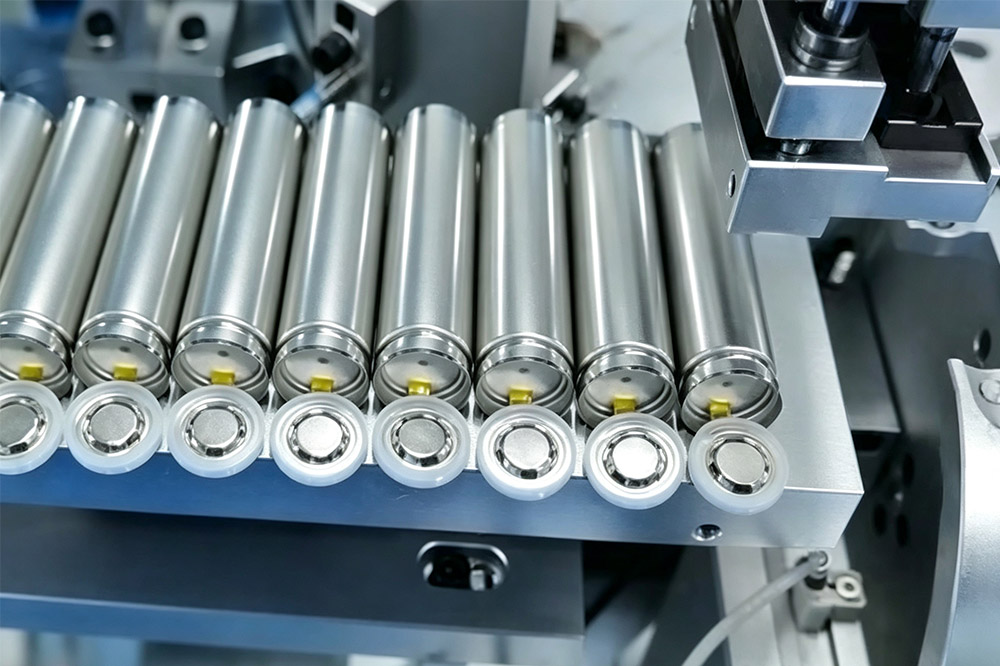
If you spend enough time around cordless tools in factories or maintenance workshops, you start noticing something interesting.
People rarely ask about the battery chemistry first.
They ask why some tools “stay strong” while others feel like they fade too quickly.
And almost always, the answer leads back to the quality of the 18650 cell inside the pack.
But “good” is not a single number. It depends on how the cell behaves under pressure, not just what is written on the label.
A good 18650 cell is not defined by capacity alone
One common misunderstanding is to judge a cell by mAh only.
3000mAh sounds better than 2000mAh on paper, but in power tools, that comparison is incomplete.
In real use, a cordless angle grinder or impact wrench doesn’t care much about theoretical capacity.
It cares about whether the voltage stays stable when load suddenly increases.
So engineers usually look at a combination of factors, not a single specification.

Discharge stability often matters more than size
In heavy-duty tools, current demand can rise quickly and unpredictably.
For example:
- An impact wrench creates sudden current spikes during hammering
- An angle grinder maintains continuous high load during cutting
- A circular saw combines both acceleration and sustained draw
A good 18650 cell must handle these changes without sharp voltage drops.
When a cell cannot keep up, users usually don’t describe it in technical terms.
They just say: “the tool feels weak under load.”
That feeling is often the first sign of poor discharge stability.
Internal resistance quietly defines real performance
This is something often overlooked outside engineering teams.
Two cells with the same capacity can behave very differently because of internal resistance.
Lower resistance usually means:
- Better current delivery
- Less heat generation
- More stable voltage under load
In OEM production, cell matching based on internal resistance is often more important than selecting the highest capacity grade.
Even a small mismatch can create imbalance in a multi-cell pack over time.

Heat is where good and bad cells separate
In real jobsite conditions, heat is unavoidable.
Cutting steel, drilling thick materials, or loosening rusted bolts all generate continuous load stress.
A good 18650 cell doesn’t just deliver power—it manages heat in a controlled way.
When thermal behavior is poor, you may see:
- Early voltage drop
- Reduced runtime after repeated cycles
- Faster aging of the pack
This is why OEM manufacturers spend a lot of time on thermal design, not just electrical performance.
Consistency across batches is often underestimated
One thing distributors learn over time is that performance variation matters more than peak performance.
A cell that performs well once is not enough.
What matters is whether thousands of cells behave the same way.
In production environments, engineers often check:
- Capacity deviation between cells
- Internal resistance matching
- Discharge curve consistency
Without this consistency, even a well-designed battery pack can feel unreliable in the field.

A real workshop observation
In a maintenance facility I visited, technicians used the same type of cordless drill across different shifts.
At first, everything seemed fine.
But over time, they noticed something subtle:
Some batteries finished the shift comfortably, while others dropped earlier even under similar usage.
The difference wasn’t the tool.
It was the internal variation between cells in different battery batches.
This kind of issue rarely shows up in datasheets.
It shows up in daily work patterns instead.
OEM manufacturers think in systems, not single cells
A good 18650 cell alone does not guarantee a good battery pack.
OEM engineers usually design around a system:
- Cell selection
- Pack structure (series/parallel balance)
- BMS configuration
- Welding resistance control
- Thermal spacing
Even small improvements in these areas can significantly change how the final battery behaves in real tools.
What wholesale buyers usually underestimate
From a procurement point of view, many buyers initially focus on:
- Capacity
- Price
- Delivery time
But experienced buyers tend to shift attention to:
- Discharge curve stability
- Batch-to-batch consistency
- Factory testing process
- Long-term supply reliability
Because in industrial tools, failures are not just technical issues—they become operational delays.
-

12V 4400 mah Lithium ion 3S2P 18650 Battery Pack
-

18650 2000mAh 3.7 volt Lithium-ion Battery
-

18650 20V 3.0Ah Cordless Drill battery
-

18650 22.2V 7.8Ah 2600Mah 6S3P Rechargeable Battery Pack
-

18650 2600mAh Rechargeable Lithium-Ion Battery 3.7V
-

18650 3.7V 10Ah Li-Ion Power Battery Pack
-

18650 3.7V 3300mah Rechargeable Lithium ion Battery
-

18650 7S7P 24V 14Ah Lithium ion Electric Scooter Battery Pack
-

18650 battery 3.7V 1500mAh Lithium-Ion Battery
-

18650 Battery 3500 mah Rechargeable Battery Cells
-

18650 Electric Scooter 48V 13000mAh Lithium Battery
-

2600mAh 3S1P 11.1V 18650 Battery Packs
-

3.7V Li ion Rechargeable 3000mah 18650 Battery Cell
-

36V 5200mAh 10S2P 18650 Battery Pack
-

48v 4400mah 13S2P 18650 Rechargeable Battery Pack
-

7S2P 24V 18650 Lithium Battery Pack
-

Electric Scooter 36V 4400mAH 10S2P 18650 Battery Pack
-

ICR 18650 Battery 2200mah 3.7V
Leave a Reply