
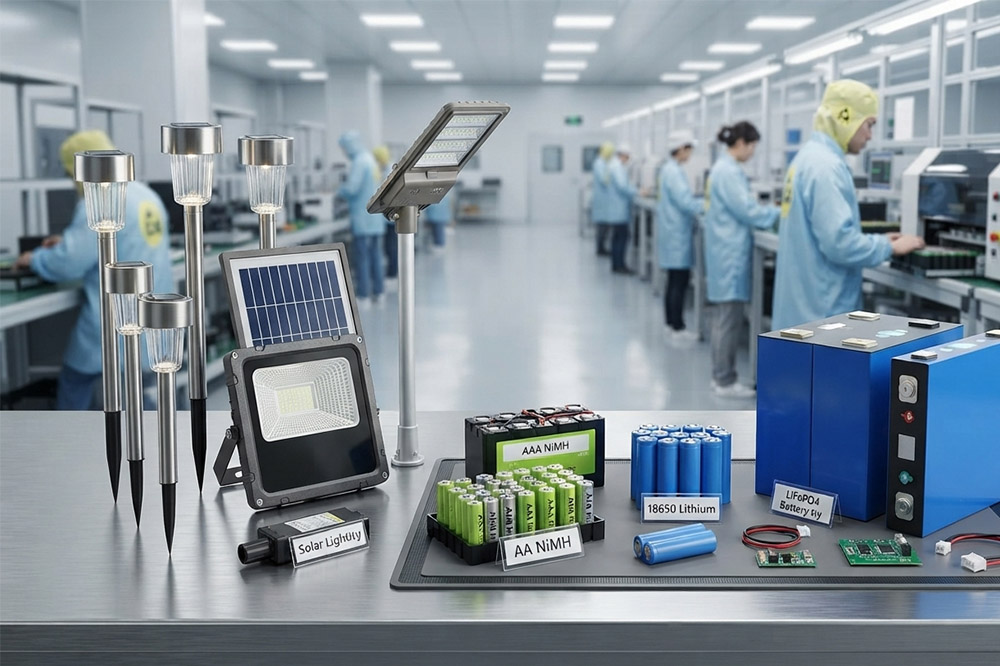
When people talk about solar lights, they usually focus on the solar panel or LED brightness. But after working with battery applications, one thing becomes clear: the rechargeable battery often decides whether a solar light becomes a reliable product or a product that creates customer complaints.
A solar light may look perfect when it leaves the factory. The real test starts after installation.
A customer installs it in a garden, parking lot, or outdoor pathway. After a few months, the light becomes weaker, the runtime gets shorter, or it stops working during cloudy days. In many cases, the problem is not the LED or solar panel. It is the battery selection.
For solar light manufacturers and bulk buyers, choosing the right rechargeable batteries for solar lights requires looking beyond price.
Battery Chemistry Matters: Not Every Rechargeable Battery Works the Same Way
Different solar lighting products have different power requirements. A small decorative garden lamp and a commercial solar street light may both use rechargeable batteries, but the battery requirements are completely different.
NiMH Battery for Solar Lights
NiMH batteries have been widely used in traditional solar garden lights.
They are still popular because:
- Low purchase cost
- Simple charging requirements
- Good safety performance
- Easy replacement
For small decorative lights, NiMH can still be a practical choice.
However, from a manufacturer’s perspective, there is a trade-off. NiMH batteries usually have lower energy density compared with lithium batteries. If the product needs longer lighting time or higher brightness, the battery size becomes a limitation.
Some buyers choose NiMH because the initial cost looks attractive, but later they find the replacement rate is higher.
Lithium Battery for Solar Lights: More Energy in Less Space
Lithium batteries have become more common in modern solar lighting products.
For example, 18650 lithium batteries are widely used in:
- Solar security lights
- Motion sensor lights
- Outdoor cameras
- Compact solar devices
The reason is simple: lithium batteries store more energy in a smaller size.
A manufacturer designing a slim solar light housing may not have enough space for a large NiMH battery pack. A lithium solution can provide higher capacity without increasing the product size too much.
But lithium batteries need proper protection.
A reliable solar light battery pack usually requires:
- Overcharge protection
- Over-discharge protection
- Short circuit protection
- Suitable charging control

Why More Solar Light Manufacturers Are Choosing LiFePO4 Batteries
For long-life outdoor applications, LiFePO4 batteries are becoming an increasingly popular option.
Compared with traditional rechargeable batteries, LiFePO4 offers:
- Longer cycle life
- Better thermal stability
- Higher safety
- More stable performance in outdoor conditions
For example, solar street light projects installed in remote areas are not easy to maintain. Nobody wants to replace batteries every year because the labor cost can exceed the battery cost.
In these situations, a LiFePO4 battery pack often makes more sense.
The initial investment may be higher, but the longer service life can reduce the total operating cost.
How Much Battery Capacity Does a Solar Light Need?
Capacity is another important factor.
Many buyers only compare mAh numbers, but capacity alone does not tell the whole story.
A suitable battery depends on:
- LED power consumption
- Required lighting hours
- Solar panel charging ability
- Local weather conditions
- Working temperature
For example, a solar light installed in a sunny area may fully recharge every day. However, the same product used in a region with frequent cloudy weather may need a larger battery capacity.
This is why experienced manufacturers usually test battery capacity together with solar panel power instead of selecting batteries separately.
Consider Voltage Before Ordering Batteries in Bulk
Voltage matching is often overlooked during purchasing.
Common solar light battery systems include:
- 1.2V NiMH battery systems
- 3.2V LiFePO4 battery systems
- 3.7V lithium-ion battery systems
A wrong voltage choice can affect:
- Charging efficiency
- LED brightness
- Controller performance
- Battery lifespan
For OEM projects, it is better to confirm the complete electrical design before ordering large quantities.
Outdoor Temperature Can Change Battery Performance
Solar lights work outside all year.
That means batteries may face:
- Summer heat
- Winter cold
- Rain and humidity
High temperatures accelerate battery aging. Low temperatures reduce available capacity.
From practical experience, many solar light failures happen not because the battery specification is wrong, but because the battery was selected without considering the installation environment.
For outdoor projects in hot climates, battery thermal stability becomes especially important.

Battery Size and Customization for Solar Light Production
Different solar lights have different internal spaces.
A manufacturer may need:
- AA battery size
- 18650 battery pack
- 26650 battery pack
- Custom lithium battery module
For OEM customers, customization is often more important than choosing a standard battery.
A battery supplier should be able to provide:
- Custom voltage
- Custom capacity
- Wire connectors
- Protection circuit
- Battery housing design
For example, a solar street light manufacturer may require a waterproof LiFePO4 battery pack instead of a standard cylindrical cell.
Common Mistakes When Buying Rechargeable Batteries for Solar Lights
One common mistake is choosing the cheapest battery.
The cheapest battery may reduce production cost, but it can create problems later:
- Shorter working time
- More warranty claims
- Negative customer reviews
Another mistake is ignoring sample testing.
Before placing a large order, manufacturers should test:
- Charging speed
- Night working time
- Temperature performance
- Battery aging
A small testing cost can prevent a much larger replacement cost later.
Choosing the Right Battery Supplier
For solar light manufacturers, the battery supplier is not only a component provider. They are part of the product development process.
A reliable supplier should provide:
- Stable battery quality
- OEM customization
- Production capability
- Safety certifications
- Technical support
Apsenx provide rechargeable lithium battery solutions including 18650 battery packs, Li-ion batteries, and LiFePO4 battery solutions for solar lighting applications.
If you are sourcing rechargeable batteries for solar lights in bulk, choosing the right battery chemistry at the beginning can help improve product reliability and reduce long-term costs.
-

12.8V 8Ah LiFePO4 Power Wall Battery
-

12V 100Ah LiFePO4 Solar Battery
-

12V 4400 mah Lithium ion 3S2P 18650 Battery Pack
-

18650 2000mAh 3.7 volt Lithium-ion Battery
-

18650 20V 3.0Ah Cordless Drill battery
-

18650 22.2V 7.8Ah 2600Mah 6S3P Rechargeable Battery Pack
-

18650 2600mAh Rechargeable Lithium-Ion Battery 3.7V
-

18650 3.7V 10Ah Li-Ion Power Battery Pack
-

18650 3.7V 3300mah Rechargeable Lithium ion Battery
-

18650 7S7P 24V 14Ah Lithium ion Electric Scooter Battery Pack
-

18650 battery 3.7V 1500mAh Lithium-Ion Battery
-

18650 Battery 3500 mah Rechargeable Battery Cells
-

18650 Electric Scooter 48V 13000mAh Lithium Battery
-

2600mAh 3S1P 11.1V 18650 Battery Packs
-

3.2V 280ah Lifepo4 Battery Cell
-

3.2V 320Ah LifePo4 Battery Cell
-

3.7V Li ion Rechargeable 3000mah 18650 Battery Cell
-

36V 5200mAh 10S2P 18650 Battery Pack
-

48V 200Ah LiFePO4 Battery Solar Power Wall
-

48v 4400mah 13S2P 18650 Rechargeable Battery Pack
-

7S2P 24V 18650 Lithium Battery Pack
-

Electric Scooter 36V 4400mAH 10S2P 18650 Battery Pack
-

ICR 18650 Battery 2200mah 3.7V
-

IP67 48V 100Ah Solid State LiFePO4 Battery
Leave a Reply