
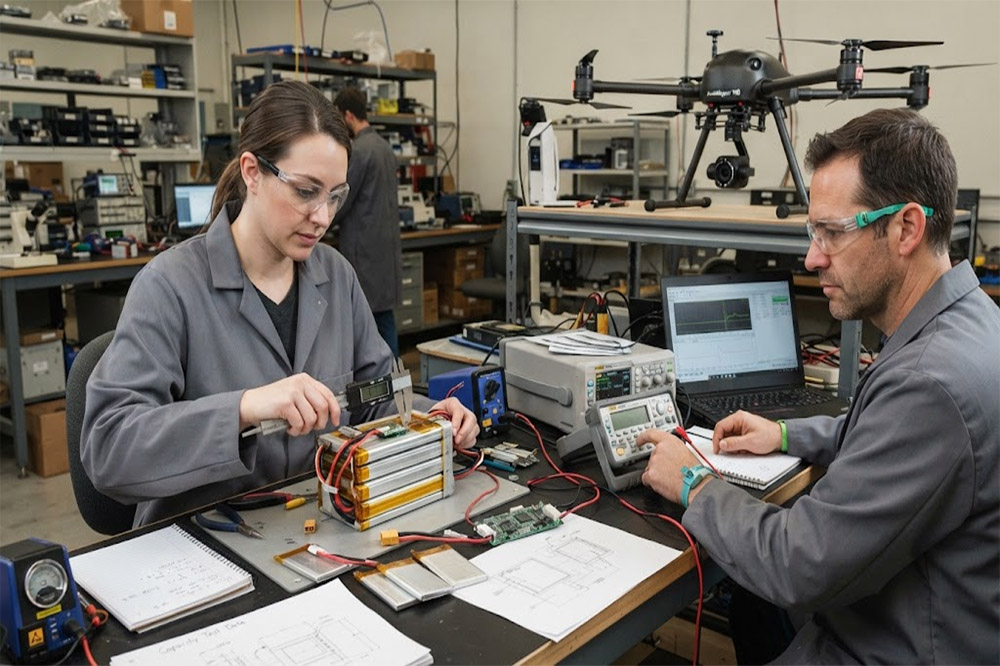
A battery can look simple from the outside.
A black battery pack, two cables, one connector and a label showing voltage and capacity. But when that battery goes inside an industrial drone, the design work behind it can be quite different.
A customer may say:
“We need a 12S 22Ah LiPo battery.”
That sounds like enough information to start.
Usually, it isn’t.
For an industrial UAV, the battery has to fit the aircraft, provide enough current, stay within the weight limit and work with the charging system. The connector, cable, BMS or protection system, housing and even the position of the wires can become important.
This is where custom LiPo battery pack design starts to make more sense than simply buying an off-the-shelf battery.
For projects with higher volumes or unusual requirements, the process usually moves through five stages:
Requirement analysis → Cell selection → Prototype → Testing → Mass production
The interesting part is what happens between those steps.
Before starting a custom project, it is useful to understand the main factors behind drone battery selection. Our LiPo Battery for Drone guide explains voltage, capacity, C rating and the differences between common UAV battery options.
It Usually Starts With the Drone, Not the Battery
When we discuss a new UAV battery project, the first thing worth understanding is the aircraft.
What does it weigh?
How much power does it normally use?
What is the peak current during takeoff?
How long should it stay in the air?
Where does the battery sit?
How much space is available?
These questions can change the battery design quite a lot.
For example, a mapping drone may spend most of its flight cruising at relatively stable power. An agricultural drone carrying a liquid payload can behave differently, especially during takeoff and when the aircraft is heavily loaded.
So instead of starting with a battery model, start with the application.
Useful information includes:
- Required voltage
- Target capacity
- Continuous current
- Peak current
- Maximum battery weight
- Maximum dimensions
- Flight-time target
- Connector type
- Charging method
- Operating temperature
- Expected order quantity
If some numbers are still unknown, that is not necessarily a problem.
In an early project, estimated figures are often enough to begin the first engineering discussion.
1. Requirement Analysis
This stage sounds boring.
It is actually where many expensive mistakes can be avoided.
Imagine a UAV manufacturer has only 65 mm of space available for battery height. The initial battery design fits electrically, but the finished pack reaches 72 mm after adding insulation, wiring and the enclosure.
The cells are correct.
The capacity is correct.
The battery still doesn’t fit.
That means going back.
For a custom UAV battery design, mechanical requirements should be considered alongside electrical requirements from the beginning.
A useful specification sheet might include:

| Requirement | Example |
|---|---|
| Battery type | LiPo |
| Nominal voltage | 44.4V |
| Capacity | 20Ah |
| Configuration | 12S |
| Continuous current | Project dependent |
| Peak current | Project dependent |
| Maximum weight | Customer defined |
| Dimensions | Customer defined |
| Connector | XT90 / custom |
| Application | Industrial UAV |
| Quantity | Prototype + mass production |
The exact values will change from project to project.
That is the point.
A custom battery should be designed around the aircraft rather than forcing the aircraft to accept whatever battery happens to be available.
2. Cell Selection Is More Than Choosing the Highest Capacity
Once the requirements are clear enough, cell selection becomes the next step.
This is where an experienced battery engineer can save time.
A customer may naturally want the largest capacity available. But the largest capacity cell is not automatically the best choice.
For an industrial drone, we may need to balance:
Energy density + discharge capability + weight + size + cycle life + cost
Sometimes increasing capacity adds too much weight.
Sometimes a lightweight battery with slightly lower capacity produces a better aircraft-level result.
And sometimes the drone simply needs more current rather than more energy.
This is particularly important for applications with high takeoff power or heavy payloads.
The battery needs to deliver current without excessive voltage sag or temperature rise.
For long-endurance UAV designs, another option worth evaluating is a 21700 Li-ion battery pack, particularly when energy density and flight endurance are important.
LiPo Makes Sense in Some UAV Projects
LiPo batteries remain popular in drones because they can offer strong discharge performance and flexible pack configurations.
They can be arranged to achieve different voltage and capacity requirements without the same form-factor limitations you might face with cylindrical cells.
For an industrial UAV, however, the design still needs to consider mechanical protection and handling.
The pouch cells need to be properly assembled, insulated and protected.
The pack should not simply be treated as a group of cells wrapped together.
This becomes particularly important when the battery will be installed and removed frequently by field operators.

3. Prototype: Where the Design Becomes Real
The prototype stage is usually where theoretical numbers meet reality.
The CAD drawing may look perfect.
Then someone installs the battery into the drone.
Maybe the connector is awkward to reach.
Maybe the cable is too short.
Maybe the pack touches another component.
Maybe the weight distribution is not what the engineer expected.
These things happen.
A useful prototype should therefore be tested not only on a battery tester but also, where practical, in the actual UAV.
The prototype stage may involve changes to:
- Battery dimensions
- Cell arrangement
- Cable length
- Connector position
- Housing
- BMS
- Insulation
- Mounting method
- Labeling
One small mechanical change can sometimes lead to several other changes.
That is normal during product development.
Prototype Samples Should Not Be Treated as the Final Product
A prototype has a different job.
Its purpose is to answer questions.
Does it fit?
Does it provide enough current?
Does the aircraft achieve the expected flight time?
Does the connector stay cool?
Does the battery become too warm?
Does the charging system work correctly?
Does the battery interfere with the aircraft’s balance?
If the answer to one of these questions is “not quite,” the prototype has still done its job.
It has found the problem before mass production.
4. Testing the Custom LiPo Battery Pack
Testing depends heavily on the UAV application.
Basic electrical checks may include:
- Voltage
- Capacity
- Internal resistance
- Charge performance
- Discharge performance
- Peak current behavior
- Temperature
But for an industrial drone, real-world testing is especially valuable.
Suppose the battery passes a laboratory discharge test.
That is useful.
But what happens when the drone takes off with a full payload in a hot environment?
That is another question.
For agriculture, mapping and inspection UAVs, operating conditions can be quite different. A battery design that performs well in a controlled workshop may need further evaluation in actual flight conditions.

Watch the Temperature
Temperature is easy to overlook when the battery is being discussed mainly in terms of voltage and capacity.
During high-current operation, the pack can heat up.
If the drone operates in a hot climate, the starting temperature may already be high.
This is one reason I would not judge a custom battery only by its rated capacity.
The combination of current, resistance, ambient temperature, cooling and flight profile matters.
For some industrial UAV projects, thermal behavior becomes one of the main design considerations.
Testing Should Also Include the Mechanical Side
Electrical testing is only part of the job.
The battery should also be checked for:
- Physical fit
- Connector security
- Cable routing
- Housing strength
- Insulation
- Mounting method
- Vibration environment
- Repeated installation and removal
A drone battery may be removed dozens or hundreds of times during its service life.
If the connector is difficult to access, operators may pull the cable instead of the connector.
If the mounting system is poor, the battery may move during flight.
Small practical details like these can become customer complaints later.

5. Moving From Prototype to Mass Production
Once the prototype has been approved, the project enters a very different phase.
Mass production needs consistency.
The first five batteries may be carefully checked by an engineer.
The next 1,000 need to follow the same approved specification without relying on one person’s memory.
This is where production procedures become important.
The manufacturer should have defined requirements for:
- Cell model
- Cell matching
- Welding
- BMS installation
- Wire routing
- Connector assembly
- Insulation
- Final testing
- Packaging
The approved prototype should become the reference for production.
Cell Consistency Becomes More Important at Volume
Suppose a UAV company orders 1,000 battery packs.
They don’t want 1,000 batteries that are merely “similar.”
They want the same battery specification.
The cell model, capacity, resistance range, dimensions and electrical behavior should remain within the agreed production requirements.
This is one reason choosing the right UAV battery manufacturer matters.
The supplier needs to be capable of repeating the design, not just making one impressive sample.
OEM Battery Design Is a Long-Term Process
For an industrial UAV company, the relationship with a battery manufacturer may last much longer than one purchase order.
The battery could go through several revisions as the aircraft develops.
Version 1 may use one connector.
Version 2 may change the cable arrangement.
Later, the company may need more capacity without increasing the battery’s overall size.
A manufacturer familiar with OEM development can help manage these changes rather than treating every new requirement as a completely separate order.
That can make a real difference when the UAV is moving from prototype to commercial production.
What Should You Send to a Battery Manufacturer?
If you want a quotation for a custom LiPo battery pack, you do not need to prepare a 50-page engineering document.
Start with the basics:
Voltage:
Capacity:
Continuous current:
Peak current:
Maximum dimensions:
Maximum weight:
Connector:
Drone application:
Estimated quantity:
Target flight time:
Photos, drawings or a battery compartment model are also helpful.
If you already have an existing battery, send photos of the label and connector.
That gives the battery manufacturer something concrete to work from.
Custom UAV Battery Design With Apsenx
For UAV companies developing a new aircraft or upgrading an existing platform, Apsenx can support the battery development process from initial requirements through production.
The project can involve:
- Cell selection
- Battery configuration
- BMS
- Connector selection
- Housing
- Prototype development
- Testing
- Mass production
The battery can be developed around the aircraft’s voltage, capacity, current, size and weight limitations instead of starting from a fixed standard pack.
For companies looking for a long-term custom UAV battery manufacturer, this approach is often more practical than modifying a standard battery after every order.
Explore the UAV Battery product category for available LiPo and Li-ion UAV battery solutions.
A Practical Example
Consider a commercial mapping drone that needs longer flight time.
The first idea might be simple:
“Increase the battery capacity.”
But increasing capacity usually means adding weight.
The heavier aircraft then needs more power.
More power reduces some of the benefit gained from the larger battery.
So the engineering team may instead look at the whole system:
Cell energy density → pack weight → aircraft power consumption → flight time
This is why custom battery development is not simply a matter of adding more cells.
Sometimes a smaller but better-matched battery produces the better overall result.
When Should You Choose Custom Battery?
A standard battery may be perfectly fine when:
- Your drone accepts a common battery size
- Performance requirements are modest
- You are buying replacement batteries
- The connector and dimensions are already fixed
Custom design becomes more attractive when:
- Space is limited
- Weight is tightly controlled
- Higher discharge is required
- Flight time is critical
- A special connector is required
- The drone uses a non-standard battery shape
- You need your own branding
- You plan long-term production
For a commercial UAV brand, these requirements are quite common.
From Prototype to Production
The most useful way to look at custom battery development is not as five isolated steps.
It is more like a loop:
Requirement → Design → Prototype → Test → Adjust → Test Again → Production
Sometimes the first prototype is approved immediately.
Sometimes it takes two or three revisions.
That depends on how mature the aircraft design is.
If the drone itself is still changing, the battery may need to change with it.
That is not necessarily a problem. It is simply part of developing a real product.
Request Custom UAV Battery Quote
If you are developing an industrial drone and need a custom LiPo battery pack, send us the basic requirements.
Useful information includes:
- Voltage
- Capacity
- Continuous and peak current
- Maximum dimensions
- Maximum weight
- Connector
- Flight-time target
- Drone application
- Prototype quantity
- Estimated mass-production quantity
Apsenx can discuss cell selection, pack structure, BMS, connectors, prototype development and production based on your project.
Request a custom UAV battery quotation for your project.
FAQ
What information is needed to design a custom LiPo battery pack?
At minimum, provide the required voltage, capacity, current, maximum dimensions, weight limit, connector and UAV application. Flight-time requirements are also useful.
Is LiPo suitable for industrial drones?
LiPo can be suitable for industrial UAV applications where high discharge capability, weight and pack configuration are important. The final choice depends on the aircraft and operating profile.
How long does custom UAV battery development take?
It depends on the complexity of the battery and how complete the aircraft requirements are. A standard modification may move quickly, while a new mechanical and electrical design can require several prototype revisions.
Should I test the prototype on the actual drone?
Yes, whenever practical. Laboratory testing is important, but actual UAV testing can reveal issues related to flight time, temperature, weight distribution, connectors and installation.
Can the battery be customized for a specific drone housing?
Yes. Dimensions, cell configuration, cable length, connector position, housing and other pack details can be developed around the aircraft.


Leave a Reply