
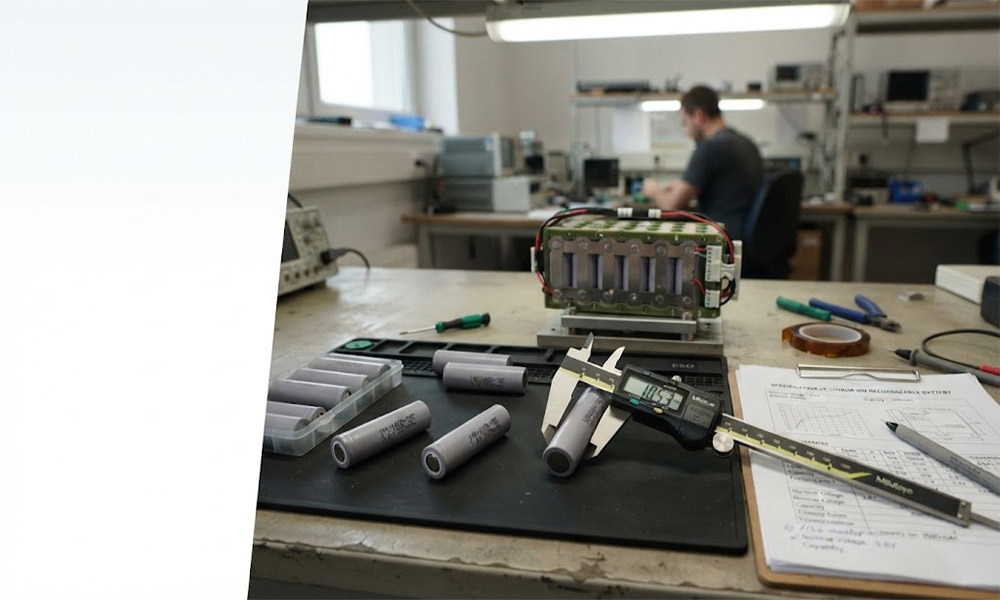
18650 lithium battery is a compact rechargeable lithium-ion cell widely used in battery packs, portable equipment, power tools and other electronic products. The right cell is not simply the one with the highest mAh rating; voltage, discharge current, application, space and purchase quantity all matter.
If you have ever opened battery pack, there is a good chance you have seen an 18650 cell inside. The name sounds technical, but the basic idea is actually quite simple: 18mm diameter and 65mm length describe the approximate physical size of the cylindrical cell.
18650 format looks simple on paper, but the actual dimensions can matter quite a bit when you are designing a battery pack. A few millimeters can sometimes decide whether a cell fits the enclosure or not. If you are working on a product with limited installation space, our guide to 18650 battery size and dimensions explains the actual cell dimensions, weight, terminal types and how individual cells affect the final battery-pack size.
What makes 18650 batteries interesting is how much work can be done with such a small cell. A single cell can power a flashlight or electronic device, while dozens of cells can be connected into a much larger battery pack for industrial equipment, e-bikes or power tools.
The tricky part starts when you actually need to buy them.
A 3500mAh cell may look better than a 2600mAh cell on a product list. That does not automatically mean it is the better choice for your project.
There are many different 18650 cells on the market, and the highest capacity cell is not automatically the right one for every product. If you’re developing an OEM battery pack, our guide on [how to choose the right 18650 battery] walks through capacity, voltage, discharge current, dimensions, cycle life and other specifications that should be checked before placing a bulk order.
What is 18650 lithium battery?
An 18650 lithium battery is a rechargeable cylindrical lithium-ion cell. Most commonly, buyers will see cells around 3.6V or 3.7V nominal voltage, although the exact electrical specifications depend on the cell chemistry and model.
Capacity is normally shown in mAh, such as 2000mAh, 2600mAh, 3000mAh or 3500mAh.
A higher capacity generally means more stored energy, but there is a trade-off. A cell designed mainly for high capacity may not be the best option when the equipment needs a large current suddenly.
That difference becomes very obvious in applications such as power tools.

18650 battery voltage is not just one number
One of the common mistakes when selecting cells is seeing “3.7V” and assuming that the battery always outputs 3.7V.
It does not.
The 3.6V or 3.7V figure is normally the nominal voltage. A lithium-ion cell reaches a higher voltage when fully charged, and its voltage gradually drops as energy is used.
When several 18650 cells are connected in series, their voltages add together.
For example:
- 2 cells in series = 2S
- 3 cells in series = 3S
- 4 cells in series = 4S
- 5 cells in series = 5S
The actual battery-pack voltage depends on the cell specification and how the cells are connected.
This is why a battery manufacturer normally needs to know the required pack voltage rather than simply hearing “I need 18650 batteries.”
Voltage is another specification that is easy to misunderstand, especially when you see 3.6V, 3.7V and 4.2V on different battery specifications. These numbers do not necessarily mean different types of 18650 cells. If you are planning a battery pack or comparing cells for an OEM project, our detailed guide to 18650 battery voltage explains nominal voltage, full-charge voltage and how series and parallel connections change the final pack voltage.
Capacity: 2000mAh, 2600mAh, 3000mAh or 3500mAh?
This is where buyers often start comparing products.
Suppose you are choosing between a 2600mAh and a 3500mAh 18650 cell. On paper, the 3500mAh cell looks like the obvious winner.
But ask what the device actually needs.
If the equipment has a relatively low current demand and longer runtime is important, higher capacity can make sense. If the equipment has a high instantaneous current demand, discharge performance may become more important than the maximum mAh number.
For battery-pack production, the calculation becomes more involved because cells may be connected in both series and parallel.
A simple example:
4 cells in parallel = 4P
If each cell is 3000mAh, the theoretical nominal capacity becomes approximately:
3000mAh × 4 = 12000mAh
Add series connections and the voltage changes while the parallel groups determine capacity.
This is one reason I would not recommend choosing cells from capacity alone.
High-drain and high-capacity cells are not the same thing
Imagine a cordless power tool being used continuously.
The motor starts. Current rises quickly. The battery is under stress.
Now compare that with a small electronic device that consumes power slowly over several hours.
Both devices can use 18650 cells, but their battery requirements are quite different.
For a high-power application, buyers should pay attention to:
- Continuous discharge current
- Peak discharge requirement
- Cell temperature
- Internal resistance
- Cycle life
- Capacity
For a lower-power device, energy capacity may receive more attention.
There is no universal “best 18650 battery.” There is usually only a better match for a particular application.
Capacity is another specification worth looking at carefully when choosing an 18650 lithium battery. A higher mAh rating usually means more stored energy, but it does not automatically mean the cell is better for every application. A power tool, portable device and industrial sensor can have very different battery requirements. If you are comparing 2000mAh, 3000mAh and 3500mAh cells, our guide to 18650 battery capacity explains how capacity affects runtime, weight, current performance and battery-pack design.
Where are 18650 batteries used?
The 18650 format has been around for years, partly because it is practical for battery-pack design.
Typical applications include:
- Power tools
- E-bike battery packs
- Portable electronics
- Flashlights
- Industrial equipment
- Backup power systems
- Consumer devices
- Custom lithium battery packs
In a factory setting, the decision is often less about the cell itself and more about the complete pack.
For example, a buyer may come with a requirement such as:
“We need a 24V battery pack, about 10Ah, and the available space is limited.”
That is already much more useful information than simply asking for “good 18650 batteries.”
The manufacturer can then work backward from voltage, capacity, current, dimensions and connection method to determine a suitable configuration.
18650 battery cells or complete battery pack?

This depends on what you are building.
If your company already has battery-pack engineering capability, purchasing individual cells in bulk may be the better option.
If you need a ready-to-use battery for your equipment, a custom 18650 battery pack can save quite a bit of development work.
The pack may include:
- Cell configuration
- BMS
- Nickel or other connection materials
- Wires
- Connectors
- Protection components
- Housing
- Custom dimensions
This is also where the difference between a cell supplier and a battery-pack manufacturer becomes important.
For buyers looking for individual cells in different capacities, the Apsenx 18650 lithium battery range is a useful place to compare available specifications.
Capacity is useful for estimating runtime, but it does not tell the whole story. Some applications need a cell that can deliver much higher current, even if that means accepting a lower capacity. If you are choosing cells for power tools, motors or other demanding equipment, our guide to high-drain vs high-capacity 18650 batteries explains the trade-off in more detail.
Choosing 18650 cell is only the first step. The same cell can be used in very different battery packs depending on how the cells are connected. If you’re trying to work out what 18650 series and parallel configuration you need, our guide explains how S and P affect voltage, capacity, current and total cell count, with practical examples such as 4S2P and 10S2P.
What should you check before buying 18650 lithium batteries in bulk?
For a small personal project, buying a few cells is relatively straightforward.
Bulk purchasing is different.
Before placing an order, I would check at least these points:
1. Capacity
Make sure the stated capacity fits your required runtime.
2. Discharge performance
Do not overlook this if the equipment draws high current.
3. Cell consistency
For battery packs, consistency between cells matters. Mixing cells with noticeably different characteristics can create problems later.
4. Application
A cell suitable for a flashlight may not be suitable for a high-power motor.
5. Quantity
Wholesale pricing usually depends heavily on order volume.
6. Testing and quality control
For commercial battery production, incoming-cell testing and consistency checks are worth discussing before a large order.
7. Certification and shipping requirements
The documentation needed can depend on the destination market and how the cells are being shipped.

How do you choose 18650 battery supplier?
Price is usually the first question from a new buyer.
It probably should not be the only one.
For a long-term project, I would rather compare several suppliers based on cell specifications, consistency, testing, communication, production capability and whether they can support the project when something changes.
That last part matters more than it sounds.
A prototype may start with 3000mAh cells. Six months later, the engineering team may want a different capacity, a new connector or a slightly different pack layout.
A supplier that only sells standard cells may not be able to help much at that stage.
A supplier with both 18650 cells and custom battery-pack capability can be more useful because the conversation can continue from the individual cell to the finished battery.
Buying 18650 lithium batteries for real project
If you are sourcing 18650 lithium batteries for resale, manufacturing or a custom product, it helps to prepare a few details before contacting a supplier:
- Required capacity
- Nominal voltage
- Discharge current
- Battery dimensions
- Estimated order quantity
- Application
- Target market
- Whether you need individual cells or a complete pack
You do not need to have every technical detail finalized.
In many projects, the mechanical design is still changing when battery sourcing begins. That is normal. Give the supplier the information you already have, and the remaining specifications can usually be discussed from there.
For wholesale buyers, Apsenx provides bulk 18650 lithium-ion batteries for OEM and wholesale applications, with multiple capacity options and customization support.
If you are comparing cells for an upcoming project, the most useful next step is usually not asking for the “best 18650 battery.”
Instead, send the required voltage, capacity, current and approximate quantity.
That gives the battery supplier something concrete to work with.
Choosing 18650 lithium battery is not only about its capacity and discharge current. The way the cell is charged, discharged, stored and exposed to temperature can have a major effect on its useful life. If battery longevity matters to your product, our guide to [18650 battery life and cycle life] explains what actually causes capacity loss and battery aging.
Conclusion
The main takeaway is simple: selecting an 18650 lithium battery should start with the application rather than the mAh number alone. Buyers who can provide voltage, capacity, current, dimensions and estimated quantity will generally have a much more productive conversation with a battery supplier.
Frequently Asked Questions
1. What is 18650 lithium battery?
18650 is cylindrical rechargeable lithium-ion cell, approximately 18mm in diameter and 65mm long. It is widely used in battery packs, portable electronics, power tools, e-bikes and other equipment.
2. Is 3500mAh 18650 battery always better than a 2600mAh cell?
No. A 3500mAh cell may provide more stored energy, but the 2600mAh cell could be more suitable for an application requiring higher discharge performance. The correct choice depends on the equipment.
3. Can 18650 batteries be used to make a 24V battery pack?
Yes. Multiple 18650 cells can be connected in series and parallel to create a higher-voltage battery pack. The exact configuration depends on the required nominal voltage, capacity and current.
4. Can I buy 18650 lithium batteries in bulk?
Yes. Bulk 18650 cells are commonly purchased for battery-pack manufacturing, electronics production and distribution. For commercial orders, buyers should discuss capacity, discharge requirements, quantity, testing and shipping requirements with the supplier.
5. Should I buy individual 18650 cells or complete battery pack?
If you already manufacture battery packs, individual cells may make sense. If you need a finished battery for your equipment, a custom battery pack can be more practical because the supplier can handle cell configuration, BMS, wiring, connectors and other requirements.
Buying 18650 battery is one thing; knowing how long it will remain useful in a real product is another. Charging frequency, temperature, discharge current and depth of discharge can all affect battery aging. If battery longevity is important for your project, our guide on [18650 battery life and cycle life] explains what the cycle-life numbers really mean and what OEM buyers should look for.
Once you have selected an 18650 cell, the next question is how the battery should be charged. The required charging voltage changes with the series configuration, while charging current is related to cell capacity and the manufacturer’s specifications. Our guide to [18650 battery charging] explains charging voltage, CC/CV charging, charging current and practical considerations for OEM battery packs.
Capacity is only one part of an 18650 battery specification. If your equipment uses motors, power tools or other high-current loads, the cell’s discharge capability can become more important than simply choosing the highest mAh rating. Read our guide to [high-drain 18650 batteries] to understand current ratings, voltage sag and cell selection.
-

12V 4400 mah Lithium ion 3S2P 18650 Battery Pack
-

18650 2000mAh 3.7 volt Lithium-ion Battery
-

18650 20V 3.0Ah Cordless Drill battery
-

18650 22.2V 7.8Ah 2600Mah 6S3P Rechargeable Battery Pack
-

18650 2600mAh Rechargeable Lithium-Ion Battery 3.7V
-

18650 3.7V 10Ah Li-Ion Power Battery Pack
-

18650 3.7V 3300mah Rechargeable Lithium ion Battery
-

18650 7S7P 24V 14Ah Lithium ion Electric Scooter Battery Pack
-

18650 battery 3.7V 1500mAh Lithium-Ion Battery
-

18650 Battery 3500 mah Rechargeable Battery Cells
-

18650 Electric Scooter 48V 13000mAh Lithium Battery
-

2600mAh 3S1P 11.1V 18650 Battery Packs
-

3.7V Li ion Rechargeable 3000mah 18650 Battery Cell
-

36V 5200mAh 10S2P 18650 Battery Pack
-

48v 4400mah 13S2P 18650 Rechargeable Battery Pack
-

7S2P 24V 18650 Lithium Battery Pack
-

Electric Scooter 36V 4400mAH 10S2P 18650 Battery Pack
-

ICR 18650 Battery 2200mah 3.7V
Leave a Reply