
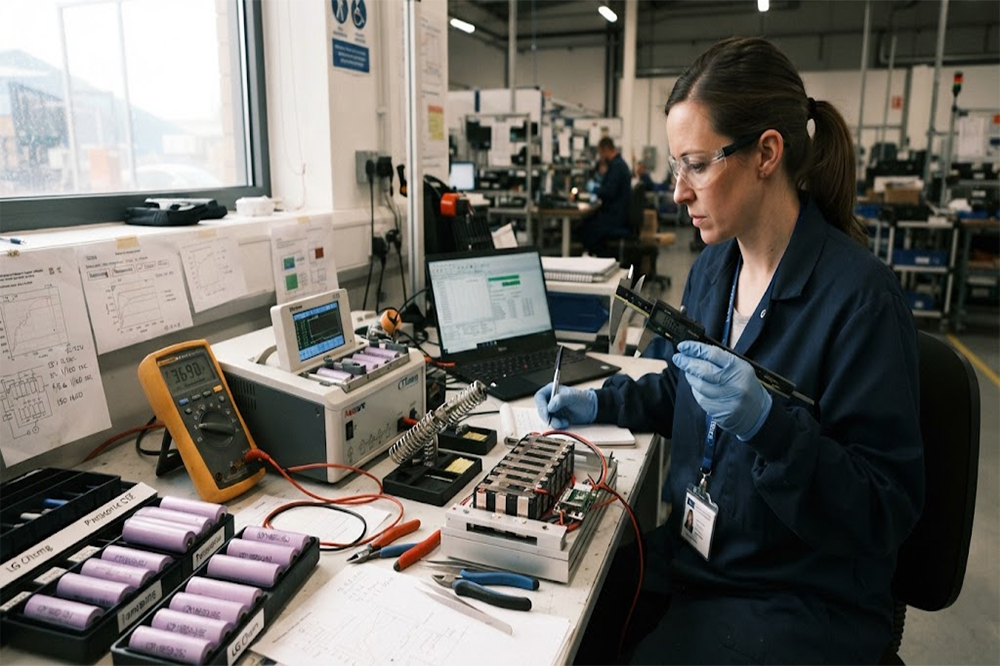
Choosing an 18650 battery is not simply a matter of picking the highest mAh rating. For an OEM or wholesale project, capacity, discharge current, voltage, cycle life, operating temperature, dimensions and target cost all need to work together.
There is a very common mistake when people start sourcing 18650 batteries.
They search for “highest capacity 18650 battery” first.
It sounds reasonable.
More mAh should mean more runtime, right?
Sometimes it does.
But if the battery is going into a power tool, robot, portable device or industrial machine, capacity is only one part of the decision.
A 3500mAh cell that cannot provide the required current may be a worse choice than a 3000mAh high-drain cell.
And if the battery has to fit inside a narrow enclosure, even the best-performing cell is useless if it doesn’t physically fit.
For a commercial project, I would start with the product rather than the cell.
What does the equipment need?
How much space is available?
How much current does it draw?
How often will the battery be charged?
Once those questions are clear, choosing the 18650 cell becomes much easier.
If you are new to 18650 lithium batteries, it is useful to first understand the cell format, voltage, capacity, applications and basic battery-pack configurations. Our [complete 18650 lithium battery guide] provides a broader introduction before you move into detailed cell selection.
Start With Voltage
Before capacity, before discharge current, start with voltage.
An individual lithium-ion 18650 cell normally has a nominal voltage around 3.6V or 3.7V, depending on the cell specification.
A fully charged conventional lithium-ion cell is commonly around 4.2V.
When several cells are connected in series, the voltage increases.
For example:
- 3S → around 11.1V nominal
- 4S → around 14.8V nominal
- 5S → around 18.5V nominal
- 10S → around 36–37V nominal
The exact figures depend on the selected cell and chemistry.
This is why you should know the required system voltage before asking a supplier for a battery quote.
If your equipment requires a 36V-class battery, the supplier needs to know whether you’re looking for a 10S configuration, rather than simply saying “I need 36V.”
For more detail, see our [18650 battery voltage guide].
Capacity: Don’t Just Chase the Biggest mAh Number
Capacity is usually listed in mAh.
A higher number generally means more stored charge.
For example:
2500mAh
3000mAh
3500mAh
4000mAh
But higher capacity can come with trade-offs.
Depending on the cell design, a high-capacity cell may not provide the same discharge performance as a cell designed for high current.
Imagine a power tool that needs a strong current burst when the motor starts.
You may have two choices:
Cell A: 3500mAh, moderate discharge capability
Cell B: 3000mAh, higher discharge capability
Cell A looks better on a simple product comparison.
Cell B may perform better in the actual tool.
This is why the battery specification should follow the application’s load profile.

Check Continuous and Peak Current
This is probably one of the most important specifications for an OEM battery project.
There are two questions:
How much current does the product normally draw?
And:
How much current can it demand at its peak?
A motor-driven product may have a relatively low average current but a much higher startup or acceleration current.
If the battery cannot handle that demand, you can see voltage sag, heating or unexpected shutdown.
For high-drain applications, don’t rely on a generic statement such as “high power.”
Ask for the actual continuous discharge rating and test conditions.
Our previous article on [high-drain vs high-capacity 18650 batteries] goes deeper into this particular trade-off.
Battery Configuration Changes Everything
One 18650 cell is rarely the whole battery.
Most commercial battery packs combine cells in series and parallel.
For example:
4S2P
means:
- 4 cells or parallel groups in series
- 2 cells in parallel per group
- 8 cells total
The nominal voltage is determined mainly by the series count.
The capacity is increased by the parallel count.
If each cell is 3000mAh:
2P = approximately 6000mAh
So a 4S2P pack is approximately:
14.8V / 6Ah
before considering the specific cell and actual usable energy.
This is why specifying only “3000mAh 18650” isn’t enough when requesting a complete battery pack.

Think About Energy in Wh Too
For product development, Wh can be more useful than mAh alone.
A simple calculation is:
Energy (Wh) ≈ Voltage (V) × Capacity (Ah)
For example:
14.8V × 6Ah ≈ 88.8Wh
This gives you a better idea of how much energy the complete pack contains.
Two batteries can have the same mAh but different voltage.
Their total energy won’t be the same.
So when comparing battery suppliers, look at Wh as well as mAh.
If you’re still working out how much capacity your product actually needs, our [18650 battery capacity guide] can help with the calculation.
Physical Size Is Not a Small Detail
This is where many battery projects become complicated.
An 18650 cell is approximately:
18mm × 65mm
But the finished battery pack will be larger.
You need room for:
- Cell insulation
- Nickel strips
- BMS
- Wires
- Connectors
- Protective materials
- Housing
- Mechanical clearance
And depending on the design, the cells may not be arranged in a simple rectangular block.
For a compact product, a few millimeters can matter.
Suppose the battery compartment is 70mm high.
An 18650 may fit comfortably.
A different cell or protected cell with additional dimensions may not.
For this reason, always provide the supplier with the maximum battery pack dimensions, not only the product’s external dimensions.
What About Protected 18650 Cells?
You may see 18650 cells sold as either bare cells or protected cells.
A protected cell can include a protection circuit, usually adding some length and sometimes diameter.
That can be useful for certain consumer applications.
But it doesn’t automatically mean a protected cell is appropriate for a custom battery pack.
For multi-cell battery packs, protection and monitoring are often handled by the pack’s BMS.
So the right configuration depends on the application.
If you’re building a multi-cell OEM battery, tell the battery manufacturer how the cells will be connected and what protection functions are required.

Cycle Life Should Match the Product
If the battery is inside a device that is charged once a week, cycle life may not be the main purchasing concern.
If the product is charged several times a day, it becomes much more important.
Consider a commercial power tool.
The customer may use it every working day.
A small difference in battery degradation can become noticeable after months of regular use.
For an industrial product, you may also have a minimum capacity requirement after a specific number of cycles.
Don’t simply ask:
“How many cycles can this cell do?”
A better question is:
“What are the cycle test conditions, and what capacity remains at the end of the test?”
Our [18650 battery life and cycle life guide] explains why cycle-life figures need to be read carefully.
Temperature Can Change Your Decision
A battery operating indoors at room temperature is one thing.
A battery installed inside outdoor equipment in summer is another.
High temperatures can accelerate battery aging.
Low temperatures can affect available performance and increase internal resistance.
If your product will operate outdoors, near motors or inside a sealed enclosure, tell your battery supplier.
A cell that performs well in a controlled laboratory environment may not be the best option for a product that routinely experiences high temperatures.
This is one of those details that is easy to ignore during prototype development and much harder to fix after mass production.
Weight Matters More Than It First Appears
A battery can meet its capacity target and still make the product too heavy.
This is particularly important for:
- Portable tools
- Robotics
- Drones
- Medical equipment
- Handheld devices
- Mobility products
Suppose increasing the pack capacity adds 500g.
That might be acceptable for industrial equipment.
For a handheld product, it could completely change the user experience.
So the battery specification should include a maximum weight when weight is important.
Don’t Forget the BMS
The battery cells are only part of a rechargeable battery pack.
A multi-cell lithium-ion battery normally requires appropriate battery management and protection.
The BMS may provide functions such as:
- Overcharge protection
- Over-discharge protection
- Overcurrent protection
- Short-circuit protection
- Cell balancing
- Temperature monitoring
The exact functions depend on the design.
A 4S battery and a 10S battery do not use the same BMS configuration.
The BMS also needs to match the cell chemistry and expected current.
So when requesting a custom battery quotation, provide the battery configuration and electrical requirements rather than asking for “an 18650 battery with BMS.”
How Much Does the 18650 Battery Cost?
Price depends on much more than capacity.
A quote can be affected by:
- Cell brand
- Cell capacity
- Discharge rating
- Quantity
- Battery configuration
- BMS
- Connector
- Wire length
- Housing
- Certifications
- Packaging
- Testing requirements
For wholesale buyers, quantity can make a major difference.
The price for 100 cells may be very different from the price for 10,000 cells.
If you’re developing a new product, it is useful to request both prototype pricing and expected mass-production pricing.
That gives you a better idea of the actual project economics.
How to Compare Two 18650 Suppliers
Don’t compare only the quotation.
Look at the complete specification.
For example:
| Item | Supplier A | Supplier B |
|---|---|---|
| Capacity | 3000mAh | 3200mAh |
| Continuous current | 10A | 6A |
| Nominal voltage | 3.6V | 3.6V |
| Cycle life | Specified | Specified |
| Cell origin | Specified | Specified |
| BMS | Included | Included |
| Testing | Standard | Custom |
| MOQ | Different | Different |
Supplier B has more capacity.
Supplier A has higher current.
Which one is better?
There isn’t enough information yet.
We still need to know what the product actually needs.
That’s the point.
A Practical 18650 Selection Checklist
Before contacting a battery manufacturer, prepare these numbers:
Voltage:
What nominal voltage does the equipment require?
Capacity:
How many Ah or Wh are required?
Current:
What is the continuous load?
Peak current:
What is the maximum short-term demand?
Dimensions:
What is the maximum battery size?
Weight:
Is there a maximum acceptable weight?
Connector:
What connector does the product use?
Operating temperature:
Where will the battery be used?
Cycle life:
How many cycles are expected?
Quantity:
Prototype, small batch or mass production?
With this information, a supplier can usually recommend a much more appropriate cell and pack configuration.
Choosing the Right 18650 Is a System Decision
There isn’t really a single “best 18650 battery.”
There is only a battery that fits a particular application better than another option.
A high-capacity cell may be ideal for a low-current portable device.
A high-drain cell may make more sense for a power tool.
A long-cycle-life cell may be more important for industrial equipment.
And sometimes the cheapest solution is simply to use a standard 18650 battery pack rather than developing a complicated custom configuration.
For OEM and wholesale buyers, the useful conversation is therefore not:
“Which 18650 battery is the best?”
It is:
“Which 18650 cell and pack configuration fits this product?”
If you are sourcing cells or developing a custom battery pack, you can review the Apsenx 18650 lithium battery product category and send your required voltage, capacity, current and dimensions for evaluation.
Frequently Asked Questions
How do I choose the right 18650 battery?
Start with the required voltage, capacity, continuous current, peak current and available space. Then compare cycle life, temperature range, weight, cell quality and cost.
Is a higher-capacity 18650 always better?
No. High-capacity cells may have lower discharge capability than high-drain cells. The better choice depends on the product’s current demand and runtime requirements.
How many 18650 cells do I need?
It depends on the required voltage and capacity. Series connections increase voltage, while parallel connections increase capacity. The exact configuration should be calculated from the product requirements.
Should I choose a high-drain 18650?
Choose a high-drain cell when the application requires substantial continuous or peak current, such as some power tools, motors and robotics applications.
Can Apsenx provide a custom 18650 battery pack?
Yes. For an OEM project, provide the required voltage, capacity, current and maximum dimensions so the appropriate cell and pack configuration can be evaluated.
-

12V 4400 mah Lithium ion 3S2P 18650 Battery Pack
-

18650 2000mAh 3.7 volt Lithium-ion Battery
-

18650 20V 3.0Ah Cordless Drill battery
-

18650 22.2V 7.8Ah 2600Mah 6S3P Rechargeable Battery Pack
-

18650 2600mAh Rechargeable Lithium-Ion Battery 3.7V
-

18650 3.7V 10Ah Li-Ion Power Battery Pack
-

18650 3.7V 3300mah Rechargeable Lithium ion Battery
-

18650 7S7P 24V 14Ah Lithium ion Electric Scooter Battery Pack
-

18650 battery 3.7V 1500mAh Lithium-Ion Battery
-

18650 Battery 3500 mah Rechargeable Battery Cells
-

18650 Electric Scooter 48V 13000mAh Lithium Battery
-

2600mAh 3S1P 11.1V 18650 Battery Packs
-

3.7V Li ion Rechargeable 3000mah 18650 Battery Cell
-

36V 5200mAh 10S2P 18650 Battery Pack
-

48v 4400mah 13S2P 18650 Rechargeable Battery Pack
-

7S2P 24V 18650 Lithium Battery Pack
-

Electric Scooter 36V 4400mAH 10S2P 18650 Battery Pack
-

ICR 18650 Battery 2200mah 3.7V
Leave a Reply