
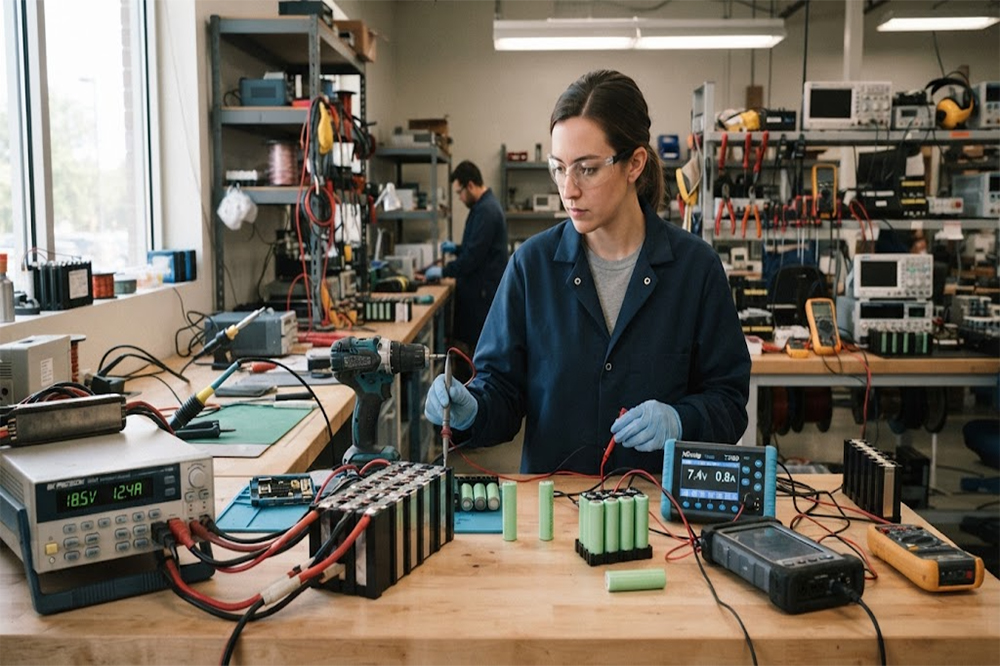
High-capacity 18650 battery is designed around longer runtime, while a high-drain 18650 focuses more on delivering higher current. For OEM and wholesale buyers, the better choice depends on the actual load rather than simply choosing the cell with the highest mAh rating.
There is more to choosing an 18650 cell than capacity and discharge current. If you are still comparing the basic specifications, our complete 18650 lithium battery guide covers cell types, voltage, capacity, applications and wholesale purchasing.
Bigger mAh Number Isn’t Always Better
When buying 18650 lithium batteries, capacity is usually the first number people compare.
3000mAh.
3500mAh.
Maybe 4000mAh if the specification looks particularly attractive.
But then you come across another cell with only 2500mAh and a much higher discharge current.
That can be confusing.
Why would anyone choose a 2500mAh cell instead of a 3500mAh one?
The answer is simple: the application may need current more than it needs extra capacity.
A battery powering a small sensor might run at a few hundred milliamps. A power tool or motor-driven device can demand several times that amount, sometimes with short bursts that are much higher than the normal operating current.
In those situations, a high-capacity cell is not automatically the better cell.
What Is High-Drain 18650 Battery?
A high-drain 18650 battery is designed to provide relatively high current while maintaining acceptable voltage and thermal performance within its specified operating conditions.
The important specification here is usually the discharge current.
You may see a datasheet listing:
- Continuous discharge current
- Maximum continuous discharge current
- Pulse discharge current
- Peak discharge current
These numbers are not interchangeable.
For a commercial battery project, the manufacturer’s test conditions should be checked rather than relying only on a large number printed on a product listing.
A cell advertised as “high drain” does not mean it can safely deliver unlimited current.
It still has a defined operating range.

What Is High-Capacity 18650 Battery?
A high-capacity 18650 is designed to store more energy within the same general 18650 form factor.
Common capacity ranges can include:
2000mAh
2600mAh
3000mAh
3500mAh
The exact maximum capacity available depends on the cell chemistry, design and manufacturer.
A high-capacity cell can be very useful for applications where the load is relatively moderate and longer runtime is more important than extreme current output.
Portable monitoring equipment is a good example.
The device may need to operate for many hours, but it does not necessarily pull a huge current.
In that situation, extra capacity can be more valuable than a very high discharge rating.
High-Drain vs High-Capacity: The Basic Difference
The simplest way to look at it is:
| Specification | High-Drain 18650 | High-Capacity 18650 |
|---|---|---|
| Main priority | Current output | Energy storage |
| Typical capacity | Often lower | Often higher |
| Discharge capability | Higher | Usually more moderate |
| Runtime | May be shorter | Usually longer |
| Heat under heavy load | Designed to manage higher load | Depends strongly on cell |
| Typical applications | Power tools, motors, high-load equipment | Electronics, backup power, portable devices |
| Main selection factor | Current demand | Runtime |
This is a general comparison, not a rule for every cell.
There are cells that sit somewhere in between.
That middle ground can actually be useful for OEM projects where both runtime and current capability matter.
Why Does High Current Matter?
Imagine a power tool starting its motor.
The current demand can jump quickly.
The battery suddenly has to deliver much more current than a small electronic sensor would normally require.
If the cell is not designed for that type of load, its voltage can drop more noticeably and the cell may generate more heat.
This is where internal resistance becomes important.
A simplified relationship is:
Voltage Drop ≈ Current × Internal Resistance
So if current increases, voltage drop caused by internal resistance also increases.
This is one reason high-drain cells are built differently from cells that mainly focus on maximum energy density.
For a power tool, electric motor or other demanding application, a cell that maintains voltage under load can be much more useful than one that simply has a larger mAh number.
A 3500mAh Cell May Not Be the Best Choice
Let’s say you have two possible cells.
Cell A
- Capacity: 3500mAh
- Continuous discharge: moderate
Cell B
- Capacity: 2800mAh
- Continuous discharge: much higher
For a low-current device, Cell A may be the obvious choice.
But if the product is a high-power tool, Cell B could be the more practical option.
The lower capacity means less stored energy per cell, but its ability to deliver current may better match the load.
And there is another point that sometimes gets overlooked.
If the high-drain cell allows the equipment to operate more efficiently under load, the actual performance difference may be smaller than the capacity numbers suggest.
That needs to be tested with the actual product rather than guessed from a catalog.
Where High-Drain 18650 Cells Make More Sense
High-drain cells are commonly considered for applications such as:
Power Tools
Cordless drills, saws and other motor-driven tools can require substantial current.
E-Bikes and Light Electric Vehicles
The battery may need to support acceleration and changing loads, rather than supplying a perfectly steady current.
Robotics
Motors and actuators can create short periods of high current demand.
Portable Industrial Equipment
Some industrial devices have pumps, motors or other components that create relatively heavy electrical loads.
High-Power Electronics
Certain devices may require a battery that can provide higher current without excessive voltage sag.
For these applications, the continuous and peak current requirements should be identified before choosing the cell.
Where High-Capacity 18650 Cells Can Be More Useful
High-capacity cells can make more sense when runtime is the main concern.
Examples include:
- Portable monitoring equipment
- Sensors
- GPS equipment
- Backup systems
- Portable lighting
- Low-current electronics
- Certain medical and laboratory devices
Again, the application determines the choice.
A sensor that draws 200mA continuously does not have the same battery requirements as a motor that can draw 15A.
It would be strange to choose both batteries based on the same specification.

Don’t Confuse Continuous Current With Peak Current
This is particularly important when buying batteries in bulk.
Suppose a cell specification says:
Continuous discharge: 10A
and another listing says:
Peak discharge: 20A
That does not necessarily mean the cell is a “20A battery.”
The duration and test conditions matter.
A short pulse and a continuous load are different things.
For an OEM battery pack, I would ask the supplier for the actual discharge specifications and test conditions.
This is much safer than selecting a cell based on a large current number from a marketplace listing.
High-Drain Cells Can Produce More Heat
Current and heat are closely related.
A simplified relationship is:
Heat ≈ I² × R
where:
- I = current
- R = resistance
Notice that current is squared.
So when current increases significantly, heat generation can rise quickly if resistance is not well controlled.
This is one reason battery-pack design cannot stop at cell selection.
The pack also needs appropriate:
- BMS
- Nickel strips or busbars
- Connections
- Insulation
- Thermal management
- Cell spacing
- Protection design
For a high-current application, the entire electrical path matters.
How Capacity and Current Affect Battery Pack Design
Suppose you need a battery for a 500W device.
At approximately 20V, the theoretical current would be:
500W ÷ 20V = 25A
That is already a substantial current requirement.
You would not simply choose a 3500mAh 18650 because it has a high capacity.
The battery designer would need to determine:
- Series configuration
- Parallel configuration
- Cell continuous current
- Peak current
- BMS rating
- Wiring
- Connector rating
- Thermal conditions
The number of cells in parallel can also help distribute the load.
For example, if a cell is suitable for a certain continuous current, multiple parallel cells can share the current demand.
The actual design still needs proper engineering and validation.

How Do You Choose Between High-Drain and High-Capacity?
I normally start with the application rather than the cell.
Ask these questions:
How much current does the equipment normally draw?
What is the peak current?
How long should it operate?
How much space is available?
What weight is acceptable?
What is the target battery cost?
Those answers usually make the direction clearer.
If runtime is the dominant concern and current demand is relatively low, high capacity is attractive.
If current demand is high, discharge capability should move much higher on the priority list.
And if both matter, look for a cell that provides a reasonable compromise.
Don’t Forget the Physical Size
Both high-drain and high-capacity cells can use the 18650 format, but the final battery design still needs to account for dimensions, weight and pack arrangement.
If your project has a tight enclosure, check the actual cell dimensions before selecting the cell.
Our earlier guide, 18650 battery size and dimensions, explains why the familiar “18mm × 65mm” description should not always be treated as an exact measurement for every finished cell.
This is especially useful when designing a custom battery pack.
Capacity, Voltage and Current Need to Be Considered Together
There is no single specification that tells you whether an 18650 cell is right for a project.
You need to look at:
Voltage
Capacity
Discharge current
Physical size
Weight
Cycle life
Temperature
Cost
For example, a 3500mAh cell at around 3.7V nominal gives roughly:
3.7V × 3.5Ah = 12.95Wh
But that energy figure does not tell you whether the cell can comfortably supply a high-current motor.
Likewise, a high-drain cell with lower capacity may be excellent for a power tool but unnecessary for a low-current sensor.
If you want to understand capacity in more detail, our 18650 battery capacity guide compares 2000mAh, 3000mAh and 3500mAh cells and explains how capacity relates to runtime and pack design.
What Should Wholesale Buyers Include in RFQ?
If you are contacting an 18650 battery supplier, avoid sending only:
“Need 10,000 pcs high-drain 18650. Please quote.”
It leaves too many questions open.
A better RFQ might say:
Cell format: 18650
Capacity target: 2500–3000mAh
Nominal voltage: 3.6/3.7V
Continuous discharge: ≥15A
Application: cordless power tool
Quantity: 10,000 pcs
If you are not sure about the right cell, say that as well:
“Please recommend a suitable high-drain cell based on our current and runtime requirements.”
That gives the supplier something useful to work with.
For standard 18650 cell sourcing, you can also review the Apsenx 18650 lithium battery product category.
For custom battery packs, provide the pack voltage, capacity, maximum current and available dimensions.
The Best 18650 Battery Is the One That Fits the Load
There is a temptation to treat battery specifications like a simple shopping list:
More mAh = better.
More amps = better.
But real battery projects rarely work that way.
A high-capacity cell may be perfect for one product and completely unsuitable for another.
A high-drain cell may cost more and store less energy, but if the equipment needs high current, that trade-off can be worthwhile.
For OEM and wholesale buyers, the useful question is not:
“Which 18650 has the highest capacity?”
It is:
“Which cell gives us the right balance of capacity, current, size, cost and service life for this product?”
That is the specification discussion worth having before a bulk order.
FAQ
What is a high-drain 18650 battery?
A high-drain 18650 is designed to deliver relatively high current within its specified operating conditions. It is commonly considered for power tools, motors, robotics and other applications with demanding electrical loads.
Is a 3500mAh 18650 better than a high-drain 2500mAh cell?
Not necessarily. The 3500mAh cell may provide longer runtime, while the 2500mAh high-drain cell may handle a higher current load more effectively. The application determines which is more suitable.
What applications need high-drain 18650 batteries?
Power tools, motorized equipment, robotics, e-bikes and other high-current devices may require high-drain cells. The actual continuous and peak current requirements should be checked before selecting the cell.
Does high-drain mean the battery charges faster?
No. High-drain capability describes how much current the cell can safely deliver, not necessarily how quickly it can be charged. Charging current has its own specification.
How should I choose an 18650 battery for a power tool?
Start with the tool’s continuous and peak current, required runtime, pack voltage, available space and weight limit. Then compare suitable high-drain cells based on their complete datasheet rather than capacity alone.
-

12V 4400 mah Lithium ion 3S2P 18650 Battery Pack
-

18650 2000mAh 3.7 volt Lithium-ion Battery
-

18650 20V 3.0Ah Cordless Drill battery
-

18650 22.2V 7.8Ah 2600Mah 6S3P Rechargeable Battery Pack
-

18650 2600mAh Rechargeable Lithium-Ion Battery 3.7V
-

18650 3.7V 10Ah Li-Ion Power Battery Pack
-

18650 3.7V 3300mah Rechargeable Lithium ion Battery
-

18650 7S7P 24V 14Ah Lithium ion Electric Scooter Battery Pack
-

18650 battery 3.7V 1500mAh Lithium-Ion Battery
-

18650 Battery 3500 mah Rechargeable Battery Cells
-

18650 Electric Scooter 48V 13000mAh Lithium Battery
-

2600mAh 3S1P 11.1V 18650 Battery Packs
-

3.7V Li ion Rechargeable 3000mah 18650 Battery Cell
-

36V 5200mAh 10S2P 18650 Battery Pack
-

48v 4400mah 13S2P 18650 Rechargeable Battery Pack
-

7S2P 24V 18650 Lithium Battery Pack
-

Electric Scooter 36V 4400mAH 10S2P 18650 Battery Pack
-

ICR 18650 Battery 2200mah 3.7V
Leave a Reply