
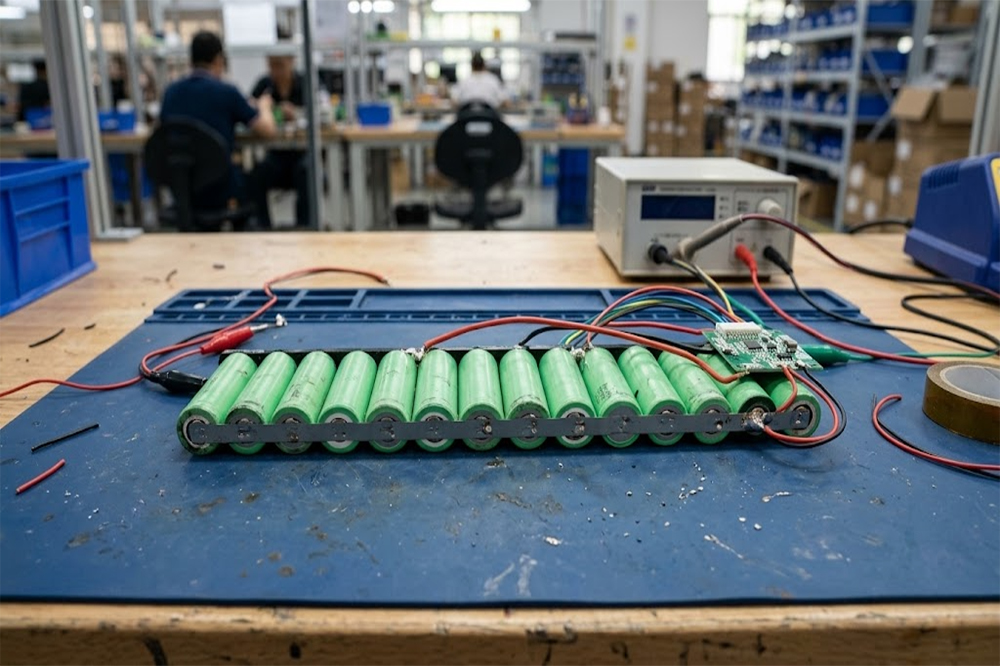
Connecting 18650 cells in series increases voltage, while connecting them in parallel increases capacity and current capability. The right configuration depends on the equipment’s voltage, runtime, current demand and available installation space.
An individual 18650 cell is relatively simple.
Usually around 3.6V or 3.7V nominal.
But most commercial products do not run from a single cell. Once several cells are combined, the battery starts to look very different.
You may see specifications such as:
3S1P
3S2P
4S2P
5S3P
At first, these codes can look like something from an engineering drawing rather than a battery specification.
They are actually quite easy to understand once you separate the two letters.
S = Series
P = Parallel
The series part mainly determines voltage.
The parallel part mainly determines capacity and current capability.
That basic idea is enough to understand most 18650 battery-pack configurations, although a real production pack involves quite a bit more than simply connecting cells together.
What Does “S” Mean in an 18650 Battery Pack?
“S” means series connection.
When cells are connected in series, their voltages add together.
For example, if we use a typical 3.7V nominal 18650 cell:
1S = 3.7V nominal
2S = 7.4V nominal
3S = 11.1V nominal
4S = 14.8V nominal
5S = 18.5V nominal
6S = 22.2V nominal
These are nominal values.
A typical lithium-ion cell can reach around 4.2V when fully charged, so the maximum pack voltage is higher.
For example:
3S → 12.6V full charge
4S → 16.8V full charge
6S → 25.2V full charge
This distinction matters when the battery is connected to electronic equipment.
A device designed for a particular voltage range needs to tolerate the battery’s actual operating range, not just the nominal number printed on the label.
What Does “P” Mean?
“P” means parallel connection.
When cells are connected in parallel, their nominal voltage stays approximately the same, while their capacity increases.
For example, imagine one cell has:
3.7V / 3000mAh
Then:
1S1P = 3.7V / 3000mAh
Two identical cells in parallel become approximately:
1S2P = 3.7V / 6000mAh
Three cells:
1S3P = 3.7V / 9000mAh
Four cells:
1S4P = 3.7V / 12000mAh
The actual usable capacity can vary depending on the cell, discharge conditions and battery management system.
But as a basic way to understand the configuration, the calculation is straightforward.

So What Does 3S2P Actually Mean?
This is probably the configuration buyers encounter most often.
3S2P means:
- 3 cells or cell groups connected in series
- 2 cells connected in parallel within each group
Total cells:
3 × 2 = 6 cells
Using 3000mAh, 3.7V cells as an example:
Nominal voltage: 3 × 3.7V = 11.1V
Capacity: 2 × 3000mAh = 6000mAh
So the battery would be approximately:
11.1V / 6000mAh
At full charge:
3 × 4.2V = 12.6V
This is a simplified example, but it is useful for understanding how the numbers work.
4S2P: Another Common Example
Now let’s take:
4S2P
This uses:
4 × 2 = 8 cells
With 3000mAh cells:
Nominal voltage: 4 × 3.7V = 14.8V
Capacity: 2 × 3000mAh = 6000mAh
Full charge:
4 × 4.2V = 16.8V
Notice something interesting here.
Compared with the 3S2P example, the capacity is the same, but the voltage is higher.
That is because we added cells in series rather than parallel.
This is one of the reasons battery designers often start with the equipment’s voltage requirement before deciding how many cells should be used.
Series vs Parallel: The Quick Comparison
| Configuration | Voltage | Capacity | Main Purpose |
|---|---|---|---|
| 1S1P | Base voltage | Base capacity | Small devices |
| 2S1P | Higher | Same | Higher voltage |
| 3S1P | Higher | Same | Higher voltage |
| 1S2P | Same | 2× | More capacity |
| 2S2P | Higher | 2× | Higher voltage + capacity |
| 3S2P | Higher | 2× | Higher voltage + capacity |
| 4S3P | Higher | 3× | Higher voltage + capacity |
The exact numbers depend on the cell specification.
The useful part is understanding the direction:
Series → voltage
Parallel → capacity/current capability

Why Not Just Keep Adding Cells?
Because battery design has limits.
Adding more cells can increase voltage, capacity and power capability, but it also increases:
- Weight
- Pack size
- Cost
- Heat
- Assembly complexity
- BMS requirements
- Failure points
Imagine an equipment manufacturer asks for a battery that provides more runtime.
One solution might be to increase the number of cells in parallel.
But if there is only a small battery compartment, that solution may not physically work.
This is where battery design becomes a balancing exercise.
You have electrical requirements on one side and mechanical restrictions on the other.
If you have not checked the available space yet, our earlier guide to 18650 battery size and dimensions is worth reading before deciding on a pack arrangement.
Series and Parallel Connections Affect Current Too
It is common to say:
Series increases voltage, parallel increases capacity.
That is a useful starting point, but it is not the entire story.
Parallel cells can also share the load current.
For example, if a particular cell configuration is designed to support a certain continuous current, adding parallel cells can distribute the current demand across the parallel group.
This is especially relevant to high-current applications.
Suppose the equipment needs a substantial current at startup.
The designer may need to increase the number of cells in parallel rather than simply increasing the number in series.
This is why the high-drain vs high-capacity 18650 battery guide is useful when selecting cells for power tools, motors and other demanding applications.
The cell itself, however, still needs to be suitable for the required current. Parallel connection is not a way to ignore the manufacturer’s limits.
Why Do 18650 Battery Packs Need a BMS?
A multi-cell lithium-ion battery pack normally needs appropriate battery management and protection.
The BMS can perform functions such as:
- Overcharge protection
- Over-discharge protection
- Over-current protection
- Cell balancing
- Temperature monitoring
The exact BMS functions depend on the design.
For example, a 4S pack requires a BMS designed for the appropriate 4-series configuration.
A BMS designed for a different series count should not simply be substituted because the connector looks similar.
This is one area where battery-pack assembly needs proper engineering rather than trial and error.
Cell Matching Matters More Than People Expect
Suppose you have eight 18650 cells.
They look identical from the outside.
That does not necessarily mean they behave identically.
Cells can differ in:
- Capacity
- Internal resistance
- Self-discharge
- Age
- State of charge
If cells with significantly different characteristics are assembled into the same pack, the pack can become harder to manage.
For commercial battery production, cells should be properly selected and matched according to the pack design and manufacturer’s process.
This becomes particularly important as the number of series-connected cells increases.
Series Packs Need More Attention to Cell Balance
Imagine a 4S pack.
Ideally, the four series groups should remain reasonably balanced.
If one group reaches its upper voltage limit earlier than the others, the charging process cannot simply continue as though all four groups were identical.
This is one reason cell balancing is important.
The BMS monitors the cell groups and helps manage differences within its design limits.
However, a BMS should not be treated as a magic solution for badly matched cells.
Good cell selection and pack assembly still matter.
How Many 18650 Batteries Do You Need?
There is no single answer.
It depends on what you are trying to achieve.
For example:
Need around 12V?
A typical lithium-ion approach may use:
3S
Need more capacity at the same voltage?
Add parallel cells:
3S2P
3S3P
3S4P
Need around 24V?
A configuration around:
6S
may be considered, depending on the required nominal voltage and equipment voltage range.
Then parallel groups can be added if more capacity or current capability is needed.
But do not design the pack from the voltage number alone.
The load, runtime, maximum current, dimensions and BMS all need to be considered.
A Simple 18650 Pack Calculation
Let’s use a practical example.
Suppose you need:
11.1V nominal
6Ah capacity
And you are considering:
3.7V / 3000mAh cells
First, series:
11.1V ÷ 3.7V = 3 cells
So:
3S
Then capacity:
6Ah ÷ 3Ah = 2
So:
2P
Final configuration:
3S2P
Total cells:
3 × 2 = 6
This is the basic calculation.
For a real production battery, you would then need to check current, BMS, dimensions, thermal conditions, connectors, charging requirements and cell specifications.
What If the Required Capacity Is Not an Exact Multiple?
This happens all the time.
For example, perhaps the target is:
11.1V / 7Ah
but the selected cell is:
3000mAh
You cannot simply make 2.33 parallel cells.
The configuration has to use whole cells.
You might need:
3S3P = 9Ah
or reconsider the cell selection.
This is one reason custom battery projects sometimes involve comparing several cell capacities before finalizing the design.
A slightly different cell can produce a much more practical pack.
Series and Parallel Design Also Changes Pack Dimensions
This is where electrical calculations meet mechanical engineering.
A 3S2P pack has six cells.
But there are several ways to arrange those six cells.
You might place them:
- Side by side
- Two rows
- Staggered
- In a custom holder
- In a long narrow configuration
The final shape depends on the product enclosure.
For an OEM project, providing the supplier with the maximum available:
Length × Width × Height
can make the design process much easier.
You can also review the 18650 battery size and dimensions guide before finalizing the mechanical layout.

What Should Wholesale Buyer Tell the Supplier?
If you are buying individual cells, you may only need to specify:
- Cell format
- Capacity
- Voltage
- Discharge current
- Quantity
If you need a complete battery pack, provide:
- Nominal voltage
- Required capacity
- Continuous current
- Peak current
- Maximum dimensions
- Connector
- Application
- Quantity
For example:
18650 battery pack
14.8V nominal
6Ah
10A continuous
15A peak
Maximum size: 150 × 40 × 70mm
Quantity: 2,000 pcs
That is much easier for a battery manufacturer to work with than simply asking for a “24V 18650 battery.”
Series and Parallel Are Only the Beginning
The S/P configuration tells you how the cells are arranged electrically.
It does not tell you everything about the finished battery.
A production battery also includes:
- Cells
- BMS
- Insulation
- Nickel strips or busbars
- Wiring
- Connector
- Housing
- Protection materials
- Charging system
For some applications, thermal management may also become important.
So if you are developing a commercial battery pack, it is better to think of the 18650 cells as the foundation rather than the complete product.
For standard 18650 cell sourcing, you can also review the Apsenx 18650 lithium battery product category.
If you already know the required voltage, capacity and dimensions, those details can be used to start a more specific OEM discussion.
A Small Configuration Change Can Change the Whole Battery
This is one of the practical lessons with 18650 packs.
Changing from:
3S2P
to:
4S2P
does not just add two cells.
It changes the nominal voltage, maximum voltage, BMS configuration and potentially the equipment’s electrical compatibility.
Changing:
3S2P
to:
3S3P
keeps the basic voltage configuration but increases capacity, cell count, weight and pack size.
So the S/P configuration should be treated as part of the product design, not just a calculation made at the end.
FAQ
What does 3S2P mean on 18650 battery?
3S2P means three cell groups are connected in series, with two cells connected in parallel in each group. The configuration uses six cells in total.
Does series increase 18650 battery capacity?
No. Series connection primarily increases voltage. The capacity in Ah generally remains based on the parallel count, assuming identical cells.
Does parallel connection increase voltage?
No. Parallel cells normally maintain approximately the same nominal voltage while increasing capacity and current-sharing capability.
How many cells are in 4S2P 18650 battery?
A 4S2P pack contains eight cells: four series groups with two cells in parallel in each group.
Do I need a BMS for a series 18650 battery pack?
A properly designed multi-cell lithium-ion pack generally requires an appropriate battery management and protection system. The BMS needs to match the series configuration and application requirements.
-

12V 4400 mah Lithium ion 3S2P 18650 Battery Pack
-

18650 2000mAh 3.7 volt Lithium-ion Battery
-

18650 20V 3.0Ah Cordless Drill battery
-

18650 22.2V 7.8Ah 2600Mah 6S3P Rechargeable Battery Pack
-

18650 2600mAh Rechargeable Lithium-Ion Battery 3.7V
-

18650 3.7V 10Ah Li-Ion Power Battery Pack
-

18650 3.7V 3300mah Rechargeable Lithium ion Battery
-

18650 7S7P 24V 14Ah Lithium ion Electric Scooter Battery Pack
-

18650 battery 3.7V 1500mAh Lithium-Ion Battery
-

18650 Battery 3500 mah Rechargeable Battery Cells
-

18650 Electric Scooter 48V 13000mAh Lithium Battery
-

2600mAh 3S1P 11.1V 18650 Battery Packs
-

3.7V Li ion Rechargeable 3000mah 18650 Battery Cell
-

36V 5200mAh 10S2P 18650 Battery Pack
-

48v 4400mah 13S2P 18650 Rechargeable Battery Pack
-

7S2P 24V 18650 Lithium Battery Pack
-

Electric Scooter 36V 4400mAH 10S2P 18650 Battery Pack
-

ICR 18650 Battery 2200mah 3.7V
Leave a Reply