
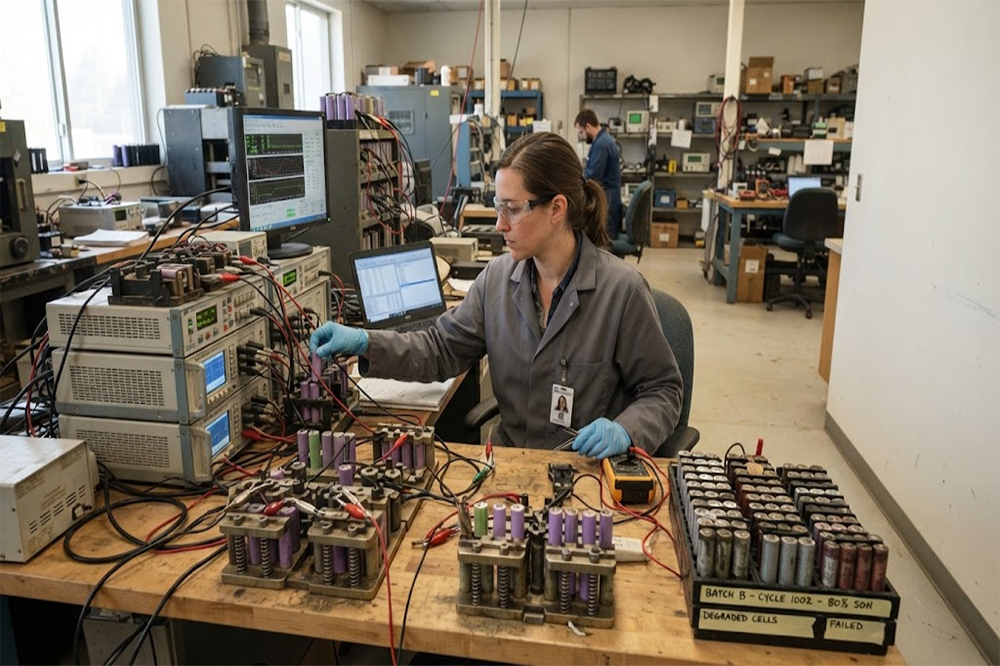
A good-quality 18650 lithium battery can provide hundreds of charge and discharge cycles, but actual service life depends heavily on temperature, charging conditions, discharge current, depth of discharge and storage. For OEM buyers, cell quality and operating conditions often matter more than the advertised cycle-life number alone.
Before looking at battery lifespan, it helps to understand the basic 18650 specifications and how they affect battery selection. Our complete 18650 lithium battery guide covers cell voltage, capacity, applications, pack design and wholesale purchasing considerations.
How Long Do 18650 Lithium Batteries Last?
One of the first questions we hear when someone starts planning an 18650 battery project is surprisingly simple:
“How long will the battery last?”
The difficult part is that there isn’t one number that works for every 18650 lithium battery.
A battery used in a low-power sensor may have a very different life from one installed in a power tool.
One may be charged gently every few days.
The other might be pushed hard several times a day.
Both use 18650 cells, but the working conditions are completely different.
For many quality lithium-ion cells, cycle life can reach several hundred cycles or more under specified test conditions. Some cells and applications can achieve much more. But the number shown on a datasheet is normally based on a particular test method, temperature, charge rate, discharge rate and end-of-life definition.
That last part gets overlooked quite often.
What Does “Battery Life” Actually Mean?
There are two different things people often mean when they ask about 18650 battery life.
Runtime
How long the battery powers a device after one charge.
For example:
“My device runs for 8 hours.”
Service Life
How long the battery remains useful before its capacity or performance drops too far.
For example:
“The battery lasted three years.”
These are not the same thing.
A battery can provide 8 hours of runtime when new and perhaps 6 hours after significant aging.
So when discussing 18650 battery lifespan, we are mainly talking about service life and cycle life.
If you are more interested in how capacity affects runtime, our guide to [18650 battery capacity] covers the relationship between mAh, energy and operating time.

How Many Cycles Can an 18650 Battery Last?
There is no universal cycle count.
A common range for quality rechargeable lithium-ion cells is several hundred full-equivalent cycles, while some cells designed for particular applications can reach well beyond that under suitable conditions.
But there is an important detail.
A “cycle” does not always mean:
100% → 0% → 100%
If a battery is discharged from 100% to 50%, then charged again, that is roughly half of a full-equivalent cycle.
Two such cycles would represent approximately one full-equivalent cycle.
So if a manufacturer specifies cycle life under a particular test, you need to know how that test was performed.
A cell tested at moderate current and controlled temperature may last much longer than the same cell operated continuously under harsh conditions.
What Happens to 18650 Battery as It Ages?
Lithium-ion batteries do not suddenly become useless after a certain number of cycles.
The change is usually gradual.
Over time, you may notice:
- Lower available capacity
- Increased internal resistance
- More voltage drop under load
- Shorter runtime
- Increased heat under heavy load
- Reduced ability to deliver peak current
Imagine a portable device that originally runs for 10 hours.
After significant aging, perhaps it only runs for 7 or 8 hours.
The battery hasn’t necessarily “failed.”
It has simply lost part of its original performance.
For some products, that reduction is acceptable.
For others, it may trigger battery replacement.
Temperature Has Big Influence on Battery Life
If there is one factor worth paying close attention to, it is temperature.
Lithium-ion cells generally perform best within their specified operating temperature range.
High temperatures can accelerate aging.
Very low temperatures can temporarily reduce available performance and increase internal resistance.
The problem becomes more obvious in applications that generate heat themselves.
For example, imagine a battery pack inside a power tool.
The motor is working hard.
The cells are delivering high current.
The electronics are generating heat.
The battery enclosure has limited airflow.
Now the battery is operating under several stresses at once.
This is quite different from a low-current sensor sitting indoors at a stable temperature.
For an OEM project, the real operating environment should be part of the cell selection process.
High Current Can Reduce Battery Life
Current matters for two reasons.
First, high current can increase heat generation inside the cell.
Second, repeated heavy loads can place more stress on the battery.
This is why a high-drain 18650 cell may be a better choice for a power tool than a high-capacity cell that was designed mainly around energy density.
The higher-current cell is not necessarily “better.”
It is simply designed for a different job.
If your application has a demanding load, our previous guide to [high-drain vs high-capacity 18650 batteries] explains this trade-off in more detail.
For a commercial battery pack, the continuous and peak current should be known before the cell is finalized.
Depth of Discharge Matters Too
Consider two batteries.
Battery A
Frequently discharged from 100% down to almost empty.
Battery B
Usually operates between roughly 30% and 80%.
They may have the same cell chemistry, but their aging behavior can be different.
In general, repeatedly using very deep discharge cycles can put more stress on a lithium-ion battery than shallower cycling.
This doesn’t mean you need to keep an 18650 battery at exactly 50% all the time.
Real products don’t work that way.
But if a system can avoid repeatedly pushing the cells to their absolute limits, battery life may benefit.
The BMS and system-level battery management strategy therefore become important.
Charging Habits Also Affect 18650 Battery Life
Charging is another area where the details matter.
A lithium-ion battery should be charged according to the cell manufacturer’s specified charging method.
Problems can arise when:
- Charging voltage is incorrect
- Charging current is too high
- The battery becomes too hot during charging
- The BMS or charger is poorly matched
- Cells become significantly unbalanced
For a multi-cell pack, the charger and BMS need to work with the pack’s series configuration.
For example, a 3S lithium-ion pack has a full-charge voltage around:
3 × 4.2V = 12.6V
A 4S pack reaches around:
4 × 4.2V = 16.8V
The charging system therefore needs to match the actual pack configuration.
If you are not familiar with the difference between nominal and full-charge voltage, see our [18650 battery voltage guide].
Storage Can Affect Battery Aging
Not every 18650 battery spends its life cycling.
Some sit in warehouses.
Others remain inside equipment for months.
Storage conditions matter.
High temperature is generally undesirable for long-term storage.
A battery stored for a long period should also be handled according to the cell manufacturer’s recommended state of charge and temperature conditions.
This is particularly relevant to wholesalers.
Imagine receiving a large shipment of 18650 cells and leaving the inventory in a hot warehouse for an extended period.
The cells may still look completely normal.
There may be no obvious external damage.
But storage conditions can still affect long-term performance.
For large-volume purchasing, warehouse management is part of battery quality control.
Why Does Internal Resistance Increase With Age?
As lithium-ion cells age, their internal resistance can increase.
That has a practical effect.
When the equipment draws current, more voltage can be lost inside the cell.
A simplified relationship is:
Voltage Drop = Current × Internal Resistance
Suppose the load suddenly increases.
A newer cell with lower internal resistance may maintain voltage better.
An older cell with higher internal resistance may show a larger voltage drop.
This can be especially noticeable in motor-driven products.
The device may still turn on, but acceleration or peak performance may not be the same as when the battery was new.

Capacity Loss Isn’t Always the Same for Every Cell
Two cells with the same nominal capacity can age differently.
Why?
Because actual battery life depends on more than the printed mAh rating.
Factors include:
- Cell chemistry
- Electrode design
- Manufacturing quality
- Charge conditions
- Discharge current
- Temperature
- Storage
- Depth of discharge
- Cell matching
- Battery-pack design
This is one reason buying only on price can create problems later.
A cheap cell that performs well in the first few months may not necessarily be the cheapest option over the complete product lifecycle.
For OEM products, replacement costs, warranty claims and field failures can quickly become more expensive than the original cell price difference.
How Long Does 18650 Battery Last in Real Products?
There is no reliable universal answer such as “three years” or “five years.”
Instead, think about usage.
Light Usage
A battery used occasionally with relatively low current may remain useful for several years.
Daily Moderate Usage
A device charged and discharged regularly may reach its practical replacement point sooner.
Heavy-Duty Usage
Power tools, robotics and high-current equipment can place significantly more stress on the cells.
Constant High Temperature
Even moderate electrical loads can become problematic if the battery operates in a hot environment for long periods.
This is why the same 18650 cell can have very different real-world service lives in different products.
A Simple Example
Imagine an industrial monitoring device.
It uses a 3000mAh 18650 battery.
The device consumes relatively little power and is only charged every few days.
The battery operates indoors at moderate temperature.
That is a relatively comfortable environment for the cell.
Now compare that with a power tool.
The battery may be discharged heavily every day.
The current can be high.
The motor generates heat.
The battery is repeatedly charged and discharged.
The physical environment may also be much rougher.
Both products may use 3000mAh 18650 cells.
But expecting them to have the same battery lifespan would not make much sense.
How Can You Make 18650 Battery Last Longer?
There are a few practical things worth doing.
Avoid unnecessary extreme temperatures
Keep the battery within the manufacturer’s specified operating and storage range.
Use the correct charger
Do not improvise charging parameters.
Avoid unnecessary deep discharge
If the product can shut down before the cells are pushed to their limits, that can help.
Match the cell to the load
Do not use a low-drain cell in an application that repeatedly demands high current.
Design the battery pack properly
BMS, cell matching, connections and thermal management all matter.
Store batteries correctly
For long-term inventory, follow the supplier’s recommended storage conditions.
These sound like basic points, but in actual battery projects, the basic things often make the difference.
What Does Cycle Life Mean for Wholesale Buyers?
If you are buying 18650 cells for an OEM project, don’t ask only:
“How many cycles?”
Ask:
“How many cycles under what test conditions?”
You may want to know:
- Charge current
- Discharge current
- Charge voltage
- Discharge cutoff
- Temperature
- End-of-life capacity percentage
- Rest time between cycles
For example, “500 cycles” by itself doesn’t tell you very much.
500 cycles at one set of conditions and 500 cycles at another set of conditions can produce very different results.
For serious projects, request the cell datasheet and test conditions before making a large purchase.
When Should 18650 Battery Be Replaced?
Replacement depends on the product.
You might replace a battery when:
- Runtime becomes too short
- Voltage drops too much under load
- Capacity falls below the required level
- The battery becomes unusually hot
- Physical damage is visible
- The BMS reports a fault
- The product can no longer meet its required performance
Do not continue using a cell that is swollen, leaking, physically damaged or showing other abnormal behavior.
For commercial products, the replacement threshold should ideally be defined during product development rather than after batteries begin failing in the field.
Battery Life Starts With Cell Selection
A long-lasting battery pack is not created by choosing a high cycle-life number and stopping there.
The cell has to match the application.
The pack has to match the cell.
The charger has to match the pack.
And the operating environment has to stay within the intended range.
This is particularly important for wholesale and OEM buyers because a battery may spend years inside someone else’s product.
A small difference in cell quality can become a much larger difference after thousands of hours of operation.
For standard 18650 lithium battery sourcing, you can review the Apsenx 18650 lithium battery product category and discuss capacity, current, dimensions and application requirements before placing a bulk order.

Frequently Asked Questions
How long does 18650 lithium battery last?
There is no fixed lifespan. Quality cells can provide several hundred cycles or more under suitable conditions, but actual service life depends on temperature, current, charging, discharge depth, storage and application.
How many cycles can 18650 battery handle?
Many quality 18650 cells are rated for several hundred cycles, while some are designed for considerably more. Always check the manufacturer’s test conditions and end-of-life definition rather than comparing cycle numbers alone.
Does high current reduce 18650 battery life?
Repeated high-current operation can increase heat and battery stress. For demanding applications, selecting a cell designed for the required continuous and peak current can help achieve better performance and service life.
How do I make 18650 battery last longer?
Use the correct charger, avoid excessive heat, avoid unnecessary deep discharge, select a cell suitable for the load and store the battery according to the manufacturer’s recommendations.
When should 18650 battery be replaced?
Replace it when capacity or runtime falls below the product requirement, voltage performance becomes inadequate, or the cell shows abnormal heating, physical damage, leakage or other safety concerns.
-

12V 4400 mah Lithium ion 3S2P 18650 Battery Pack
-

18650 2000mAh 3.7 volt Lithium-ion Battery
-

18650 20V 3.0Ah Cordless Drill battery
-

18650 22.2V 7.8Ah 2600Mah 6S3P Rechargeable Battery Pack
-

18650 2600mAh Rechargeable Lithium-Ion Battery 3.7V
-

18650 3.7V 10Ah Li-Ion Power Battery Pack
-

18650 3.7V 3300mah Rechargeable Lithium ion Battery
-

18650 7S7P 24V 14Ah Lithium ion Electric Scooter Battery Pack
-

18650 battery 3.7V 1500mAh Lithium-Ion Battery
-

18650 Battery 3500 mah Rechargeable Battery Cells
-

18650 Electric Scooter 48V 13000mAh Lithium Battery
-

2600mAh 3S1P 11.1V 18650 Battery Packs
-

3.7V Li ion Rechargeable 3000mah 18650 Battery Cell
-

36V 5200mAh 10S2P 18650 Battery Pack
-

48v 4400mah 13S2P 18650 Rechargeable Battery Pack
-

7S2P 24V 18650 Lithium Battery Pack
-

Electric Scooter 36V 4400mAH 10S2P 18650 Battery Pack
-

ICR 18650 Battery 2200mah 3.7V
Leave a Reply