
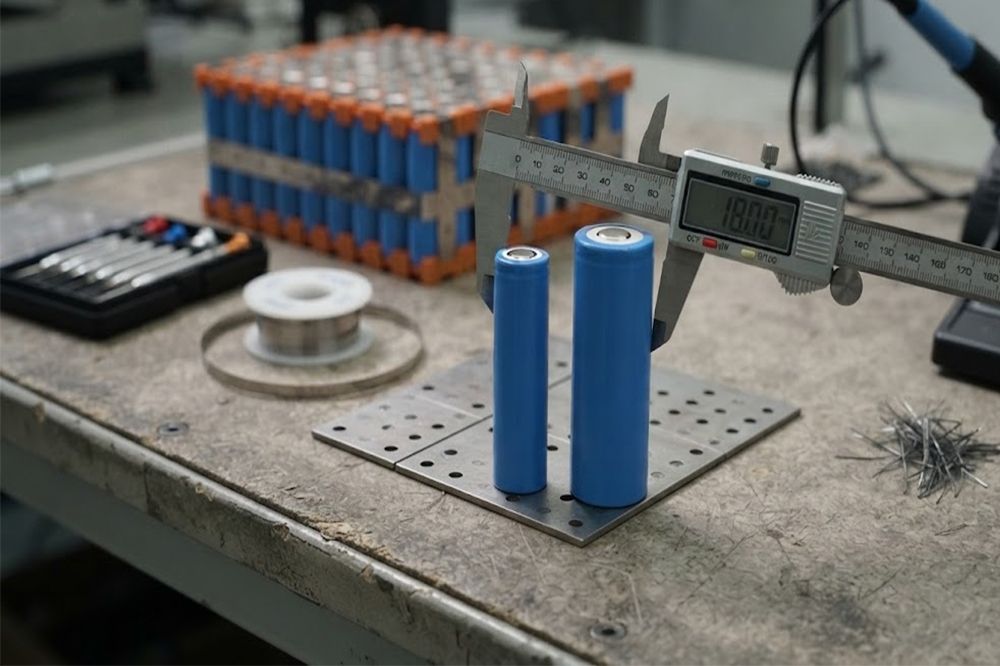
18650 and 21700 lithium batteries use the same basic cylindrical lithium-ion concept, but their physical size, capacity and pack characteristics are different. For OEM buyers, 21700 can offer more energy per cell, while 18650 can still make more sense when space, existing tooling, cost or compatibility are the priority.
18650 vs 21700: Should You Really Switch to the Bigger Cell?
The 21700 battery looks like a natural replacement for the 18650.
It is bigger.
It can usually hold more energy.
And for some applications, that extra capacity is very useful.
But bigger does not automatically mean better.
This is something that becomes obvious when you start designing a real battery pack rather than comparing two cells on a product page.
An existing product may already have an enclosure designed around 18650 cells. The battery holder, BMS, welding fixture and internal wiring may all be based on that format.
Changing to 21700 is no longer just a cell replacement.
The whole pack may need to change.
So when someone asks, “Is 21700 better than 18650?”, my answer would usually be:
It depends on what you are trying to improve.
If the goal is more energy in a similar cylindrical-cell architecture, 21700 is interesting.
If the goal is keeping an existing compact product or reducing changes to production, 18650 may still be the more practical choice.
What Is the Difference Between 18650 and 21700?
The numbers describe the approximate physical dimensions.
18650
- About 18mm diameter
- About 65mm length
21700
- About 21mm diameter
- About 70mm length
The 21700 is therefore both wider and longer.
That sounds like a small difference.
It isn’t.
When you place dozens or hundreds of cells into a battery pack, those extra millimeters can change the entire mechanical layout.
A pack designed around 18650 cells cannot simply accept 21700 cells because the cells “look similar.”
The holder, spacing, enclosure and connections need to be checked.
For a closer look at 18650 dimensions, see our [18650 battery size and dimensions guide].

Why Is the 21700 Bigger?
The larger cylindrical format provides more internal volume.
That gives cell manufacturers more room to design for higher energy storage and, depending on the cell chemistry and construction, higher power capability.
You will often find 21700 cells with capacities above many common 18650 cells.
For example, a 3000mAh 18650 might be compared with a 4000mAh or 5000mAh-class 21700.
But this is not a universal rule.
There are different 21700 cells with different chemistry, capacity and discharge characteristics.
Likewise, not every 18650 is a low-capacity cell.
So it is better to compare actual datasheets rather than treating the format number as a performance specification.
18650 vs 21700 Capacity
This is where 21700 becomes attractive for many battery manufacturers.
Suppose you compare:
18650: 3000mAh
with:
21700: 5000mAh
At a nominal voltage of around 3.6–3.7V, the approximate energy per cell would be:
18650
3.7V × 3Ah ≈ 11.1Wh
21700
3.7V × 5Ah ≈ 18.5Wh
That’s a noticeable difference.
Fewer cells may be needed to achieve a particular total energy target.
For example, if the product needs roughly 1kWh of battery energy, the 21700 configuration could potentially use fewer cells than an equivalent 18650 design.
That can simplify some aspects of pack construction.
But there is a catch.
The larger cell also takes up more space individually.
So whether the final battery becomes smaller depends on the complete pack layout, not just the Wh per cell.
Does 21700 Have More Voltage Than 18650?
Not necessarily.
This is an important point.
18650 and 21700 are physical formats, not voltage specifications.
Both can use lithium-ion chemistry with a nominal voltage around 3.6V or 3.7V, depending on the cell design.
So:
18650 ≠ a specific voltage
and
21700 ≠ a specific voltage
If you connect either type in series, the pack voltage increases according to the number of cells or series groups.
For example:
4S 18650
and
4S 21700
can both have approximately:
14.4–14.8V nominal
depending on the specific cells.
The physical cell format does not determine the battery-pack voltage.
For more detail, see our [18650 battery voltage guide].
Which Has Better Discharge Current?
This one is less straightforward.
Some 21700 cells offer very high continuous discharge capability.
Some 18650 cells also have excellent high-drain performance.
So you cannot say:
“21700 always has higher current.”
That would be too simple.
The actual discharge rating comes from the cell design.
For a power tool, electric vehicle or other high-load application, compare:
- Continuous discharge current
- Peak discharge current
- Internal resistance
- Operating temperature
- Capacity under load
- Cycle life
If the application requires high current, our [high-drain vs high-capacity 18650 battery guide] explains why capacity alone should not determine your cell selection.
What About Battery Pack Size?
This is where the comparison gets interesting.
Suppose you want to build a pack with a certain voltage and energy target.
The 21700 may require fewer cells because each cell stores more energy.
For example, you might compare:
18650: 3Ah
with:
21700: 5Ah
If both are used in a 10S configuration:
10S1P 18650
Approximately:
36–37V / 3Ah
10S1P 21700
Approximately:
36–37V / 5Ah
Same series count.
Different capacity.
The 21700 pack has more energy from the same number of cells.
But the physical pack dimensions can be different.
That’s why battery designers normally look at both electrical and mechanical requirements at the same time.

Does 21700 Always Make the Battery Smaller?
Not necessarily.
This is a common misunderstanding.
A 21700 cell has more energy, but it is also physically larger.
If you only need a small battery, the larger cell may actually make packaging harder.
For example, imagine a handheld device with a narrow battery compartment.
An 18650 cell might fit comfortably.
A 21700 may be too wide.
Even if the 21700 provides more energy, it doesn’t help if you cannot physically fit it inside the product.
For OEM projects, the enclosure usually tells you more about the appropriate cell format than the marketing specification does.
18650 Can Still Be the Better Choice
The 18650 format has been around for a long time.
That means there is a huge ecosystem around it.
You can find:
- Cell holders
- Battery cases
- Welding fixtures
- BMS solutions
- Charging systems
- Pack designs
- Production equipment
For a manufacturer already producing 18650 packs, moving to 21700 may require additional tooling and process changes.
Sometimes the product doesn’t need the extra capacity anyway.
If a 3000mAh 18650 already gives the required runtime, switching to a larger cell could simply add unnecessary cost and redesign work.
This is especially true for mature products.
When 21700 Starts to Make More Sense
21700 becomes more attractive when the project needs more energy from each cell.
For example:
Electric Vehicles
More energy per cell can help reduce the number of cells required for certain pack designs.
E-Bikes
A larger cell can provide a useful balance between capacity and current capability.
Power Tools
Some high-performance tools use larger-format cylindrical cells to achieve higher pack energy and power.
Energy Storage
The larger capacity per cell can simplify certain battery configurations.
High-End Portable Equipment
If the enclosure can accommodate the larger diameter, the additional energy may be valuable.
The exact result still depends on the cell.
18650 vs 21700: A Practical Comparison
| Specification | 18650 | 21700 |
|---|---|---|
| Approx. diameter | 18mm | 21mm |
| Approx. length | 65mm | 70mm |
| Cell volume | Smaller | Larger |
| Typical capacity range | Broad | Often higher |
| Energy per cell | Lower in many cases | Often higher |
| High-drain options | Available | Available |
| Existing ecosystem | Very mature | Growing/mature |
| Pack size | More compact cell | Larger cell |
| Best advantage | Compatibility & compactness | Higher energy per cell |
The word “typical” is important here.
There are exceptions in almost every row.
What Happens to Cell Count?
Suppose a battery manufacturer wants to build a 10S pack.
With 18650 cells:
10S2P = 20 cells
With 21700 cells:
10S2P = 20 cells
The number of cells is the same.
But the capacity can be very different.
Now imagine the manufacturer wants a certain capacity.
The 18650 pack may need:
10S3P
while a higher-capacity 21700 cell may achieve the same target with:
10S2P
Now the cell count drops from:
30 cells → 20 cells
That’s a significant change.
It can affect:
- Welding points
- BMS design
- Pack weight
- Assembly time
- Internal resistance
- Wiring
- Production cost
- Available space
This is one of the strongest arguments for considering 21700 in a new battery design.

But Fewer Cells Does Not Automatically Mean Lower Cost
This is another place where the simple calculation can be misleading.
A 21700 cell may cost more per unit than an 18650 cell.
You need to compare the cost of the complete battery pack, not only the price of one cell.
A 21700 design might use fewer cells and fewer welding points.
That could offset some of the higher cell cost.
On the other hand, an existing 18650 production line may already be optimized, making the 18650 battery pack cheaper to manufacture.
For large-volume OEM projects, production efficiency can matter as much as the cell price.
What About Battery Weight?
Again, don’t assume that bigger automatically means heavier in the final product.
A single 21700 cell will generally weigh more than a single 18650.
But if the 21700 configuration uses fewer cells to achieve the same energy target, the total pack weight may not increase proportionally.
The correct comparison is:
same voltage + same usable energy + same current requirement
Then compare:
- Total cell count
- Cell weight
- Pack structure
- BMS
- Wiring
- Housing
That gives a more meaningful answer.
Can You Replace 18650 With a 21700?
Usually, not as a direct drop-in replacement.
Even if the nominal voltage is similar, the physical dimensions are different.
You also need to check:
- Battery holder
- Cell spacing
- Pack enclosure
- BMS
- Current requirements
- Charging system
- Welding process
- Thermal conditions
If you’re developing a new product, you can select either format at the beginning.
If you’re modifying an existing 18650 product, switching to 21700 needs more careful mechanical and electrical evaluation.
What Should OEM Buyers Compare?
If you are deciding between 18650 and 21700 for a commercial project, I would compare at least these points:
1. Required Energy
How many Wh does the product actually need?
2. Current Demand
What is the normal current?
What is the peak?
3. Available Space
This can eliminate one format very quickly.
4. Weight Target
A larger cell may or may not improve the final pack weight.
5. Production Cost
Look at the complete pack rather than only the individual cell price.
6. Existing Production Setup
If you already have an 18650 production line, changing formats has a cost.
7. Expected Battery Life
Cell chemistry, temperature and operating conditions still matter regardless of format.
Our [18650 battery life guide] explains the factors that influence cycle life and long-term performance.
A Simple Example From OEM Project
Imagine a company is developing a portable industrial device.
The first prototype uses:
10 × 18650 cells
The team discovers that the battery capacity is slightly below the target.
There are several possible solutions.
They could:
- Increase the number of parallel cells
- Choose a higher-capacity 18650
- Redesign the enclosure
- Consider 21700 cells
The last option may provide more capacity per cell.
But if the enclosure is already close to the maximum size, it might create another problem.
This is why battery design rarely has one perfect answer.
Sometimes the best solution is not the newest cell format.
It is the format that creates the fewest problems for the entire product.
Should New Project Start With 18650 or 21700?
If you are developing a completely new product, there is no reason to automatically choose 18650 simply because it is familiar.
At the same time, there is no reason to choose 21700 simply because it is larger.
Start with:
Voltage
Capacity
Continuous current
Peak current
Runtime
Available dimensions
Weight
Target production quantity
Then compare both formats.
For standard 18650 cells, you can also review the Apsenx 18650 lithium battery product category when comparing available cell options for wholesale sourcing.
18650 or 21700? It Depends on the Product
If your project needs more energy per cell and has enough room for a larger cylindrical format, 21700 is worth serious consideration.
If your product is compact, already designed around 18650 cells, or doesn’t need the extra energy, 18650 can still be a very sensible choice.
There is no prize for using the largest cell.
What matters is whether the battery fits the product, the electrical load and the production budget.
For a new OEM battery project, comparing both formats at the prototype stage is usually much easier than trying to change the cell format after production tooling has already been completed.
Frequently Asked Questions
Is 21700 better than 18650?
Not always. 21700 can provide more capacity per cell, but 18650 may be better for compact products, existing designs or applications that do not need additional energy.
Can I replace an 18650 with a 21700?
Usually not as a direct replacement. The 21700 is larger, so the battery holder, enclosure, spacing, BMS and pack structure may need to be redesigned.
Does a 21700 battery have higher voltage than an 18650?
Not necessarily. Both formats can have similar nominal lithium-ion voltage. Voltage mainly depends on the cell chemistry and the number of cells connected in series.
Does 21700 last longer than 18650?
Not automatically. Battery life depends on cell chemistry, charging, discharge current, temperature, depth of discharge and other operating conditions rather than cell format alone.
Which is better for an OEM battery pack?
It depends on the application. 21700 can be attractive when higher energy per cell is useful, while 18650 can be preferable when compact dimensions, existing tooling or compatibility are more important.
-

12V 4400 mah Lithium ion 3S2P 18650 Battery Pack
-

18650 2000mAh 3.7 volt Lithium-ion Battery
-

18650 20V 3.0Ah Cordless Drill battery
-

18650 22.2V 7.8Ah 2600Mah 6S3P Rechargeable Battery Pack
-

18650 2200Mah 10S3P 36V 6.6Ah Electric Scooter Lithium Battery
-

18650 2600Mah 10S3P 36V 7.8ah Scooter Battery
-

18650 2600mAh Rechargeable Lithium-Ion Battery 3.7V
-

18650 3.7V 10Ah Li-Ion Power Battery Pack
-

18650 3.7V 3300mah Rechargeable Lithium ion Battery
-

18650 36V 5.2Ah Electric Bicyle Battery
-

18650 7S7P 24V 14Ah Lithium ion Electric Scooter Battery Pack
-

18650 battery 3.7V 1500mAh Lithium-Ion Battery
-

18650 Battery 3500 mah Rechargeable Battery Cells
-

18650 Electric Scooter 48V 13000mAh Lithium Battery
-

1S2P 3.7V 1600mAh 14500 Lithium Battery
-

2000Mah 18650 Battery Cell 6Ah 36V Scooter Battery
-

21700 3.7V 4800mAh Rechargeable Lithium-Ion Battery
-

2600mAh 3S1P 11.1V 18650 Battery Packs
-

3.7V 21700 Rechargeable Lithium Battery Cells 5000mah
-

3.7V 5000mah 26650 Battery
-

3.7V Li ion Rechargeable 3000mah 18650 Battery Cell
-

32140 LiFePO4 Battery Cell 3.2V – 10000mAh / 15000mAh
-

32700 Lifepo4 3.2V 6000mah Lithium Battery
-

36V 5200mAh 10S2P 18650 Battery Pack
-

48V 15ah 720wh Ebike Battery
-

48v 4400mah 13S2P 18650 Rechargeable Battery Pack
-

60V 21Ah 18650 16S7P E Bike Battery
-

7S2P 24V 18650 Lithium Battery Pack
-

Customized 48V-72V Triangle Ebike Lithium Battery Pack | 52V 30Ah
-

Electric Scooter 36V 4400mAH 10S2P 18650 Battery Pack
-

ICR 18650 Battery 2200mah 3.7V
Leave a Reply