
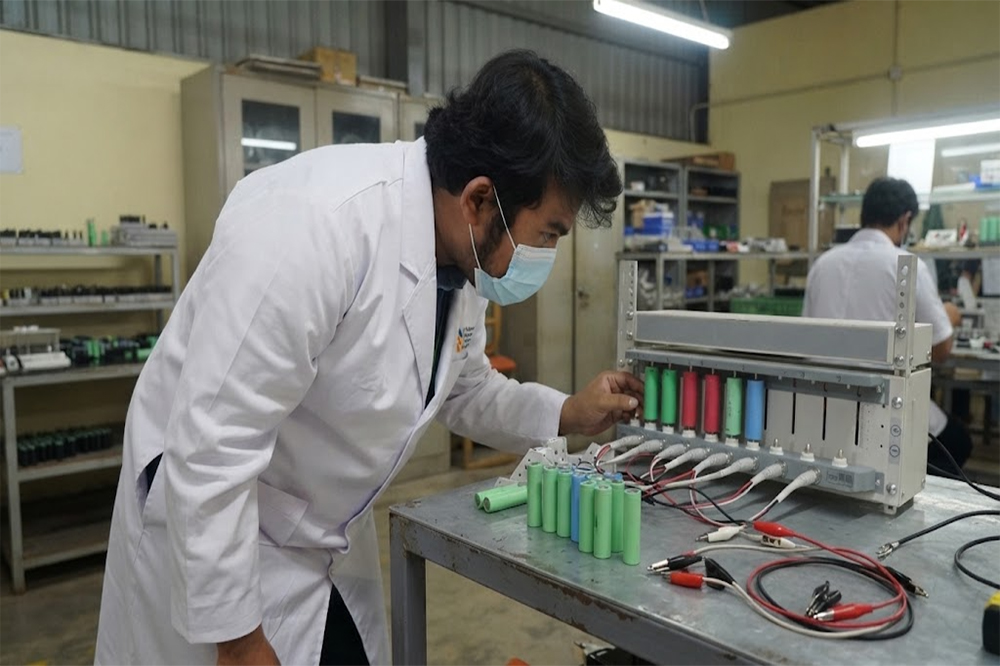
18650 battery capacity is usually expressed in mAh or Ah and mainly affects how long a battery can operate. A higher-capacity cell can provide longer runtime, but it may not be the best choice when current demand, size, weight or cost are more important.
Capacity is only one part of choosing an 18650 lithium battery. If you are still comparing cell types and specifications, our complete 18650 lithium battery guide is a useful starting point, covering capacity, voltage, applications, cell selection and wholesale purchasing in one place.
When buyers start comparing 18650 lithium batteries, capacity is usually the first number they notice.
2000mAh.
2600mAh.
3000mAh.
3500mAh.
And naturally, the reaction is often:
“Then 3500mAh must be the better battery, right?”
Not necessarily.
Capacity is important, but battery selection gets a little more complicated once the cell is going into a real product.
A flashlight, portable monitor, power tool and e-bike do not use their batteries in the same way. One may need long runtime, while another needs high current for a motor. A third may have a very tight battery compartment where a particular cell is simply not practical.
So when comparing 18650 battery capacity, it helps to look beyond the number printed on the specification sheet.
What does mAh mean on 18650 battery?
mAh means milliamp-hours.
It is a measurement of electrical charge capacity.
For example:
3000mAh = 3Ah
In simple terms, a 3000mAh cell has a nominal capacity of 3Ah under the manufacturer’s specified testing conditions.
That does not mean it will always provide exactly 3000mA for exactly one hour.
Real-world runtime depends on the discharge current, cut-off voltage, temperature, equipment efficiency and other factors.
This is one of those battery specifications that looks very straightforward until you actually put the cell into a product.

2000mAh vs 3000mAh vs 3500mAh
These three capacity levels are useful examples because they show how buyers often approach cell selection.
2000mAh 18650
A 2000mAh cell provides less stored charge than a 3000mAh or 3500mAh cell of the same nominal voltage.
That does not automatically make it a poor choice.
If the application has relatively low runtime requirements or places more emphasis on cost, current capability, weight or other performance characteristics, a 2000mAh cell may still make sense.
3000mAh 18650
3000mAh is a very practical capacity range for many battery-pack applications.
It offers a useful balance between capacity and overall cell characteristics, depending on the specific cell model.
For buyers developing general-purpose battery packs, 3000mAh is often a reasonable starting point for comparison.
3500mAh 18650
A 3500mAh cell provides more capacity than a 3000mAh cell, assuming the specifications are tested under comparable conditions.
That can be attractive for products where runtime is a major concern.
But there is a catch.
A high-capacity cell is not automatically a high-current cell.
If the equipment pulls substantial current, the discharge specification needs to be checked separately.
Higher Capacity Does Not Always Mean Longer Runtime
This is worth explaining with a simple example.
Imagine two 18650 cells:
Cell A: 3000mAh
Cell B: 3500mAh
At first glance, Cell B looks better.
But suppose the device requires a high current and Cell B is not designed for that load.
The result may not be as attractive as the capacity numbers suggest.
Battery performance depends on the whole combination:
Capacity + discharge current + voltage + load + temperature + battery design
For a low-current monitoring device, the 3500mAh cell could be a very sensible choice.
For a high-current power tool, another cell with a lower nominal capacity but stronger discharge performance could be more appropriate.
This is why I would be cautious about choosing cells based on mAh alone.

How Much Runtime Can a 3000mAh 18650 Provide?
There is a simple theoretical calculation:
Runtime ≈ Capacity ÷ Load Current
So, if a 3000mAh cell is supplying a constant 500mA load:
3000mAh ÷ 500mA = 6 hours
That is only a rough theoretical calculation.
Actual runtime can be shorter because of:
- Battery discharge characteristics
- Voltage cut-off
- Temperature
- Device efficiency
- Aging
- Current variation
- BMS losses
If the equipment consumes 1A instead:
3000mAh ÷ 1000mA ≈ 3 hours
Again, real-world performance will vary.
For an OEM project, it is better to test the actual battery with the real equipment rather than promise a runtime based only on a simple mathematical calculation.
Capacity and Voltage Work Together
Capacity alone does not tell you the total energy stored in a battery.
A useful calculation is:
Energy (Wh) = Voltage (V) × Capacity (Ah)
For a 3.7V nominal 3000mAh cell:
3.7V × 3Ah ≈ 11.1Wh
For a 3.7V nominal 3500mAh cell:
3.7V × 3.5Ah ≈ 12.95Wh
This gives you a better way to compare battery energy.
It also explains why voltage and capacity should be discussed together when designing a battery pack.
If you want to understand the voltage side in more detail, see our 18650 battery voltage guide, which explains 3.6V vs 3.7V, full-charge voltage and series/parallel configurations.
What Happens When 18650 Cells Are Connected in Parallel?
Parallel connections are commonly used when a battery needs more capacity.
For example:
1S1P: 1 cell
1S2P: 2 cells
1S3P: 3 cells
If three 3000mAh cells are connected in parallel, the nominal voltage remains around 3.7V while the theoretical capacity becomes:
3000mAh × 3 = 9000mAh
Or:
9Ah
This is one of the basic building blocks of custom 18650 battery-pack design.
When more capacity is required, the battery designer can increase the number of cells in parallel, provided the physical space, current requirements and overall design allow it.
What Happens When Cells Are Connected in Series?
Series connections increase voltage rather than simply adding capacity.
For example, four 3000mAh cells connected in series would typically give approximately:
14.8V nominal
while the capacity remains around:
3000mAh
assuming identical cells and a properly designed pack.
This can then be combined with parallel connections.
For example:
4S2P
would use eight cells.
The nominal voltage would be around:
14.8V
and the theoretical capacity would be:
6000mAh / 6Ah
This is why an 18650 battery pack can be designed around very different voltage and capacity requirements using the same basic cell format.

Does Capacity Affect Battery Weight?
It can.
Different 18650 cell models have different weights, constructions and energy densities.
If you are building a battery with a large number of cells, the difference can add up.
Imagine two pack designs using 40 cells.
If one cell is 5 grams heavier:
40 × 5g = 200g
That is another 200 grams before the housing and other components are considered.
For a stationary industrial device, this may not matter much.
For a handheld product or mobile equipment, it could be worth discussing.
So when selecting a high-capacity 18650 cell, I would look at the relationship between:
Capacity → Weight → Dimensions → Current → Cost
rather than capacity by itself.
How Does Capacity Affect Wholesale Pricing?
Capacity is one of the factors that affects battery cost, but it is not the only one.
For bulk buyers, pricing can also depend on:
- Cell model
- Cell grade
- Quantity
- Discharge performance
- Testing requirements
- Packaging
- Certifications
- Shipping requirements
- Customization
A buyer ordering several thousand 3000mAh cells may receive a very different quotation from someone ordering a few hundred specialty high-drain cells.
For this reason, a useful RFQ should include the estimated quantity.
If you are not sure which capacity is best, you can also ask the supplier to compare two or three suitable options.
That is often more useful than simply asking:
“What is your cheapest 3500mAh cell?”
Which 18650 Capacity Should You Choose?
There is no universal answer.
Here is a practical way to think about it.
Choose around 2000mAh when:
The project is more cost-sensitive or the application does not need maximum runtime, assuming the cell’s discharge performance fits the load.
Consider around 3000mAh when:
You want a balanced option for general battery-pack applications and need a reasonable combination of capacity and overall performance.
Consider around 3500mAh when:
Longer runtime is important and the application does not require a discharge rate beyond what the cell can safely provide.
But these are only starting points.
The actual cell model matters more than the number alone.
Two cells can both be labeled “3000mAh” and still behave differently under load.
What Should Wholesale Buyer Ask For?
If you are sourcing 18650 cells for production, I would suggest sending something like this:
Required capacity: 3000mAh
Nominal voltage: 3.7V
Continuous discharge: XXA
Quantity: 5,000 pcs
Application: industrial equipment
If you need a complete battery pack, add:
Pack voltage: XXV
Pack capacity: XXAh
Maximum dimensions: XXX × XXX × XXX mm
Connector: XXX
This gives the supplier enough information to start discussing suitable cells.
If the final capacity has not been decided yet, say so. For example:
“We are comparing 3000mAh and 3500mAh options and would like your recommendation based on current demand and available space.”
That is a much more useful conversation.
Higher mAh Number Is Only Better When the Product Can Use It
This is probably the most practical way to look at 18650 battery capacity.
A 3500mAh cell can be an excellent choice.
It can also be the wrong choice.
If the product needs long runtime at a modest current, the extra capacity may be valuable.
If the product has a demanding motor or tight space, a different cell may make more sense.
And if you are building thousands of battery packs, the small differences in cell price, weight and performance become much more important.
For standard 18650 lithium-ion cells, you can review available options in the Apsenx 18650 lithium battery product category.
For OEM battery pack, send the required voltage, capacity, current, dimensions and quantity. The right cell can then be selected around the actual product instead of forcing the product to fit the battery.
FAQ
What is the capacity of an 18650 battery?
18650 cells are available in different capacities. Common specifications include around 2000mAh, 2600mAh, 3000mAh and 3500mAh, depending on the cell model and manufacturer.
Is a 3500mAh 18650 better than a 3000mAh cell?
Not always. A 3500mAh cell can provide more stored energy, but the 3000mAh cell may offer better discharge performance, cost or suitability for a particular application.
How long will a 3000mAh 18650 battery last?
A rough estimate is capacity divided by load current. A 500mA load could theoretically run for around six hours, but actual runtime will vary with load, voltage cut-off, temperature and equipment efficiency.
Does connecting 18650 batteries increase capacity?
Connecting cells in parallel increases capacity while keeping the nominal voltage approximately the same. The exact capacity depends on the number and specification of cells connected in parallel.
What 18650 capacity is best for wholesale?
There is no single best capacity. The right choice depends on the application, discharge requirement, dimensions, target price and required runtime. For a commercial project, comparing several suitable cell options is often better.
-

12V 4400 mah Lithium ion 3S2P 18650 Battery Pack
-

18650 2000mAh 3.7 volt Lithium-ion Battery
-

18650 20V 3.0Ah Cordless Drill battery
-

18650 22.2V 7.8Ah 2600Mah 6S3P Rechargeable Battery Pack
-

18650 2600mAh Rechargeable Lithium-Ion Battery 3.7V
-

18650 3.7V 10Ah Li-Ion Power Battery Pack
-

18650 3.7V 3300mah Rechargeable Lithium ion Battery
-

18650 7S7P 24V 14Ah Lithium ion Electric Scooter Battery Pack
-

18650 battery 3.7V 1500mAh Lithium-Ion Battery
-

18650 Battery 3500 mah Rechargeable Battery Cells
-

18650 Electric Scooter 48V 13000mAh Lithium Battery
-

2600mAh 3S1P 11.1V 18650 Battery Packs
-

3.7V Li ion Rechargeable 3000mah 18650 Battery Cell
-

36V 5200mAh 10S2P 18650 Battery Pack
-

48v 4400mah 13S2P 18650 Rechargeable Battery Pack
-

7S2P 24V 18650 Lithium Battery Pack
-

Electric Scooter 36V 4400mAH 10S2P 18650 Battery Pack
-

ICR 18650 Battery 2200mah 3.7V
Leave a Reply