
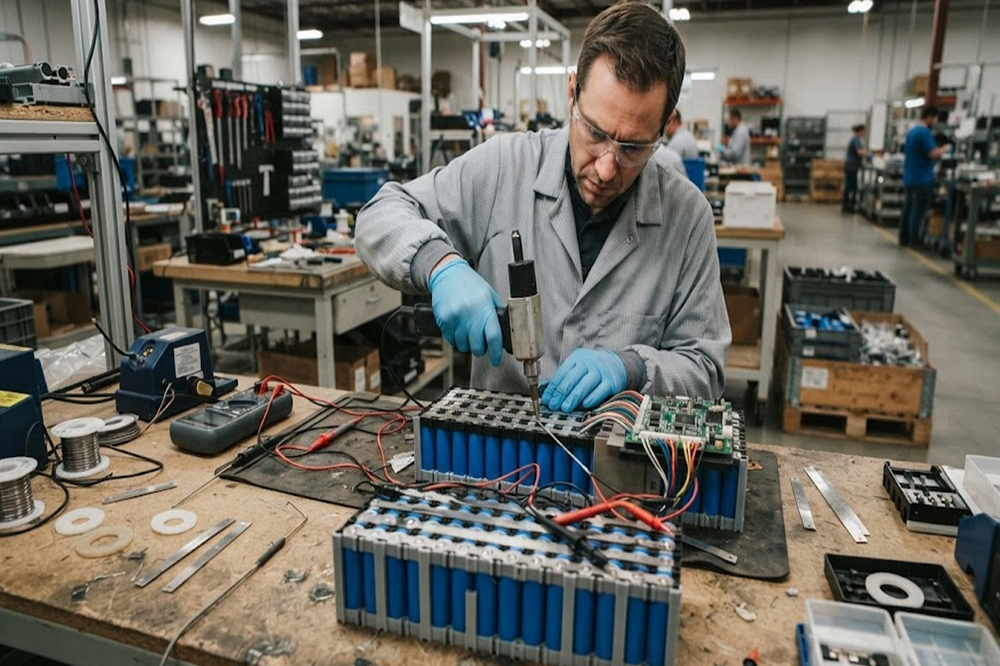
18650 battery pack is built by connecting individual cells in series, parallel, or a combination of both. Understanding how these connections affect voltage, capacity, energy and current is essential when developing a custom battery pack for an OEM product.
If you’re still getting familiar with 18650 cells, it helps to start with the basics before calculating a complete pack. Our [complete 18650 lithium battery guide] covers cell specifications, applications, capacity, voltage and the main considerations when sourcing 18650 cells for commercial projects.
18650 Battery Pack Configuration: Series or Parallel?
When a customer asks for a “24V 18650 battery,” there is still quite a lot we don’t know.
How much capacity?
What current?
What size?
How many cells?
What BMS?
And perhaps most importantly, how should the cells be connected?
This is where series and parallel configuration comes in.
A single 18650 cell usually has a nominal voltage around 3.6–3.7V. If you need a higher voltage, you connect cells in series.
If you need more capacity or current capability, you normally connect cells in parallel.
It sounds straightforward.
The tricky part is combining both to meet the actual requirements of the product.
For example, a 24V-class battery and a 24V 10Ah battery are not the same specification. One describes voltage; the other gives you voltage plus capacity.
For OEM battery buyers, getting this distinction right at the quotation stage can save quite a bit of back-and-forth later.

What Does “S” Mean in an 18650 Battery Pack?
The S stands for series.
When cells are connected in series, their voltage adds together.
A typical lithium-ion 18650 cell may have a nominal voltage of approximately 3.6V or 3.7V.
So, roughly:
- 1S = 3.6–3.7V
- 2S = 7.2–7.4V
- 3S = 10.8–11.1V
- 4S = 14.4–14.8V
- 5S = 18–18.5V
- 6S = 21.6–22.2V
- 7S = 25.2–25.9V
- 10S = 36–37V
The exact nominal voltage depends on the selected cell chemistry and specification.
Full-charge voltage is different.
For a conventional 4.2V lithium-ion cell, a 4S pack reaches approximately:
4 × 4.2V = 16.8V
So when someone says “14.8V battery,” they are generally talking about nominal voltage, not the voltage immediately after a full charge.
For a detailed explanation, see our [18650 battery voltage guide].
What Does “P” Mean?
The P stands for parallel.
Parallel cells increase capacity.
Imagine one 18650 cell rated at:
3000mAh
If you connect two identical cells in parallel:
3000mAh + 3000mAh = 6000mAh
So:
1P = 3000mAh
2P = 6000mAh
3P = 9000mAh
The voltage stays approximately the same.
This is the key difference:
Series → increases voltage
Parallel → increases capacity
That simple rule is the foundation of most cylindrical lithium-ion battery-pack configurations.
What Does 4S2P Mean?
This is one of the most common questions.
A 4S2P battery pack contains:
4 groups connected in series
with:
2 cells in parallel in each group
So the total cell count is:
4 × 2 = 8 cells
If each cell is 3000mAh and approximately 3.7V nominal:
Voltage
4 × 3.7V = 14.8V nominal
Capacity
2 × 3000mAh = 6000mAh
Energy
14.8V × 6Ah ≈ 88.8Wh
So an 8-cell pack can provide approximately:
14.8V / 6Ah / 88.8Wh
The actual usable energy will depend on the cell, discharge conditions, BMS settings and application.
What About 10S2P?
Let’s use the same 3000mAh cell.
A 10S2P configuration contains:
10 × 2 = 20 cells
Nominal voltage:
10 × 3.7V = 37V
Capacity:
2 × 3Ah = 6Ah
Approximate energy:
37V × 6Ah = 222Wh
This configuration could therefore be described as approximately:
37V 6Ah 222Wh
This kind of calculation is useful when discussing requirements with a battery manufacturer.
Instead of saying:
“I need a 200Wh 18650 battery.”
You can provide:
“Target around 36–37V, 6Ah, approximately 220Wh, with maximum dimensions of…”
That’s much easier for the engineering team to work with.

How Many 18650 Cells Do You Actually Need?
There is no single answer.
The number depends on three main things:
Required voltage
Required capacity
Selected cell
For example, suppose the project needs around 36V and 10Ah.
Using a 3.7V, 3000mAh cell:
You need approximately:
10S for voltage
and
4P for capacity.
That gives:
10S4P
Total cells:
10 × 4 = 40 cells
Approximate pack:
37V / 12Ah
Actually, 4 × 3Ah = 12Ah, which is above the 10Ah target.
You could potentially select another cell capacity or another configuration depending on the exact requirements.
This is why battery configuration is usually an optimization problem rather than simply multiplying numbers.
Why Not Just Add More Cells in Parallel?
You can increase capacity by adding parallel cells.
But there are practical limits.
More cells mean:
- More space
- More weight
- More welding points
- More connections
- Higher material cost
- Larger pack dimensions
There is also the BMS and thermal design to consider.
A 10S4P pack contains 40 cells.
A 10S8P pack contains 80 cells.
The second pack has twice the parallel capacity, but it also requires significantly more physical space and materials.
If the customer says, “I need twice the runtime,” simply doubling the number of cells may not be the best solution.
Sometimes a higher-capacity cell is worth considering.
This is one reason we recommend comparing actual 18650 cell specifications before fixing the final configuration.
Series and Parallel Affect Current Too
Parallel configuration can also increase the battery’s current capability.
Suppose one cell has a continuous discharge rating of:
10A
Two identical cells in parallel could theoretically provide around:
20A
under appropriate conditions.
Three parallel cells:
30A
Again, this is a simplified calculation.
The actual pack current capability depends on cell characteristics, temperature, connections, BMS limits and the manufacturer’s specified operating conditions.
You should not simply multiply the current rating and assume the finished pack will always deliver that number.
Still, the basic principle is useful:
More parallel cells can share the load.
For power tools, robotics and motor-driven equipment, this can become particularly important.
Matching Cells Is Extremely Important
You should not randomly combine different 18650 cells inside the same pack.
For a commercial battery pack, cells should normally be matched according to relevant electrical characteristics.
Mixing cells with different:
- Capacity
- Internal resistance
- Chemistry
- Age
- Discharge capability
can create imbalance problems.
Imagine assembling a large pack from leftover cells from different suppliers.
One cell group may reach full charge earlier than another.
Another group may discharge faster.
The BMS has to manage those differences, but it cannot turn mismatched cells into identical cells.
For OEM production, consistent cell sourcing and production testing are therefore important.

The BMS Must Match the Configuration
A 4S battery needs a BMS designed for a 4-series configuration.
A 10S battery needs a BMS designed for 10 series groups.
This is not something to guess.
The BMS needs to work with:
- Series count
- Cell chemistry
- Charge voltage
- Discharge current
- Temperature sensors
- Protection requirements
- Communication requirements, if needed
For example, a 10S lithium-ion pack typically needs a BMS designed around that 10-series architecture.
The BMS is not just an accessory attached to the battery at the end.
It is part of the battery system.
Physical Arrangement Matters More Than You Might Expect
Electrical calculations are only half the job.
You still need to physically arrange the cells.
For example, a 10S4P pack has 40 cells.
Depending on the product enclosure, they could be arranged in several different layouts.
Maybe:
10 cells long × 4 cells wide
Or another arrangement that better fits the available space.
Then you need to account for:
- Nickel strips
- Insulation
- BMS
- Wiring
- Connectors
- Protective foam
- Housing
A theoretical configuration may work electrically but fail mechanically.
This happens quite often during early prototypes.
The engineering team calculates the pack perfectly, then discovers the battery is 5mm too thick for the enclosure.
That’s why providing the maximum allowable dimensions early is so useful.
18650 Battery Configuration and Energy
Once you know voltage and capacity, calculating approximate energy is simple:
Wh = V × Ah
For example:
14.8V × 6Ah = 88.8Wh
Or:
37V × 6Ah = 222Wh
This number helps when comparing battery packs with different voltage and capacity combinations.
For example:
24V 10Ah
and
36V 10Ah
do not contain the same amount of energy.
Approximate energy:
24V × 10Ah = 240Wh
36V × 10Ah = 360Wh
The capacity in Ah is the same.
The energy is not.
For more information, see our guide to [18650 battery capacity and Wh calculation].
Common 18650 Configurations
Here are some configurations that frequently appear in battery projects:
| Configuration | Approx. Voltage* | Capacity with 3000mAh Cells | Total Cells |
|---|---|---|---|
| 3S1P | 11.1V | 3Ah | 3 |
| 3S2P | 11.1V | 6Ah | 6 |
| 4S1P | 14.8V | 3Ah | 4 |
| 4S2P | 14.8V | 6Ah | 8 |
| 5S2P | 18.5V | 6Ah | 10 |
| 6S2P | 22.2V | 6Ah | 12 |
| 10S2P | 37V | 6Ah | 20 |
| 10S4P | 37V | 12Ah | 40 |
*Approximate nominal voltage based on a 3.7V nominal cell.
Actual battery specifications depend on the selected cell.
Series vs Parallel: A Quick Way to Remember
If you’re new to battery pack design, remember it this way:
Series
Voltage goes up.
Parallel
Capacity and current capability can go up.
Series + Parallel
You can increase both voltage and capacity.
For example:
10S3P
means:
- Higher voltage from 10 series groups
- Higher capacity from 3 cells in parallel
- 30 cells total
That’s the basic architecture behind many custom 18650 battery packs.
What Should You Send a Battery Manufacturer?
If you’re requesting a quote, don’t only send:
“18650 battery, 10S.”
That’s not enough.
A useful RFQ might look more like this:
Battery type: 18650 lithium-ion
Configuration: 10S2P
Nominal voltage: 37V
Capacity: 6Ah
Target energy: approximately 222Wh
Maximum dimensions: 80 × 80 × 150mm
Peak current: 20A
Connector: Custom
Application: Industrial equipment
Quantity: 500 pcs
Now the manufacturer has something concrete to work with.
If you don’t know the configuration yet, that’s also fine.
Give the supplier the required voltage, capacity, current and dimensions, and ask them to recommend the cell arrangement.
A Practical Example: Designing a 24V Battery
Let’s say an OEM customer has a machine that needs:
24V-class battery
8Ah
15A continuous current
25A peak current
Limited battery compartment
A possible approach is to start around a 7S configuration.
7 × 3.7V ≈ 25.9V nominal
Then determine how many cells are needed in parallel.
If one cell is 3000mAh:
3P = 9Ah
So a possible configuration is:
7S3P
Total cells:
21 cells
Approximate energy:
25.9V × 9Ah ≈ 233Wh
But whether this is actually suitable depends on the selected cell’s discharge rating, the required peak current, the enclosure and BMS.
That’s why this calculation is a starting point—not the final design.
When a Standard Configuration Is Better
Not every project needs a completely custom battery architecture.
If your equipment can accept a standard configuration, using a commonly available pack can reduce:
- Development time
- Prototype cost
- Production complexity
- Lead time
Custom design becomes more valuable when the product has unusual dimensions, special current requirements, a particular connector, communication requirements or strict weight limitations.
For high-volume OEM projects, the best configuration is often the one that balances performance with production practicality.
18650 Series and Parallel Configuration Is About Balance
A good battery pack isn’t simply the one with the most cells.
You are balancing:
Voltage
Capacity
Current
Size
Weight
Heat
BMS requirements
Cost
For one product, 4S2P might be ideal.
For another, 10S4P may make more sense.
And for a third product, moving from 18650 to 21700 could be worth considering if higher energy per cell is useful. Our [18650 vs 21700 battery comparison] explains when the larger format may make sense.
If you are developing a commercial battery and already know the voltage, capacity and dimensions, those numbers are usually enough for an initial configuration discussion with a battery manufacturer.
Frequently Asked Questions
What does 4S2P mean for 18650 batteries?
4S2P means four series groups with two cells in parallel in each group. It contains eight cells total. With 3000mAh cells, the pack is approximately 14.8V and 6Ah nominal.
Does parallel connection increase voltage?
No. Parallel connection keeps the voltage approximately the same while increasing capacity and potentially increasing current capability.
Does series connection increase battery capacity?
Series connection mainly increases voltage. The Ah capacity remains approximately the same as one parallel group.
How many cells are in a 10S2P battery?
A 10S2P configuration contains 10 series groups with two cells in each group, giving a total of 20 18650 cells.
Can you design a custom 18650 battery pack?
Yes. For an OEM project, the most useful starting information is required voltage, capacity, continuous and peak current, maximum dimensions, connector requirements and expected quantity.
-

12V 4400 mah Lithium ion 3S2P 18650 Battery Pack
-

18650 2000mAh 3.7 volt Lithium-ion Battery
-

18650 20V 3.0Ah Cordless Drill battery
-

18650 22.2V 7.8Ah 2600Mah 6S3P Rechargeable Battery Pack
-

18650 2600mAh Rechargeable Lithium-Ion Battery 3.7V
-

18650 3.7V 10Ah Li-Ion Power Battery Pack
-

18650 3.7V 3300mah Rechargeable Lithium ion Battery
-

18650 7S7P 24V 14Ah Lithium ion Electric Scooter Battery Pack
-

18650 battery 3.7V 1500mAh Lithium-Ion Battery
-

18650 Battery 3500 mah Rechargeable Battery Cells
-

18650 Electric Scooter 48V 13000mAh Lithium Battery
-

2600mAh 3S1P 11.1V 18650 Battery Packs
-

3.7V Li ion Rechargeable 3000mah 18650 Battery Cell
-

36V 5200mAh 10S2P 18650 Battery Pack
-

48v 4400mah 13S2P 18650 Rechargeable Battery Pack
-

7S2P 24V 18650 Lithium Battery Pack
-

Electric Scooter 36V 4400mAH 10S2P 18650 Battery Pack
-

ICR 18650 Battery 2200mah 3.7V
Leave a Reply