
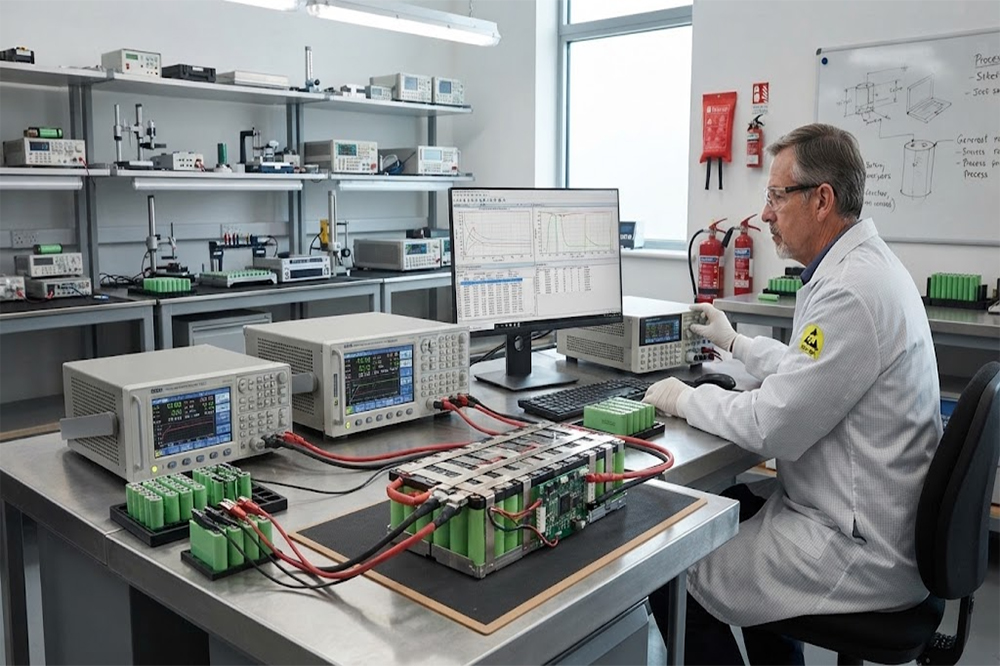
Not every 18650 battery is designed to deliver high current. For power tools, robotics, motors and other demanding equipment, discharge capability can matter just as much as capacity.
A high-drain 18650 should be selected according to continuous current, peak current, temperature, internal resistance and the actual load profile—not simply the highest mAh number.
Why Capacity Isn’t Everything
When someone asks for 18650 battery, one of the first questions is usually:
“How many mAh?”
That’s reasonable.
Capacity tells you how much charge the cell can store. But there is another question that becomes much more important when the equipment draws a lot of power:
“How much current can the cell actually deliver?”
Consider a power tool sitting on a workbench.
When the trigger is pulled, the motor doesn’t always draw the same current as it does once it is already spinning. There can be a short, heavy current demand at startup.
A cell that looks excellent on paper because it has 3500mAh may not be the right choice if the application needs a strong discharge current.
This is where high-drain 18650 batteries come into the picture.
What Is a High-Drain 18650 Battery?
A high-drain 18650 is designed to deliver relatively high current while maintaining acceptable voltage and temperature performance.
Compared with a general-purpose high-capacity cell, a high-drain cell may sacrifice some capacity in exchange for better current performance.
For example, a buyer may have to choose between:
Higher capacity
and
Higher discharge capability
There isn’t one answer that works for every application.
For a low-power sensor that runs continuously for months, capacity may be the priority.
For a power tool that repeatedly drives a motor, current capability may be much more important.
That’s why cell selection should start with the equipment, not the catalog.

What Does Discharge Current Mean?
Discharge current is simply the amount of current the battery provides to the load.
It is measured in:
A — amps
For example:
10A
15A
20A
30A
When selecting an 18650 cell, you may see specifications such as:
Maximum continuous discharge current: 20A
or:
Maximum continuous discharge current: 30A
This doesn’t mean the cell should be operated at that maximum all the time.
The actual recommended operating current depends on the manufacturer’s testing conditions, temperature and other factors.
For an OEM project, I would rather know the customer’s real continuous and peak current than simply see a requested “30A cell.”
Continuous Current vs Peak Current
These two specifications are easy to mix up.
Continuous current is the current the battery needs to provide for an extended period under defined conditions.
Peak current is a short-duration current demand.
Imagine an electric motor.
It might normally consume:
8A
but briefly require:
20A
when starting.
If the cell can handle the short peak without excessive voltage sag or overheating, the battery may work properly.
But if the battery is only evaluated against the 8A average current, the design can miss the startup demand.
This is why I usually recommend giving the battery supplier both numbers:
Continuous current
Peak current + peak duration
For example:
Continuous: 10A
Peak: 25A for 3 seconds
That’s much more useful than simply saying:
“Need a high-drain battery.”
What Is C Rating?
Some battery specifications use C rating to describe discharge capability.
The basic calculation is:
Current = Capacity × C Rating
For a 3000mAh cell:
3Ah × 5C = 15A
At:
10C = 30A
But there is an important catch.
Not every supplier uses C rating in exactly the same practical way.
Some manufacturers emphasize maximum pulse discharge, while others specify continuous discharge current directly.
For OEM procurement, a direct current specification such as:
20A continuous
is often easier to interpret than a C rating without test conditions.
If a supplier gives you a C rating, ask what it means and how it was tested.
Does Higher Capacity Mean Lower Current?
Not necessarily, but there can be a trade-off.
Battery manufacturers are constantly balancing several characteristics:
- Capacity
- Discharge current
- Internal resistance
- Cycle life
- Heat generation
- Cost
- Energy density
A high-capacity cell is designed with one set of priorities.
A high-drain cell is designed with another.
In some cell families, manufacturers can achieve both relatively high capacity and strong discharge performance.
But there are still physical and chemical limits.
So I would be careful with the idea that:
“3500mAh must be better than 3000mAh.”
For a motor-driven product, that isn’t necessarily true.
Internal Resistance Matters More Than Many Buyers Expect
Internal resistance is one of those specifications that doesn’t get much attention until a battery starts behaving badly.
When current flows through the cell, internal resistance causes voltage loss and heat generation.
A simplified relationship is:
Voltage Drop = Current × Internal Resistance
For example, if internal resistance is:
20mΩ
and current is:
20A
the theoretical voltage drop associated with that resistance is approximately:
0.4V
The actual battery behavior is more complicated, but the example shows why internal resistance matters.
Lower internal resistance generally helps high-current applications by reducing voltage sag and heat generation.
This is one reason battery manufacturers test internal resistance during quality control.
Why Voltage Sag Can Cause Problems
Imagine a battery pack connected to a motor.
At rest, the pack may show a healthy voltage.
Then the motor starts.
The current jumps.
The battery voltage temporarily falls.
If the voltage falls too far, the equipment may:
- Shut down
- Trigger undervoltage protection
- Lose power
- Reduce motor speed
- Restart unexpectedly
The battery may still contain plenty of energy.
The problem is that it cannot maintain the required voltage under that particular load.
This is a very common reason why simply increasing battery capacity doesn’t always solve a power problem.

A Simple Example: 3000mAh High-Drain Cell
Suppose you are considering a:
3000mAh 18650
for a high-power application.
The nominal energy is roughly:
3.7V × 3Ah = 11.1Wh
But energy isn’t the only question.
Suppose the equipment needs:
15A continuous
and:
25A peak
You need to check whether the selected cell can safely handle those requirements.
A cell with 3000mAh capacity and strong discharge performance may be a good fit.
Another 3000mAh cell with a lower discharge capability may not be.
Same capacity.
Very different application suitability.
How Many High-Drain Cells Are Needed?
Parallel connection can increase the available current of a battery pack.
Suppose one cell is rated for:
15A continuous
Two cells in parallel can theoretically provide approximately:
30A
under suitable conditions.
Four cells in parallel:
60A
Again, this is a simplified calculation.
The actual pack design also needs to consider:
- Cell matching
- Busbar or nickel-strip design
- BMS current rating
- Temperature
- Wiring resistance
- Connector rating
- Fuse protection
So don’t simply multiply the cell current and assume the finished pack automatically has the same capability.
Example: 5S2P High-Drain Battery Pack
Let’s say a customer needs a battery for a compact power device.
Target:
18.5V nominal
6Ah
Using:
3000mAh cells
A possible configuration is:
5S2P
Voltage:
5 × 3.7V = 18.5V
Capacity:
2 × 3Ah = 6Ah
Total cells:
10
If each cell is suitable for a defined high-current application, the parallel arrangement can also increase the pack’s current capability.
Full-charge voltage:
5 × 4.2V = 21V
Nominal energy:
18.5V × 6Ah = 111Wh
Now the battery engineer can start looking at the cell’s actual discharge characteristics.
High-Drain 18650 for Power Tools
Power tools are one of the clearest examples of why discharge current matters.
A drill or impact driver can have:
- Motor startup current
- Sudden load changes
- Repeated acceleration
- High current under mechanical resistance
The battery needs to cope with these changes.
If the cells are poorly matched or the internal resistance is too high, the pack may heat up quickly or experience significant voltage sag.
For this type of application, I would normally look at:
Peak current
Continuous current
Internal resistance
Cell temperature
Cycle life
rather than choosing the cell based on capacity alone.
High-Drain 18650 for E-Bikes and Small EV Systems
Small electric vehicles and e-bike battery packs also require careful current calculations.
Suppose a motor system needs:
500W
At approximately:
36V
the theoretical current is:
500W ÷ 36V ≈ 13.9A
But that’s only the basic operating calculation.
Acceleration, hills and controller behavior can increase current demand.
If the system briefly needs 25A or more, the battery pack needs to be designed around those conditions.
This is where parallel cell groups become important.
More parallel cells can distribute the current across more cells, potentially reducing the load on each individual cell.

High-Drain Cells for Robotics
Robotics can be a little tricky because the load changes constantly.
A robot may spend one moment moving slowly and the next moment accelerating, lifting an object or turning against resistance.
That creates a changing current profile.
For robotic applications, the battery supplier should ideally receive information about:
- Average current
- Maximum current
- Peak duration
- Operating voltage
- Runtime requirement
- Battery dimensions
A current measurement taken during real operation is often more useful than a theoretical estimate.
If you already have a prototype, recording the actual current draw can make cell selection much easier.
Temperature Should Not Be Ignored
High current creates heat.
The higher the current, the more important thermal management becomes.
Internal resistance contributes to heat generation, and repeated high-current discharge can raise cell temperature.
If the battery is installed inside a tightly sealed enclosure, heat has fewer ways to escape.
This can change the design completely.
A battery that works well on an open test bench might behave differently once installed inside a compact plastic housing.
For OEM projects, always tell the supplier the expected operating environment.
Especially:
Minimum temperature
Normal temperature
Maximum temperature
What Is a “30A 18650”?
You will often see searches for:
30A 18650 battery
But this phrase isn’t enough to define a cell.
Ask:
30A continuous or peak?
At what temperature?
At what cutoff voltage?
For how long?
What is the cell capacity?
What is the manufacturer’s test method?
A “30A” label without supporting information doesn’t tell you very much.
For serious procurement, a datasheet is more valuable than a large number printed on the product page.
Can a 3500mAh 18650 Be High Drain?
Yes, depending on the specific cell.
Capacity and discharge capability are separate specifications.
However, not every 3500mAh cell is suitable for high-current applications.
The actual cell model matters.
A 3500mAh cell designed primarily for energy density may have a different current rating from a 3000mAh cell designed for power output.
This is why the correct approach is:
Application → Current requirement → Cell selection
rather than:
Highest mAh → Hope it works
How to Select a High-Drain 18650 for OEM Production
For a prototype, you can often test several candidate cells.
For mass production, consistency becomes more important.
A practical OEM selection process might look like this:
1. Define the load
Measure continuous and peak current.
2. Define the voltage
Determine the required nominal and maximum battery voltage.
3. Define runtime
Calculate the approximate Wh requirement.
4. Check physical space
Determine how many cells can fit.
5. Compare cell characteristics
Look at capacity, current, resistance and cycle life.
6. Test the pack
Check temperature, voltage sag and runtime under realistic loads.
This last step is often where the real differences between cells become obvious.
Don’t Forget the BMS
A high-drain cell does not automatically make a high-current battery pack.
The BMS also needs to support the required current.
For example, if the cells can handle a high current but the BMS is rated too low, the BMS may cut off during normal operation.
The same applies to:
- Nickel strips
- Copper busbars
- Wires
- Connectors
- Fuses
- Switches
The entire current path needs to be considered.
A battery is a system, not just a group of cells.
High-Drain 18650 vs High-Capacity 18650
| Feature | High-Drain 18650 | High-Capacity 18650 |
|---|---|---|
| Main priority | Current output | Runtime |
| Typical application | Power tools, motors | Low/medium-power devices |
| Capacity | Often moderate | Often higher |
| Discharge capability | Higher | Application dependent |
| Heat management | More important | Still important |
| Voltage sag | Designed to minimize under load | Depends on cell |
| Best selection method | Current requirement | Energy/runtime requirement |
There is some overlap between the two categories.
A modern cell may provide reasonably high capacity and strong discharge performance at the same time.
The datasheet is what matters.
What Should You Tell a Battery Manufacturer?
If you need a quotation for a high-drain 18650 battery, try to provide:
Battery voltage
Capacity
Continuous current
Peak current
Peak duration
Battery dimensions
Application
Quantity
For example:
18.5V, 6Ah battery, 15A continuous, 25A peak for 3 seconds, maximum size 60 × 80 × 150mm, 2,000 sets.
That’s enough information for a supplier to begin evaluating the cell and configuration.
If you only say:
“Need high-drain 18650.”
you may receive several completely different proposals.
Where High-Drain 18650 Batteries Make Sense
High-drain 18650 cells can be useful for:
- Power tools
- Cordless equipment
- Robotics
- E-bikes
- Portable power equipment
- Motorized devices
- Industrial equipment
- RC equipment
- Backup power systems
- High-power consumer electronics
The final cell selection still depends on the actual electrical load.
A Practical Point for Wholesale Buyers
If you’re buying 18650 cells for resale, don’t assume every customer wants the same thing.
One customer may ask for:
3000mAh high-drain cells
Another may want:
3500mAh cells for longer runtime
Another may care mainly about:
low price and stable supply
And a battery-pack manufacturer may care most about:
consistent internal resistance and capacity matching
This is why keeping a small range of suitable 18650 cell specifications can sometimes be more useful than stocking only one “best” model.
Buying High-Drain 18650 Batteries in Bulk
For wholesale or OEM orders, the cell model and testing standard should be clearly defined before mass production.
A proper specification can include:
- Nominal capacity
- Rated capacity
- Nominal voltage
- Maximum charge voltage
- Continuous discharge current
- Peak discharge current
- Internal resistance
- Cycle life
- Operating temperature
- Cell dimensions
- Testing conditions
If the cells will be assembled into battery packs, matching and quality-control requirements should also be discussed.
This becomes especially important when the order quantity reaches thousands or tens of thousands of cells.
Need High-Drain 18650 Cells or Custom Packs?
Apsenx works with wholesale and OEM battery requirements, including individual 18650 lithium-ion cells and customized battery packs.
If you’re looking for a high-drain 18650, the most useful information to send is:
Voltage + Capacity + Continuous Current + Peak Current + Dimensions + Quantity
You can also browse the Apsenx 18650 lithium battery category to review available 18650 battery products.
If you’re not sure which cell is suitable, send the equipment’s voltage and current requirements first. The cell selection can then be worked backward from the application.
Before comparing high-drain cells, it helps to understand the 18650 format itself, including typical specifications, applications and battery-pack configurations. Start with our [complete 18650 lithium battery guide] for a broader introduction.
If your main concern is runtime rather than high current, capacity may be the more important specification. Our guide to [18650 battery capacity, mAh, Ah and Wh] explains how to calculate the energy available from individual cells and complete battery packs.
High-current applications can experience noticeable voltage sag under load, so understanding nominal voltage, full-charge voltage and discharge limits is important. See our [18650 battery voltage guide] for practical voltage calculations.
When one cell cannot provide enough current or capacity, parallel cell groups can distribute the load across multiple cells. Our [18650 series and parallel configuration guide] explains how S/P configurations affect a finished battery pack.
High-current operation and temperature can both influence long-term cell performance. If cycle life is important for your product, read our guide to [18650 battery life and cycle life] before finalizing the cell specification.
A high-drain battery also needs an appropriate charging system. If you’re developing a rechargeable battery pack, see our [18650 battery charging guide] for information about charging voltage, charging current and CC/CV charging.
Frequently Asked Questions
What is a high-drain 18650 battery?
A high-drain 18650 is designed to deliver relatively high discharge current while maintaining suitable voltage and thermal performance. The exact current rating depends on the cell model and manufacturer.
Is a 3500mAh 18650 high drain?
Not necessarily. Capacity and discharge capability are separate specifications. A 3500mAh cell may be suitable for high-current use, but its actual continuous and peak discharge ratings must be checked.
What does 20A mean on an 18650 battery?
It usually refers to a specified discharge-current capability, but you need to confirm whether the rating is continuous or pulse and review the manufacturer’s test conditions.
Are high-drain 18650 batteries good for power tools?
They can be very suitable because power tools often have high startup and operating current demands. The cell should be selected according to the tool’s actual continuous and peak current.
How can I choose an 18650 for a high-current application?
Start with the required voltage, continuous current, peak current and peak duration. Then compare cell capacity, discharge rating, internal resistance, temperature performance and cycle life.
-

12V 4400 mah Lithium ion 3S2P 18650 Battery Pack
-

18650 2000mAh 3.7 volt Lithium-ion Battery
-

18650 20V 3.0Ah Cordless Drill battery
-

18650 22.2V 7.8Ah 2600Mah 6S3P Rechargeable Battery Pack
-

18650 2600mAh Rechargeable Lithium-Ion Battery 3.7V
-

18650 3.7V 10Ah Li-Ion Power Battery Pack
-

18650 3.7V 3300mah Rechargeable Lithium ion Battery
-

18650 7S7P 24V 14Ah Lithium ion Electric Scooter Battery Pack
-

18650 battery 3.7V 1500mAh Lithium-Ion Battery
-

18650 Battery 3500 mah Rechargeable Battery Cells
-

18650 Electric Scooter 48V 13000mAh Lithium Battery
-

2600mAh 3S1P 11.1V 18650 Battery Packs
-

3.7V Li ion Rechargeable 3000mah 18650 Battery Cell
-

36V 5200mAh 10S2P 18650 Battery Pack
-

48v 4400mah 13S2P 18650 Rechargeable Battery Pack
-

7S2P 24V 18650 Lithium Battery Pack
-

Electric Scooter 36V 4400mAH 10S2P 18650 Battery Pack
-

ICR 18650 Battery 2200mah 3.7V
Leave a Reply