
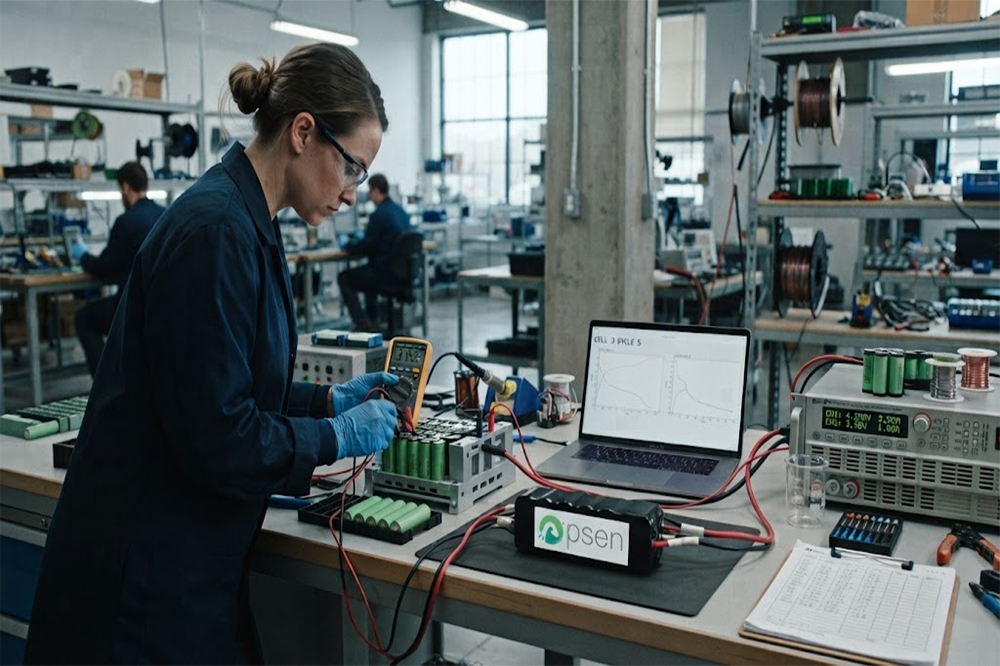
18650 battery capacity is usually shown in mAh or Ah, but these numbers do not tell the whole story. Voltage, series and parallel configuration, discharge current and the actual application all affect how much energy a battery pack can provide.
OEM buyers, choosing the highest-capacity 18650 is not always the best solution. The better choice depends on the required runtime, available space, current demand and target battery life.
What Does 18650 Battery Capacity Actually Mean?
When people talk about an 18650 battery, capacity is usually the first specification they ask about.
“Is it 2500mAh?”
“Do you have 3000mAh?”
“What about 3500mAh?”
These questions are common, especially when buying cells in bulk.
But capacity can be a little misleading if you look at the number by itself.
18650 battery with a capacity of 3000mAh stores more charge than a 2000mAh cell of the same voltage range.
Simple enough.
But if you are designing a battery pack, you also need to know the voltage.
That’s where Wh becomes useful.
For example:
3.7V × 3Ah ≈ 11.1Wh
So a 3000mAh 18650 cell has roughly 11.1Wh of nominal energy when using 3.7V as the nominal voltage.
This is why battery buyers should not compare mAh alone when looking at batteries with different voltages.
mAh Is the Number You See Most Often
Most individual 18650 cells are labeled in:
mAh — milliamp-hours
For example:
- 2000mAh
- 2500mAh
- 2600mAh
- 3000mAh
- 3200mAh
- 3500mAh
The basic idea is simple.
3000mAh cell can theoretically deliver:
3000mA for 1 hour
under specified conditions.
Or:
1500mA for about 2 hours
Again, this is a simplified calculation.
Real battery runtime is affected by discharge current, cutoff voltage, temperature, cell condition and the equipment itself.
So don’t treat:
3000mAh ÷ 1000mA = exactly 3 hours
as a guarantee.
It is a starting calculation.

What Is the Difference Between mAh and Ah?
There is no difference in the actual amount of charge.
They are simply different units.
1000mAh = 1Ah
So:
3000mAh = 3Ah
5000mAh = 5Ah
7000mAh = 7Ah
This becomes more convenient when discussing larger battery packs.
small consumer battery might be described as:
3000mAh
while an industrial battery pack may be described as:
10Ah
Both are describing capacity.
For B2B battery quotations, Ah is often easier to read once the pack capacity becomes larger.
What Does Wh Tell You?
Wh means:
Watt-hour
It describes the approximate amount of electrical energy stored in a battery.
The basic calculation is:
Wh = Voltage × Ah
For example:
3.7V × 3Ah = 11.1Wh
3.7V 5000mAh battery:
3.7V × 5Ah = 18.5Wh
For a 3.7V 7000mAh battery:
3.7V × 7Ah = 25.9Wh
This is especially useful when comparing batteries with different voltages.
12V battery and a 24V battery may have the same Ah rating, but their stored energy is different.
How Is 18650 Pack Capacity Calculated?
This is where the series and parallel configuration becomes important.
Let’s take a common example:
4S2P
using:
3000mAh 18650 cells
The “4S” means four cells or cell groups connected in series.
The “2P” means two cells are connected in parallel in each group.
The approximate pack voltage is:
4 × 3.7V = 14.8V
The capacity is:
2 × 3Ah = 6Ah
So the pack is approximately:
14.8V 6Ah
Its nominal energy is:
14.8V × 6Ah = 88.8Wh
This is much more useful for a product engineer than simply saying:
“The battery uses eight 3000mAh cells.”
Series Increases Voltage, Parallel Increases Capacity
This is probably the easiest rule to remember.
Series = voltage
Parallel = capacity
For example:
3S1P
3 × 3.7V = approximately 11.1V
Capacity remains the capacity of one cell.
3S2P
Voltage remains approximately 11.1V.
Capacity doubles.
3S3P
Voltage remains approximately 11.1V.
Capacity becomes three times the capacity of one cell.
This is why the same 18650 cell can be used to build battery packs with very different specifications.
If you want more examples, see our [18650 series and parallel configuration guide].

Does More mAh Always Mean a Better Battery?
Not necessarily.
This is something worth keeping in mind when comparing suppliers.
3500mAh cell sounds better than a 3000mAh cell.
low-current application where runtime is the priority, it may indeed be the better choice.
But imagine a product that requires a high discharge current.
high-capacity cell may not necessarily provide the current performance that the application needs.
There can also be differences in:
- Internal resistance
- Maximum discharge current
- Charging rate
- Cycle life
- Operating temperature
- Cell dimensions and construction
So the “best” 18650 depends on what the battery is supposed to do.
High Capacity vs High Discharge
Let’s imagine two projects.
Project A: Portable Monitoring Device
The device consumes relatively little power.
It runs for long periods.
The customer wants fewer charging cycles.
higher-capacity cell could make sense.
Project B: Power Tool
tool draws a large current when the motor starts.
battery needs to handle repeated current peaks.
Here, discharge performance may be more important than simply maximizing mAh.
3000mAh high-drain cell could be a better choice than a 3500mAh cell that isn’t suitable for the current demand.
This is one reason I would not recommend selecting an 18650 based on capacity alone.
Why Advertised Capacity Can Be Confusing
When you compare 18650 cells from different suppliers, you may see very similar numbers.
For example:
3000mAh
3100mAh
3200mAh
3500mAh
It is tempting to compare these numbers directly.
But the testing conditions matter.
Capacity is measured under defined conditions, including discharge current and cutoff voltage.
cell tested under one condition may produce a different measured capacity under another.
This doesn’t necessarily mean the manufacturer is doing something wrong.
It means battery specifications need context.
wholesale purchases, ask the supplier for the actual cell datasheet and test conditions instead of relying only on a product listing.

How Much Capacity Do You Really Need?
This depends on the load.
simple starting point is:
Battery energy required = Power consumption × Operating time
For example, if a device consumes:
10W
and needs to operate for:
5 hours
the theoretical energy requirement is:
10W × 5h = 50Wh
You would then need to consider conversion losses, BMS consumption, temperature, aging and reserve capacity.
So a 50Wh battery isn’t necessarily enough to guarantee five hours of real operation.
In an actual product, I would normally leave some margin rather than designing the battery right at the theoretical minimum.
A Practical Example With an 18650 Pack
Suppose a customer is developing a portable industrial device.
Required battery:
14.8V
Target runtime:
6 hours
Average power consumption:
8W
The theoretical energy requirement is:
8W × 6h = 48Wh
Now consider a 4S2P pack using 3000mAh cells.
Nominal energy:
14.8V × 6Ah = 88.8Wh
That appears to provide plenty of energy.
But the final usable runtime still depends on the actual load profile and conversion efficiency.
the device has periods of higher consumption.
Maybe the DC-DC converter isn’t 100% efficient.
Maybe the battery must retain usable capacity after aging.
This is why experienced battery engineers rarely stop at the first Wh calculation.
Why Battery Capacity Changes Over Time
new 18650 cell does not maintain exactly the same capacity forever.
Repeated charging and discharging gradually affect the cell.
Temperature, current, depth of discharge and storage conditions all play a role.
battery that originally provides 3000mAh may provide less usable capacity after significant aging.
This is normal lithium-ion behavior.
If your product is expected to operate for several years, the battery should be sized with its expected aging in mind.
Our article on [18650 battery life and cycle life] goes deeper into this issue.
Capacity and Battery Size Are Connected
Higher capacity often means a different cell design.
The physical dimensions of an 18650 remain standardized around the 18 × 65mm format, but internal cell chemistry and construction can vary.
You should therefore avoid assuming that every “3500mAh 18650” will have identical performance.
And when you’re building a custom pack, the available enclosure space can become the deciding factor.
Sometimes the electrical target says:
10Ah
but the enclosure only allows:
8 cells
That changes the discussion.
You may need to reconsider the cell capacity, pack configuration or even the mechanical design.
For more information, see our guide to [18650 battery size and dimensions].
What Capacity Should a Wholesale Buyer Order?
This depends heavily on the application.
If you are a distributor, it can be tempting to stock one high-capacity 18650 and use it for everything.
In practice, customers can have very different requirements.
One customer may need:
2000mAh
for a cost-sensitive device.
Another may ask for:
3000mAh
for general-purpose equipment.
A third may prioritize:
high discharge current
rather than maximum capacity.
For distributors, having several suitable cell options can therefore be more practical than trying to make one model fit every project.
Capacity Tolerance Matters in Bulk Orders
Suppose you order:
10,000 × 3000mAh
cells.
The important question isn’t only whether the nominal capacity is 3000mAh.
You also need to understand the supplier’s capacity tolerance and testing method.
Consistent cells are particularly important if they will be assembled into multi-cell battery packs.
Significant variation between cells can create imbalance issues during operation and charging.
For OEM battery production, incoming inspection and cell matching are worth considering.
How Many 18650 Cells Do You Need?
The number of cells depends on the required series and parallel configuration.
For example:
4S1P = 4 cells
4S2P = 8 cells
4S3P = 12 cells
10S2P = 20 cells
10S4P = 40 cells
If you know the required voltage and capacity, the configuration can usually be worked backward.
For example, if the target is approximately:
37V 12Ah
and you use:
3Ah cells
you may need:
10S4P
because:
10 × 3.7V = 37V
4 × 3Ah = 12Ah
Total:
40 cells
This kind of calculation is useful when estimating battery cost before moving into detailed engineering.
What About 5000mAh or 7000mAh 18650 Batteries?
Be careful with unusually high capacity claims.
The 18650 format has physical limitations.
If a supplier advertises an extremely high-capacity 18650, ask for:
- Manufacturer
- Exact cell model
- Datasheet
- Nominal capacity
- Rated capacity
- Discharge conditions
- Internal resistance
- Test report
A printed capacity number on the wrapper is not enough for an OEM purchase.
This is especially important when the battery will be used in a commercial product.
Capacity Is Only One Part of the Specification
When requesting an 18650 battery quotation, I would normally include more than:
“3000mAh 18650 battery.”
A better request could look like:
Cell type: 18650 Li-ion
Nominal voltage: 3.6V/3.7V
Capacity: 3000mAh
Discharge current: required continuous/peak current
Charging current: required charging rate
Cycle life: target cycle requirement
Application: industrial equipment
Quantity: 5,000 pcs
That gives the supplier something meaningful to work with.
If you’re ordering a complete battery pack, add:
Series configuration
Parallel configuration
Dimensions
BMS requirement
Connector
Operating temperature
This can save several rounds of emails later.
Choosing Capacity for an OEM Battery Pack
A good battery specification usually starts with the application rather than the cell.
Ask:
How long does the product need to operate?
What is the average power consumption?
What is the peak current?
How much space is available?
How often will the battery be charged?
What temperature will it experience?
Then calculate the required energy.
After that, choose the appropriate 18650 cell and pack configuration.
Sometimes the answer is a high-capacity cell.
Sometimes it isn’t.
For a power-intensive product, discharge capability may take priority.
For a low-power monitoring device, capacity and cycle life may matter more.
Need Help Choosing 18650 Capacity?
For wholesale and OEM buyers, Apsenx can evaluate the battery requirements based on the actual application instead of only quoting a generic 18650 capacity.
You can provide:
Voltage + Capacity + Current + Dimensions + Quantity
If you already have a target battery configuration, such as 4S2P, 5S2P or 10S4P, include that as well.
You can also browse the Apsenx 18650 lithium battery category to review the available 18650 battery options.
For a custom battery project, the more useful starting point is usually the final product requirement rather than simply asking for the highest mAh cell.
new 18650 lithium-ion cells, it is worth looking beyond capacity alone. Our [complete 18650 lithium battery guide] covers cell specifications, voltage, applications, pack configuration and the main factors to consider before purchasing cells in bulk.
Capacity and voltage are often discussed together, especially when calculating the energy of a battery pack. If you need to understand nominal voltage, full-charge voltage and series configurations, read our [18650 battery voltage guide].
More capacity does not automatically mean better performance. If your application requires high current, the discharge capability of the cell may be more important than adding a few hundred mAh. See our guide to [high-drain vs high-capacity 18650 batteries] before selecting a cell.
Once you know the required capacity, the next question is how many cells are needed. Our [18650 series and parallel configuration guide] explains how S and P configurations affect voltage, capacity and total cell count.
Capacity also changes as a battery ages. If your product needs to maintain useful runtime over hundreds of charging cycles, our guide to [18650 battery life and cycle life] explains the factors that can affect long-term capacity retention.
Capacity is also closely connected to charging. A larger battery pack may require more charging time or a higher charging current if fast charging is required. See our [18650 battery charging guide] for practical information about charging voltage, current and CC/CV charging.
Frequently Asked Questions
What is the capacity of a typical 18650 battery?
Many 18650 lithium-ion cells are available in capacities ranging from around 2000mAh to 3500mAh, depending on the cell model and application. Always verify the manufacturer’s rated capacity.
How do I calculate 18650 battery Wh?
Multiply nominal voltage by capacity in Ah. For example, a 3.7V 3Ah cell has approximately 11.1Wh of nominal energy.
Does 2P double 18650 battery capacity?
Yes. Assuming identical cells, connecting two cells in parallel approximately doubles the capacity while keeping the nominal voltage similar.
Is a 3500mAh 18650 better than a 3000mAh cell?
Not always. A 3500mAh cell may provide longer runtime, but the 3000mAh cell could offer better discharge performance or other characteristics more suitable for the application.
How many 18650 cells do I need for a 12V battery?
It depends on the required voltage range and chemistry. A typical 3S lithium-ion configuration is approximately 11.1V nominal and 12.6V fully charged. Parallel cells are then added according to the required capacity.
-

12V 4400 mah Lithium ion 3S2P 18650 Battery Pack
-

18650 2000mAh 3.7 volt Lithium-ion Battery
-

18650 20V 3.0Ah Cordless Drill battery
-

18650 22.2V 7.8Ah 2600Mah 6S3P Rechargeable Battery Pack
-

18650 2600mAh Rechargeable Lithium-Ion Battery 3.7V
-

18650 3.7V 10Ah Li-Ion Power Battery Pack
-

18650 3.7V 3300mah Rechargeable Lithium ion Battery
-

18650 7S7P 24V 14Ah Lithium ion Electric Scooter Battery Pack
-

18650 battery 3.7V 1500mAh Lithium-Ion Battery
-

18650 Battery 3500 mah Rechargeable Battery Cells
-

18650 Electric Scooter 48V 13000mAh Lithium Battery
-

2600mAh 3S1P 11.1V 18650 Battery Packs
-

3.7V Li ion Rechargeable 3000mah 18650 Battery Cell
-

36V 5200mAh 10S2P 18650 Battery Pack
-

48v 4400mah 13S2P 18650 Rechargeable Battery Pack
-

7S2P 24V 18650 Lithium Battery Pack
-

Electric Scooter 36V 4400mAH 10S2P 18650 Battery Pack
-

ICR 18650 Battery 2200mah 3.7V
Leave a Reply