
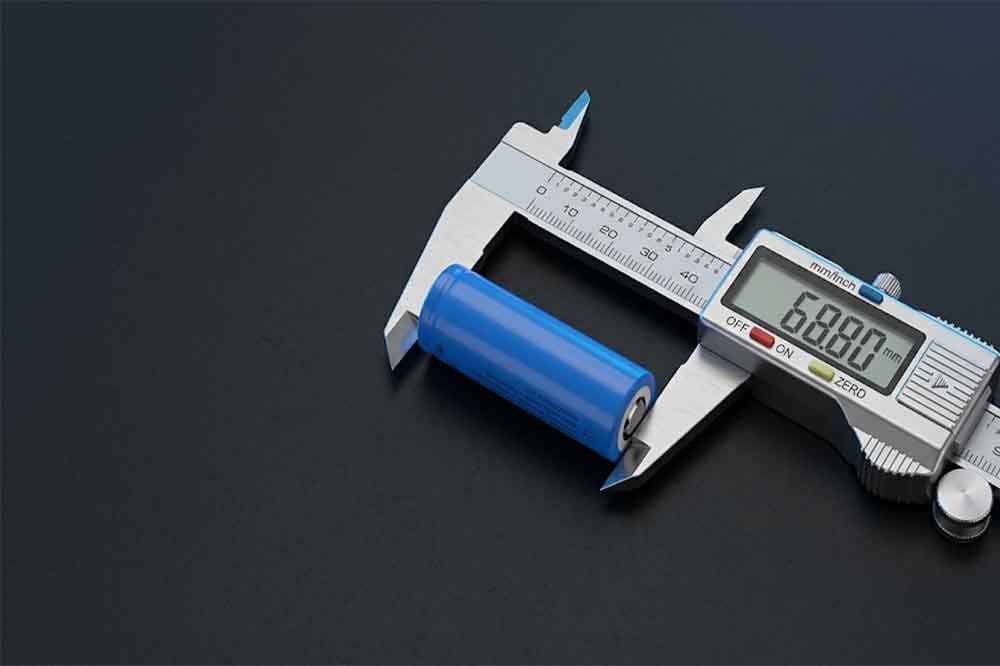
A protected 18650 battery may fit the same general category as a standard 18650 cell, but its actual dimensions can be different. The added protection circuit, insulating materials, and terminal construction may increase the overall length. For buyers and product engineers, this difference can determine whether a battery fits an existing device or requires a change to the enclosure.
When purchasing protected 18650 batteries in bulk, checking only the battery name is not enough. Diameter, total length, terminal style, dimensional tolerance, and the space available inside the equipment should all be confirmed before an order is placed.
What Are the Standard 18650 Battery Dimensions?
The name 18650 refers to a cylindrical lithium-ion cell format. The numbers generally indicate a nominal diameter of approximately 18 mm and a nominal length of approximately 65 mm.
These figures describe the general cell format, not a guarantee that every finished battery will measure exactly 18 mm by 65 mm.
The dimensions of a complete protected battery may differ from those of the bare cell. Protection components, additional insulation, terminal design, and the outer covering can affect its final size.
What Does 18650 Mean?
The 18650 format is widely used in rechargeable lithium-ion batteries for portable electronics, lighting equipment, instruments, and battery packs.
However, the format name does not specify every product characteristic. It does not tell buyers the exact capacity, chemistry, discharge current, protection cutoff, or final assembled dimensions.
Two batteries described as 18650 may therefore have different electrical specifications and physical measurements.
When reviewing a supplier’s datasheet, confirm whether the listed dimensions refer to the bare cell or the complete protected battery. This simple distinction can prevent compatibility problems during product development.
Typical Dimensions of Protected 18650 Batteries
A conventional unprotected 18650 cell is commonly around 18 mm in diameter and 65 mm in length. A protected version can be longer because additional components are installed at the end of the cell.
Physical dimensions are only one part of battery selection. Buyers should also understand protected 18650 battery voltage differences before confirming electrical compatibility with their devices.
Depending on the product design, protected 18650 batteries may measure approximately 68–72 mm or more in overall length. This is an illustrative range, not a universal specification. Some products fall outside it, and the diameter can also vary with the wrapper and protective construction.
Buyers should never use this approximate range as the final basis for a production design. Request the exact drawing or dimensional specification for the model being purchased.
For an existing device, even a small difference in length may prevent the battery compartment from closing or stop the contact spring from operating correctly.

Why Is a Protected 18650 Battery Longer?
The main reason is the addition of a protection circuit and its associated construction.
A protected lithium-ion battery generally includes an overcharge, over-discharge, and overcurrent protection arrangement, depending on the design. The protection components may be installed near one terminal and connected to the cell through an appropriate electrical structure.
Additional insulation and terminal construction can also affect the final dimensions.
Protection Circuit and Additional Components
The protection circuit is intended to help prevent specified unsafe operating conditions. It adds components that are not present in the same form on a typical unprotected cell.
Some protected batteries use a raised button-top terminal, while others have different terminal arrangements. These choices can change the measured overall length.
The finished battery wrapper and insulating rings should also be included when assessing fit. A measurement taken from a bare cell before assembly may not represent the finished product.
For OEM buyers, ask the supplier for the dimensions of the completed battery, including its protection circuit, terminal, wrapper, and any other external components.
Button-Top vs. Flat-Top Designs
A button-top battery has a raised positive terminal. A flat-top battery has a flatter terminal profile.
The terminal style affects the overall geometry and may affect compatibility with a battery holder, charging equipment, or device contacts. It should not be treated as a purely cosmetic difference.
Some equipment requires a specific contact arrangement. A battery with the wrong terminal type may fail to make reliable electrical contact even if its body diameter and length appear suitable.
Also, a button-top design is not necessarily protected, and a flat-top design is not necessarily unprotected. Buyers should verify both the protection configuration and terminal specification.
How to Measure Protected 18650 Battery Dimensions
For accurate purchasing and engineering work, measure the finished battery rather than relying on the format name.
1. Measure the maximum diameter. Use a suitable caliper to measure across the widest part of the battery body. Include the outer wrapper and any protruding features that affect the available space.
2. Measure the overall length. Measure from the bottom of the negative terminal to the highest point of the positive terminal. For a button-top model, include the raised button.
3. Confirm the terminal profile. Record whether the battery is flat-top, button-top, or another specified configuration.
4. Check the external construction. Note wrapper thickness, insulating rings, exposed metal areas, and any other features that may affect installation or electrical clearance.
5. Compare the result with the supplier drawing. Confirm the nominal dimensions and permitted tolerances rather than relying on a single sample measurement.
Use appropriate measurement equipment and avoid damaging the battery wrapper or terminals. Lithium-ion cells can become hazardous if their insulation or terminals are damaged.

Will a Protected 18650 Battery Fit Your Device?
Physical compatibility depends on more than the battery’s nominal diameter and length.
Start by checking the internal dimensions of the battery compartment. The usable space must accommodate the complete battery, not just the cylindrical cell body.
Next, inspect the contact arrangement. Spring contacts may provide some movement, while fixed contacts may require a more precise overall length. A battery that is too short can lose contact during movement, while one that is too long can place excessive pressure on the terminals or prevent the enclosure from closing.
Consider the installation environment as well. Vibration, temperature changes, and repeated battery replacement can affect contact reliability.
If the device was designed around an unprotected 18650 cell, do not assume that a protected replacement will fit. The extra length may require a different battery holder, revised enclosure, or alternative battery design.
For a new OEM project, the most reliable approach is to establish the battery compartment’s maximum dimensions early in the design process. Then select a battery model that satisfies both the physical and electrical requirements.
Never force an oversized battery into a compartment or remove its protective covering to make it fit.
A battery may fit the compartment but still fail to meet the device’s electrical requirements. Check the protected 18650 discharge current requirements before approving the battery model.
Battery Dimension Tolerances and Bulk Purchasing
In B2B purchasing, the nominal dimensions are only part of the specification. Buyers should also understand dimensional tolerances, meaning the permitted variation around the specified measurements.
For example, a drawing may list a nominal length and a maximum permitted length. The buyer needs to know which measurement applies to the finished protected battery and how the supplier controls it during production.
This is particularly important when ordering hundreds or thousands of batteries for a product with a tightly fitted compartment.
Before approving a bulk order, request a technical datasheet and, where appropriate, a dimensioned drawing. Confirm whether the dimensions include the protection circuit and all external insulating materials.
A sample inspection can help verify that the supplied product matches the approved specification. For recurring orders, define the accepted dimensions and inspection method before production begins.
Packaging and transport can also affect the condition of the battery wrapper and terminals. Incoming quality checks should identify damaged insulation, bent terminals, or other physical defects rather than focusing on measurements alone.
Protected 18650 Dimensions in Custom Battery Packs
Protected individual cells and custom multi-cell battery packs require different dimensional checks.
A single protected cell has a relatively simple external shape, but a battery pack may include multiple cells, interconnections, a battery management system (BMS), wiring, connectors, insulation, and an enclosure.
The total pack dimensions depend on the cell arrangement and the space required for these additional components. A compact cell layout does not automatically result in a compact finished pack.
For OEM and ODM projects, provide the supplier with the available enclosure dimensions, connector position, cable exit direction, mounting requirements, and expected operating conditions.
If the pack must fit an existing product, a mechanical drawing is usually more useful than a general description such as “fits 18650 batteries.” The drawing should identify critical dimensions and any areas where clearance is limited.
Also confirm the electrical design. Changing from a bare cell to a protected cell or changing the pack’s protection architecture may affect available space and assembly requirements.
A battery supplier should assess the complete design instead of promising compatibility based only on the cell format.

Common Mistakes When Selecting Battery Size
One frequent mistake is assuming that every 18650 battery is exactly 65 mm long. This overlooks the additional construction used in many protected models.
Another is checking the body diameter but ignoring the terminal height. The positive terminal may be the feature that determines whether the battery fits.
Buyers may also confuse a protected cell with a complete battery pack. A pack with multiple cells, wiring, and a BMS has a different overall size and mounting requirement.
Finally, relying on a product photograph instead of a technical drawing can lead to avoidable errors. Images rarely provide enough information to establish exact dimensions or tolerances.
The best practice is to confirm the exact model, finished dimensions, terminal configuration, and approved drawing before production or bulk purchasing.
Conclusion
Protected 18650 battery dimensions depend on the underlying cell format, protection circuit, terminal construction, insulation, and finished assembly. Although a conventional 18650 cell is commonly around 18 mm in diameter and 65 mm long, a protected version may be longer and may differ in its external profile.
For reliable product integration, verify the maximum diameter, overall length, terminal style, dimensional tolerance, and available installation space. OEM buyers should request the complete battery drawing and approve a sample when dimensional compatibility is critical.
A few careful checks before ordering can reduce fitting problems, production delays, and unnecessary redesign costs.
Frequently Asked Questions
What are the dimensions of a protected 18650 battery?
A protected 18650 battery may measure approximately 68–72 mm or more in length, depending on its construction. Confirm the manufacturer’s finished-battery dimensions before purchasing.
Are all protected 18650 batteries the same size?
No. Protection circuits, terminal styles, insulation, and manufacturing designs can change the final dimensions. Always check the exact model specification.
Will a protected 18650 battery fit an unprotected 18650 battery holder?
Not necessarily. A protected model is often longer, so it may not fit the holder or allow the device enclosure to close properly.
What should buyers measure before ordering protected 18650 batteries?
Check the maximum diameter, overall length including the positive terminal, terminal style, dimensional tolerance, and available compartment clearance.
Can OEM suppliers customize protected 18650 battery dimensions?
Some OEM suppliers can develop custom battery assemblies to meet specified space requirements. Feasibility depends on the cell, protection design, electrical requirements, and available enclosure space.
When selecting batteries for a new product, buyers should evaluate dimensions, electrical specifications, and installation requirements together. Explore our 18650 lithium battery products to compare available battery options for different equipment and OEM applications.
Related Products
-

12V 4400 mah Lithium ion 3S2P 18650 Battery Pack
-

18650 2000mAh 3.7 volt Lithium-ion Battery
-

18650 20V 3.0Ah Cordless Drill battery
-

18650 22.2V 7.8Ah 2600Mah 6S3P Rechargeable Battery Pack
-

18650 2600mAh Rechargeable Lithium-Ion Battery 3.7V
-

18650 3.7V 10Ah Li-Ion Power Battery Pack
-

18650 3.7V 3300mah Rechargeable Lithium ion Battery
-

18650 7S7P 24V 14Ah Lithium ion Electric Scooter Battery Pack
-

18650 battery 3.7V 1500mAh Lithium-Ion Battery
-

18650 Battery 3500 mah Rechargeable Battery Cells
-

18650 Electric Scooter 48V 13000mAh Lithium Battery
-

2600mAh 3S1P 11.1V 18650 Battery Packs
-

3.7V Li ion Rechargeable 3000mah 18650 Battery Cell
-

36V 5200mAh 10S2P 18650 Battery Pack
-

48v 4400mah 13S2P 18650 Rechargeable Battery Pack
-

7S2P 24V 18650 Lithium Battery Pack
-

Electric Scooter 36V 4400mAH 10S2P 18650 Battery Pack
-

ICR 18650 Battery 2200mah 3.7V
Leave a Reply