
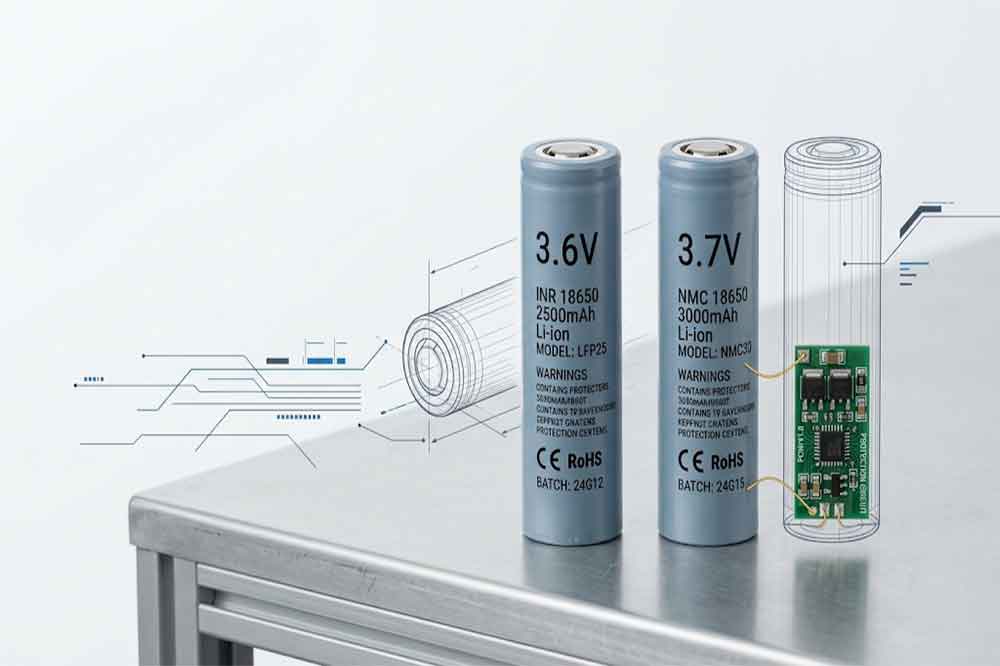
When purchasing a protected 18650 battery, one of the first details buyers notice is the voltage rating. Some product specifications list 3.6V, while others show 3.7V. This can create confusion for engineers, distributors, and manufacturers who need a reliable replacement battery or are developing a new battery-powered device.
Does a 3.6V protected 18650 battery work differently from a 3.7V version? Does the protection circuit change the rated voltage? And can both batteries use the same charger?
In many conventional lithium-ion applications, the answer is straightforward: 3.6V and 3.7V are commonly used nominal voltage ratings for similar lithium-ion cell technologies. However, buyers should still verify the cell chemistry, charging requirements, discharge limits, and manufacturer’s specifications before selecting a replacement.
Understanding these details helps avoid unnecessary product changes and reduces compatibility problems during battery sourcing.
For a broader introduction to cell formats, capacity ratings, and battery selection, read our [complete guide to standard 18650 batteries]
What Does Protected 18650 Voltage Mean?
An 18650 battery is a cylindrical rechargeable cell measuring approximately 18 mm in diameter and 65 mm in length. A protected 18650 battery combines a lithium-ion cell with a protection circuit, usually installed near the positive terminal.
The voltage rating describes the cell’s nominal operating voltage rather than its voltage at every moment of use.
For conventional single-cell lithium-ion batteries, three voltage values are especially important:
- Nominal voltage: The representative voltage used for product specifications and electrical calculations.
- Full-charge voltage: The upper charging voltage specified for the particular cell.
- Discharge cutoff voltage: The lower voltage limit established by the cell specification, device, or protection system.
A conventional 3.6V or 3.7V lithium-ion 18650 cell often has a full-charge voltage of 4.2V. This is common for many lithium-ion chemistries, including certain LCO and NMC cells, but it must not be assumed for every lithium-based battery.
For example, a battery labeled 3.7V may measure approximately 4.2V immediately after a full charge. During use, its voltage gradually decreases depending on its state of charge, current demand, temperature, and internal resistance.
Therefore, the nominal voltage alone does not describe the complete operating voltage range of a protected 18650 battery.
3.6V vs 3.7V: What Is the Difference?
The most important distinction is that 3.6V and 3.7V often represent different nominal voltage conventions rather than two fundamentally different battery sizes.
| Specification | 3.6V 18650 | 3.7V 18650 |
|---|---|---|
| Rated voltage | 3.6V nominal | 3.7V nominal |
| Typical full-charge voltage for compatible conventional Li-ion cells | 4.2V | 4.2V |
| Physical cell format | 18650 cylindrical | 18650 cylindrical |
| Protection circuit | Depends on product | Depends on product |
| Capacity options | Vary by cell model | Vary by cell model |
| Interchangeability | Verify specifications | Verify specifications |
These similarities do not mean that every 3.6V battery is interchangeable with every 3.7V battery. A matching nominal voltage is only one part of the selection process.

Nominal Voltage and Actual Operating Voltage
Nominal voltage is a convenient reference value. It helps engineers estimate energy, calculate system requirements, and communicate battery specifications.
Suppose a product uses one 18650 cell rated at 3.7V and 3,000mAh.
Its nominal energy is approximately:
3.7V × 3.0Ah = 11.1Wh.
If a comparable cell is rated at 3.6V and 3,000mAh, its nominal energy is:
3.6V × 3.0Ah = 10.8Wh.
The difference in this calculation is about 2.8%. However, this arithmetic does not prove that one battery provides more usable energy in practice. Actual performance depends on the cell’s discharge characteristics, usable voltage range, capacity, load, and cutoff settings.
When comparing suppliers, buyers should examine the complete datasheet rather than selecting a battery based only on the higher nominal voltage.
Why Manufacturers Use Different Voltage Ratings
Battery manufacturers may use 3.6V or 3.7V to describe cells with broadly similar nominal operating characteristics. The convention can vary by manufacturer, cell design, and product documentation.
The label alone does not identify the exact chemistry, capacity, internal resistance, or cycle life.
This matters in OEM purchasing. Two suppliers may both offer a protected 18650 battery rated at 3.7V, yet their products can differ considerably in discharge capability, dimensions, protection thresholds, and connector options.
A more useful comparison includes the cell model, nominal capacity, maximum charging voltage, recommended discharge conditions, and protection-circuit specifications.
Does a Protection Circuit Change Battery Voltage?
A protection circuit is designed to help prevent unsafe operating conditions. It does not normally change the underlying cell’s nominal voltage rating.
The protection circuit may monitor voltage and current and disconnect the battery when a specified protection threshold is reached. The exact functions depend on the circuit design.
Overcharge and Over-Discharge Protection
Common protection functions include:
- Overcharge protection to interrupt charging when the upper voltage threshold is exceeded.
- Over-discharge protection to disconnect the load when the lower threshold is reached.
- Overcurrent protection to interrupt excessive discharge current.
- Short-circuit protection to respond to certain short-circuit conditions.
Not every protected 18650 product includes identical functions or settings. Some designs may also include temperature protection, but this should be confirmed with the supplier.
Protection is a backup safety measure, not a substitute for a suitable charger, a compatible device, or proper battery management.
For battery-powered equipment, the protection thresholds should be compatible with the cell specifications and the equipment’s expected operating conditions.
Protection Board Voltage Drop
A protection circuit introduces electrical resistance through its MOSFETs, conductors, and other components. When current flows, this resistance can produce a small voltage drop.
For example, if the effective resistance of the conducting protection path is 30 milliohms and the discharge current is 2A, the approximate voltage drop is:
2A × 0.03Ω = 0.06V.
The actual voltage drop depends on the circuit and operating conditions. At higher currents, the drop and heat generation may become more significant.
This is especially relevant when selecting a protected 18650 battery for equipment with high startup currents, motors, lighting systems, or other demanding loads.
A battery that performs adequately at a low current may not meet the same application’s requirements at a higher current.
What Is the Full-Charge Voltage of a Protected 18650 Battery?
For many conventional lithium-ion 18650 cells rated at 3.6V or 3.7V nominal, the specified full-charge voltage is 4.2V per cell. Nevertheless, the exact value must be confirmed from the manufacturer’s datasheet.
Do not assume that every lithium-based battery uses a 4.2V charging limit. Different chemistries and cell designs may require different charging voltages.
A compatible charger should match the battery’s chemistry, charging voltage, charging method, and current limits.
For a single conventional 4.2V lithium-ion cell, the charger must be designed for that charging profile. Connecting a battery to a charger intended for a different chemistry can cause improper charging and potentially create a serious safety hazard.
It is also important to distinguish nominal voltage from the charger’s output rating. A 3.7V battery is not necessarily charged to only 3.7V.
For protected cells, confirm that the charger and the battery protection circuit are compatible. Do not rely on the protection board to stop an unsuitable charger from causing damage.
How to Choose the Right Protected 18650 Battery
The best protected 18650 battery is the one that meets the device’s electrical, mechanical, and safety requirements.
Before placing an order, review the following details.
1. Confirm the chemistry and voltage range.
Check the nominal voltage, maximum charging voltage, and permitted discharge range. Do not use the 3.6V or 3.7V label as the only selection criterion.
2. Check the capacity and discharge current.
A battery rated at 3,000mAh may provide a different usable runtime from another battery with the same stated capacity. Discharge rate, temperature, cell quality, and cutoff voltage all influence the result.
The protection circuit must also support the application’s normal and peak current requirements.
3. Measure the complete battery dimensions.
Protected 18650 batteries may be longer than standard unprotected cells because of the protection circuit and terminal construction. Button-top designs may also differ in length from flat-top designs.
If the battery fits inside a narrow enclosure, measure the complete protected battery, not just the cylindrical cell.
4. Verify terminal and connection requirements.
Confirm whether the device requires a button-top or flat-top terminal, specific polarity, welded tabs, wires, or a connector. A battery with the correct voltage can still be unsuitable if its physical connections do not match.
5. Request the relevant technical documents.
For commercial applications, ask for the cell datasheet, protection-board specifications, charging requirements, and applicable transport and compliance documents. Request sample testing before approving a large production order.
These checks are particularly useful when replacing batteries in existing equipment or developing a new product for wholesale distribution.

Common Voltage Mistakes in Battery Selection
Several mistakes appear repeatedly when buyers compare protected 18650 batteries.
The first is assuming that 3.7V is always more powerful than 3.6V. Nominal voltage by itself does not establish discharge performance, usable energy, or current capability.
The second is treating every 18650 battery as interchangeable. Different chemistries, lengths, terminals, protection thresholds, and discharge ratings can make apparently similar products incompatible.
Another common mistake is overlooking the protection board. A protected battery may have a lower permitted continuous discharge current than the underlying cell, depending on the circuit design.
Finally, some buyers compare capacity figures without checking test conditions. Capacity measurements depend on factors such as discharge current, temperature, and cutoff voltage. Datasheets and test conditions should be reviewed before making a purchasing decision.
A clear technical specification helps prevent these problems before samples enter the testing stage.
Protected 18650 Voltage for OEM and Bulk Purchasing
For manufacturers and distributors, voltage selection should be part of a complete battery specification rather than a standalone purchasing requirement.
An OEM supplier may offer protected 18650 batteries with different capacities, protection-board configurations, terminal styles, wire assemblies, and packaging options. The available choices depend on the cell model and production requirements.
When requesting a quotation, provide the nominal voltage, capacity, maximum charging voltage, continuous and peak current requirements, target dimensions, connection type, and expected order quantity.
If the battery is being used in an existing product, sharing the original battery label, mechanical drawing, or device requirements can help the supplier assess compatibility.
For custom projects, sample validation should include charging behavior, loaded voltage, runtime, protection cutoff, physical fit, and operation under the intended temperature and current conditions.
A battery supplier should confirm the proposed design against the actual application rather than relying solely on a nominal voltage match.
Apsenx supports B2B lithium battery sourcing and OEM/ODM battery pack development. Buyers can discuss cell selection, protection circuit requirements, wiring, packaging, and customized battery configurations according to their project specifications.
The key point is simple: 3.6V and 3.7V can describe broadly similar conventional lithium-ion 18650 cells, but compatibility must be verified using the complete battery specification. Checking the charging limit, discharge capability, protection circuit, and physical dimensions is a more reliable way to select the right protected 18650 battery.
Businesses sourcing cylindrical cells for commercial equipment can explore our [18650 lithium batteries for OEM and wholesale applications] to discuss suitable cell specifications and customized battery solutions.”
Frequently Asked Questions
Q1. Is a 3.6V protected 18650 battery the same as a 3.7V battery?
They can be similar conventional lithium-ion cells with different nominal voltage ratings. However, chemistry, capacity, discharge limits, and protection settings must be checked before treating them as interchangeable.
Q2. What is the full-charge voltage of a 3.7V protected 18650 battery?
Many conventional 3.7V lithium-ion 18650 cells have a maximum charging voltage of 4.2V. Always confirm the specific cell’s datasheet and use a compatible charger.
Q3. Does a protection circuit reduce battery voltage?
The protection circuit does not normally change the nominal voltage rating. Its electrical resistance can cause a small voltage drop under load, depending on the current and circuit design.
Q4. Can I replace a 3.6V protected 18650 battery with a 3.7V model?
Possibly, but verify charging voltage, discharge current, capacity, dimensions, terminal configuration, and protection thresholds. The device manufacturer’s requirements take priority over the nominal voltage label.
Q5. Is a protected 18650 battery longer than an unprotected battery?
Often, yes. The protection circuit and terminal construction can increase overall length. Measure the complete battery and check the enclosure’s available space before ordering.
-

12V 4400 mah Lithium ion 3S2P 18650 Battery Pack
-

18650 2000mAh 3.7 volt Lithium-ion Battery
-

18650 20V 3.0Ah Cordless Drill battery
-

18650 22.2V 7.8Ah 2600Mah 6S3P Rechargeable Battery Pack
-

18650 2600mAh Rechargeable Lithium-Ion Battery 3.7V
-

18650 3.7V 10Ah Li-Ion Power Battery Pack
-

18650 3.7V 3300mah Rechargeable Lithium ion Battery
-

18650 7S7P 24V 14Ah Lithium ion Electric Scooter Battery Pack
-

18650 battery 3.7V 1500mAh Lithium-Ion Battery
-

18650 Battery 3500 mah Rechargeable Battery Cells
-

18650 Electric Scooter 48V 13000mAh Lithium Battery
-

2600mAh 3S1P 11.1V 18650 Battery Packs
-

3.7V Li ion Rechargeable 3000mah 18650 Battery Cell
-

36V 5200mAh 10S2P 18650 Battery Pack
-

48v 4400mah 13S2P 18650 Rechargeable Battery Pack
-

7S2P 24V 18650 Lithium Battery Pack
-

Electric Scooter 36V 4400mAH 10S2P 18650 Battery Pack
-

ICR 18650 Battery 2200mah 3.7V
Leave a Reply