
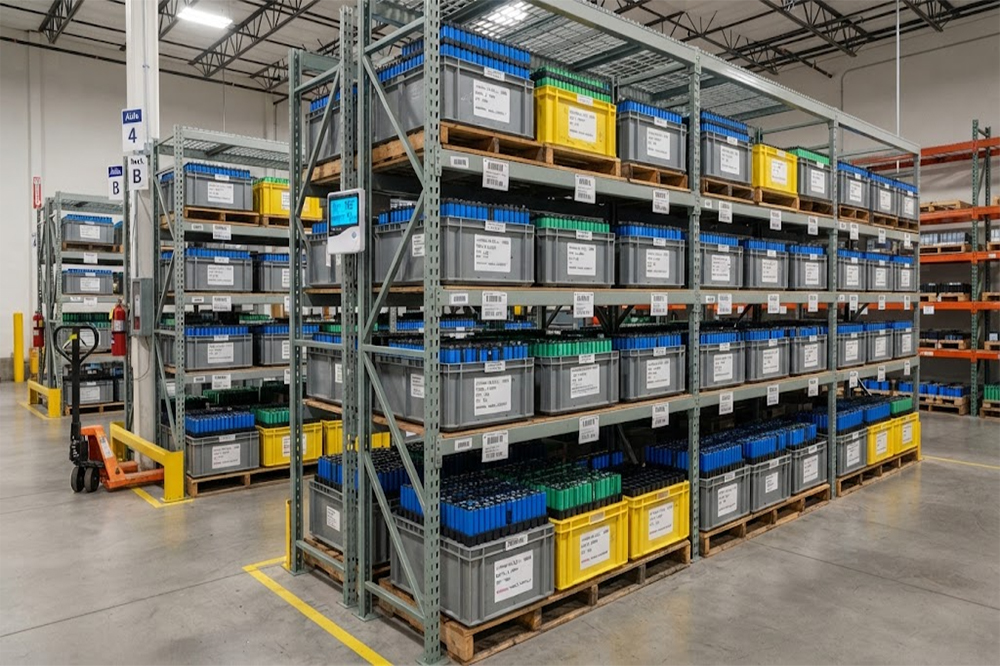
Proper storage can make a noticeable difference to the service life and safety of 18650 lithium batteries. This guide explains practical storage conditions, voltage levels, temperature control, inspection routines, and warehouse considerations for both individual cells and bulk inventory.
Why 18650 Battery Storage Matters
An 18650 lithium-ion cell can sit unused for months, but that does not mean storage conditions are irrelevant.
A common mistake is to charge a battery to 100% and then leave it in a drawer, warehouse, toolbox, or production area for a long time. The battery may look perfectly fine when it is finally used, but high state of charge, heat, moisture, and poor handling can gradually affect its performance.
For individual users, storage is usually simple. For manufacturers, distributors, and battery pack assemblers, the situation is different. Hundreds or thousands of cells may remain in inventory before they are assembled into a finished product.
That makes storage conditions part of battery quality management, not just housekeeping.
What Voltage Should 18650 Battery Have During Storage?
For long-term storage, 18650 lithium-ion battery generally should not be kept fully charged.
A moderate state of charge is usually more suitable for storage because it reduces the stress placed on the cell compared with keeping it at maximum voltage for an extended period.
A practical storage range is often around 3.6V–3.8V per cell, although the exact recommendation depends on the cell chemistry, manufacturer specifications, and expected storage period.
For example:
- 1 cell: around 3.6–3.8V
- 2 cells in series: around 7.2–7.6V
- 3 cells in series: around 10.8–11.4V
- 4 cells in series: around 14.4–15.2V
Do not assume every lithium battery should be stored at exactly the same voltage. Always check the manufacturer’s recommended storage conditions when available.
If you’re still unclear about nominal voltage versus full-charge voltage, our guide to 18650 battery voltage explains why a cell can be described as 3.6V, 3.7V, or 4.2V depending on the context.
Keep 18650 Batteries Away From Excessive Heat
Temperature is one of the easiest storage factors to overlook.
A warehouse might feel comfortable to people while being less than ideal for lithium battery inventory. Direct sunlight, metal containers exposed to the sun, poorly ventilated storage rooms, and locations close to heating equipment can all create unnecessary temperature stress.

For long-term storage, a cool, dry, and stable environment is preferable.
Avoid storing cells:
- In direct sunlight
- Next to heaters
- Inside hot vehicles
- Near steam or water sources
- In poorly ventilated areas
- Where temperatures fluctuate heavily
Short-term exposure to a warm environment does not automatically mean a battery is damaged. The bigger concern is repeated or prolonged exposure.
This is particularly important for wholesalers because batteries may spend weeks or months waiting for an order before shipment.
Humidity and Physical Protection Also Matter
Lithium-ion cells are electrical products, so moisture is not something you want around the terminals.
A dry storage environment helps reduce the chance of corrosion, contamination, and packaging problems.
Physical protection is equally important. Cells should not be thrown loosely into boxes where the positive and negative terminals can contact metal objects.
For loose 18650 cells, use appropriate packaging that keeps the terminals separated and prevents the cells from moving around excessively.
Never store loose cells together with:
- Coins
- Keys
- Metal tools
- Bare wires
- Screws
- Other conductive objects
A short circuit can happen surprisingly easily when exposed battery terminals touch conductive material.
Should 18650 Batteries Be Stored in a Refrigerator?
Usually, there is no need to put ordinary 18650 batteries in a household refrigerator.
The idea sounds reasonable because lower temperatures can slow chemical reactions, but a household refrigerator also introduces condensation and moisture concerns. Taking a cold battery into a warm, humid environment can create condensation on its surface.
For most normal applications, a stable room-temperature storage environment is much easier to manage.
If a manufacturer specifies special storage conditions for a particular cell, follow those instructions instead of applying generic advice.

Check Stored Batteries Periodically
Long-term storage should not mean forgetting about the batteries.
A simple inspection every few months can help identify problems before the cells are used in a product.
Check for:
- Unusual swelling
- Damaged wrapping
- Corrosion
- Leakage
- Significant voltage loss
- Physical dents
- Damaged terminals
- Excessive temperature during inspection or testing
Voltage is particularly useful for inventory management. If one cell has dropped noticeably lower than the others, it deserves additional attention.
This becomes even more important when preparing cells for battery packs. Cells with significantly different characteristics may create imbalance after being connected together.
For a deeper look at this issue, see our guide to 18650 battery internal resistance, which explains how cell resistance affects voltage drop, heat generation, and pack performance.
What About Partially Used 18650 Batteries?
Used cells need more attention than new inventory.
Suppose a production line removes several cells from a battery pack because of a configuration change. Those cells may still have usable capacity, but their history is now different from new cells.
Before returning them to inventory, record their condition where possible.
For example:
Cell A: 3.78V
Cell B: 3.77V
Cell C: 3.79V
Cell D: 3.45V
The fourth cell deserves investigation instead of being placed back into the same storage box without checking.
For professional battery assembly, voltage alone is not enough. Capacity, internal resistance, physical condition, and previous usage can all affect whether a cell is suitable for reuse.
Our guide on how to test an 18650 battery covers practical methods for checking voltage, capacity, resistance, and general cell condition.
Storage for Wholesale 18650 Battery Inventory
The requirements become more practical when you are managing large quantities.
A battery distributor might receive several thousand 18650 cells and ship them gradually over several months. In this situation, inventory rotation is useful.
A simple first-in, first-out (FIFO) approach can prevent older inventory from sitting forgotten at the back of a warehouse.
It is also helpful to record:
- Cell model
- Capacity
- Batch number
- Arrival date
- Storage voltage
- Inspection date
- Quantity
- Packaging condition
Keeping different models and batches clearly separated reduces the chance of mixing cells with different specifications.
This matters when customers request specific capacity or discharge characteristics. A 3000mAh cell and a 3500mAh cell may have similar dimensions, but they are not interchangeable in every application.
You can see the available 18650 lithium battery products and capacity options in the Apsenx product category.
Apsenx 18650 Lithium Battery Products

Storage Before Battery Pack Assembly
Battery manufacturers often receive cells before the final pack design is completed.
This creates another practical issue: cells may sit in inventory before assembly.
When the cells eventually enter production, don’t simply assume that cells from the same box are perfectly matched. A production inspection should confirm that the cells meet the required specifications.
For packs using series or parallel connections, matching becomes especially important.
If you’re designing a multi-cell pack, our 18650 series and parallel configuration guide explains how cell connections affect voltage, capacity, and overall pack configuration.
A Simple 18650 Storage Checklist
For everyday warehouse management, the process does not need to be complicated.
Before storage:
- Check the cell appearance.
- Confirm the voltage.
- Use suitable insulating packaging.
- Separate different models and batches.
- Record the storage date.
During storage:
- Keep the environment cool and dry.
- Avoid direct sunlight.
- Keep terminals protected.
- Inspect inventory periodically.
- Rotate older stock first.
Before use:
- Inspect the cell again.
- Check voltage.
- Check for physical damage.
- Test suspicious cells.
- Match cells appropriately for pack assembly.
This simple workflow is usually more useful than trying to create an overly complicated storage system.
Final Thoughts
Good 18650 battery storage is mostly about avoiding unnecessary stress.
Keep the cells at an appropriate storage charge level, protect them from heat and moisture, prevent accidental short circuits, and inspect older inventory before putting it back into service.
For individual users, that may mean storing a few cells correctly in a dry cabinet. For wholesalers and battery manufacturers, it means adding storage checks to normal inventory management.
When you’re buying 18650 cells in bulk, storage requirements are worth discussing with the supplier before placing the order. The right packaging, cell specifications, batch management, and inspection process can make a difference once the batteries move from warehouse stock into actual battery packs.
FAQs
1. What voltage should an 18650 battery have during storage?
A common practical range is around 3.6V–3.8V per cell for long-term storage, but the manufacturer’s specific storage recommendation should take priority.
2. Can I store an 18650 battery fully charged?
It is better not to keep lithium-ion cells at full charge for extended periods. A moderate state of charge is generally more suitable for long-term storage.
3. Is it safe to store 18650 batteries in a hot warehouse?
High temperatures are not ideal for long-term lithium-ion battery storage. Keep batteries in a cool, dry, stable environment away from direct sunlight and heat sources.
4. How often should stored 18650 batteries be checked?
For long-term inventory, periodic inspections every few months are a reasonable practical approach. Check voltage, physical condition, packaging, and signs of damage.
5. Can old 18650 batteries still be used?
Potentially, but they should be inspected and tested first. Age, storage conditions, previous use, capacity loss, and increased internal resistance can all affect suitability.
-

12V 4400 mah Lithium ion 3S2P 18650 Battery Pack
-

18650 2000mAh 3.7 volt Lithium-ion Battery
-

18650 20V 3.0Ah Cordless Drill battery
-

18650 22.2V 7.8Ah 2600Mah 6S3P Rechargeable Battery Pack
-

18650 2600mAh Rechargeable Lithium-Ion Battery 3.7V
-

18650 3.7V 10Ah Li-Ion Power Battery Pack
-

18650 3.7V 3300mah Rechargeable Lithium ion Battery
-

18650 7S7P 24V 14Ah Lithium ion Electric Scooter Battery Pack
-

18650 battery 3.7V 1500mAh Lithium-Ion Battery
-

18650 Battery 3500 mah Rechargeable Battery Cells
-

18650 Electric Scooter 48V 13000mAh Lithium Battery
-

2600mAh 3S1P 11.1V 18650 Battery Packs
-

3.7V Li ion Rechargeable 3000mah 18650 Battery Cell
-

36V 5200mAh 10S2P 18650 Battery Pack
-

48v 4400mah 13S2P 18650 Rechargeable Battery Pack
-

7S2P 24V 18650 Lithium Battery Pack
-

Electric Scooter 36V 4400mAH 10S2P 18650 Battery Pack
-

ICR 18650 Battery 2200mah 3.7V
Leave a Reply