
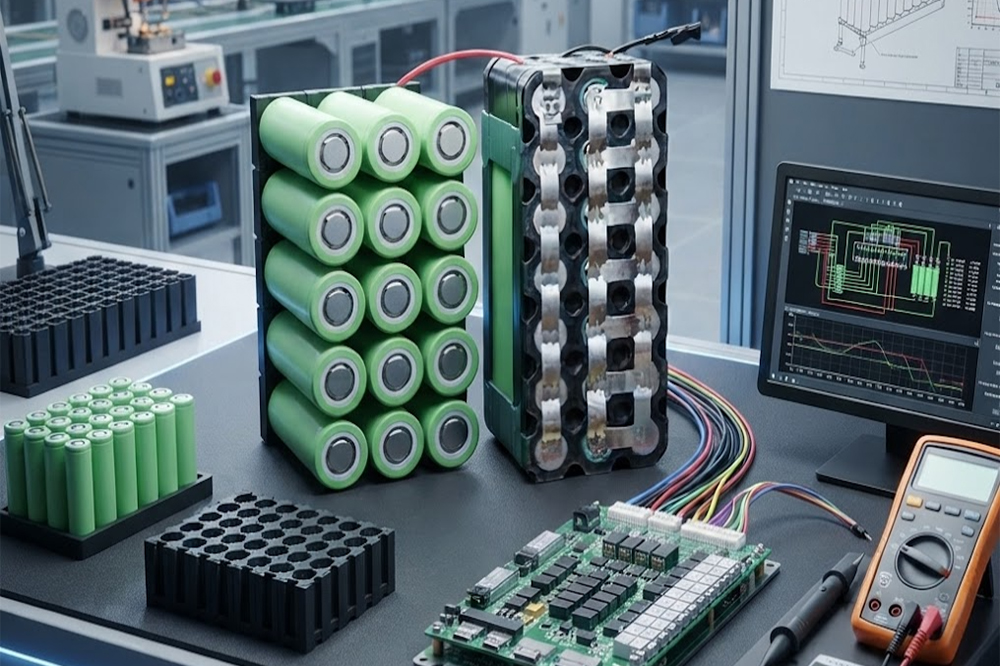
Custom 18650 battery pack usually starts with a simple request: “We need a battery with this voltage, capacity, and size.”
The difficult part comes later. The cells must fit inside the enclosure. The BMS must support the series configuration. The battery must deliver enough current without excessive voltage drop. The connector must match the customer’s equipment, and the charger must work with the finished pack.
That is why custom battery development is not only a cell-buying process. It is a combination of electrical design, mechanical design, assembly, testing, and production management.
Working with an experienced 18650 battery pack manufacturer can reduce many of these problems. However, the buyer still needs to provide accurate requirements and check the sample carefully before moving into mass production.
1. Start With the Application
The first step is to understand where the battery will be used.
A battery for a small electronic device may need high energy density and compact dimensions. A battery for a power tool may need high discharge current and strong resistance to voltage sag. An e-bike battery may require a larger capacity, a specific mounting shape, and a communication connection to the controller.
Before asking for a quotation, collect the following information:
- Application or equipment type
- Required nominal voltage
- Fully charged voltage
- Required capacity
- Continuous discharge current
- Peak discharge current
- Maximum battery dimensions
- Expected operating time
- Charging method
- Connector type
- Operating temperature
- Estimated order quantity
A clear application description helps the manufacturer recommend a practical battery design instead of simply selecting cells based on capacity.
2. Select the Right 18650 Cells
Not all 18650 batteries have the same performance. Two cells may have the same capacity but very different discharge capabilities, internal resistance, and cycle performance.
For a low-current device, a 3000mAh or 3500mAh cell may be a suitable choice. A power tool or high-load device may need a high-drain cell with a lower internal resistance and stronger current output.
Important cell specifications include:
Capacity
Capacity is normally shown in mAh or Ah. It affects how long the battery can operate before recharging.
Discharge Current
The cell must support both the continuous and peak current required by the equipment. Selecting a cell only by its capacity can create performance problems.
Internal Resistance
Higher internal resistance can lead to more heat and greater voltage drop under load. For demanding applications, cell consistency and resistance are especially important.
Cell Condition
A custom pack should normally use new cells from a consistent production batch. Mixing old, used, or different-condition cells can reduce pack balance and service life.
More details about cell selection can be found in the [18650 Battery Internal Resistance Guide] and the [High-Drain 18650 Battery Guide].

3. Decide the Series and Parallel Configuration
The series connection determines voltage. The parallel connection mainly determines capacity and current capability.
For example, a 4S2P pack uses eight cells:
- 4 cells connected in series
- 2 cells connected in parallel at each series level
- Nominal voltage: approximately 14.8V when using 3.7V cells
- Full charging voltage: approximately 16.8V
- Capacity: two times the capacity of one cell
If each cell has a capacity of 3000mAh, the finished 4S2P pack will have approximately 6000mAh, or 6Ah.
The basic calculation is:
Pack nominal voltage = Cell nominal voltage × Series count
Pack capacity = Cell capacity × Parallel count
The final design also needs to consider current sharing, available space, heat generation, and the equipment’s voltage tolerance. A configuration that works electrically may still be unsuitable if it cannot fit inside the product housing.
4. Match the BMS to the Battery Pack
The BMS, or battery management system, protects and monitors the battery pack. It is not a universal component that can be selected separately from the cell configuration.
The BMS should match:
- Number of cells in series
- Battery chemistry
- Continuous discharge current
- Peak current requirement
- Charging current
- Balance function
- Temperature protection
- Communication requirements
- Physical installation space
For example, a 4S lithium-ion battery pack generally needs a BMS designed for a 4-series configuration. Using a BMS with the wrong series count can cause incorrect voltage monitoring and unsafe charging behavior.
The BMS rating should also be realistic. A board marked with a high current value may not perform well in a compact enclosure if the wires, nickel strips, connectors, and thermal design cannot handle the same current.
A battery pack manufacturer should confirm the relationship between the cells, BMS, charger, and load before finalizing the design.

5. Check the Mechanical Design
Electrical specifications are only one part of a custom battery pack.
The finished pack must fit the equipment. The manufacturer may need to work with a drawing, 3D model, sample housing, or actual product enclosure.
Mechanical details may include:
- Overall length, width, and height
- Cell arrangement
- Wire exit direction
- Connector position
- Mounting holes
- Casing material
- PVC shrink film
- Plastic holder
- Insulation paper
- Foam protection
- Label position
- Weight limitation
Even a few millimeters can affect installation. It is better to provide the maximum available dimensions rather than only the approximate internal space.
If the pack will be installed in a moving product, vibration and impact should also be considered. The cells, wires, and protection materials need to remain stable during normal use.
6. Confirm the Connector and Charging Requirements
The connector is often overlooked during the first quotation. Later, it can become a major reason for redesign.
Provide the manufacturer with:
- Connector brand or model
- Male or female type
- Wire length
- Wire gauge
- Polarity
- Pin definition
- Communication pins, if applicable
- Charging connector
- Load connector
- Waterproof requirement
The charger must also match the battery pack. A 4S lithium-ion pack normally requires a charger with a charging voltage of 16.8V. A charger designed for a different series configuration may not be suitable.
The charging current should be selected according to the cells, BMS, thermal conditions, and expected charging time. A higher charging current is not automatically better.
7. Develop a Sample Before Mass Production
A sample is one of the most important stages in custom battery development.
The first sample allows the buyer to check whether the proposed design works in the real product. It is also the best time to discover problems before they affect a large order.
The sample evaluation should include:
- Physical dimensions
- Weight
- Connector position
- Voltage
- Capacity
- Discharge performance
- Charging behavior
- BMS protection
- Temperature during operation
- Installation fit
- Communication function, if required
- Label and packaging details
For some projects, one sample is not enough. A buyer may need several samples from different production batches or several prototype revisions before approving the final design.
Do not judge a custom battery pack only by its appearance. A clean-looking pack still needs electrical and functional testing.

8. Test the Battery Pack Before Approval
A practical testing plan should cover both normal operation and protection functions.
Common tests include:
Capacity Test
The pack is charged and discharged under controlled conditions to verify its usable capacity.
Voltage Test
Check nominal voltage, full charging voltage, and voltage behavior under load.
Current Test
Confirm that the pack can deliver the required continuous and peak current.
Temperature Test
Monitor the cells, BMS, wires, connectors, and casing during charging and discharge.
Protection Test
Check overcharge, over-discharge, over-current, short-circuit, and temperature protection where applicable.
Balance Test
For multi-series packs, verify that the cell groups remain within the expected voltage range.
Mechanical Test
Check whether the pack can withstand normal installation, movement, and handling without loose components or damaged wires.
The test conditions should be recorded. A result without test current, test time, temperature, and equipment information is difficult to compare.
9. Review Production Quality Control
Once the sample is approved, the next concern is production consistency.
A reliable 18650 battery pack manufacturer should have a clear process for:
- Incoming cell inspection
- Cell voltage testing
- Internal resistance testing
- Capacity grading
- Cell matching
- Nickel strip welding
- Insulation
- BMS installation
- Wire and connector assembly
- Pack testing
- Appearance inspection
- Labeling
- Final packaging
Cell matching is particularly important for multi-series packs. Cells with large differences in capacity or internal resistance may cause imbalance during charging and discharging.
Spot welding should also be controlled carefully. Weak welds can create resistance and heating, while excessive welding energy may damage the cell. The process should be checked through pull tests, visual inspection, and electrical testing.
10. Confirm Packaging and Shipping Requirements
Lithium battery packs require suitable packaging and transportation arrangements.
Before production, confirm:
- Individual pack protection
- Inner box design
- Outer carton dimensions
- Quantity per carton
- Battery labels
- Product labels
- Shipping documents
- Required test reports
- Destination country requirements
- Transport method
Depending on the product and shipment route, documents such as UN38.3 test information and MSDS may be required. The exact requirements should be confirmed according to the battery design, transport method, and destination.
Packaging should protect the connector, wires, casing, and battery surface. A pack that passes factory testing can still be damaged by poor packaging during transportation.
11. Questions to Ask a Custom Battery Pack Manufacturer
Before choosing a supplier, ask practical questions instead of focusing only on the unit price.
Useful questions include:
- Which cell brand and model will be used?
- Are the cells new and from a consistent batch?
- Can you provide a cell datasheet?
- How do you test capacity and internal resistance?
- What BMS model will be used?
- What are the continuous and peak current ratings?
- Can you manufacture according to our drawing?
- Can you customize the connector, wire, casing, and label?
- How many samples can we order?
- What is the sample lead time?
- What tests are completed before shipment?
- What is the minimum order quantity?
- How do you control production consistency?
- What documents are available for shipping?
- Can you support future design changes?
A supplier that asks detailed technical questions is often better prepared for custom projects than one that gives a quick price without checking the application.
12. A Practical OEM Development Process
A typical custom 18650 battery pack project follows this sequence:
Requirement confirmation → Cell and configuration proposal → Drawing review → Quotation → Sample production → Testing and revision → Sample approval → Pilot order → Mass production → Final inspection → Shipment
The timeline depends on the battery structure, cell availability, casing requirements, connector customization, and testing needs.
Simple packs may move quickly when standard cells and connectors are used. More complex packs may require additional design work, tooling, communication testing, or several sample revisions.
Conclusion
A custom 18650 battery pack is a complete system rather than a collection of cells. Voltage, capacity, current, BMS, mechanical dimensions, charging, connectors, and testing must all work together.
The best way to reduce risk is to define the application clearly, select cells based on real operating requirements, approve a tested sample, and confirm the manufacturer’s production controls before placing a bulk order.
Apsenx supplies 18650 lithium-ion batteries for wholesale and OEM applications, supporting different capacity requirements for battery pack development. For a custom project, buyers can provide the required voltage, capacity, dimensions, current, connector, and estimated quantity so the battery design can be evaluated more accurately.
Frequently Asked Questions
Can a manufacturer customize any 18650 battery pack?
Many battery packs can be customized, including voltage, capacity, cell arrangement, BMS, wires, connectors, casing, labels, and packaging. The final design depends on available space, electrical requirements, and production feasibility.
How many cells are needed for a custom 18650 pack?
The number of cells depends on the series and parallel configuration. Series cells determine voltage, while parallel cells increase capacity and current capability.
Should I choose capacity or discharge current first?
The application determines the priority. Low-power devices may focus more on capacity, while power tools and other high-load equipment usually require stronger discharge performance.
Is a BMS included in every custom battery pack?
Most rechargeable multi-cell lithium-ion packs require a suitable BMS or protection system. The exact design depends on the series count, current, charging method, and application.
Do I need to test a sample before ordering in bulk?
Yes. Sample testing helps confirm dimensions, capacity, current, charging behavior, BMS protection, and installation compatibility before mass production.
What information should I send to a battery pack manufacturer?
Send the required voltage, capacity, current, dimensions, application, connector details, charging method, operating temperature, drawings, sample photos, and estimated order quantity.
-

12V 4400 mah Lithium ion 3S2P 18650 Battery Pack
-

18650 2000mAh 3.7 volt Lithium-ion Battery
-

18650 20V 3.0Ah Cordless Drill battery
-

18650 22.2V 7.8Ah 2600Mah 6S3P Rechargeable Battery Pack
-

18650 2600mAh Rechargeable Lithium-Ion Battery 3.7V
-

18650 3.7V 10Ah Li-Ion Power Battery Pack
-

18650 3.7V 3300mah Rechargeable Lithium ion Battery
-

18650 7S7P 24V 14Ah Lithium ion Electric Scooter Battery Pack
-

18650 battery 3.7V 1500mAh Lithium-Ion Battery
-

18650 Battery 3500 mah Rechargeable Battery Cells
-

18650 Electric Scooter 48V 13000mAh Lithium Battery
-

2600mAh 3S1P 11.1V 18650 Battery Packs
-

3.7V Li ion Rechargeable 3000mah 18650 Battery Cell
-

36V 5200mAh 10S2P 18650 Battery Pack
-

48v 4400mah 13S2P 18650 Rechargeable Battery Pack
-

7S2P 24V 18650 Lithium Battery Pack
-

Electric Scooter 36V 4400mAH 10S2P 18650 Battery Pack
-

ICR 18650 Battery 2200mah 3.7V
Leave a Reply