
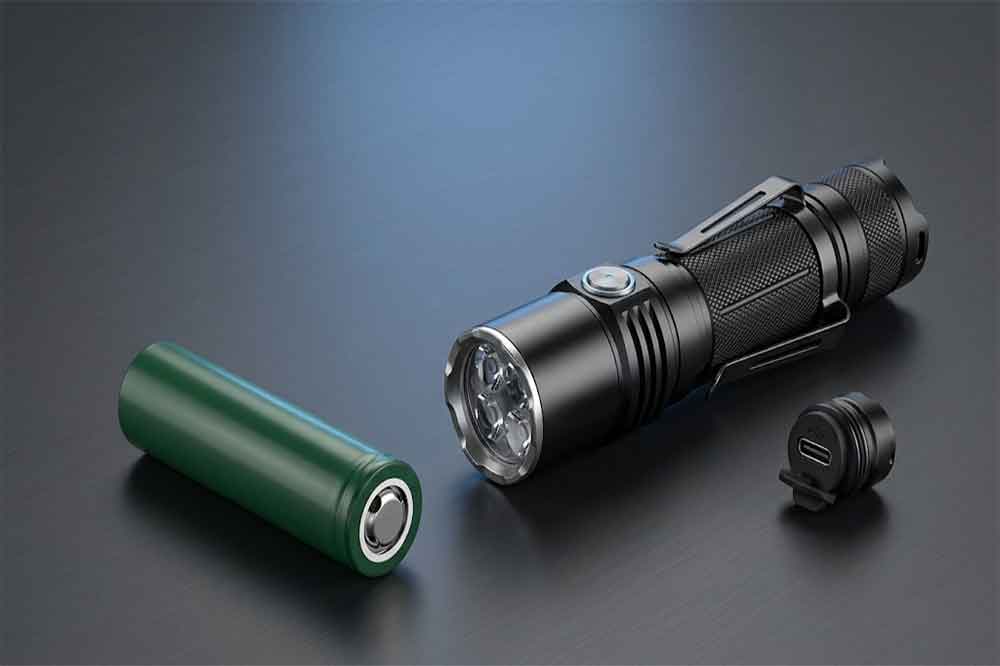
A flashlight can work perfectly with one 18650 battery and refuse to run properly with another. Sometimes the new battery is too long. Sometimes the light starts on its highest setting, then switches off after a few seconds. The capacity printed on the wrapper may look right, but the battery still does not suit the flashlight.
These problems often come down to three things: physical fit, discharge capability, and the way the flashlight manages power.
A protected 18650 battery for flashlight applications adds an electronic protection circuit to the lithium-ion cell. That circuit can help prevent certain unsafe operating conditions, but it also affects the battery’s overall length and current limits. Before choosing a replacement or placing a bulk order, it is worth checking the details rather than relying on the 18650 label alone.
Why Flashlights Need the Right 18650 Battery
Many rechargeable flashlights use 18650 cells because the format offers a useful balance of energy storage and compact size. However, flashlights do not all consume power in the same way.
A small inspection light may spend most of its time on a low setting. A high-output tactical flashlight or searchlight may draw substantially more current when the brightest mode is selected.
The battery must supply the current required by the light without exceeding its own operating limits. Its protection circuit must also tolerate the normal load profile.
This is why a battery with a higher advertised capacity is not automatically the better choice. A model may offer more stored energy but still have an unsuitable current rating or physical size.
Will a Protected 18650 Battery Fit Your Flashlight?
Check the battery compartment before comparing capacity or price. A protected cell is often longer than a conventional unprotected 18650 cell because of the additional protection components and terminal construction.
A conventional 18650 cell is commonly around 18 mm in diameter and 65 mm long. A protected version may be approximately 68–72 mm or longer, depending on the design. These are reference ranges, not guaranteed dimensions for every product.
Battery Length and Diameter
Measure the usable space inside the flashlight, including the clearance required for the battery contacts and the end cap. Do not measure only the visible cylindrical section.
A battery that is slightly too long may prevent the end cap from closing. Forcing it into place can put excessive pressure on the contacts or damage the insulation.
Diameter matters too. The outer wrapper, insulating rings, and construction can affect the finished size. If the flashlight uses a close-fitting battery tube, even a small dimensional difference may cause problems.
For a more detailed explanation of measurements and tolerances, read our guide to protected 18650 battery dimensions.
Flat-Top or Button-Top?
The positive terminal is another detail worth checking.
A button-top battery has a raised positive terminal, while a flat-top battery has a flatter contact surface. Some flashlights are designed around one particular terminal style. Others use spring contacts that accommodate both.
Do not assume that a protected battery will automatically fit because it has the right diameter. Check the flashlight manufacturer’s compatibility information, terminal arrangement, and maximum battery length.
Also, button-top does not automatically mean protected. Terminal shape and the presence of a protection circuit are separate specifications.

How Much Discharge Current Does Your Flashlight Need?
Current demand is especially important when a flashlight has several brightness settings.
A light running at low output may draw relatively little current, while turbo mode can place a much heavier load on the battery. If the cell or protection circuit cannot support that load, the flashlight may dim, shut down, or refuse to enter its highest mode.
Check the battery manufacturer’s specified continuous discharge current and compare it with the flashlight’s requirements. The protection circuit’s current capability must also be sufficient.
High Modes and Startup Current
Some high-output flashlights use electronic drivers that regulate LED current or maintain a target output power. Their input current can change with battery voltage, driver efficiency, and operating mode.
If the light has a turbo mode, confirm that the battery is suitable for that mode rather than judging compatibility from the low or medium setting.
For example, a flashlight drawing 12W from a battery operating at 3.6V would require about 3.33A before accounting for conversion losses. The actual battery-side current may be higher, especially with a regulated driver.
This calculation is only an illustration. Use the flashlight’s actual electrical specifications and the battery manufacturer’s ratings when selecting a cell.
For additional guidance, see our article on protected 18650 discharge current limits.
Why a Flashlight May Shut Off Unexpectedly
A sudden shutdown does not always mean that the battery is empty.
The load may exceed the protection circuit’s overcurrent threshold. The cell voltage may fall below the flashlight’s low-voltage cutoff. Voltage sag under a heavy load can also cause the light’s electronics to stop operating.
Heat, worn contacts, and high resistance in the battery compartment can contribute to the problem.
If the flashlight repeatedly switches off at high output, stop using that combination until its compatibility has been checked. Confirm the battery model, current specifications, contact condition, and flashlight requirements. Do not bypass the protection circuit to keep the light running.
Battery Capacity and Real-World Runtime
Battery capacity is usually expressed in milliamp-hours (mAh) or amp-hours (Ah). It indicates how much charge the cell can store under specified test conditions, but it does not directly tell you how long a flashlight will run.
Runtime depends on the flashlight’s power consumption, driver efficiency, battery condition, temperature, and the point at which the light reduces output or shuts down.
A flashlight used mainly on low mode may run much longer than the same light operated continuously at maximum brightness.
For a rough energy estimate, multiply capacity in amp-hours by nominal voltage to obtain watt-hours. For example, a hypothetical 3.0Ah cell at 3.6V stores approximately 10.8Wh of nominal energy. The usable energy delivered to the flashlight will depend on the operating conditions and the system design.
Do not compare batteries by mAh alone. A useful comparison includes capacity, permitted discharge current, cell quality, protection circuit specifications, and the actual dimensions of the finished battery.
Protection Features Worth Checking
A protected 18650 battery typically incorporates a circuit designed to respond to specified abnormal conditions. Depending on the design, these may include overcharge, over-discharge, overcurrent, and short-circuit protection.
For a flashlight buyer, the important question is whether the complete battery is suitable for the intended device.
Protection circuitry has its own operating limits. If the flashlight draws more current than the circuit permits, the output may disconnect. The circuit also cannot compensate for an unsuitable charger, damaged insulation, or poor electrical contacts.
Check the manufacturer’s documentation for the protection functions provided, operating temperature range, and applicable electrical ratings. Do not assume that every protected battery uses the same thresholds or offers identical performance.
If you are selecting a cell and circuit for a flashlight product line, our guide to matching an 18650 protection circuit with the battery cell explains the key compatibility checks.
Charging, Temperature, and Everyday Use
Use a charger approved for the battery type and follow the manufacturer’s instructions. A flashlight with an internal charging port may have its own charging requirements, so check whether the device is designed for protected cells and whether the battery is intended to be charged inside the flashlight.
Temperature also affects battery performance. Cold conditions can reduce available output, while heavy use in a confined flashlight body can increase heat. Check the permitted operating conditions of both the cell and the protection circuit.
Inspect the wrapper and insulating ring regularly. If the battery has a torn wrapper, damaged terminal, swelling, leakage, or unusual heating, stop using it and follow the manufacturer’s safety guidance.
Never carry loose lithium-ion batteries with metal objects that could bridge the terminals. Use suitable battery cases during transport and storage.

What Flashlight Brands Should Check Before Bulk Ordering
For distributors and flashlight manufacturers, the approval process should cover more than a sample that fits into the battery tube.
Start by confirming the exact cell model, capacity, continuous discharge current, protection configuration, terminal style, and finished dimensions. Ask the supplier for a datasheet and a drawing that identifies the maximum length and diameter.
Next, test the battery in the actual flashlight. Check low, medium, and high modes, including turbo operation where applicable. Observe startup behavior, voltage drop, runtime, and temperature under representative conditions.
For OEM projects, document the approved battery specification before production. If the flashlight has limited space, establish the maximum dimensions early and confirm whether a protected cell can fit without modifying the enclosure.
A reliable supplier should be able to explain the difference between the bare cell rating and the finished protected battery rating. That information helps prevent repeated shutdowns, compatibility complaints, and avoidable changes after the product enters production.
Conclusion
Choosing a protected 18650 battery for a flashlight involves more than matching the capacity printed on the label. The finished battery must fit the compartment, use the correct terminal style, support the light’s current demand, and operate within its specified temperature and voltage limits.
For individual users, the flashlight manufacturer’s compatibility guidance is the best starting point. For OEM buyers, confirm the complete battery specification and test the approved model in the finished device before placing a production order.
Frequently Asked Questions
Can I use a protected 18650 battery in any flashlight?
No. Check the flashlight’s supported battery type, maximum length, terminal style, and required discharge current. Some flashlights are designed only for specific cell configurations.
Are protected 18650 batteries too long for flashlights?
Not always, but protection components can increase overall length. Compare the finished battery dimensions with the flashlight’s available compartment space before buying.
Does a higher-capacity 18650 battery make a flashlight brighter?
Not necessarily. Brightness depends primarily on the LED, driver, and operating mode. Capacity mainly affects available energy and potential runtime, while discharge capability affects whether the battery can support the load.
Why does my flashlight turn off when I use turbo mode?
The current demand may exceed the battery or protection circuit’s limits. Low cell voltage, voltage sag, or the flashlight’s own thermal and low-voltage protections may also cause shutdown.
What should flashlight manufacturers check before bulk ordering protected 18650 batteries?
Confirm dimensions, terminal configuration, capacity, continuous discharge rating, protection features, operating temperature, and sample performance in the actual flashlight. Document the approved specification before production.
A battery can have the right capacity and still fail to fit inside the flashlight tube. Check our guide to protected 18650 battery dimensions before choosing a replacement.
High-output flashlights place different demands on a battery than low-power models. Our guide to protected 18650 discharge current limits explains what to check before using a battery under a heavier load.
The protection circuit must suit both the cell and the flashlight’s load profile. Read more about matching 18650 protection circuit with the cell before finalizing a battery specification.
For flashlight manufacturers and distributors, battery selection should account for both device compatibility and electrical performance. Explore our 18650 lithium battery products for battery sourcing and OEM project discussions.
Related Products
-

12V 4400 mah Lithium ion 3S2P 18650 Battery Pack
-

18650 2000mAh 3.7 volt Lithium-ion Battery
-

18650 20V 3.0Ah Cordless Drill battery
-

18650 22.2V 7.8Ah 2600Mah 6S3P Rechargeable Battery Pack
-

18650 2600mAh Rechargeable Lithium-Ion Battery 3.7V
-

18650 3.7V 10Ah Li-Ion Power Battery Pack
-

18650 3.7V 3300mah Rechargeable Lithium ion Battery
-

18650 7S7P 24V 14Ah Lithium ion Electric Scooter Battery Pack
-

18650 battery 3.7V 1500mAh Lithium-Ion Battery
-

18650 Battery 3500 mah Rechargeable Battery Cells
-

18650 Electric Scooter 48V 13000mAh Lithium Battery
-

2600mAh 3S1P 11.1V 18650 Battery Packs
-

3.7V Li ion Rechargeable 3000mah 18650 Battery Cell
-

36V 5200mAh 10S2P 18650 Battery Pack
-

48v 4400mah 13S2P 18650 Rechargeable Battery Pack
-

7S2P 24V 18650 Lithium Battery Pack
-

Electric Scooter 36V 4400mAH 10S2P 18650 Battery Pack
-

ICR 18650 Battery 2200mah 3.7V
Leave a Reply