
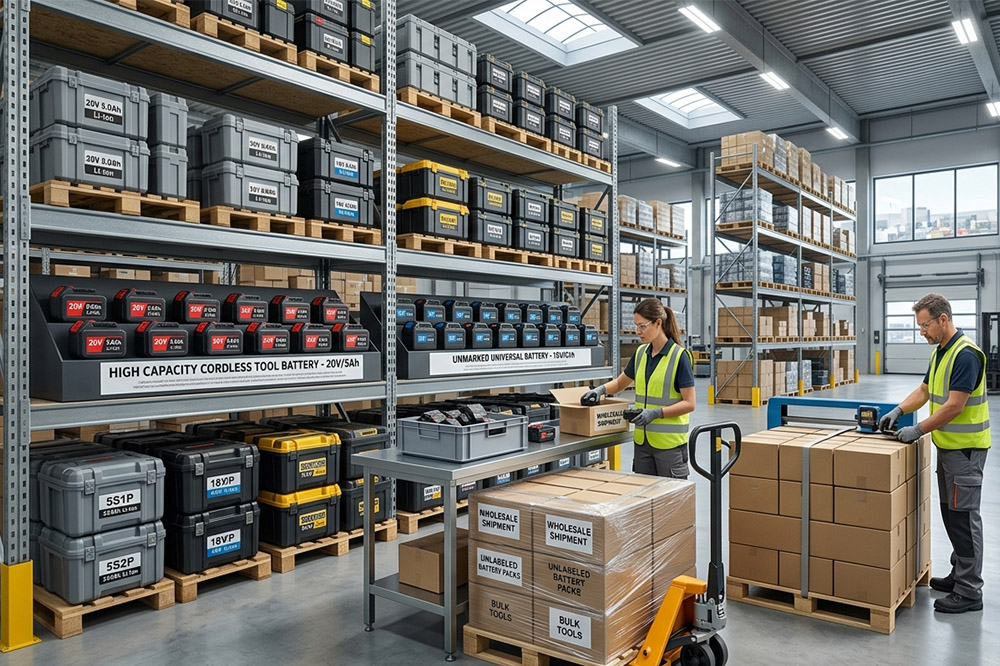
Not long ago, the aftermarket for power tool batteries was mostly driven by small repair shops and local battery rebuilders. Today, the picture looks quite different. More distributors are entering the market, online retailers are expanding their battery catalogs, and OEM manufacturers are receiving inquiries from companies that never sold batteries before.
I’ve noticed one thing during conversations with buyers over the past year. Fewer people ask, “Do you sell 18650 batteries?” Instead, they ask, “Can you supply stable battery packs every month?”
That small change probably says more about the market than any statistics.
Demand is becoming more professional.
The Replacement Market Keeps Growing
Power tools don’t disappear when their batteries wear out.
In many industries, the tools themselves remain in good working condition for years. Construction companies, maintenance contractors, landscaping businesses, and equipment rental firms often prefer replacing battery packs instead of buying entirely new tools.
It makes financial sense.
Picture a warehouse with hundreds of cordless drills. If each tool only needs a new battery pack every few years, replacing batteries becomes far less expensive than replacing the entire fleet.
That simple calculation has helped fuel the aftermarket battery business.
Interestingly, many battery buyers aren’t replacing one or two packs anymore. They’re purchasing hundreds or even thousands at a time.

Why 18650 Battery Packs Still Matter
There’s been plenty of discussion about 21700 cells over the last few years.
Yes, many flagship power tools are gradually adopting larger cells.
But here’s something that’s easy to overlook.
Millions of older cordless tools are still in daily use.
These tools weren’t designed around 21700 batteries. They’re built around 18650 cell configurations, and many users have no reason to replace equipment that still works perfectly.
Because of that, aftermarket demand for 18650 battery packs remains surprisingly stable.
Several distributors we’ve worked with actually reported stronger repeat orders than expected, largely because their customers wanted compatible replacement batteries rather than completely new tools.
Buyers Are Becoming More Selective
A few years ago, capacity numbers dominated almost every conversation.
Now the questions sound different.
Can the battery survive continuous heavy discharge?
How consistent are the production batches?
What warranty support is available?
Can OEM branding be added?
Can shipments remain stable during peak season?
To me, that’s a sign of a maturing market.
Wholesale buyers have already experienced the consequences of inconsistent battery quality. Once warranty claims begin piling up, saving a dollar or two per battery doesn’t seem nearly as attractive.
The Shift from Price to Reliability
One battery distributor shared an interesting experience with us.
They switched suppliers after receiving multiple complaints about batteries losing capacity within six months.
The replacement supplier wasn’t the cheapest option.
Actually, their pricing was slightly higher.
But warranty returns dropped noticeably.
The overall business became more profitable because customer service costs fell.
It’s easy to focus on purchase price.
It’s harder to calculate the hidden cost of replacing defective batteries.
That’s something experienced importers rarely ignore anymore.
Battery Repair Businesses Are Expanding
Something else worth mentioning is the rapid growth of battery refurbishment companies.
Ten years ago, rebuilding battery packs often meant local technicians repairing a few batteries every week.
Today, some refurbishment companies process hundreds of battery packs every day.
Many purchase OEM-grade 18650 cells in bulk and rebuild batteries for:
- Cordless drills
- Impact drivers
- Angle grinders
- Lawn equipment
- Industrial maintenance tools
- Vacuum cleaners
- Electric pruning tools
In other words, they aren’t competing with tool manufacturers.
They’re extending the service life of existing equipment.
That creates another steady source of demand for quality battery cells.
OEM Manufacturing Is Becoming More Flexible
Another trend I’ve noticed is that buyers no longer expect one standard battery pack to fit every project.
Customization has become almost routine.
Some customers request higher-capacity battery packs.
Others focus on reducing weight.
Some need private label packaging.
Others require custom connectors or different Battery Management Systems.
OEM manufacturers that can support flexible production usually stand out.
Simply selling battery cells isn’t enough anymore.
Customers increasingly want complete battery solutions.
Certifications Matter More Than Before
International buyers have become much more cautious.
Especially in Europe, North America, and Australia, documentation is often discussed before pricing.
Typical requests include:
- UN38.3
- IEC62133
- CE
- MSDS
- RoHS
- Shipping compliance documents
Without these certifications, even a well-made battery may struggle to enter certain markets.
For wholesalers, paperwork can sometimes be just as important as battery performance.
Looking Ahead
Will 21700 batteries continue gaining market share?
Probably.
Will 18650 aftermarket battery packs disappear anytime soon?
I don’t think so.
There are simply too many cordless tools already operating worldwide. Many contractors are reluctant to replace equipment that still performs reliably. As long as those tools remain in service, demand for dependable replacement battery packs will likely continue.
The market may gradually change, but it doesn’t usually change overnight.

OEM Aftermarket 18650 Battery Solutions
We manufacture high-quality aftermarket 18650 battery packs and lithium-ion cells for global distributors, battery repair companies, power tool brands, and OEM customers.
Our manufacturing capabilities include:
- Premium high-drain 18650 lithium-ion cells
- OEM & ODM battery pack production
- Private label manufacturing
- Custom voltage and capacity configurations
- Matched battery cells for consistent performance
- Spot-welded battery pack assembly
- Low MOQ for pilot projects
- Stable monthly production capacity
- Complete export certifications including UN38.3, IEC62133, CE and MSDS
Many wholesale customers begin by evaluating several sample battery packs under real working conditions before moving into larger production orders. In our experience, those field tests often reveal much more than laboratory specifications alone. That’s usually where long-term supplier relationships begin.
-

12V 4400 mah Lithium ion 3S2P 18650 Battery Pack
-

18650 2000mAh 3.7 volt Lithium-ion Battery
-

18650 20V 3.0Ah Cordless Drill battery
-

18650 22.2V 7.8Ah 2600Mah 6S3P Rechargeable Battery Pack
-

18650 2600mAh Rechargeable Lithium-Ion Battery 3.7V
-

18650 3.7V 10Ah Li-Ion Power Battery Pack
-

18650 3.7V 3300mah Rechargeable Lithium ion Battery
-

18650 7S7P 24V 14Ah Lithium ion Electric Scooter Battery Pack
-

18650 battery 3.7V 1500mAh Lithium-Ion Battery
-

18650 Battery 3500 mah Rechargeable Battery Cells
-

18650 Electric Scooter 48V 13000mAh Lithium Battery
-

2600mAh 3S1P 11.1V 18650 Battery Packs
-

3.7V Li ion Rechargeable 3000mah 18650 Battery Cell
-

36V 5200mAh 10S2P 18650 Battery Pack
-

48v 4400mah 13S2P 18650 Rechargeable Battery Pack
-

7S2P 24V 18650 Lithium Battery Pack
-

Electric Scooter 36V 4400mAH 10S2P 18650 Battery Pack
-

ICR 18650 Battery 2200mah 3.7V
Leave a Reply