
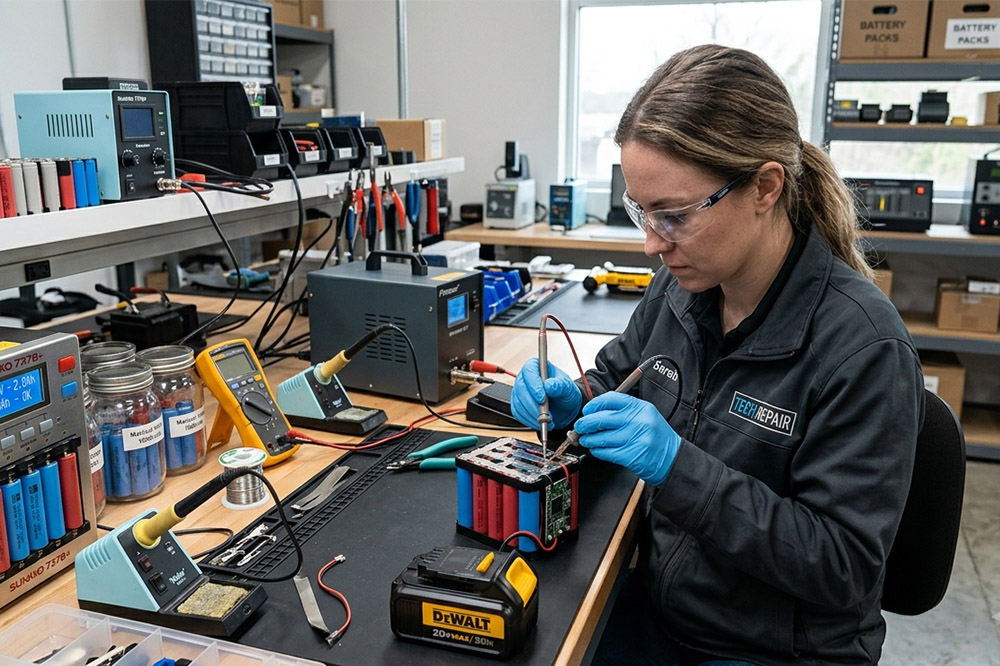
A few years ago, rebuilding cordless tool batteries was mostly something hobbyists talked about in online forums. These days, it’s a different story. Repair shops, rental companies, battery distributors, and even tool brands are paying much more attention to battery refurbishment.
The reason isn’t difficult to understand.
A cordless drill that originally cost a few hundred dollars may become almost useless because the battery no longer holds a charge. Throwing away the entire pack feels wasteful, especially when the plastic housing, terminals, and protection board are still in decent condition.
So the obvious question becomes: can the battery simply be rebuilt with new 18650 cells?
In many cases, yes.
But doing it well requires more than replacing old cells with new ones.
Why 18650 Cells Are Still Common Inside Cordless Tool Batteries
Although many premium brands have started moving toward 21700 batteries, millions of cordless tools on the market still rely on 18650 lithium-ion cells.
If you’ve opened battery packs from different manufacturers, you’ve probably noticed something interesting.
The outside design changes dramatically from one brand to another.
Inside, however, many of them follow a surprisingly similar layout. Multiple 18650 cells are connected in series and parallel, managed by a Battery Management System (BMS), and protected inside a durable housing.
That common design makes refurbishment possible.
Still, possible doesn’t always mean easy.

The First Mistake Many People Make
One thing I’ve seen repeatedly is buyers focusing almost entirely on battery capacity.
Someone searches for “highest capacity 18650” and assumes that’s automatically the best choice.
For power tools, that’s rarely true.
A cordless impact wrench doesn’t care much about impressive marketing numbers if the battery can’t deliver high current under heavy load.
We’ve had customers send back samples from unknown suppliers because the batteries became unusually hot after just a few minutes of testing.
Interestingly, the rated capacity wasn’t the problem.
The discharge capability was.
Power tools demand high-drain cells, not simply high-capacity ones.
Refurbishing Isn’t Just Replacing Cells
Imagine a repair technician rebuilding twenty battery packs in one afternoon.
The old cells are removed.
New cells are spot welded.
Everything looks finished.
Then charging begins.
Suddenly one pack stops halfway through charging.
Another reaches full voltage much earlier than expected.
A third runs normally for several cycles before shutting down unexpectedly.
What happened?
Often, the issue isn’t poor workmanship.
It’s inconsistent cell quality.
Professional battery rebuilding usually starts with cell grading.
Manufacturers sort batteries by:
- Voltage consistency
- Internal resistance
- Capacity
- Production batch
Only after matching these values do they begin assembling battery packs.
That extra step often separates reliable refurbished batteries from short-lived repairs.
Should You Replace Individual Cells?
This question comes up quite often.
Technically, replacing only one damaged cell can work.
Practically, it isn’t always the best decision.
Picture an old battery pack that’s already completed hundreds of charge cycles.
Nine cells have aged together.
One brand-new replacement cell is added.
Now the pack contains batteries with different internal characteristics.
The imbalance may not show immediately.
After several weeks, though, charging becomes less stable.
Eventually the protection circuit may disconnect the battery even though several cells still have usable capacity.
Because of this, many commercial repair businesses replace an entire matched cell group instead of individual cells.
It costs a little more today.
It usually prevents customer complaints later.
What Professional Buyers Usually Ask
Retail buyers often ask about capacity.
Wholesale buyers ask different questions.
Conversations usually sound more like this:
“Can you provide matched production batches?”
“How stable is your monthly output?”
“Can you customize battery packs for our tool brand?”
“Do you provide spot welding before shipment?”
“Can samples be tested before bulk production?”
Those questions reveal long-term thinking.
Reliable battery supply isn’t only about today’s shipment.
It’s about getting the same quality six months later.
Selecting an OEM 18650 Battery Supplier
Battery refurbishment businesses depend heavily on consistency.
One weak production batch can quickly become dozens of warranty claims.
That’s why experienced buyers normally evaluate suppliers based on factors such as:
- High-drain cell performance
- Low internal resistance
- Stable production capacity
- Complete export certifications
- OEM and ODM support
- Cell matching capability
- Quality inspection procedures
- Flexible MOQ
Price obviously matters.
But many buyers eventually discover that cheaper batteries often become expensive once warranty replacements begin.
Applications Beyond Cordless Drills
Refurbishing with 18650 cells isn’t limited to handheld drills.
We regularly see demand from companies repairing:
- Impact drivers
- Circular saws
- Angle grinders
- Electric pruning shears
- Garden tools
- Leaf blowers
- Portable vacuum cleaners
- Construction equipment batteries
Although every battery pack has its own structure, the goal stays remarkably similar—restore reliable performance without replacing the entire tool.

OEM 18650 Battery Solutions for Battery Rebuilding
We manufacture high-quality 18650 lithium-ion cells for battery refurbishment companies, power tool manufacturers, and OEM battery pack assemblers worldwide.
Whether you’re rebuilding cordless tool batteries or developing a custom lithium battery solution, we can provide:
- Premium high-drain 18650 cells
- OEM & ODM battery manufacturing
- Cell matching by voltage and internal resistance
- Spot-welded battery pack assembly
- Custom voltage and capacity configurations
- Low MOQ for engineering validation
- Stable supply for wholesale projects
- UN38.3, IEC62133, CE, MSDS and other export documentation
One thing we’ve learned from working with battery repair companies is that successful refurbishment isn’t really about finding the cheapest battery. It’s about finding cells that behave consistently over hundreds of charge cycles. That difference may not be obvious during the first week, but customers usually notice it months later—and that’s often what determines whether they come back with another order.
-

12V 4400 mah Lithium ion 3S2P 18650 Battery Pack
-

18650 2000mAh 3.7 volt Lithium-ion Battery
-

18650 20V 3.0Ah Cordless Drill battery
-

18650 22.2V 7.8Ah 2600Mah 6S3P Rechargeable Battery Pack
-

18650 2600mAh Rechargeable Lithium-Ion Battery 3.7V
-

18650 3.7V 10Ah Li-Ion Power Battery Pack
-

18650 3.7V 3300mah Rechargeable Lithium ion Battery
-

18650 7S7P 24V 14Ah Lithium ion Electric Scooter Battery Pack
-

18650 battery 3.7V 1500mAh Lithium-Ion Battery
-

18650 Battery 3500 mah Rechargeable Battery Cells
-

18650 Electric Scooter 48V 13000mAh Lithium Battery
-

2600mAh 3S1P 11.1V 18650 Battery Packs
-

3.7V Li ion Rechargeable 3000mah 18650 Battery Cell
-

36V 5200mAh 10S2P 18650 Battery Pack
-

48v 4400mah 13S2P 18650 Rechargeable Battery Pack
-

7S2P 24V 18650 Lithium Battery Pack
-

Electric Scooter 36V 4400mAH 10S2P 18650 Battery Pack
-

ICR 18650 Battery 2200mah 3.7V
Leave a Reply