
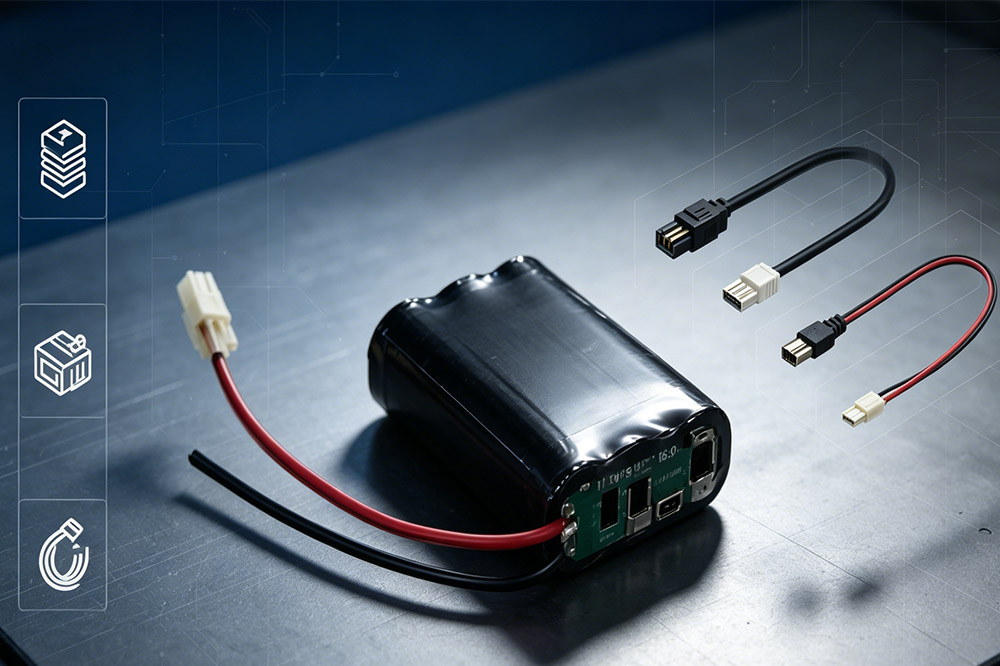
Most Buyers Don’t Start With a Standard Battery — They End Up Customizing It
In real OEM projects, very few devices can fully adopt a standard battery pack without any adjustment.
At the beginning, most buyers try to fit a standard 11.1V battery pack into their design.
But once the product moves closer to production, the same questions always come up:
- “Can the size be smaller?”
- “Can the connector match our board?”
- “Can the cable be longer or different?”
At that point, the discussion naturally moves from standard to custom.
What Can Actually Be Customized in a 11.1V Battery Pack?
A 11.1V lithium battery pack (such as a 3S1P 18650 structure) is actually quite flexible in design.
Here are the most common customization areas.
1. Size and Internal Layout
This is usually the first adjustment.
Even with the same 3S1P structure, the internal arrangement can be changed.
For example:
- Flat layout for slim devices
- Compact stacked layout for narrow spaces
- Split arrangement for irregular housings
The goal is not just to change dimensions,
but to make the battery fit naturally into the device structure.
2. Capacity Adjustment
Capacity is not fixed to a single value.
It can be adjusted by:
- Changing cell grade
- Switching cell capacity (e.g. 2200mAh → 2600mAh → higher options)
- Moving from 1P to 2P structure if space allows
But in real projects, capacity is always balanced with:
- Size
- Weight
- Heat performance
So it’s rarely just “make it bigger.”
3. Connector Type
This is one of the most important customization points.
Different devices require different interfaces, such as:
- JST connectors
- Molex plugs
- DC barrel connectors
- Custom industrial connectors
In many cases, the connector determines whether the battery is “plug and play” or not.

4. Cable Length and Direction
A detail that is often underestimated.
Depending on how the battery is installed, you may need:
- Short cables for tight internal layouts
- Longer cables for flexible mounting positions
- Side-exit or top-exit wiring
Small changes here can make installation much easier during assembly.
5. Protection Board (BMS) Configuration
The BMS is not always the same.
It can be adjusted based on your application, including:
- Overcharge / over-discharge thresholds
- Current protection levels
- Temperature protection (NTC sensor integration)
For more sensitive devices, this part becomes especially important.
6. Battery Shape and Mechanical Design
Not all devices use a rectangular space.
Some projects require:
- Irregular shapes
- Curved designs
- Split-pack structures
In these cases, the battery becomes part of the mechanical design, not just a component.
A Common Mistake in Custom Battery Projects
One of the most common issues is this:
The device is already designed, and only at the end does the team try to “fit a battery in.”
This often leads to:
- Size conflicts
- Connector mismatch
- Last-minute redesigns
A better approach is to involve the battery design early,
even during the prototype stage.
How OEM Buyers Usually Start a Custom Project
Most real projects follow a similar pattern:
- Share device specifications or drawings
- Define voltage requirement (e.g. 11.1V system)
- Confirm size constraints
- Choose initial structure (3S1P or similar)
- Adjust details after testing
It’s rarely perfect at the first step — it evolves through testing.

What Helps Speed Up Customization
If you want faster feedback from suppliers, the most useful information includes:
- Device application
- Available internal space (even rough dimensions)
- Expected runtime
- Connector type (if already defined)
- Working current range
With these, most of the design direction becomes much clearer.
Final Thought
A custom 11.1V battery pack is not just about changing specs.
It’s about making sure the power system fits naturally into your product — both physically and electrically.
The more clearly the requirements are defined early,
the smoother the whole development process becomes.
Related Products
-

12V 4400 mah Lithium ion 3S2P 18650 Battery Pack
-

18650 2000mAh 3.7 volt Lithium-ion Battery
-

18650 20V 3.0Ah Cordless Drill battery
-

18650 22.2V 7.8Ah 2600Mah 6S3P Rechargeable Battery Pack
-

18650 2600mAh Rechargeable Lithium-Ion Battery 3.7V
-

18650 3.7V 10Ah Li-Ion Power Battery Pack
-

18650 3.7V 3300mah Rechargeable Lithium ion Battery
-

18650 7S7P 24V 14Ah Lithium ion Electric Scooter Battery Pack
-

18650 battery 3.7V 1500mAh Lithium-Ion Battery
-

18650 Battery 3500 mah Rechargeable Battery Cells
-

18650 Electric Scooter 48V 13000mAh Lithium Battery
-

2600mAh 3S1P 11.1V 18650 Battery Packs
-

3.7V Li ion Rechargeable 3000mah 18650 Battery Cell
-

36V 5200mAh 10S2P 18650 Battery Pack
-

48v 4400mah 13S2P 18650 Rechargeable Battery Pack
-

7S2P 24V 18650 Lithium Battery Pack
-

Electric Scooter 36V 4400mAH 10S2P 18650 Battery Pack
-

ICR 18650 Battery 2200mah 3.7V
Leave a Reply