
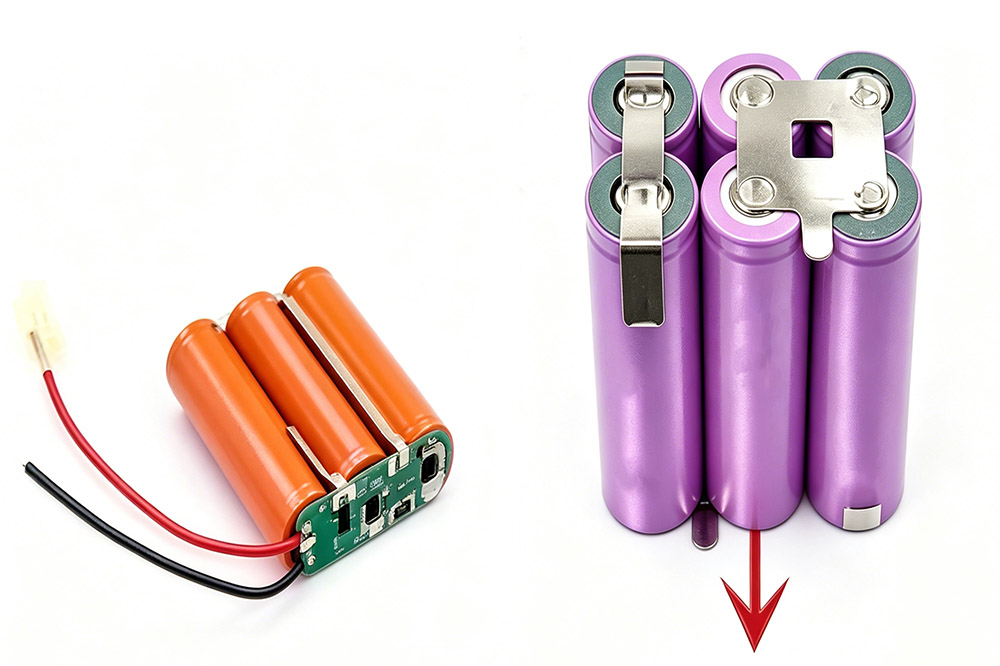
Most People Think It’s Just About Capacity — It’s Not
When comparing 3S1P and 3S2P battery packs, the first thing that comes to mind is simple:
3S2P = more capacity
3S1P = smaller size
That’s true, but in real projects, the decision is rarely that straightforward.
Once the battery goes inside your device, things like space, weight, and stability start to matter just as much as runtime.
What’s the Actual Difference?
Let’s keep it simple.
- 3S1P = 3 cells in series (total: 3 cells)
- 3S2P = 3 cells in series, 2 in parallel (total: 6 cells)
Both give you the same voltage:
11.1V nominal
The difference comes down to:
- Capacity
- Physical size
- Weight
- Load handling
Where 3S1P Usually Makes More Sense
In most OEM projects, 3S1P is the starting point.
It works well when:
- The device is handheld
- Space is limited
- Weight matters
- Power consumption is moderate
Typical examples:
- Handheld terminals
- Scanners
- Portable testing devices
In these cases, keeping the battery compact is often more important than maximizing runtime.
When 3S2P Becomes the Better Option
At some point, many projects outgrow 3S1P.
Usually not because something failed —
but because real usage shows the battery doesn’t last long enough.
That’s when 3S2P comes in.
It’s a better fit when:
- The device runs for long periods
- Charging frequently is not practical
- Power draw is relatively high
- Stability under load is important
Because the load is shared across more cells,
3S2P also tends to perform more steadily in demanding conditions.
The Part People Often Overlook
A lot of buyers focus only on capacity.
But in reality, these factors can be just as important:
1. Available Space Inside the Device
A 3S2P pack is significantly larger than a 3S1P pack.
That sounds obvious, but here’s what often happens:
A team decides to upgrade for longer runtime,
only to realize later that the battery no longer fits the housing.
At that point, you’re not just changing a battery —
you’re redesigning the product.
2. Weight and User Experience
If your device is handheld, weight adds up quickly.
Even a small increase can make the device feel noticeably heavier over time.
For industrial equipment, this may not matter.
For handheld products, it definitely does.
3. Heat and Load Distribution
Under higher load:
- A 3S1P pack pushes more stress on each individual cell
- A 3S2P pack spreads the load, reducing strain
That’s why for devices that run continuously or draw more power,
3S2P often feels more stable in real use.
A Practical Way to Decide
If you’re still unsure, here’s a straightforward way to think about it:
Choose 3S1P if:
- Your device has tight space constraints
- You need to keep weight down
- Runtime requirements are moderate
- You’re still in early testing stages
Choose 3S2P if:
- Runtime is a key requirement
- The device runs for long periods
- You have enough internal space
- Power consumption is relatively high

How Most Projects Actually Approach This
In practice, many teams don’t get it perfect on the first try.
A common approach looks like this:
- Start with a 3S1P battery pack for prototyping
- Test real-world performance
- Adjust to 3S2P if runtime or stability isn’t enough
This way, you’re making decisions based on actual data,
not assumptions.
One More Thing — It’s Not Just Adding More Cells
Switching from 3S1P to 3S2P isn’t just “doubling capacity.”
It may also require:
- A different BMS setup
- Changes in internal layout
- Adjustments to mounting or wiring
Ignoring these details can lead to new issues later on.
Final Thought
On paper, 3S1P and 3S2P look like a simple comparison.
In reality, the right choice depends on how your device is used,
not just what the spec sheet says.
If you’re working on a new project, it’s usually safer to:
- Start simple
- Test under real conditions
- Then scale the battery configuration if needed
That approach tends to save more time than trying to get everything perfect from the start.
Related Products
-

12V 4400 mah Lithium ion 3S2P 18650 Battery Pack
-

18650 2000mAh 3.7 volt Lithium-ion Battery
-

18650 20V 3.0Ah Cordless Drill battery
-

18650 22.2V 7.8Ah 2600Mah 6S3P Rechargeable Battery Pack
-

18650 2600mAh Rechargeable Lithium-Ion Battery 3.7V
-

18650 3.7V 10Ah Li-Ion Power Battery Pack
-

18650 3.7V 3300mah Rechargeable Lithium ion Battery
-

18650 7S7P 24V 14Ah Lithium ion Electric Scooter Battery Pack
-

18650 battery 3.7V 1500mAh Lithium-Ion Battery
-

18650 Battery 3500 mah Rechargeable Battery Cells
-

18650 Electric Scooter 48V 13000mAh Lithium Battery
-

2600mAh 3S1P 11.1V 18650 Battery Packs
-

3.7V Li ion Rechargeable 3000mah 18650 Battery Cell
-

36V 5200mAh 10S2P 18650 Battery Pack
-

48v 4400mah 13S2P 18650 Rechargeable Battery Pack
-

7S2P 24V 18650 Lithium Battery Pack
-

Electric Scooter 36V 4400mAH 10S2P 18650 Battery Pack
-

ICR 18650 Battery 2200mah 3.7V
Leave a Reply