
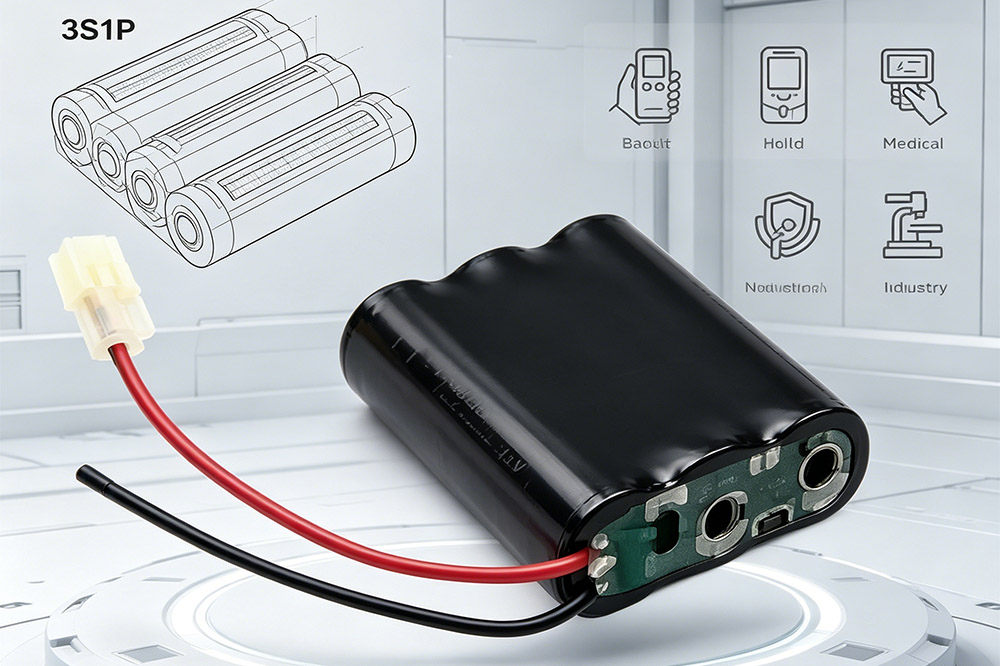
Not All 11.1V Battery Packs Are the Same
On paper, most suppliers will tell you the same thing:
11.1V, 2600mAh, 18650 cells.
But if you’ve actually bought battery packs before, you already know—
two batteries with the same specs can behave very differently in real use.
Some hold up well after months of operation.
Some start showing issues after just a few cycles.
That gap usually doesn’t come from the voltage or capacity.
It comes from how the pack is built.
Where 11.1V (3S1P) Actually Fits
The 3S1P structure is one of those configurations that keeps showing up in projects for a reason.
It’s compact enough to fit into handheld devices, but still provides enough voltage for stable operation.
Most common use cases we see from customers:
- Portable terminals and handheld devices
- Smart access control systems
- Medical portable equipment
- Monitoring or inspection devices
- Small robotics or automation modules
If your device is designed around a 12V system but needs something lighter and rechargeable,
this is usually where 11.1V becomes the default choice.

What Makes One Battery Pack More Reliable Than Another
From a buyer’s perspective, there are a few details that matter more than anything else.
1. The Cells Inside the Pack
This is the core of everything.
Even if the outer label looks identical, the cells inside can vary a lot:
- Different manufacturers
- Different consistency between batches
- Different cycle performance
What you’ll notice in practice is simple:
stable cells mean fewer failures in the field.
2. The BMS (Protection Board)
A good battery pack is not just cells connected together.
The BMS controls:
- Overcharge protection
- Over-discharge protection
- Short-circuit protection
If this part is unstable, the whole pack becomes unpredictable.
This is also one of the areas where quality differences are easy to overlook during sourcing.
3. Assembly Details
Things like:
- Spot welding quality
- Internal wiring layout
- Insulation and protection materials
These don’t show up on a datasheet,
but they directly affect long-term reliability.
3S1P vs Other Configurations: When Is It the Right Choice?
3S1P is usually selected when:
- Space is limited
- Weight matters
- Power consumption is moderate
If the device needs longer runtime,
buyers often move to:
- 3S2P (double capacity)
- 3S3P or higher for industrial use
So in most cases, choosing 3S1P is not about “better or worse”
—it’s about fitting the design constraints of your product.

What Buyers Usually Ask Before Moving Forward
After handling enough inquiries, you start to see patterns.
Here are the questions that come up almost every time:
Can the size be adjusted?
Very often, yes.
Even with the same 3S1P structure,
the layout can be changed to fit different device housings.
What about connectors?
This is rarely standard.
Most projects require:
- Specific connector types
- Defined cable lengths
- Sometimes even custom pin arrangements
Can capacity be upgraded later?
It depends on the structure.
If your device allows more space,
the pack can usually be redesigned into a higher parallel configuration.
Are there certifications available?
For any serious project, this is not optional.
Documents like:
- UN38.3
- MSDS
- Transport-related reports
are usually required before shipping or integration.
A Practical Tip From Real Projects
One thing many buyers only realize after a few rounds of sourcing:
Consistency matters more than initial performance.
A sample may work perfectly.
But what really matters is whether the next 500 or 1,000 units behave the same way.
That’s where supplier experience, process control, and cell sourcing start to show their value.
Final Thoughts
The 11.1V 3S1P 18650 battery pack is not a complicated product on the surface.
But once it goes into a real device, small differences start to matter.
If your project is long-term,
it’s worth paying attention to:
- How the pack is built
- Whether it can be customized for your design
- And how stable the supply is over time
Because in the end,
a battery is not just a component—it becomes part of your product’s reliability.
Related Products
-

12V 4400 mah Lithium ion 3S2P 18650 Battery Pack
-

18650 2000mAh 3.7 volt Lithium-ion Battery
-

18650 20V 3.0Ah Cordless Drill battery
-

18650 22.2V 7.8Ah 2600Mah 6S3P Rechargeable Battery Pack
-

18650 2600mAh Rechargeable Lithium-Ion Battery 3.7V
-

18650 3.7V 10Ah Li-Ion Power Battery Pack
-

18650 3.7V 3300mah Rechargeable Lithium ion Battery
-

18650 7S7P 24V 14Ah Lithium ion Electric Scooter Battery Pack
-

18650 battery 3.7V 1500mAh Lithium-Ion Battery
-

18650 Battery 3500 mah Rechargeable Battery Cells
-

18650 Electric Scooter 48V 13000mAh Lithium Battery
-

2600mAh 3S1P 11.1V 18650 Battery Packs
-

3.7V Li ion Rechargeable 3000mah 18650 Battery Cell
-

36V 5200mAh 10S2P 18650 Battery Pack
-

48v 4400mah 13S2P 18650 Rechargeable Battery Pack
-

7S2P 24V 18650 Lithium Battery Pack
-

Electric Scooter 36V 4400mAH 10S2P 18650 Battery Pack
-

ICR 18650 Battery 2200mah 3.7V
Leave a Reply