
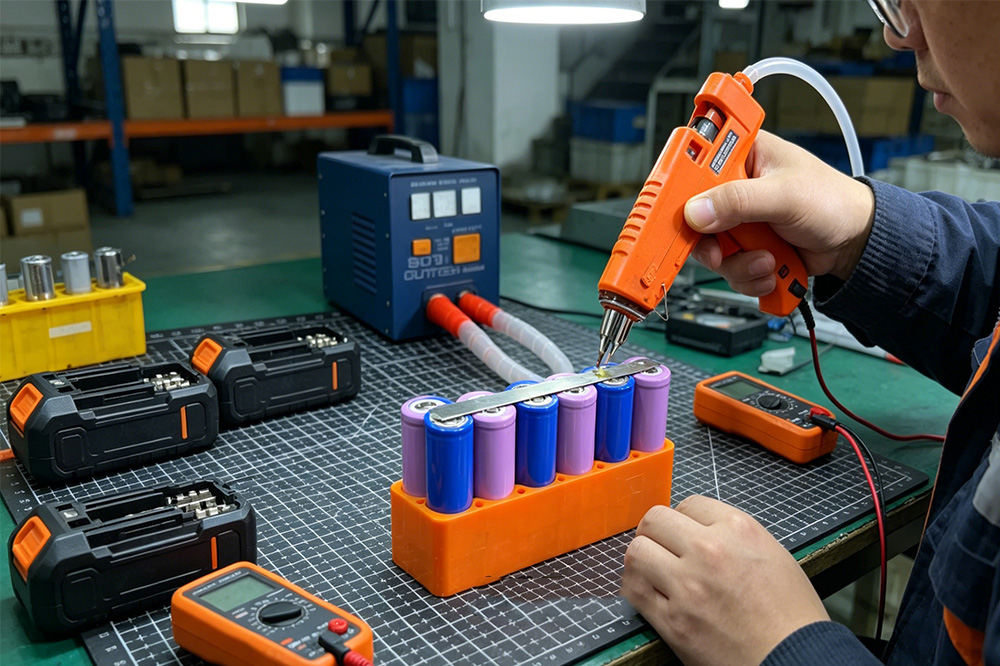
I still remember the first time someone asked for “just a stable 18650 cell for power tools, nothing fancy, just reliable in bulk.”
That “nothing fancy” part usually doesn’t age well.
Because once you start dealing with drills, grinders, outdoor tools, or even construction-site equipment, the battery stops being a simple component. It becomes something closer to a behavior pattern—how it reacts under sudden load, how it warms up after 20 minutes, how it behaves when the operator pushes the tool harder than expected.
And in wholesale orders, those patterns start to matter more than the spec sheet.
When buyers say “power tools battery,” they usually mean something else
On paper, most 18650 cells look similar:
- 2000mAh, 2600mAh, 3000mAh…
- “high drain” labeled everywhere
- discharge ratings that all sound aggressive enough
But in real bulk testing scenarios, especially for tool packs, the difference shows up in less obvious places.
One thing that gets repeated in industry buying guides (and I’ve seen this too in practice) is that capacity alone doesn’t predict performance in tools. A higher mAh cell can actually feel weaker if it sags under load.
Power tools care more about:
- voltage stability under sudden torque load
- internal resistance consistency across batches
- heat buildup after repeated bursts
- cycle behavior when partially charged (not always full/full discharge cycles in real life)
It sounds technical, but on the production floor it’s very visible: two packs built with “same spec” cells can behave like different products.
Bulk buyers don’t fail at specs—they fail at consistency
Something that’s easy to overlook when ordering wholesale 18650 cells is batch variation.
Even when the numbers match, what really matters is how tightly controlled the production is.
In practice, buyers usually run into three patterns:
- First batch feels perfect, second batch slightly softer under load
- Internal resistance spreads wider than expected in large shipments
- A small percentage of cells behave “normal” in testing but drift under real usage
This is why experienced buyers often ask suppliers to pre-sort cells or provide matched groups for pack assembly. Not because they want perfection, but because they want predictability.
And predictability is what keeps warranty costs from quietly growing later.

The “high drain” label is not always the full story
Many guides mention high discharge ratings, but in real tool applications, the discharge curve matters more than the peak number.
A cell that claims high discharge might still:
- drop voltage quickly after a few seconds of load
- recover slowly after repeated bursts
- heat unevenly in multi-cell packs
For power tools, especially cordless drills or saws, that “dip and recover” behavior is what operators actually feel as power inconsistency.
One interesting observation from field feedback:
users rarely complain about capacity—they complain about “weak torque after a while.”
That usually traces back to discharge behavior, not mAh.
A small detail that changes everything: internal resistance grouping
This part doesn’t get enough attention in beginner guides.
When building battery packs for tools, mixing cells with slightly different internal resistance can lead to uneven load sharing.
In bulk supply situations, that becomes:
- one cell working harder than others
- localized heating inside packs
- faster aging in specific positions of the pack
It doesn’t always show up immediately. Sometimes it appears after a few weeks of field use, which makes troubleshooting harder.
That’s why serious buyers often request:
- tight IR sorting (not just capacity matching)
- pre-discharge cycling before pack assembly
- consistency reports per batch
Not always, but often enough that it becomes standard practice in larger orders.
What wholesale buyers usually ask after the first shipment
There’s a pattern I’ve noticed in follow-up emails (and it’s surprisingly consistent):
At first, questions are about price and mAh.
After delivery, the questions change:
- “Why does this batch feel slightly weaker?”
- “Can we tighten internal resistance next order?”
- “Do you have a version more stable under heavy load?”
- “Can we reduce variation between cells?”
That shift tells you something important:
buyers don’t stay at specification level for long. They move quickly into behavior-level evaluation.
A realistic sourcing note
If you’re sourcing wholesale 18650 batteries for power tools, there’s a point where datasheets stop helping.
You start relying more on:
- sample testing under real tool load
- temperature observation after repeated bursts
- consistency between 20–50 random units, not just 1–2 samples
- how stable the supplier is across multiple batches, not just one shipment
This is where bulk purchasing becomes less about “choosing a battery” and more about “controlling variability.”
And that part is usually underestimated at the beginning.

A simple scenario that explains the whole problem
Imagine a 13S pack used in cordless construction tools.
Day one: everything feels strong.
After a week of site use:
- some packs run slightly shorter
- torque feels uneven under pressure
- charging curves start differing subtly
Nothing is “broken,” but performance perception drops.
That’s usually where buyers start looking deeper—not at the chemistry type, but at cell consistency and sourcing quality.
Not a conclusion, but something most buyers eventually realize
Wholesale 18650 batteries for power tools are less about finding the “best cell” and more about avoiding unexpected variation when scaled.
And strangely, the more experienced the buyer becomes, the less they talk about specs—and the more they talk about behavior, stability, and repeatability.
If you’re currently comparing suppliers, it might help to shift the question slightly:
Not “which cell is best?”
but “which batch behaves the most predictably under load?”
That small change usually leads to very different decisions.
-

12V 4400 mah Lithium ion 3S2P 18650 Battery Pack
-

18650 2000mAh 3.7 volt Lithium-ion Battery
-

18650 20V 3.0Ah Cordless Drill battery
-

18650 22.2V 7.8Ah 2600Mah 6S3P Rechargeable Battery Pack
-

18650 2600mAh Rechargeable Lithium-Ion Battery 3.7V
-

18650 3.7V 10Ah Li-Ion Power Battery Pack
-

18650 3.7V 3300mah Rechargeable Lithium ion Battery
-

18650 7S7P 24V 14Ah Lithium ion Electric Scooter Battery Pack
-

18650 battery 3.7V 1500mAh Lithium-Ion Battery
-

18650 Battery 3500 mah Rechargeable Battery Cells
-

18650 Electric Scooter 48V 13000mAh Lithium Battery
-

2600mAh 3S1P 11.1V 18650 Battery Packs
-

3.7V Li ion Rechargeable 3000mah 18650 Battery Cell
-

36V 5200mAh 10S2P 18650 Battery Pack
-

48v 4400mah 13S2P 18650 Rechargeable Battery Pack
-

7S2P 24V 18650 Lithium Battery Pack
-

Electric Scooter 36V 4400mAH 10S2P 18650 Battery Pack
-

ICR 18650 Battery 2200mah 3.7V
Leave a Reply