
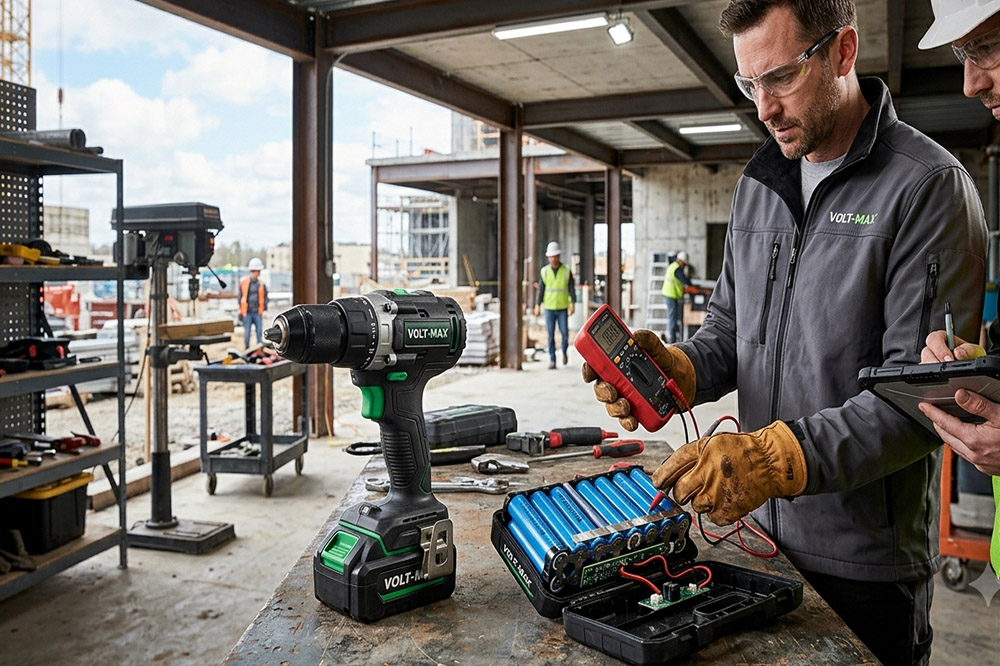
When users complain about a power tool battery, they usually say one thing first: “The battery does not last long enough.”
However, in many real applications, the problem is not only the battery capacity. A drill used on a construction site, a grinder working on metal, or a saw cutting continuously will put very different pressure on the battery pack.
This is where 18650 lithium cells become an important choice for power tool battery manufacturers and OEM solution providers.
A well-designed 18650 battery pack can provide longer working time, stable power output, and better durability. But simply adding more cells does not always solve the problem. The cell quality, pack structure, discharge capability, and BMS design all affect the final runtime.
From my experience working with battery applications, many customers first focus on “how many mAh” the battery has. Capacity is important, but it is only one part of the whole picture.
Runtime Is Not Only About Battery Capacity
A common misunderstanding is that a higher capacity battery always means longer working time.
For example, a 3000mAh 18650 cell may provide better runtime than a 2000mAh cell, but if the power tool requires a high current output, the lower-quality high-capacity cell may lose voltage quickly.
Imagine a cordless grinder cutting thick metal. The motor can suddenly demand a large amount of current. If the battery cells cannot handle that load, the voltage drops, the tool becomes weaker, and the user feels that the battery is “empty” even when some energy remains inside.
For power tools, the balance between capacity and discharge rate is usually more important than chasing the biggest number.
Choosing the Right 18650 Cells for Power Tools
Different power tools require different battery characteristics.
A small electric screwdriver may work well with standard 18650 cells, while a professional impact wrench needs high-drain cells that can handle strong current output.
For example:
- Low-power tools: focus more on capacity and cycle life
- Medium power tools: balance capacity and discharge performance
- Heavy-duty tools: prioritize high discharge rate and thermal stability
In many industrial battery projects, 2500mAh to 3500mAh 18650 cells are commonly considered because they offer a practical balance between energy density and current capability.
A 3500mAh cell looks attractive on paper, but if the application requires 20A or 30A continuous discharge, a lower-capacity high-drain cell might actually provide better real-world performance.
This is something that is often discovered during testing, not just by looking at the datasheet.

Increasing Battery Runtime Through Pack Design
The 18650 cell is only the basic building block. The battery pack design decides how much performance the user finally gets.
A battery pack can increase voltage by connecting cells in series and increase capacity by connecting cells in parallel.
For example:
- 5S2P configuration: higher voltage with additional capacity
- 10S3P configuration: designed for higher voltage and longer runtime
- 13S2P configuration: commonly used in higher-voltage applications
The correct configuration depends on the motor voltage, current demand, and working environment.
A construction worker using a cordless drill for several hours does not only need more energy. They need a battery that keeps stable output from the first hole to the last hole.
This is why professional battery pack suppliers usually analyze the tool application before recommending a cell combination.
Reduce Energy Loss Inside the Battery Pack
Sometimes the battery cells are good, but the battery runtime is still disappointing.
The reason can be hidden inside the battery pack.
Several factors can reduce available energy:
Poor Connection Design
High resistance connections create heat and waste energy. During heavy operation, even small resistance differences can affect performance.
Weak Battery Management System
A BMS protects the battery from overcharge, over-discharge, and overheating. But an unsuitable BMS can limit current too early, causing the tool to stop before the battery energy is fully used.
Poor Thermal Management
Power tools often work in harsh environments. High temperature increases battery stress and can shorten battery life.
For OEM customers developing power tool batteries, thermal testing is just as important as capacity testing.
Why 18650 Cells Are Still Popular in Power Tools
Although newer battery formats continue to appear, 18650 cells remain widely used because they provide a good combination of:
- Mature production technology
- Stable supply chain
- Flexible pack design
- Reliable performance
- Competitive cost
For battery manufacturers and distributors, 18650 cells are easier to customize for different power tools.
A customer developing a new cordless tool may need a compact 18V battery pack today and a higher-capacity 36V pack in the future. The 18650 platform allows more flexibility.

Practical Example: Extending Drill Battery Runtime
A customer producing cordless drills may find that their original battery pack works for around 30 minutes under heavy drilling.
After testing, the issue may not be insufficient capacity. The original cells may have high internal resistance, causing voltage drops during high-current operation.
By changing to high-performance 18650 cells and optimizing the pack structure:
- Voltage stability improves
- Heat generation decreases
- Tool performance remains stronger
- Actual working time increases
The improvement users notice is not always “the battery lasts twice as long.” Sometimes the biggest difference is that the tool keeps normal power until the battery is almost empty.
That feeling matters a lot for professional users.
What OEM Buyers Should Check Before Ordering 18650 Battery Packs
For companies sourcing custom power tool batteries, several questions are worth asking:
- What is the continuous discharge current?
- What is the peak current requirement?
- Which 18650 cell model is suitable?
- How many cycles can the pack achieve?
- What protection functions does the BMS include?
- Are battery certifications available?
A reliable battery supplier should provide more than just a price quotation. The battery needs to match the tool.
For wholesale buyers, importers, and power tool manufacturers, choosing the right 18650 battery pack supplier can directly affect product reputation in the market.

Conclusion
Improving power tool battery runtime is not simply about increasing battery capacity. The best results usually come from combining suitable 18650 cells, correct pack configuration, reliable BMS protection, and proper thermal design.
For companies developing cordless tools or replacing existing battery solutions, a customized 18650 lithium battery pack can provide a practical way to improve runtime and user experience.
The right battery is not always the one with the biggest capacity number. It is the one that continues delivering stable power when the tool is actually being used.
-

12V 4400 mah Lithium ion 3S2P 18650 Battery Pack
-

18650 2000mAh 3.7 volt Lithium-ion Battery
-

18650 20V 3.0Ah Cordless Drill battery
-

18650 22.2V 7.8Ah 2600Mah 6S3P Rechargeable Battery Pack
-

18650 2600mAh Rechargeable Lithium-Ion Battery 3.7V
-

18650 3.7V 10Ah Li-Ion Power Battery Pack
-

18650 3.7V 3300mah Rechargeable Lithium ion Battery
-

18650 7S7P 24V 14Ah Lithium ion Electric Scooter Battery Pack
-

18650 battery 3.7V 1500mAh Lithium-Ion Battery
-

18650 Battery 3500 mah Rechargeable Battery Cells
-

18650 Electric Scooter 48V 13000mAh Lithium Battery
-

2600mAh 3S1P 11.1V 18650 Battery Packs
-

3.7V Li ion Rechargeable 3000mah 18650 Battery Cell
-

36V 5200mAh 10S2P 18650 Battery Pack
-

48v 4400mah 13S2P 18650 Rechargeable Battery Pack
-

7S2P 24V 18650 Lithium Battery Pack
-

Electric Scooter 36V 4400mAH 10S2P 18650 Battery Pack
-

ICR 18650 Battery 2200mah 3.7V
Leave a Reply