
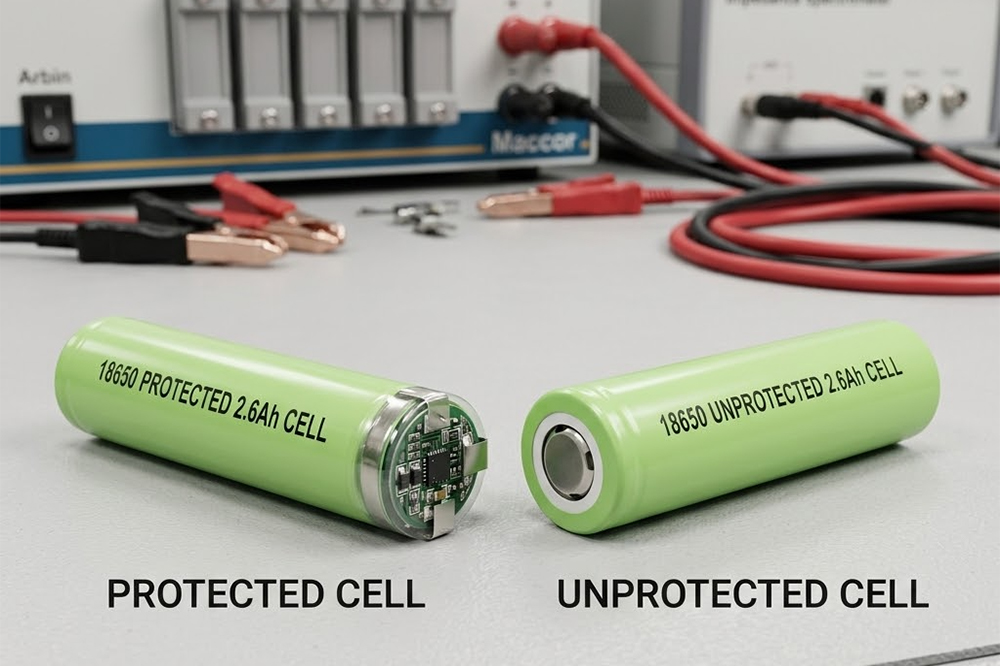
Protected and unprotect 18650 batteries may look almost identical, but they are designed for different applications. The right choice depends on the equipment, BMS design, current requirements, available space and how the battery will be used.
18650 battery can look like a very simple product.
cylindrical metal cell, two terminals and a label.
But sometimes there is a small protection circuit attach to the end of the cell. That small addition changes how the battery should be used.
where buyers often run into confusion.
customer may ask for “18650 batteries” without specifying whether they need protect or unprotected cells. For a small consumer device, that might be a manageable misunderstanding. For a custom battery pack, it can become a much bigger problem.
battery may not fit.
current output may not be suitable.
protection system may conflict with the pack design.
Or the buyer may end up paying for a feature that the final product does not actually need.
So, what is the difference?
What Is Protected 18650 Battery?
protected 18650 battery normally has a small protection circuit connected to the cell.
circuit is designed to help protect the cell against certain abnormal conditions, such as:
- Overcharge
- Over-discharge
- Excessive current
- Short circuit
exact protection functions and thresholds depend on the battery design.
protection circuit is usually placed at one end of the cylindrical cell and connected to the cell through a small conductive strip.
From the outside, you may notice that a protected 18650 battery is slightly longer than a standard bare cell.
matters more than it first appears.
If a device was designed around a standard 65mm-class 18650 cell, adding extra length may make the protected version difficult or impossible to install.
What Is Unprotected 18650 Battery?
unprotected 18650 cell is essentially the cell itself without an individual protection circuit attached.
This does not mean the battery is inherently poor quality or unsafe.
It means the cell does not have that separate protection board built into the individual cell.
Unprotected cells are commonly used inside battery packs where protection and battery management are handled by a separate BMS, or Battery Management System.
For example, a battery pack may contain several 18650 cells connected in series and parallel.
Instead of adding a protection board to every cell, the pack uses a BMS to monitor and manage the battery system.
This is one reason unprotected 18650 cells are common in OEM battery-pack production.

Protect vs. Unprotected 18650: A Quick Comparison
| Feature | Protected 18650 | Unprotected 18650 |
|---|---|---|
| Protection circuit | Usually integrated | Not integrated |
| Cell size | Usually longer | Standard cell dimensions |
| Current path | Protection circuit adds resistance | More direct current path |
| High-current use | Depends on protection circuit | Often preferred for pack design |
| Battery packs | Sometimes unsuitable | Common choice |
| Individual-cell applications | Often useful | Requires external protection |
| BMS requirement | Depends on application | Usually required in packs |
| Custom pack flexibility | More limited | Higher |
| Cost | Usually higher | Usually lower |
This table is only a starting point.
The actual choice should always come from the application requirements.
Why Size Can Become a Problem
One of the first things I would check when selecting a protected 18650 is the physical dimension.
standard 18650 cell is approximately 18mm in diameter and around 65mm in length, although actual dimensions vary by cell construction and terminal design.
protected cell can be longer because of the protection circuit and the way it is assembled.
That extra few millimeters may not sound important.
Put the cell into a tight battery holder, however, and suddenly it matters.
particularly relevant for:
- Flashlights
- Portable electronics
- Battery-powered instruments
- Consumer devices
- Compact equipment
Before ordering a large quantity, check both the diameter and length, not just the 18650 designation.
If you are designing custom battery pack, dimensions should be confirmed before finalizing the enclosure.
What About High-Current Applications?
where protected and unprotected cells can behave quite differently.
protection circuit introduces additional components into the current path.
low-current application, this may not be a major concern.
high-current application, however, every part of the current path deserves attention.
protection circuit has its own current limit and electrical characteristics. If the equipment suddenly demands more current than the protection circuit allows, it may disconnect the battery.
Imagine a power tool starting its motor.
normal running current may be acceptable, but the startup current can be considerably higher.
protection circuit interprets that current as an over-current condition, the battery can shut down.
why high-current equipment often requires a different battery architecture.
If you are working on a power tool, e-bike, robotics project or other demanding application, our guide to high-drain 18650 batteries explains continuous current, peak current, C rating and voltage sag in more detail.
Does Unprotected 18650 Mean It Has No Safety System?
Not necessarily,This is important distinction.
Unprotected cell does not have an individual protection board, but the complete battery system can still include several layers of protection.
A properly designed battery pack may use:
- BMS protection
- Overcharge protection
- Over-discharge protection
- Over-current protection
- Short-circuit protection
- Temperature monitoring
- Charger control
- Mechanical protection
In other words, safety can be designed at the pack level instead of the individual-cell level.
OEM battery packs, this approach often gives the manufacturer more control over the complete system.
BMS can be selected according to the pack voltage, current, cell configuration and application.
When Does Protected 18650 Make More Sense?
Protected cells can be useful when the battery is being used individually or in equipment that does not already have an appropriate battery management system.
simple device may be designed to accept a single replaceable 18650 battery.
In that situation, having protection integrated into the cell can provide an additional layer of protection against abnormal charging and discharging conditions.
can make protected cells a practical choice for certain consumer products.
But compatibility still comes first.
device needs to accept the protected cell physically and electrically.
When Are Unprotect Cells Usually Better?
Unprotected cells are often a better fit for custom battery packs.
Suppose you are designing a 5S2P battery pack.
You already have:
- defined series configuration
- defined parallel configuration
- suitable BMS
- charger designed for the pack
- battery enclosure
- controlled charging system
Adding an individual protection circuit to every cell may not be necessary.
Instead, the battery pack can use cells selected and matched for the application and let the BMS manage the complete pack.
This is one reason OEM battery manufacturers often work with bare 18650 cells rather than protected consumer batteries.
If you want to understand how series and parallel configurations change pack voltage and capacity, our 18650 series and parallel configuration guide is a useful next step.
Internal Resistance Matters Here Too
There is another specification worth checking: internal resistance.
A protection circuit adds components to the electrical path, so protected and unprotected versions should not be treated as electrically identical simply because they use the same basic cell.
Internal resistance also changes with cell age, temperature and measurement conditions.
high-current applications, this can have a noticeable effect on voltage sag and heat generation.
Our guide to 18650 battery internal resistance explains how resistance affects voltage drop, heating, current performance and cell matching.
This is particularly useful when you are comparing cells for a multi-cell battery pack.
Don’t Forget the BMS
unprotected 18650 battery pack, the BMS becomes important part of the overall system.
BMS needs to match the battery configuration and application.
3S pack and a 10S pack require different voltage-management arrangements.
current rating also matters.
A BMS rated for a small current application should not simply be installed into a high-power battery pack because the voltage configuration happens to match.
BMS, cells, charger, wiring and protection strategy should be considered together.
so why battery pack design should begin with the application requirements rather than simply selecting the cheapest available 18650 cell.

Protected Cells Are Not Automatically “Better”
This is probably the biggest misunderstanding.
Protected does not automatically mean better.
Unprotected does not automatically mean worse.
They are different solutions.
protected 18650 can be a good choice for a device designed around individual cells.
unprotected cell can be the better choice for an engineered battery pack with a properly selected BMS.
Think about it like this:
Protected cell = protection integrated into the individual battery.
Unprotected cell = protection handled elsewhere in the system.
Neither approach is universally superior.
How Should OEM Buyers Choose?
For OEM and wholesale buyers, I recommend starting with five questions:
1. Is the cell used individually?
If yes, a protected version may be worth considering.
2. Is there already a BMS?
If the battery is part of a custom pack, an unprotected cell may make more sense.
3. What is the required current?
High-current applications require careful evaluation of cell discharge capability and protection limits.
4. What space is available?
Check the actual cell dimensions, including any protection circuit.
5. does the complete battery system require?
The cell should match the charger, BMS, enclosure and equipment.
This approach usually produces a better result than asking whether protected or unprotected cells are simply “better.”
A Practical Example
Imagine two different products.
The first is a flashlight using one replaceable 18650 battery.
There is no external BMS.
A protected 18650 may be a sensible option if the flashlight is designed to accept its dimensions.
Now consider a 10S2P battery pack for industrial equipment.
The manufacturer already has a dedicated BMS and charger and needs relatively high current.
In this case, individual protected cells may add unnecessary size and resistance.
The manufacturer would more likely evaluate suitable unprotected cells and build protection into the complete battery system.
Same 18650 format.
Completely different battery requirements.
What Should You Ask Your 18650 Battery Supplier?
When requesting a quotation, avoid simply writing:
“Please quote 18650 battery, 3000mAh.”
That leaves too much room for misunderstanding.
Instead, provide the supplier with:
- Capacity requirement
- Continuous discharge current
- Peak current
- Cell dimensions
- Protected or unprotected requirement
- Quantity
- Battery application
- Required cell configuration
- BMS requirements if applicable
If you are unsure whether your application needs a protected or unprotected cell, provide the equipment requirements and ask the supplier to recommend a suitable cell architecture.
larger OEM projects, sample testing before mass production is strongly recommended.

Final Thoughts
Protected and unprotected 18650 batteries are not competing versions where one simply replaces the other.
They serve different roles.
Protected cells make sense when protection needs to be integrated directly into the individual battery. Unprotected cells are often more suitable for professionally designed battery packs where a separate BMS handles system-level protection.
The decision comes down to the complete application.
Check the dimensions. Check the current. Check the BMS. Check the charger. And, especially for high-current applications, look beyond capacity and consider internal resistance and cell consistency as well.
For wholesale and OEM buyers, getting this decision right before placing a large order can prevent a surprisingly expensive redesign later.
FAQs
What is a protected 18650 battery?
A protected 18650 normally includes a small protection circuit that helps protect the cell against conditions such as overcharge, over-discharge, excessive current and short circuits.
Are unprotected 18650 batteries safe?
They can be used safely when they are part of a properly designed battery system with suitable charging and protection circuitry. They require more careful system-level design.
Are protected 18650 batteries longer?
Usually, yes. The added protection circuit can increase the overall cell length, although the exact dimensions depend on the design.
Can I use protected 18650 batteries in a battery pack?
Sometimes, but it depends on the pack design. In many custom battery packs, unprotected cells are preferred because the pack already uses a dedicated BMS.
Which is better for high-current applications?
There is no universal answer, but high-current battery packs commonly use suitable unprotected cells with a properly designed BMS. The cell’s discharge capability and internal resistance should also be evaluated.
-

12V 4400 mah Lithium ion 3S2P 18650 Battery Pack
-

18650 2000mAh 3.7 volt Lithium-ion Battery
-

18650 20V 3.0Ah Cordless Drill battery
-

18650 22.2V 7.8Ah 2600Mah 6S3P Rechargeable Battery Pack
-

18650 2600mAh Rechargeable Lithium-Ion Battery 3.7V
-

18650 3.7V 10Ah Li-Ion Power Battery Pack
-

18650 3.7V 3300mah Rechargeable Lithium ion Battery
-

18650 7S7P 24V 14Ah Lithium ion Electric Scooter Battery Pack
-

18650 battery 3.7V 1500mAh Lithium-Ion Battery
-

18650 Battery 3500 mah Rechargeable Battery Cells
-

18650 Electric Scooter 48V 13000mAh Lithium Battery
-

2600mAh 3S1P 11.1V 18650 Battery Packs
-

3.7V Li ion Rechargeable 3000mah 18650 Battery Cell
-

36V 5200mAh 10S2P 18650 Battery Pack
-

48v 4400mah 13S2P 18650 Rechargeable Battery Pack
-

7S2P 24V 18650 Lithium Battery Pack
-

Electric Scooter 36V 4400mAH 10S2P 18650 Battery Pack
-

ICR 18650 Battery 2200mah 3.7V
Leave a Reply