
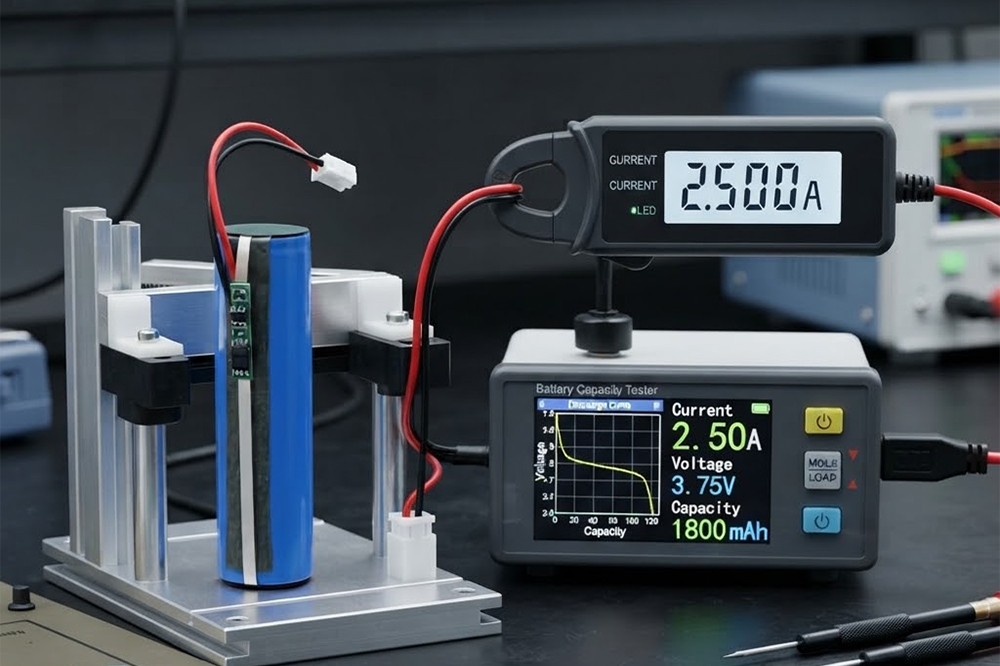
18650 battery capacity tells you how much energy a cell can store, but discharge current determines how much power it can deliver safely. This guide explains continuous current, peak current, C-rate, internal resistance, voltage sag, and the key points buyers should check before selecting 18650 cells.
18650 battery may look suitable based on its voltage and capacity, but those two specifications do not tell the whole story. A 3000mAh cell, for example, may work well in a flashlight or portable device but perform poorly in a high-power tool if its discharge current is too low.
For battery pack designers, the important question is not simply “How many mAh does this cell have?” It is also:
How much current can the cell deliver continuously, and how will it behave under the actual load?
Discharge current affects power output, voltage stability, operating temperature, cycle life, and overall battery pack safety. Understanding this specification helps wholesale buyers, engineers, and OEM customers select cells that match the real requirements of their equipment.
What Is 18650 Battery Discharge Current?
Discharge current is the amount of electrical current that an 18650 cell can deliver to a connected device or battery pack. It is measured in amperes, usually written as A.
For example:
- A cell rated at 5A is designed for relatively low-current applications.
- A cell rated at 10A can support a higher continuous load.
- A cell rated at 20A or more may be suitable for certain high-power applications, depending on its chemistry, construction, temperature, and test conditions.
The discharge current rating must always be considered together with the manufacturer’s test conditions. A current figure without a clear definition may be misleading.
A supplier may list several different current values:
- Continuous discharge current
- Maximum continuous discharge current
- Peak discharge current
- Pulse discharge current
- Recommended operating current
These terms are not interchangeable.
Continuous Discharge Current vs Peak Discharge Current
Continuous Discharge Current
Continuous discharge current is the current a cell can deliver for a specified period under defined conditions without exceeding its safety or temperature limits.
This is the most important rating for equipment that draws power for several minutes or hours, such as:
- Portable power equipment
- E-bike battery packs
- Industrial instruments
- Mobility devices
- Backup power systems
- High-output lighting equipment
A cell rated for 15A continuous discharge should not automatically be treated as a 15A cell under every condition. The actual rating may depend on ambient temperature, cutoff voltage, cooling, cell temperature, and the manufacturer’s testing method.
Peak or Pulse Discharge Current
Peak discharge current refers to a higher current that the cell may deliver for a short period. The duration could be a few seconds or another defined interval.
Peak current may be relevant when a motor starts, a device accelerates, or an electronic system briefly demands extra power.
For example, a cell could have specifications similar to:
| Specification | Example Value |
|---|---|
| Nominal capacity | 3000mAh |
| Continuous discharge | 10A |
| Peak discharge | 15A for a short duration |
| Nominal voltage | 3.6V or 3.7V |
The peak value should not be used as the normal operating current. Running a cell continuously at its short-duration peak rating can create excessive heat, accelerate aging, and increase safety risks.

What Is the C-Rate of an 18650 Battery?
The C-rate expresses discharge current in relation to the cell’s capacity.
The basic formula is:
Discharge Current = Capacity in Ah × C-rate
For a 3000mAh cell:
- 3000mAh = 3Ah
- 1C = 3A
- 2C = 6A
- 5C = 15A
A 3000mAh cell rated at 5C would theoretically support a 15A discharge under the specified test conditions.
For a 2000mAh cell:
- 1C = 2A
- 2C = 4A
- 5C = 10A
This explains why two cells with different capacities can have different current capabilities. Capacity alone does not determine discharge performance.
However, C-rate should not be treated as a universal guarantee. The actual current limit depends on the cell design, chemistry, temperature, internal resistance, and test method.
Does Higher Capacity Mean Higher Discharge Current?
Not necessarily.
High-capacity and high-discharge cells are often designed with different priorities. A high-capacity cell may use a design optimized for energy storage, while a high-discharge cell may use materials and construction that allow current to flow with less internal heating.
For example:
| Cell Type | Typical Priority | Common Application |
|---|---|---|
| High-capacity cell | Longer runtime | Portable electronics, energy storage |
| High-discharge cell | Higher current output | Power tools, motors, high-power devices |
| Balanced cell | Moderate capacity and current | General-purpose battery packs |
A 3500mAh cell is not automatically more suitable than a 2500mAh cell. If the equipment requires high current, a lower-capacity high-drain cell may provide better real-world performance.
The correct choice depends on the complete load profile:
- Normal operating current
- Startup current
- Peak current
- Operating time
- Available cooling
- Required battery life
- Pack size and weight
For a broader comparison of capacity options, see our guide to 18650 battery capacity and discharge performance.
Why Internal Resistance Matters
Internal resistance is one of the key factors affecting an 18650 battery’s discharge performance. It is measured in milliohms, or mΩ.
When current flows through a cell, part of the voltage is lost inside the battery. This voltage loss can be estimated as:
Voltage Drop = Current × Internal Resistance
For example, if a cell has an internal resistance of 30mΩ and the load draws 10A:
Voltage Drop = 10A × 0.03Ω = 0.3V
The actual voltage behavior is more complex, but the example shows why internal resistance matters.
Higher internal resistance can cause:
- Greater voltage sag
- More heat generation
- Lower usable power
- Reduced efficiency
- Earlier low-voltage cutoff
- Faster performance degradation
Internal resistance may increase as a cell ages, becomes cold, or operates under unsuitable conditions. It can also vary between cells from different production batches.
For battery pack manufacturing, cell matching is important because cells with significantly different resistance values may share current unevenly.
What Is Voltage Sag Under Load?
Voltage sag is the temporary drop in battery voltage when a load is connected.
An 18650 cell may show approximately 3.6V or 3.7V at rest, but its voltage can drop when the device draws a high current. Once the load is removed, the voltage may partially recover.
Voltage sag becomes more noticeable when:
- The discharge current is high
- The cell has high internal resistance
- The battery is cold
- The cell is near empty
- The battery has aged
- The wiring or connectors add resistance
A cell with excessive voltage sag may cause a device to:
- Shut down unexpectedly
- Reduce motor speed
- Trigger a low-voltage warning
- Deliver unstable output
- Stop before the expected runtime
This is why a battery should be tested under a realistic load rather than evaluated only with an open-circuit voltage measurement.
For more information about voltage behavior, read 18650 battery voltage under load.

How Discharge Current Affects Heat
When current passes through a cell, internal resistance produces heat. The approximate relationship is:
Heat Generation = I² × R
This means heat increases rapidly as current rises.
For example, doubling the current can increase resistive heat by approximately four times if resistance remains constant.
Excessive heat may lead to:
- Reduced cycle life
- Capacity loss
- Increased internal resistance
- Swelling or damage in unsuitable conditions
- Thermal safety concerns
- Uneven performance within a battery pack
The same cell may perform differently in different environments. A battery pack with good airflow or thermal management may handle a load better than a tightly enclosed pack with little cooling.
For OEM projects, current testing should be conducted in the actual enclosure or in a test setup that closely represents the final product.
Series and Parallel Configurations Affect Pack Current
The number of cells in a battery pack changes the total voltage, capacity, and current capability.
Series Connection
Cells connected in series increase voltage. The current capability of the pack is generally limited by the current capability of one cell in the series group.
For example, four 10A cells connected in series form a 4S pack:
- Nominal voltage: approximately 14.4V or 14.8V
- Continuous current: approximately 10A, subject to design limits
- Capacity: unchanged from one cell
Parallel Connection
Cells connected in parallel increase capacity and current capability.
For example, two 10A cells connected in parallel may provide:
- Higher total capacity
- Approximately 20A theoretical current capability
- The same nominal voltage as one cell
A 4S2P pack using 3000mAh cells would have approximately:
- Nominal voltage: 14.4V or 14.8V
- Capacity: 6000mAh
- Theoretical continuous current: based on two parallel cells and their verified rating
The actual pack current is also limited by:
- BMS rating
- Nickel strip or busbar design
- Fuse
- Wires
- Connectors
- Welding quality
- Cell matching
- Thermal management
Adding more cells in parallel does not automatically solve every current problem. The complete pack must be designed and tested as one system.
BMS and Wiring Must Match the Battery Current
A battery pack may contain high-discharge cells but still fail to deliver the expected current if the protection and connection components are undersized.
Before selecting an 18650 cell, check the ratings of:
BMS
The BMS should support the required continuous current and any expected peak current. Its overcurrent protection threshold should be compatible with the application.
Nickel Strip or Busbar
The conductive connection must handle the current without excessive heating. Thickness, width, material, weld quality, and current path length all matter.
Wires
Thin wires can create voltage drop and heat. The wire gauge should be selected according to current, length, insulation, temperature, and installation conditions.
Connectors
Connectors must support the expected current. A high-current cell connected through a low-rated connector will not provide a reliable high-current solution.
Fuse and Protection Components
Fuses and protection devices should be selected based on the pack’s normal load, startup current, and fault conditions.
A reliable OEM battery pack requires compatibility between the cell, BMS, wiring, connectors, enclosure, charger, and equipment.

How Buyers Should Compare 18650 Discharge Ratings
When reviewing a supplier’s specification sheet, do not look at the current number alone. Check the following points.
1. Is the Rating Continuous or Peak?
A specification of “20A” is incomplete unless it explains whether the value is continuous, pulse, or maximum recommended current.
2. What Is the Test Temperature?
Discharge performance may change significantly at low or high temperatures. The supplier should identify the test temperature or operating range.
3. What Is the Cutoff Voltage?
The cutoff voltage affects the test result. A cell discharged to a lower cutoff voltage may appear to provide more energy than one tested under a stricter condition.
4. Is the Cell New and Genuine?
Reclaimed, aged, or mixed cells may have very different internal resistance and current performance from new cells.
5. Is the Capacity Tested at the Same Current?
Capacity measured at a low current may not represent the usable capacity under a high-current load.
6. Are the Cells Matched?
For battery pack production, cells should be matched by:
- Capacity
- Internal resistance
- Voltage
- Self-discharge behavior
- Production batch, where possible
7. Are Test Reports Available?
For a commercial project, request relevant test data rather than relying only on a marketing label. Depending on the project, useful documents may include:
- Capacity test results
- Internal resistance data
- Discharge curves
- Cycle test data
- Safety test reports
- Batch inspection records
A Practical Example: Choosing Cells for a 12A Load
Suppose a device normally draws 8A and may briefly reach 12A.
A cell rated at 5A continuous would not be a suitable choice for a single-cell design. Even if its capacity is high, the current demand exceeds its intended operating range.
A 15A continuous cell may be more appropriate, but the complete design still needs to consider:
- Whether 12A is continuous or only a short peak
- Ambient temperature
- Enclosure ventilation
- BMS current rating
- Wire and connector resistance
- Required runtime
- Voltage sag
- Cell aging over time
For a multi-cell pack, parallel cells can divide the load. However, the design should use verified ratings and include a safety margin rather than operating continuously at the absolute maximum.
Choosing Between High-Capacity and High-Discharge Cells
The decision can be summarized as follows:
| Requirement | More Suitable Cell Type |
|---|---|
| Long runtime at low current | High-capacity cell |
| Short bursts of high power | High-discharge cell |
| Motor startup loads | High-discharge or balanced cell |
| Compact energy storage | High-capacity cell |
| Power tools | High-discharge cell |
| Portable electronics | High-capacity or balanced cell |
| Industrial custom battery pack | Selected according to load profile |
A balanced design may use a slightly lower-capacity cell if it provides better voltage stability, lower heat, and longer service life under the actual load.
The best cell is not necessarily the one with the largest mAh number or the highest advertised amp rating. It is the one that meets the application’s electrical, thermal, mechanical, and safety requirements.
What Wholesale and OEM Buyers Should Ask Suppliers
Before placing a bulk order, buyers should request clear answers to these questions:
- What is the nominal capacity of the cell?
- What is the verified continuous discharge current?
- Is there a separate peak or pulse rating?
- How long can the cell deliver the peak current?
- What are the test temperature and cutoff voltage?
- What is the typical internal resistance?
- Are capacity and resistance test records available?
- Are the cells new, genuine, and from the same production batch?
- Can the supplier provide discharge curves?
- Can the supplier recommend a suitable cell for the planned battery pack?
For custom battery pack projects, the supplier should also review:
- Required voltage
- Continuous and peak load
- Capacity target
- Maximum pack dimensions
- Operating temperature
- BMS requirements
- Connector type
- Charging method
- Annual quantity
- Prototype testing requirements
A reliable supplier should be able to discuss the complete application instead of recommending a cell based only on capacity.
Final Thoughts
18650 battery discharge current is a critical specification for any application that requires stable power under load. Continuous current, peak current, C-rate, internal resistance, voltage sag, heat generation, and pack configuration all influence the final result.
Capacity tells you how much energy a cell can store. Discharge current tells you how effectively it can deliver that energy to the equipment.
Before buying 18650 cells in bulk, compare the actual load requirements with verified cell ratings, and make sure the BMS, wiring, connectors, and thermal design can support the same operating conditions. For OEM battery packs, testing the complete assembly is just as important as selecting the individual cell.
For a broader overview of battery selection, start with our standard 18650 batteries buying guide.
-

12V 4400 mah Lithium ion 3S2P 18650 Battery Pack
-

18650 2000mAh 3.7 volt Lithium-ion Battery
-

18650 20V 3.0Ah Cordless Drill battery
-

18650 22.2V 7.8Ah 2600Mah 6S3P Rechargeable Battery Pack
-

18650 2600mAh Rechargeable Lithium-Ion Battery 3.7V
-

18650 3.7V 10Ah Li-Ion Power Battery Pack
-

18650 3.7V 3300mah Rechargeable Lithium ion Battery
-

18650 7S7P 24V 14Ah Lithium ion Electric Scooter Battery Pack
-

18650 battery 3.7V 1500mAh Lithium-Ion Battery
-

18650 Battery 3500 mah Rechargeable Battery Cells
-

18650 Electric Scooter 48V 13000mAh Lithium Battery
-

2600mAh 3S1P 11.1V 18650 Battery Packs
-

3.7V Li ion Rechargeable 3000mah 18650 Battery Cell
-

36V 5200mAh 10S2P 18650 Battery Pack
-

48v 4400mah 13S2P 18650 Rechargeable Battery Pack
-

7S2P 24V 18650 Lithium Battery Pack
-

Electric Scooter 36V 4400mAH 10S2P 18650 Battery Pack
-

ICR 18650 Battery 2200mah 3.7V
Leave a Reply