
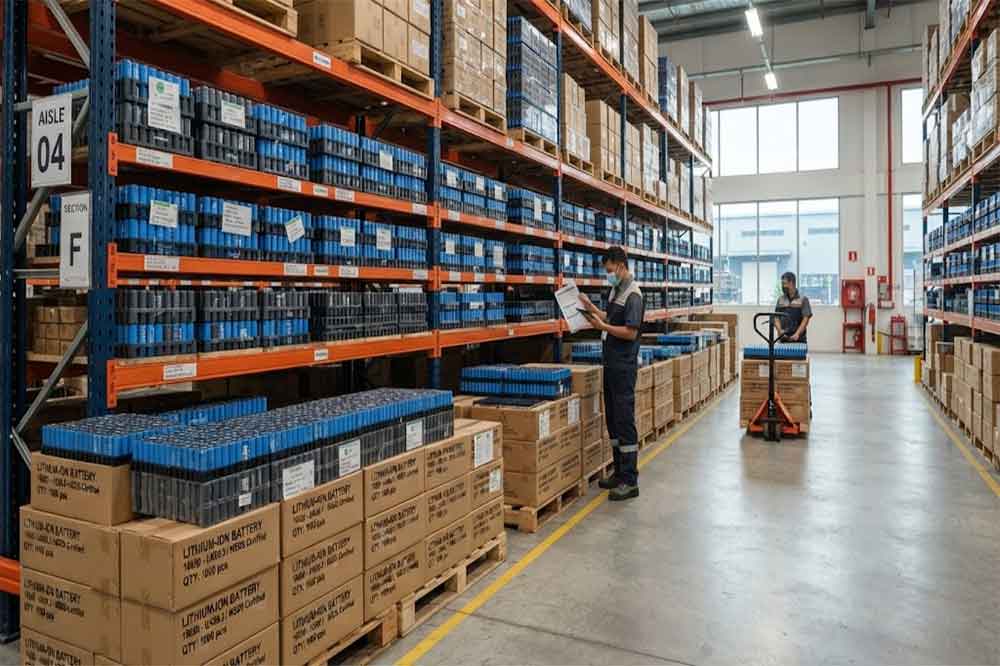
Buying few 18650 cells for testing is very different from buying thousands for production.
A sample order can help confirm dimensions, capacity, discharge performance, and compatibility. A bulk order introduces another set of questions: cell consistency, production batches, documentation, packaging, lead time, quality control, and long-term supply.
For wholesalers, battery pack manufacturers, distributors, and OEM buyers, these details can affect the final product just as much as the cell specification itself.
This guide explains what to check when buying 18650 batteries in bulk, from the first sample to repeat production.
1. Define the Cell Specification Before Asking for a Quote
A common mistake is starting with a simple request such as:
“Please quote 18650 batteries, 3000mAh.”
That specification is not complete enough for a serious bulk purchase.
A supplier needs to know what type of 18650 cell is required and how it will be used.
A basic RFQ should include:
- Cell type
- Nominal voltage
- Capacity
- Continuous discharge current
- Peak current, if applicable
- Cell dimensions
- Flat-top or button-top terminal
- Quantity
- Application
- Required certifications or documents
- Destination country
- Expected delivery schedule
For OEM battery packs, also provide the intended series/parallel configuration when it is already known.
A more detailed specification usually leads to a more useful quotation.
2. Decide Whether You Need Cells or Complete Battery Packs
“Buying 18650 batteries in bulk” can mean two different things.
The first is purchasing loose 18650 cells.
The second is purchasing assembled battery packs containing 18650 cells.
These require different purchasing specifications.
For loose cells, the buyer may focus on:
- Cell model
- Capacity
- Voltage
- Discharge rating
- Internal resistance
- Terminal type
- Quantity
- Batch information
For assembled packs, the buyer may also need:
- Pack voltage
- Pack capacity
- S/P configuration
- BMS
- Connector
- Housing
- Wire specification
- Dimensions
- Label
- Packaging
- Certification
- Functional testing
Making this distinction early avoids confusion during quotation.

3. Know the Exact Capacity You Are Buying
Capacity is one of the most important specifications when purchasing 18650 cells.
Common specifications may include 2000mAh, 2500mAh, 2600mAh, 3000mAh, 3200mAh, and 3500mAh.
However, the number printed in a quotation should not be treated as the only evidence.
Ask how the capacity is tested.
Important test conditions can include:
- Charging method
- Charging voltage
- Discharge current
- Cutoff voltage
- Test temperature
- Rest time
- Testing equipment
Two suppliers can quote the same nominal capacity but use different test conditions.
For bulk purchasing, the test method matters because it gives the buyer a consistent basis for comparison.
For more information, see Standard 18650 Battery Capacity: 2000mAh, 2600mAh, 3000mAh or 3500mAh?
4. Check Discharge Current Carefully
Capacity and discharge current are different specifications.
A 3500mAh cell is not automatically suitable for a high-current application.
A power tool, motor system, industrial device, or high-output product may require a cell with a much higher discharge capability.
When reviewing a quotation, ask whether the stated current is:
- Continuous discharge current
- Maximum continuous current
- Pulse or peak current
- Manufacturer’s recommended operating limit
These terms should not be treated as interchangeable.
For high-current projects, also consider voltage sag, internal resistance, temperature rise, and the number of cells connected in parallel.
See 18650 Battery Discharge Current: What Buyers Should Check for more background.
5. Ask for the Cell Datasheet
A professional bulk quotation should be supported by technical information.
A cell datasheet may contain:
- Nominal voltage
- Nominal capacity
- Standard charging method
- Maximum charging current
- Continuous discharge current
- Discharge cutoff voltage
- Operating temperature
- Dimensions
- Weight
- Internal resistance
- Cycle information
- Safety information
The datasheet should match the exact cell model being quoted.
A general 18650 datasheet is not enough when the buyer is approving a specific cell for production.

6. Confirm the Cell Model and Manufacturer
Before placing a bulk order, confirm exactly what cell is being supplied.
Ask for:
- Manufacturer name
- Exact cell model
- Cell chemistry
- Rated capacity
- Production specification
- Datasheet
- Batch information
This becomes particularly important when a buyer is developing a product around a specific cell.
A replacement cell with a similar capacity may still have different dimensions, internal resistance, discharge performance, or charging characteristics.
For OEM projects, changing the cell after product validation may require additional testing.
7. Sample Testing Should Come Before Bulk Production
A sample is not only for checking whether the battery looks correct.
It is an opportunity to verify the cell against the actual application.
Depending on the project, sample testing can include:
Capacity test
Check whether the measured capacity matches the agreed specification.
Internal resistance test
Compare resistance between samples.
Discharge test
Evaluate voltage behavior under the intended load.
Charging test
Confirm charging behavior with the planned charger or BMS.
Temperature test
Monitor temperature under representative operating conditions.
Dimension check
Measure actual cell dimensions before designing or approving the battery holder.
For an OEM battery pack, testing the assembled pack is also important.
8. Check Cell Matching for Bulk Battery Pack Production
Buying thousands of cells does not mean putting any four cells together and building a pack.
Cell matching becomes important when cells are assembled into multi-cell battery packs.
The manufacturer may need to control:
- Capacity
- Internal resistance
- Open-circuit voltage
- Production batch
- Cell age
- Self-discharge characteristics
For example, a 13S4P battery pack contains:
13 × 4 = 52 cells
Those cells need to work together as a system.
Good cell matching can help improve pack consistency and reduce differences between parallel groups.
9. Ask About Internal Resistance
Internal resistance is often overlooked during purchasing because capacity is easier to understand.
But resistance can have a significant effect on high-current applications.
A simplified relationship is:
Power loss ≈ I² × R
As current increases, the effect of resistance becomes more noticeable.
When comparing bulk suppliers, ask:
- What is the resistance specification?
- How is it measured?
- At what temperature?
- At what state of charge?
- What equipment is used?
- Is the value an average or maximum?
- How is batch consistency controlled?
The testing method should be consistent before comparing results from different suppliers.
10. Understand Batch Consistency
A sample from one production batch does not automatically represent every future batch.
This is particularly important for long-term OEM projects.
A buyer may approve a cell based on a sample and later order a much larger quantity.
The supplier should be able to explain how it controls production consistency.
Useful information may include:
- Incoming material inspection
- Cell testing
- Capacity grading
- Internal resistance grading
- Batch identification
- Sampling inspection
- Final QC
- Production records
For repeat orders, keeping the approved cell specification and sample reference can make quality control easier.
11. Check Production Date and Storage Conditions
Lithium-ion cells are not normally treated like a product that can be stored indefinitely without consideration.
Production date and storage conditions can matter, especially for large purchases.
Ask the supplier about:
- Production date
- Storage temperature
- Storage conditions
- Recommended storage period
- Packaging condition
- Stock rotation
For a project requiring a large quantity, buyers may prefer controlled production and shipment rather than receiving old inventory without clear batch information.
12. Packaging Matters in Bulk Orders
A bulk shipment may contain hundreds or thousands of cells.
Packaging should protect the cells during handling and transportation.
Depending on the product and shipping method, packaging may include:
- Individual insulation
- Trays
- Inner cartons
- Outer cartons
- Protective separators
- Batch labels
- Quantity labels
The packaging method should also be suitable for the destination and transportation requirements.
For international shipments, battery transportation documentation and packaging requirements should be confirmed before shipping.

13. Ask for the Required Compliance Documents
The exact documents depend on the market, product, transportation method, and application.
Common battery-related documents may include:
- UN38.3 test information
- MSDS/SDS
- CE-related documentation where applicable
- RoHS documentation where applicable
- UL-related documentation where applicable
- Quality-system documentation
- Cell datasheet
- Test reports
Do not assume that a supplier having one certificate means every cell model has the same certification coverage.
Ask for documents related to the exact product being purchased.
14. Understand MOQ Before Planning Your Purchase
Minimum order quantity can vary significantly between suppliers and products.
For standard loose cells, the MOQ may depend on:
- Cell model
- Stock availability
- Production schedule
- Packaging requirements
- Custom labeling
- Custom sorting or grading
- OEM requirements
A stocked standard cell may have a different purchasing condition from a cell that needs a dedicated production run.
For buyers planning long-term supply, it is useful to ask about both:
Sample MOQ
and
Mass-production MOQ
This makes it easier to plan the project from prototype to production.
15. Compare the Total Purchase Cost
The unit cell price is important, but it is not the entire purchasing cost.
A bulk buyer may also need to consider:
- Packaging
- Testing
- Certification documents
- Custom labeling
- Sorting
- BMS
- Assembly
- Shipping
- Insurance
- Import costs
- Local taxes
- Storage
- Quality inspection
For loose cells, logistics can also depend on the shipment quantity, packaging, destination, and transportation method.
A slightly different unit price may therefore have a different total landed cost.
For a complete OEM battery pack, the calculation should include all major components rather than comparing cell prices alone.
16. Check Lead Time Before Placing the Purchase Order
Lead time can be very different for stocked cells and custom production.
A supplier should ideally clarify:
- Sample preparation time
- Production lead time
- Testing time
- Packaging time
- Shipping preparation
- Estimated dispatch date
A buyer planning a product launch should also leave time for incoming inspection.
It is risky to calculate the project schedule using only the manufacturer’s production time.
International transportation and customs processing can add additional time.
17. Ask How Repeat Orders Are Controlled
Long-term OEM purchasing is not a one-time transaction.
The first order may be used to validate the product. Later orders need to maintain the same basic specification.
Discuss how repeat orders are controlled.
Useful questions include:
Will the same cell model be supplied?
How are production batches recorded?
What happens if the original cell is discontinued?
Will the buyer be informed before a specification change?
Can an alternative cell be provided for approval?
These questions become more important when the battery is installed in a product that will remain in production for several years.
18. Build a Simple Bulk Purchasing Checklist
Before confirming an order, buyers can review the following list.
Technical
- Exact cell model
- Nominal voltage
- Capacity
- Discharge current
- Internal resistance
- Dimensions
- Terminal type
- Cell chemistry
Quality
- Sample test results
- Capacity grading
- Resistance testing
- Batch information
- Production date
- QC process
Documentation
- Datasheet
- Safety documentation
- Transportation documents
- Applicable compliance documents
- Test reports
Commercial
- Quantity
- MOQ
- Lead time
- Packaging
- Payment terms
- Shipping terms
- Repeat-order conditions
A checklist helps prevent a common purchasing problem: confirming the price before confirming the product specification.
19. What Should Be Included in an 18650 Bulk RFQ?
For B2B buyers, a clear RFQ can save several rounds of emails.
A practical RFQ could look like this:
Product: 18650 lithium-ion cell
Capacity: 3000mAh
Nominal voltage: 3.6V/3.7V according to approved specification
Discharge requirement: [required current]
Quantity: [required quantity]
Terminal: flat top/button top
Application: [application]
Required documents: datasheet, MSDS/SDS, UN38.3 and other applicable documents
Destination: [country/city]
Sample requirement: [quantity]
Mass production target: [quantity/month or year]
Additional requirement: [label, sorting, packaging, OEM pack assembly, etc.]
The more complete the RFQ, the easier it is for a battery supplier to recommend the right cell and provide a realistic quotation.
20. Common Mistakes When Buying 18650 Cells in Bulk
Buying only by capacity
A 3500mAh cell may not be appropriate for a high-current application.
Comparing different test conditions
Capacity numbers should be compared under consistent test conditions.
Ignoring batch information
A buyer needs to know what production batch the approved samples represent.
Skipping sample testing
A bulk order should not normally be the first opportunity to test the cell.
Assuming all 18650 cells are identical
Dimensions, terminals, resistance, capacity, and discharge performance can vary between models.
Focusing only on unit price
Shipping, testing, documents, packaging, and quality control can affect total purchasing cost.
Ordering too much before validation
Large quantities should generally follow successful sample and prototype evaluation.

21. Bulk Buying Is a Supply-Chain Decision
The main difference between sample purchasing and bulk purchasing is consistency.
A sample answers:
“Does this cell work?”
A bulk purchasing process needs to answer several additional questions:
“Can the supplier provide the same specification?”
“Can the quality remain consistent?”
“Can the quantity be delivered on schedule?”
“Can the supplier provide the required documentation?”
“What happens when we place the next order?”
These questions matter for wholesalers and OEM manufacturers because the battery becomes part of their own supply chain.
Conclusion
Buying 18650 batteries in bulk requires more than finding a suitable capacity and negotiating a unit price.
The buyer should confirm the exact cell model, capacity, discharge capability, internal resistance, dimensions, production batch, testing method, documentation, packaging, MOQ, lead time, and repeat-order conditions.
For OEM battery projects, sample testing should come before mass production, and cell matching should be considered when multiple cells are assembled into a pack.
The goal is not simply to buy a large quantity of 18650 cells.
The goal is to establish a stable supply of cells that consistently meet the technical requirements of the finished product.
-

12V 4400 mah Lithium ion 3S2P 18650 Battery Pack
-

18650 2000mAh 3.7 volt Lithium-ion Battery
-

18650 20V 3.0Ah Cordless Drill battery
-

18650 22.2V 7.8Ah 2600Mah 6S3P Rechargeable Battery Pack
-

18650 2600mAh Rechargeable Lithium-Ion Battery 3.7V
-

18650 3.7V 10Ah Li-Ion Power Battery Pack
-

18650 3.7V 3300mah Rechargeable Lithium ion Battery
-

18650 7S7P 24V 14Ah Lithium ion Electric Scooter Battery Pack
-

18650 battery 3.7V 1500mAh Lithium-Ion Battery
-

18650 Battery 3500 mah Rechargeable Battery Cells
-

18650 Electric Scooter 48V 13000mAh Lithium Battery
-

2600mAh 3S1P 11.1V 18650 Battery Packs
-

3.7V Li ion Rechargeable 3000mah 18650 Battery Cell
-

36V 5200mAh 10S2P 18650 Battery Pack
-

48v 4400mah 13S2P 18650 Rechargeable Battery Pack
-

7S2P 24V 18650 Lithium Battery Pack
-

Electric Scooter 36V 4400mAH 10S2P 18650 Battery Pack
-

ICR 18650 Battery 2200mah 3.7V
Leave a Reply