
When people shop for 18650 batteries, they usually focus on the numbers first.
3000mAh.
3500mAh.
10A discharge.
20A discharge.
Cycle life.
Those specifications are important, but they aren’t always the reason a battery works—or doesn’t work—in a particular device.
One of the most common questions that comes up is surprisingly simple:
Should I choose a flat top or a button top 18650 battery?
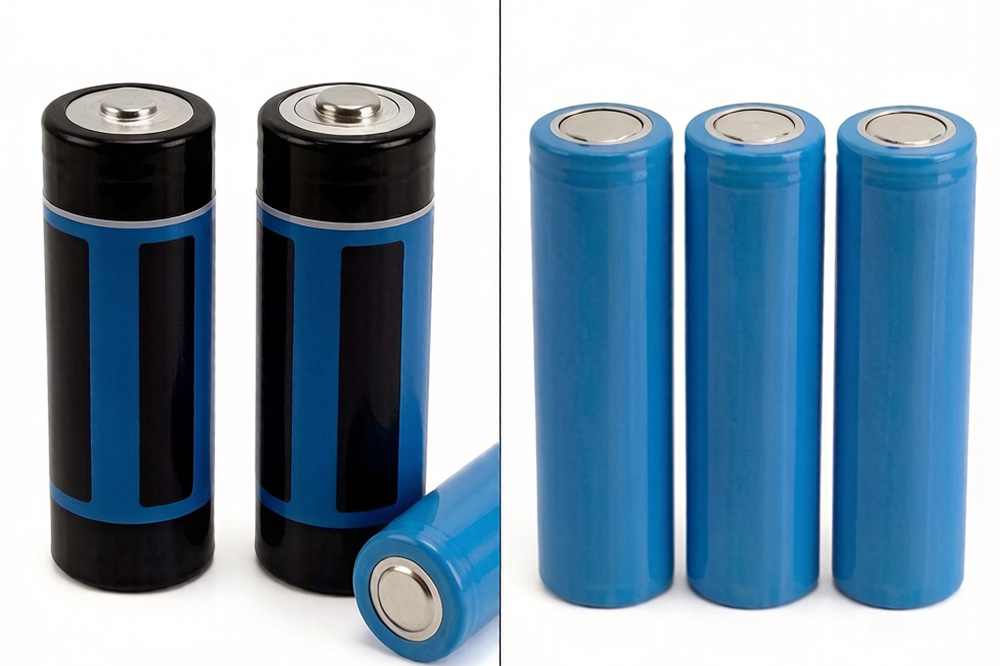
At first glance, the difference looks minor. One battery has a raised positive terminal, while the other has a flat contact surface.
But once you start working with flashlights, battery packs, industrial equipment, or custom electronics, that small difference becomes much more important than most people expect.
What Is Flat Top 18650 Battery?
A flat top battery has a positive terminal that sits almost level with the top of the cell.
There’s no raised button and no additional cap.
Because of this design, flat top batteries are commonly used in battery packs and industrial applications.
If you’ve ever opened a power tool battery, portable power station, energy storage module, or laptop battery pack, chances are the cells inside were flat top batteries.
Manufacturers generally prefer them because they are easier to connect using nickel strips and spot welding equipment.
For battery pack production, simplicity usually wins.
If you’re evaluating 3000mAh flat top 18650 batteries for battery pack assembly, OEM manufacturing, energy storage systems, or industrial applications, you can explore detailed specifications here:

What Is Button Top 18650 Battery?
A button top battery includes a small metal protrusion on the positive terminal.
The purpose isn’t to increase capacity or improve performance.
It’s simply there to help the battery make contact inside devices designed around that extra height.
Many flashlights, portable electronics, and battery holders were originally built to accommodate button top batteries.
In those situations, the raised terminal helps ensure a reliable electrical connection.
Without it, the battery may be too short to reach the contact point.
The Biggest Difference Isn’t Performance
This is where many buyers get confused.
A button top battery isn’t automatically more powerful.
A flat top battery isn’t automatically higher capacity.
The terminal design has very little to do with the actual chemistry inside the battery.
You can find:
- Flat top 3000mAh batteries
- Button top 3000mAh batteries
- Flat top high-drain batteries
- Button top protected batteries
The terminal style mainly affects physical compatibility and assembly methods.
That’s why two batteries with nearly identical specifications can end up being used in completely different products.
How Much Longer Is a Button Top Battery?
Although both batteries belong to the 18650 family, they aren’t always exactly the same length.
A typical flat top 18650 battery is around 65 mm long.
A button top battery is often between 66 mm and 69 mm long depending on the design and whether additional protection circuitry is included.
A few millimeters may not sound significant.
In reality, those few millimeters can determine whether a battery fits properly inside:
- Flashlights
- Battery holders
- Charging cradles
- Portable instruments
- Custom enclosures
Engineers spend a surprising amount of time worrying about very small dimensions.
Battery selection is one of those areas where a couple of millimeters can create compatibility problems.
A Common Misunderstanding: Button Top Does Not Mean Protected
One of the most common misconceptions online is that button top batteries are protected and flat top batteries are unprotected.
That’s not true.
The terminal style and protection system are completely separate features.
You can find:
- Flat top protected batteries
- Flat top unprotected batteries
- Button top protected batteries
- Button top unprotected batteries
The button only changes the shape of the positive terminal.
Protection circuits are an entirely different component that helps prevent:
- Overcharging
- Over-discharging
- Short circuits
- Excessive current draw
When comparing batteries, it’s important not to confuse these two characteristics.
Why Flashlight Users Care About Flat Top vs Button Top
Spend a few minutes reading flashlight forums and you’ll notice this topic comes up constantly.
The reason is simple.
Many flashlights are designed around a specific battery length.
Some require the extra height provided by a button top battery.
Others work perfectly with flat top cells.
Some newer models support both.
What catches many users off guard is that two batteries may share the same voltage and capacity but still behave differently because one physically reaches the contact point and the other doesn’t.
Before buying replacement batteries, it’s always worth checking what the device manufacturer recommends.
Will Both Batteries Work With The Same Charger?
Most modern lithium-ion chargers can handle both flat top and button top batteries without any issues.
However, there are exceptions.
Certain chargers were designed around specific battery lengths and contact positions.
In those cases, a shorter flat top battery may not make reliable contact.
For individual users, this is usually a quick compatibility check.
For OEM projects, manufacturers typically test the battery, charger, and protection system together to avoid unexpected problems later.
Why Most High-Drain 18650 Batteries Use Flat Top Designs
Another pattern you’ll notice is that many high-drain batteries are sold in flat top form.
This isn’t because flat top batteries automatically perform better.
The real reason is manufacturing.
Flat top batteries are easier to integrate into larger battery assemblies.
They’re commonly used in:
- Power tools
- Portable power stations
- Electric mobility products
- Industrial equipment
- Energy storage systems
When dozens or even hundreds of cells need to be connected together, flat top designs simplify the entire assembly process.

Flat Top Is the Standard Format for Battery Packs
Walk through a battery pack factory and you’ll quickly notice something.
Most production lines are using flat top cells.
There are several practical reasons behind this.
Flat top batteries are:
- Easier to spot weld
- Easier to automate
- Easier to stack together
- More consistent in dimensions
- Better suited for large-scale manufacturing
For OEM projects, consistency is often more important than convenience.
That’s one reason flat top batteries continue to dominate battery pack production worldwide.
Can a Flat Top Battery Be Converted to Button Top?
Some users place conductive spacers or small magnets on top of flat top batteries to increase terminal height.
In certain devices, this may temporarily solve a fitment issue.
However, it’s generally considered a workaround rather than a long-term solution.
For commercial products, industrial equipment, and battery pack manufacturing, it’s usually better to use the battery type the device was originally designed for.
That approach reduces connection issues and improves reliability over time.
What Do OEM Battery Buyers Usually Choose?
For individual consumer use, the answer depends on the device.
For manufacturers, the answer is usually much clearer.
Most OEM buyers prefer flat top batteries because they integrate more easily into battery packs and automated production systems.
Flat top cells are commonly found in:
- Medical devices
- Industrial instruments
- Portable electronics
- Power stations
- Electric mobility products
- Custom battery packs
The goal isn’t simply to power a device.
The goal is to create a battery system that can be assembled efficiently, tested consistently, and scaled into mass production.
That’s where flat top batteries tend to have an advantage.
So Which One Is Better?
Neither design is universally better.
They’re simply designed for different situations.
If you’re replacing a battery in a flashlight or consumer device, compatibility should be your first concern.
If you’re designing a battery pack, developing a product, or sourcing cells for manufacturing, flat top batteries will usually be the preferred option.
That’s why most commercial battery packs, industrial systems, and OEM battery assemblies rely on flat top 18650 cells rather than button top versions.
-

12V 4400 mah Lithium ion 3S2P 18650 Battery Pack
-

18650 2000mAh 3.7 volt Lithium-ion Battery
-

18650 20V 3.0Ah Cordless Drill battery
-

18650 22.2V 7.8Ah 2600Mah 6S3P Rechargeable Battery Pack
-

18650 2600mAh Rechargeable Lithium-Ion Battery 3.7V
-

18650 3.7V 10Ah Li-Ion Power Battery Pack
-

18650 3.7V 3300mah Rechargeable Lithium ion Battery
-

18650 7S7P 24V 14Ah Lithium ion Electric Scooter Battery Pack
-

18650 battery 3.7V 1500mAh Lithium-Ion Battery
-

18650 Battery 3500 mah Rechargeable Battery Cells
-

18650 Electric Scooter 48V 13000mAh Lithium Battery
-

2600mAh 3S1P 11.1V 18650 Battery Packs
-

3.7V Li ion Rechargeable 3000mah 18650 Battery Cell
-

36V 5200mAh 10S2P 18650 Battery Pack
-

48v 4400mah 13S2P 18650 Rechargeable Battery Pack
-

7S2P 24V 18650 Lithium Battery Pack
-

Electric Scooter 36V 4400mAH 10S2P 18650 Battery Pack
-

ICR 18650 Battery 2200mah 3.7V
Leave a Reply