
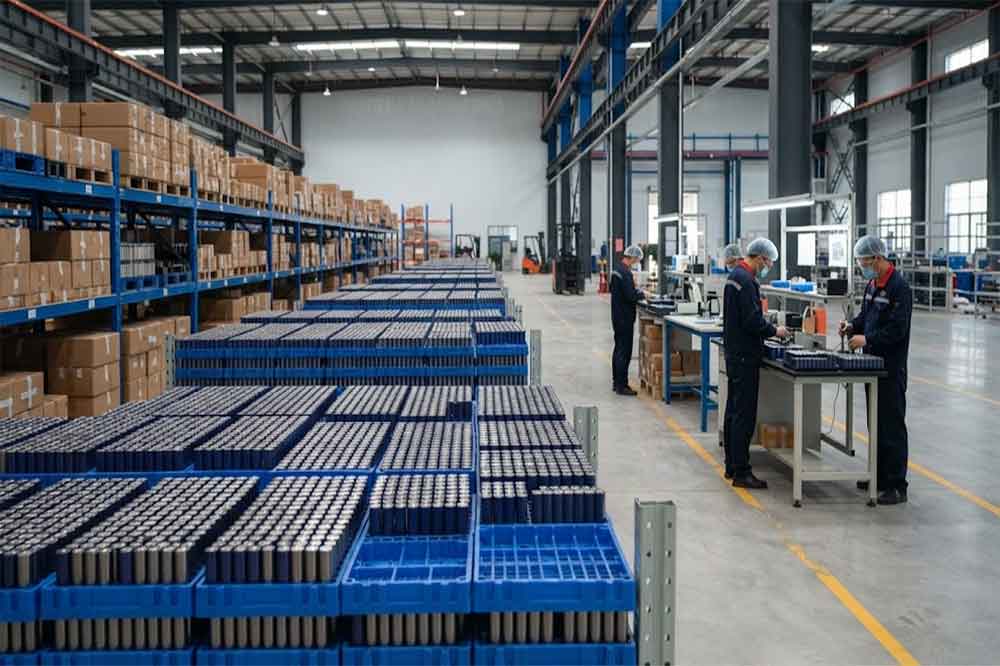
Buying 18650 battery cells in bulk from China can reduce sourcing costs and give buyers access to a large manufacturing supply chain. However, the process involves more than finding a supplier and asking for a quote.
The cell model, capacity, discharge current, batch consistency, packaging, shipping method, and documents all matter. For OEM battery pack projects, the supplier’s ability to maintain the same specification over repeated orders is also important.
This guide explains how to buy 18650 battery cells in bulk from China, from preparing an RFQ to receiving and checking the shipment.
Start With a Clear 18650 Battery Specification
Before contacting Chinese suppliers, prepare a basic specification sheet.
A supplier can give a faster and more useful quotation when the requirements are clear.
At minimum, include:
- 18650 cell type
- Nominal voltage
- Rated capacity
- Continuous discharge current
- Peak discharge current, if required
- Cell dimensions
- Flat top or button top
- Chemistry
- Quantity
- Required documents
- Delivery destination
For example, a request such as “I need 18650 batteries” is too broad.
A better RFQ could specify:
18650 Li-ion cell, 3.6V nominal, 3000mAh, suitable for a custom battery pack, 5,000 cells required, delivery to the United States.
You can then add the required discharge current, size limits, terminal type, packaging, and certification documents.
For more information, see our guide on [How to Choose 18650 Cells for OEM Battery Packs].
Decide Whether You Need Cells or Complete Battery Packs
Chinese battery suppliers may sell individual cells, battery packs, or both.
These are different purchasing projects.
Individual 18650 cells are commonly used by battery pack manufacturers and OEM assembly companies. The buyer handles the series-parallel configuration, BMS, welding, enclosure, and final pack assembly.
A complete battery pack requires more engineering work from the supplier. The supplier may handle cell selection, cell matching, spot welding, BMS installation, wiring, connectors, insulation, and enclosure assembly.
Therefore, state clearly whether you need:
18650 cells only
or
Complete 18650 battery packs
This simple distinction can prevent confusion during quotation.
Find Chinese 18650 Battery Suppliers
There are several ways to find suppliers in China.
Buyers may use B2B platforms, search engines, industry directories, trade shows, referrals, or direct manufacturer websites.
However, the first supplier you find should not automatically become your final supplier.
Start with several potential suppliers.
Then compare them using the same specification.
Look at:
- Product range
- Cell specifications
- Factory information
- OEM capability
- Quality control
- Sample support
- Documents
- MOQ
- Lead time
- Export experience
- Communication
For bulk purchasing, consistency is often more important than a low initial quotation.
A supplier may offer a good sample but struggle to maintain the same specification over repeated production batches. That is why supplier verification should continue after the first sample.
For a broader supplier checklist, see [Standard 18650 Battery Supplier: What to Ask Before Bulk Orders].

Check Whether the Supplier Is a Factory or a Trading Company
Not every Chinese battery supplier is a cell manufacturer.
Some companies manufacture battery packs but source cells from other manufacturers. Others operate mainly as trading companies.
A trading company is not automatically unsuitable.
The important question is whether the supplier can clearly explain the supply chain.
Ask:
- Who manufactures the cells?
- What is the cell model?
- Is the model stable?
- Can the same model be supplied for future orders?
- Where are the cells stored?
- Who performs incoming inspection?
- Who performs capacity testing?
- Can the supplier provide the datasheet?
- Can the supplier provide batch information?
For OEM battery pack projects, this information becomes especially important.
The supplier should also tell you when a cell substitution is necessary.
Do not accept an unapproved replacement simply because the replacement has a similar capacity.
Different cells can have different discharge performance, internal resistance, dimensions, and charging characteristics.
Ask for the Exact Cell Model
“3000mAh 18650” is not a complete specification.
Different 18650 cells can have the same nominal capacity but different performance.
For example, two 3000mAh cells may have different:
- Continuous discharge ratings
- Internal resistance
- Energy density
- Cycle characteristics
- Operating temperature ranges
- Physical dimensions
- Manufacturer specifications
For this reason, request the exact manufacturer and model whenever possible.
Then request the corresponding datasheet.
The datasheet gives you a technical reference for the quotation.
It also makes future purchasing easier because you have a fixed specification to compare against.
Check Capacity and Test Conditions
Capacity is one of the most commonly misunderstood 18650 specifications.
A supplier may quote a nominal capacity such as 3000mAh. However, the test conditions also matter.
Ask about:
- Charging method
- Discharge current
- Cut-off voltage
- Test temperature
- Test standard
- Rated capacity
- Typical capacity
For example, a 3000mAh cell tested under a low discharge current may not behave the same way in a high-current battery pack.
Therefore, do not compare suppliers using the mAh number alone.
Compare the complete test conditions.
For a deeper explanation, read [Standard 18650 Battery Capacity: 2000mAh, 2600mAh, 3000mAh or 3500mAh?].

Check Discharge Current for the Application
Capacity tells you how much charge a cell can store. It does not tell you everything about how much current the cell can deliver.
This matters for power tools, mobility products, high-power electronics, and other demanding applications.
For example, a high-capacity 18650 cell may not be the right choice for a high-current application.
On the other hand, a high-discharge cell may provide less capacity.
The correct choice depends on the actual load.
Ask the supplier for the continuous discharge rating and, where relevant, the peak discharge rating.
Also provide the expected battery pack current.
The supplier can then recommend a suitable cell rather than simply offering the highest-capacity model.
See [High Capacity vs High Discharge 18650 Batteries] for more background.
Order Samples Before a Bulk Purchase
Samples are one of the most useful steps in Chinese battery sourcing.
Do not place a large order based only on product photos or a datasheet.
Start with a sample quantity that allows your engineering team to test the cells.
Depending on the project, you may check:
- Actual capacity
- Voltage
- Internal resistance
- Discharge performance
- Physical dimensions
- Weight
- Terminal condition
- Temperature behavior
- Self-discharge
- Compatibility with your battery design
For an OEM pack, sample testing should ideally use the actual pack configuration.
This provides more useful information than testing the cell alone.
Test More Than One Sample
Testing one cell is not enough for a bulk order.
Individual cells naturally have some variation.
A larger sample group gives you a better view of the batch.
For example, a buyer may request a group of samples and measure capacity and internal resistance across the cells.
The results can then be compared.
Large differences may require further discussion with the supplier.
This is especially important for packs that use many cells in parallel.
Check Cell Matching for Battery Pack Production
Cell matching becomes important when individual 18650 cells are assembled into a battery pack.
Cells can differ in capacity, internal resistance, voltage, and self-discharge.
A professional battery pack manufacturer can test and sort cells before assembly.
The exact matching limits should depend on the cell model and application.
There is no single tolerance that fits every battery pack.
For example, a 10S4P pack contains 40 cells.
The four parallel cells in each group should be properly selected for the intended pack design.
Good matching can improve consistency between groups.
However, matching does not replace good-quality cell sourcing.
The starting cells still need to meet the required specification.
Ask About Production Batch and Date
Production date is another useful question when buying 18650 cells in bulk.
Ask the supplier:
- When were the cells produced?
- Are all cells from the same batch?
- How were they stored?
- How long have they been in storage?
- Can future orders use the same cell model?
For a large OEM project, the batch information should be recorded.
This creates a useful purchasing history.
It also helps when investigating differences between production runs.
Confirm MOQ Before Negotiating the Order
MOQ means minimum order quantity.
Chinese suppliers may have different MOQs for different cell models.
The MOQ can depend on:
- Cell model
- Cell manufacturer
- Available stock
- Custom requirements
- Packaging
- Production schedule
- Order quantity
Do not assume that every 18650 model has the same MOQ.
A supplier may have ready stock for one model but require a production order for another.
Therefore, ask about MOQ at the beginning of the quotation process.
Understand Stock and Production Lead Time
“Available” can mean different things.
A supplier may have the cells in its warehouse.
Alternatively, the supplier may need to arrange production or obtain cells from an upstream manufacturer.
Ask whether the quoted quantity is:
- Ready stock
- Reserved stock
- In production
- Available after a new production run
Also ask for the estimated lead time.
For recurring orders, ask how quickly the supplier can replenish the same model.
This matters more than a single delivery date.
Confirm Packaging Before Shipping
18650 cells need suitable packaging for transportation.
Ask the supplier how the cells will be packed.
Depending on the order, packaging may include trays, cartons, insulation, protective materials, or other suitable packaging methods.
Confirm:
- Quantity per carton
- Cell arrangement
- Protective packaging
- Carton dimensions
- Gross weight
- Net weight
- Shipping marks
- Label requirements
Good packaging reduces the chance of damage during handling and transportation.

Check Lithium Battery Shipping Documents
International transportation of lithium-ion cells involves shipping requirements and documentation.
Before placing an order, ask which documents the supplier can provide.
Common documents may include:
- UN38.3 test report
- Safety Data Sheet (SDS/MSDS)
- Product specification
- Test reports
- Commercial invoice
- Packing list
- Other shipping documents required for the destination
Document requirements can vary by transport method and destination.
Therefore, confirm the requirements with the freight forwarder before shipment.
Do not wait until the goods are ready to ship.
Choose the Shipping Method
The best shipping method depends on quantity, destination, urgency, and carrier requirements.
For smaller quantities, buyers may use air freight or other available shipping services.
For larger commercial orders, sea freight may become more practical.
However, lithium-ion cells have specific transportation requirements.
The supplier and freight forwarder should confirm whether the selected route can accept the shipment.
For an international B2B order, provide the exact destination before requesting a freight quotation.
For example:
5,000 pcs 18650 cells, FOB Shenzhen.
or:
5,000 pcs 18650 cells, delivered to our warehouse in California.
The supplier can then quote according to the agreed shipping terms.
Understand Incoterms Before Comparing Quotes
Two suppliers may quote different prices because they use different trade terms.
Common terms in international battery purchasing include:
- EXW
- FOB
- CIF
- DAP
The meaning of each term affects which party handles transportation, insurance, customs procedures, and other costs.
Therefore, compare quotations using the same Incoterm whenever possible.
A low EXW quotation cannot be directly compared with a delivered quotation.
The final purchasing cost may be very different.
Ask About Payment Terms
Payment terms should be confirmed before production starts.
Common arrangements may include a deposit followed by payment before shipment.
The exact terms depend on the supplier, order size, relationship, and project.
Put the agreed terms in writing.
The purchase order should clearly state:
- Product model
- Quantity
- Capacity
- Required specification
- Packaging
- Documents
- Delivery terms
- Lead time
- Payment terms
- Approved sample reference
This reduces misunderstandings later.
Use a Pre-Shipment Quality Check
For a large 18650 bulk order, consider a quality inspection before shipment.
The inspection can verify whether the shipment matches the agreed specification.
Depending on the project, the inspection may cover:
- Quantity
- Model
- Appearance
- Voltage
- Capacity
- Internal resistance
- Dimensions
- Packaging
- Labels
- Documents
The inspection method should be agreed before production.
That way, both buyer and supplier understand what will be checked.
Keep an Approved Sample
An approved sample can become a useful reference for future orders.
Keep records of:
- Cell model
- Capacity
- Voltage
- Dimensions
- Weight
- Internal resistance
- Test results
- Batch information
- Photos
- Datasheet
- Approved sample date
When placing a repeat order, compare the new shipment against the approved specification.
This is especially useful when the same 18650 cells are used in long-term OEM production.
Be Careful With Cell Substitution
One common sourcing problem occurs when a supplier changes the cell model without clearly informing the buyer.
A replacement cell may have a similar capacity but different electrical characteristics.
For OEM battery packs, this can affect the final design.
Therefore, establish a simple rule:
No cell model substitution without buyer approval.
If the original model becomes unavailable, ask the supplier to provide:
- The proposed replacement model.
- Its datasheet.
- Capacity and discharge specifications.
- Internal resistance data.
- Dimensions.
- Sample availability.
- Comparison with the approved cell.
Test the replacement before using it in production.
Build a Long-Term Supply Plan
Bulk purchasing is easier when the supplier relationship is planned beyond one order.
For recurring battery production, discuss:
- Monthly or annual demand
- Forecast quantities
- Expected delivery schedule
- Approved cell model
- Backup cell options
- Batch control
- Quality inspection
- Packaging
- Storage
- Replacement rules
For example, a buyer may need 5,000 cells for the first order and around 50,000 cells per year.
That is different from a one-time purchase.
The supplier should understand the expected demand and production cycle.
This can help both sides plan inventory and production.
A Practical RFQ Template for Chinese 18650 Suppliers
A clear RFQ saves time.
You can send the following information:
Product: 18650 lithium-ion cell
Nominal voltage: 3.6V
Capacity: 3000mAh
Discharge current: [required value]
Top type: Flat top
Quantity: 5,000 pcs
Application: Custom battery pack
Destination: [country/city]
Required documents: Datasheet, UN38.3, SDS/MSDS
Packaging: Standard export packaging
Shipping term: FOB / CIF / DAP
Sample: Required before bulk order
Repeat demand: [estimated annual quantity]
Then ask the supplier to provide:
- Exact cell model
- Manufacturer
- Datasheet
- MOQ
- Sample price
- Bulk quotation
- Lead time
- Production date
- Batch information
- Packaging details
- Available documents
- Shipping options
This format makes supplier comparison much easier.
Common Mistakes When Buying 18650 Cells From China
Choosing the cheapest quotation
A lower unit price does not necessarily mean a lower total purchasing cost.
Testing, freight, rejected cells, delays, and replacement costs can affect the final result.
Buying without samples
A datasheet cannot replace physical testing.
Always test samples when the project is new.
Comparing only capacity
A 3500mAh cell is not automatically better for every application.
Discharge current, dimensions, resistance, temperature, and pack requirements also matter.
Accepting an unapproved substitute
The replacement may look similar but perform differently.
Keep the approved cell model fixed unless a replacement is tested and approved.
Ignoring repeat supply
A cell that is available today may not be suitable for a long-term project if the supplier cannot maintain supply.
Ask about future availability before committing to a large OEM project.
Comparing suppliers with different shipping terms
Always check whether quotations are EXW, FOB, CIF, DAP, or another term.
Otherwise, the price comparison may not be meaningful.
China 18650 Bulk Buying Checklist
Before placing a bulk order, confirm these points:
| Item | What to Check |
|---|---|
| Cell model | Exact manufacturer and model |
| Capacity | Rated capacity and test conditions |
| Voltage | Nominal and charging limits |
| Current | Continuous and peak discharge |
| Dimensions | Length and diameter |
| Top type | Flat top or button top |
| Resistance | Test method and target range |
| Batch | Production date and batch information |
| Samples | Tested and approved |
| MOQ | Minimum order quantity |
| Lead time | Stock or production |
| Documents | Datasheet, UN38.3, SDS/MSDS |
| Packaging | Quantity and protection |
| Shipping | Suitable lithium battery route |
| Trade term | EXW, FOB, CIF, DAP, etc. |
| Substitution | Buyer approval required |
| Repeat supply | Future order capability |
Final Thoughts
Buying 18650 battery cells in bulk from China is not simply a price comparison exercise.
The process starts with a clear specification.
Then, verify the supplier, request samples, test the cells, confirm documents, and agree on shipping terms.
For OEM battery projects, also pay attention to cell matching, batch consistency, and long-term supply.
A good bulk purchase should work beyond the first shipment.
The same specification should remain clear when you place the second, third, and later orders.
For buyers developing a custom battery pack, the next step is usually to connect cell sourcing with the complete pack design. See [How to Select 18650 Batteries for Custom Battery Pack Manufacturing] for the next stage.
Frequently Asked Questions
Can I buy 18650 battery cells directly from China?
Yes. International buyers can purchase 18650 cells from Chinese battery suppliers and manufacturers. Before ordering, confirm the exact cell model, specifications, documents, MOQ, shipping method, and delivery terms.
What should I include in an RFQ for 18650 cells?
Include the cell model or required specifications, capacity, voltage, discharge current, top type, quantity, application, destination, required documents, shipping terms, and sample requirements.
Should I order samples before buying 18650 cells in bulk?
Yes. Sample testing helps verify capacity, resistance, dimensions, discharge performance, and compatibility with the intended battery pack before a large order is placed.
What documents should I ask for when buying 18650 cells?
Depending on the shipment and destination, buyers may request a datasheet, UN38.3 documentation, SDS/MSDS, product test reports, commercial invoice, packing list, and other required shipping documents.
How can I avoid receiving a different 18650 cell model?
Specify the approved manufacturer and model in the purchase order. Also state that substitutions require buyer approval and testing before production.
Is buying 18650 cells directly from a factory always cheaper?
Not necessarily. The total cost depends on the cell specification, order quantity, shipping terms, freight, documents, testing, packaging, and other purchasing requirements. Compare suppliers using the same specification and trade terms.
-

12V 4400 mah Lithium ion 3S2P 18650 Battery Pack
-

18650 2000mAh 3.7 volt Lithium-ion Battery
-

18650 20V 3.0Ah Cordless Drill battery
-

18650 22.2V 7.8Ah 2600Mah 6S3P Rechargeable Battery Pack
-

18650 2600mAh Rechargeable Lithium-Ion Battery 3.7V
-

18650 3.7V 10Ah Li-Ion Power Battery Pack
-

18650 3.7V 3300mah Rechargeable Lithium ion Battery
-

18650 7S7P 24V 14Ah Lithium ion Electric Scooter Battery Pack
-

18650 battery 3.7V 1500mAh Lithium-Ion Battery
-

18650 Battery 3500 mah Rechargeable Battery Cells
-

18650 Electric Scooter 48V 13000mAh Lithium Battery
-

2600mAh 3S1P 11.1V 18650 Battery Packs
-

3.7V Li ion Rechargeable 3000mah 18650 Battery Cell
-

36V 5200mAh 10S2P 18650 Battery Pack
-

48v 4400mah 13S2P 18650 Rechargeable Battery Pack
-

7S2P 24V 18650 Lithium Battery Pack
-

Electric Scooter 36V 4400mAH 10S2P 18650 Battery Pack
-

ICR 18650 Battery 2200mah 3.7V
Leave a Reply