
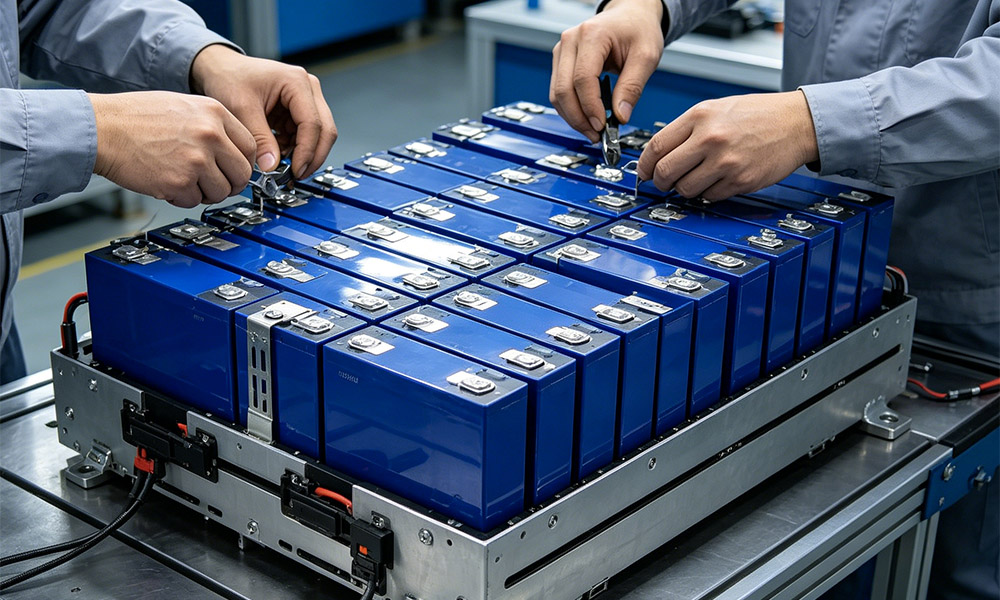
If you’re planning to build a lithium battery pack for solar systems, industrial equipment, or OEM projects, the biggest challenge is not assembly—it’s making the right decisions before you even start.
Most battery failures don’t come from wiring mistakes. They come from wrong cell selection, poor consistency, and unstable supply.
This guide focuses on what actually matters if you are sourcing or building battery packs at scale.
Why Most Lithium Battery Pack Projects Fail Early
From real B2B cases, the common issues are:
- Cells from different batches → voltage imbalance
- Inconsistent internal resistance → overheating
- Unstable supplier → difficult to scale orders
- Weak BMS matching → reduced lifespan
Even a well-designed pack will fail if the cell foundation is not stable.
That’s why experienced buyers start from cell quality and supply chain, not just configuration.
Choosing the Right Cell: The Foundation of Every Battery Pack

For energy storage and industrial applications, large-format LiFePO4 cells are now the mainstream choice.
A typical example used in real projects is:3.2V 280Ah LiFePO4 battery cell
Why this type of cell is widely used:
- High capacity → fewer cells, simpler structure
- Long cycle life → 4000–6000+ cycles
- Stable chemistry → safer for large systems
- Easier pack design compared to 18650 cells
In practical terms:
- 16 cells (16S) → 51.2V system
- Total energy ≈ 14kWh
That’s a standard configuration for solar storage, telecom backup, and industrial power systems.
How to Build Lithium Battery Pack
1. Define System Requirements
Before anything else:
- Voltage: 12V / 24V / 48V / higher
- Capacity: based on runtime needs
- Discharge current: peak vs continuous
- Application scenario
For example:
- Solar storage → 48V systems are common
- Industrial equipment → depends on load profile
2. Design Series & Parallel Configuration
- Series (S): increases voltage
- Parallel (P): increases capacity
Typical configurations:
- 16S1P → 51.2V 280Ah
- 16S2P → 51.2V 560Ah
Using large-capacity cells like 3.2V 280Ah LiFePO4 battery cell
helps reduce connection complexity and improves consistency.
3. Cell Matching (Critical for Lifespan)
This step is often overlooked.
Good battery packs require:
- Same batch cells
- Close voltage levels
- Matched internal resistance
Without this, even new packs can degrade quickly.
4. Mechanical Assembly
Key points:
- Use compression structure (important for prismatic cells)
- Apply busbars instead of loose wiring
- Ensure uniform torque on terminals
Poor mechanical design = hidden long-term failure risk.
5. BMS Integration
A proper BMS will:
- Balance cells
- Protect against overcharge / discharge
- Monitor temperature
- Ensure safe operation
Mismatch between BMS and cells is a common issue in low-cost builds.
6. Testing Before Deployment
Before actual use:
- Check voltage consistency
- Run initial charge/discharge cycles
- Monitor temperature and performance
Skipping testing often leads to early field failures.

DIY vs Bulk Supply: What Most Buyers Choose
If you’re building a few packs for testing, DIY is fine.
But for commercial use:
DIY Limitations
- Hard to maintain consistency
- Time-consuming
- Difficult to scale
Bulk Cell Supply + Pack Integration
- Stable quality across batches
- Easier to standardize production
- Supports long-term projects
- Reduces technical risk
That’s why most distributors and OEM buyers prefer sourcing cells like 3.2V 280Ah LiFePO4 battery cell and building packs with a structured solution.
What B2B Buyers Usually Care About (Before Sending Inquiry)
If you want real inquiries, these are the decision points:
- Are the cells Grade A?
- Can you provide matched cells?
- Do you support bulk orders consistently?
- What’s the lead time?
- Are certifications available (UN38.3, MSDS)?
If your product page answers these clearly, conversion rate goes up significantly.

Final Thoughts: Build Smart, Not Just Fast
Building a lithium battery pack is not difficult.
Building a reliable and scalable battery solution is.
The difference comes down to:
- Cell quality
- Consistency
- Supply stability
If your project involves energy storage, OEM manufacturing, or wholesale distribution, starting with proven cells like
3.2V 280Ah LiFePO4 battery cell will save you time, cost, and risk in the long run.
Related Products
-

12.8V 8Ah LiFePO4 Power Wall Battery
-

12V 100Ah LiFePO4 Solar Battery
-

12V 4400 mah Lithium ion 3S2P 18650 Battery Pack
-

18650 20V 3.0Ah Cordless Drill battery
-

18650 22.2V 7.8Ah 2600Mah 6S3P Rechargeable Battery Pack
-

18650 2200Mah 10S3P 36V 6.6Ah Electric Scooter Lithium Battery
-

18650 2600Mah 10S3P 36V 7.8ah Scooter Battery
-

18650 3.7V 10Ah Li-Ion Power Battery Pack
-

18650 36V 5.2Ah Electric Bicyle Battery
-

18650 7S7P 24V 14Ah Lithium ion Electric Scooter Battery Pack
-

18650 Electric Scooter 48V 13000mAh Lithium Battery
-

1S2P 3.7V 1600mAh 14500 Lithium Battery
-

2000Mah 18650 Battery Cell 6Ah 36V Scooter Battery
-

21700 3.7V 4800mAh Rechargeable Lithium-Ion Battery
-

2600mAh 3S1P 11.1V 18650 Battery Packs
-

3.2V 280ah Lifepo4 Battery Cell
-

3.2V 320Ah LifePo4 Battery Cell
-

3.7V 21700 Rechargeable Lithium Battery Cells 5000mah
-

3.7V 5000mah 26650 Battery
-

32140 LiFePO4 Battery Cell 3.2V – 10000mAh / 15000mAh
-

32700 Lifepo4 3.2V 6000mah Lithium Battery
-

36V 5200mAh 10S2P 18650 Battery Pack
-

48V 15ah 720wh Ebike Battery
-

48V 200Ah LiFePO4 Battery Solar Power Wall
-

48v 4400mah 13S2P 18650 Rechargeable Battery Pack
-

60V 21Ah 18650 16S7P E Bike Battery
-

7S2P 24V 18650 Lithium Battery Pack
-

Customized 48V-72V Triangle Ebike Lithium Battery Pack | 52V 30Ah
-

Electric Scooter 36V 4400mAH 10S2P 18650 Battery Pack
-

IP67 48V 100Ah Solid State LiFePO4 Battery
Leave a Reply