
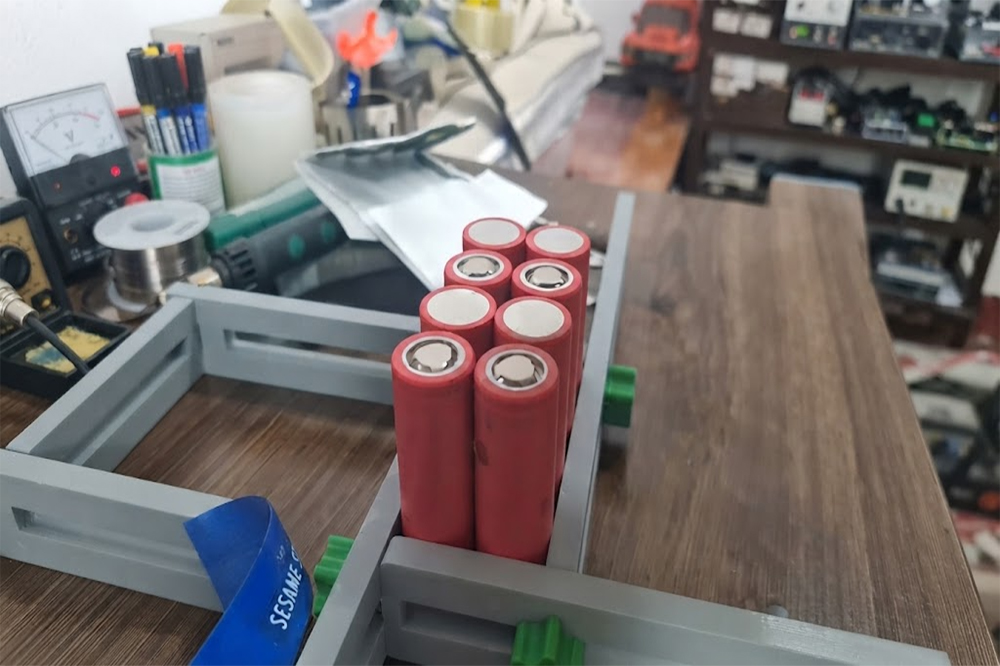
Designing an 18650 battery pack involves more than connecting several cells together. Cell selection, voltage, capacity, discharge current, BMS, physical dimensions, thermal management, and final testing all need to match the application.
Why 18650 Battery Pack Design Starts With the Application
A battery pack should be designed around the product, not the other way around.
A portable device may need a compact 2S pack, while an e-bike, power tool, or industrial device could require many more cells. Two products may even use the same 18650 cell but need completely different pack configurations.
Before selecting cells, define the basic requirements:
- Required voltage
- Required capacity
- Operating current
- Peak current
- Available installation space
- Expected runtime
- Charging method
- Operating temperature
- Communication requirements, if applicable
- Required protection functions
Getting these details first makes the rest of the design much easier.
1. Choose the Right 18650 Cell
Cell selection is usually the first technical decision.
Capacity is important, but it is not the only specification worth looking at. A 3000mAh cell designed for moderate current may behave very differently from a high-drain cell with a similar capacity.
For demanding applications, pay attention to:
- Nominal voltage
- Capacity
- Continuous discharge current
- Peak discharge capability
- Internal resistance
- Cycle life
- Operating temperature
- Cell dimensions
Our guide to high-drain 18650 batteries explains why current capability should be considered alongside capacity when selecting cells for power tools, e-bikes, robotics, and other high-load equipment.
2. Calculate the Series Configuration
The number of cells connected in series determines the pack voltage.
Suppose one 18650 cell has a nominal voltage of 3.7V. A 4S configuration would have a nominal voltage of approximately:
3.7V × 4 = 14.8V
A 5S pack would be approximately:
3.7V × 5 = 18.5V
The full-charge voltage is higher because each lithium-ion cell can reach around 4.2V when fully charged, assuming that charging limit applies to the selected cell.
Therefore, a 4S pack would reach approximately:
4.2V × 4 = 16.8V
This distinction is important when selecting the charger and BMS.
For a more detailed explanation, see our article on 18650 battery voltage, which covers nominal voltage, full-charge voltage, and common pack voltage calculations.

3. Use Parallel Cells to Increase Capacity
Parallel connections increase capacity and current capability while keeping the nominal voltage of the cell group approximately the same.
For example, if one cell is rated at 3000mAh:
1P = 3000mAh
2P = 6000mAh
3P = 9000mAh
A 4S2P pack therefore contains eight cells:
4 × 2 = 8 cells
Its approximate nominal voltage would be 14.8V, while the capacity would be around 6000mAh.
Real-world results can vary depending on cell characteristics, operating conditions, and the design of the finished pack.
Our 18650 series and parallel configuration guide goes deeper into this calculation and explains how different combinations affect voltage and capacity.
4. Think About Energy, Not Just Capacity
Battery buyers often talk about mAh, but watt-hours are usually more useful when comparing the energy available from different voltage packs.
The basic calculation is:
Wh = Voltage × Ah
For example, a 14.8V 6Ah pack would have approximately:
14.8V × 6Ah = 88.8Wh
This does not mean the device will always receive exactly 88.8Wh of usable energy. Efficiency losses, discharge conditions, temperature, cutoff voltage, and other factors affect actual performance.
Still, Wh provides a useful starting point when estimating runtime.
5. Calculate Current Requirements Carefully
Current demand is one of the areas where a battery design can go wrong.
A device rated at 300W may draw a different current depending on its operating voltage.
At approximately 15V:
300W ÷ 15V = 20A
That is a substantial current for a battery pack.
The design therefore needs cells capable of delivering the required current without excessive voltage sag or heat generation. The BMS, nickel strips, wires, connectors, and other electrical components also need to support the load.
Peak current deserves separate attention. Motors and other inductive loads can briefly draw much more current during startup than they consume during normal operation.
6. Internal Resistance Can Change Pack Performance
Cell resistance becomes more noticeable as current increases.
A cell with higher internal resistance can experience greater voltage drop under load. Heat generation can also increase.
This is one reason cell matching matters when building multi-cell packs.
Imagine a group containing cells with noticeably different resistance values. During a heavy load, some cells may experience more voltage drop and heating than others.
Our article on 18650 battery internal resistance explains how resistance affects voltage sag, heat, aging, and cell matching.
For commercial battery production, resistance testing can therefore be part of incoming quality control rather than an optional laboratory exercise.
7. Select the BMS After Defining the Pack
The BMS should match the battery configuration and application.
A 4S pack needs a BMS designed for four cells in series. A 10S pack requires a different configuration.
Current rating matters too. A BMS intended for a low-current portable device may not be suitable for a battery pack powering a high-current motor.
Depending on the design, the BMS may provide functions such as:
- Overcharge protection
- Over-discharge protection
- Overcurrent protection
- Short-circuit protection
- Cell balancing
- Temperature monitoring
Some advanced systems also provide communication functions for monitoring battery status.
The BMS is important, but it should not be used to compensate for poor cell selection or an unsuitable pack design.
8. Cell Matching Makes a Difference
Cells used in the same battery pack should have compatible characteristics.
Ideally, production cells are matched according to relevant parameters such as:
- Capacity
- Internal resistance
- Voltage
- Model
- Production batch
This becomes increasingly important as the number of cells increases.
For example, a 10S4P battery pack contains 40 cells. A small difference between individual cells can become more noticeable when those cells operate together for hundreds of charge and discharge cycles.
Randomly mixing old and new cells is not a good approach for a professional battery pack.
9. Physical Dimensions Need to Be Checked Early
An 18650 cell has a standard naming format, but real battery pack dimensions depend on the cell, insulation, holder or spacing, busbars, BMS, wires, enclosure, and assembly method.
A pack that looks suitable on paper may not fit inside the customer’s product.
Leave room for:
- Cell insulation
- Nickel strips or busbars
- BMS
- Wiring
- Connectors
- Protective enclosure
- Thermal management
- Mechanical tolerances
This is particularly important for compact electronics where a few millimeters can determine whether the finished pack fits.
10. Thermal Management Should Not Be an Afterthought
Battery cells generate heat when current flows through them.
The amount depends on factors such as current, internal resistance, operating time, and environmental conditions.
A compact pack with limited airflow may therefore need a different design from a larger pack installed in a ventilated enclosure.
High-current applications deserve particular attention. Cell spacing, enclosure material, ventilation, thermal paths, and temperature monitoring can all influence the final design.
If the pack becomes unusually hot during testing, don’t simply assume that adding a higher-current BMS will solve the problem. The root cause may be the cells, connections, resistance, or overall pack structure.
11. Decide How the Cells Will Be Connected
18650 battery packs are commonly assembled using spot-welded nickel strips rather than directly soldering wires onto individual cells.
The connection method should minimize unnecessary heat and provide reliable electrical contact.
A typical pack may include:
18650 cells → nickel connections → BMS → wires/connectors → enclosure
The exact structure depends on the product.
Insulation is also important. Fish paper, insulating rings, heat-shrink tubing, separators, and other suitable materials may be used to reduce the chance of accidental contact.
12. Testing Comes Before Shipment
A finished battery pack should be tested before it goes into a customer’s product.
Testing may include:
- Pack voltage
- Charging behavior
- Discharge performance
- Capacity
- BMS protection
- Cell balance
- Temperature
- Connector and wiring condition
- Insulation
- Physical dimensions
A basic functional test can catch wiring mistakes. More detailed testing can reveal problems that are not visible from the outside.
For individual cells or reused cells, our guide on how to test an 18650 battery provides a useful reference for voltage, capacity, internal resistance, and battery condition checks.

A Simple 18650 Pack Design Example
Consider a portable device that requires approximately:
14.8V nominal voltage
6Ah capacity
20A peak current
A possible starting configuration could be 4S2P, assuming a suitable 3000mAh cell is selected.
The calculation would be:
4 cells in series × 3.7V = 14.8V
2 cells in parallel × 3000mAh = 6000mAh
That gives:
4S2P = 14.8V, 6Ah, 8 cells
The next step is not simply ordering eight cells.
The designer still needs to confirm whether the selected cells can handle the required current, whether the BMS supports the expected load, whether the physical dimensions fit, and whether the thermal design is adequate.
This is where a specification sheet becomes a real engineering project.
Custom 18650 Battery Pack Design for OEM Projects
OEM battery projects often start with incomplete information.
A customer may say:
“We need a 12V rechargeable battery, around 5Ah, and it needs to fit inside this enclosure.”
That is a useful starting point, but it is not yet a complete battery specification.
The manufacturer may need the enclosure dimensions, load profile, charging method, connector requirements, operating temperature, expected runtime, and installation environment before recommending a cell and configuration.
A good OEM process usually develops the battery specification together with the product requirements.
For wholesale buyers, it also helps to separate cell purchasing from finished battery pack requirements. The best cell for a standalone application may not be the best choice once it is integrated into a compact pack.

Common 18650 Battery Pack Design Mistakes
Several mistakes appear repeatedly in custom battery projects.
Choosing capacity before current
A high mAh rating does not automatically mean the cell can handle the required load.
Ignoring peak current
Motors and similar loads can create short periods of much higher current demand.
Selecting the BMS too early
The BMS should be matched to the final series count, current, chemistry, and protection requirements.
Mixing different cells
Different capacities, resistance levels, ages, or models can cause imbalance.
Leaving too little physical space
The cells are only part of the finished pack. BMS boards, insulation, wiring, connectors, and enclosure components all take space.
Skipping pack-level testing
A cell can pass inspection while the finished battery pack still has a wiring, BMS, insulation, or assembly problem.
Final Thoughts
A good 18650 battery pack design is a balance between electrical performance, physical space, safety, cost, and expected service life.
Start with the application. From there, determine voltage, capacity, current, dimensions, and operating conditions. Select the cell only after those requirements are clear.
Series and parallel configuration then define the basic electrical structure. The BMS, connections, insulation, thermal design, and enclosure complete the system.
For OEM and wholesale projects, sample testing is especially valuable. A battery that looks perfect in a spreadsheet still needs to work inside the actual product.
FAQs
1. How many 18650 batteries do I need for a battery pack?
It depends on the required voltage and capacity. Series cells increase voltage, while parallel cells increase capacity. For example, a 4S2P pack uses eight cells.
2. How do I calculate an 18650 battery pack?
Determine the required voltage first, then calculate the series count. Next, use the required capacity to determine the parallel count. Current, cell capability, BMS rating, dimensions, and thermal requirements should then be checked.
3. Do 18650 battery packs need a BMS?
Multi-cell lithium-ion packs commonly use a suitable BMS for protection and cell management. The BMS should match the series configuration, current requirements, battery chemistry, and application.
4. Can I mix different 18650 cells in one pack?
It is generally not recommended for professional battery packs. Differences in capacity, resistance, age, and discharge characteristics can cause imbalance and affect pack performance.
5. Can Apsenx customize 18650 battery packs?
Custom battery pack projects normally depend on the required cell specification, electrical configuration, dimensions, BMS, connector, enclosure, and application. OEM buyers should provide their product requirements so the appropriate battery design can be evaluated.
-

12V 4400 mah Lithium ion 3S2P 18650 Battery Pack
-

18650 2000mAh 3.7 volt Lithium-ion Battery
-

18650 20V 3.0Ah Cordless Drill battery
-

18650 22.2V 7.8Ah 2600Mah 6S3P Rechargeable Battery Pack
-

18650 2600mAh Rechargeable Lithium-Ion Battery 3.7V
-

18650 3.7V 10Ah Li-Ion Power Battery Pack
-

18650 3.7V 3300mah Rechargeable Lithium ion Battery
-

18650 7S7P 24V 14Ah Lithium ion Electric Scooter Battery Pack
-

18650 battery 3.7V 1500mAh Lithium-Ion Battery
-

18650 Battery 3500 mah Rechargeable Battery Cells
-

18650 Electric Scooter 48V 13000mAh Lithium Battery
-

2600mAh 3S1P 11.1V 18650 Battery Packs
-

3.7V Li ion Rechargeable 3000mah 18650 Battery Cell
-

36V 5200mAh 10S2P 18650 Battery Pack
-

48v 4400mah 13S2P 18650 Rechargeable Battery Pack
-

7S2P 24V 18650 Lithium Battery Pack
-

Electric Scooter 36V 4400mAH 10S2P 18650 Battery Pack
-

ICR 18650 Battery 2200mah 3.7V
Leave a Reply