
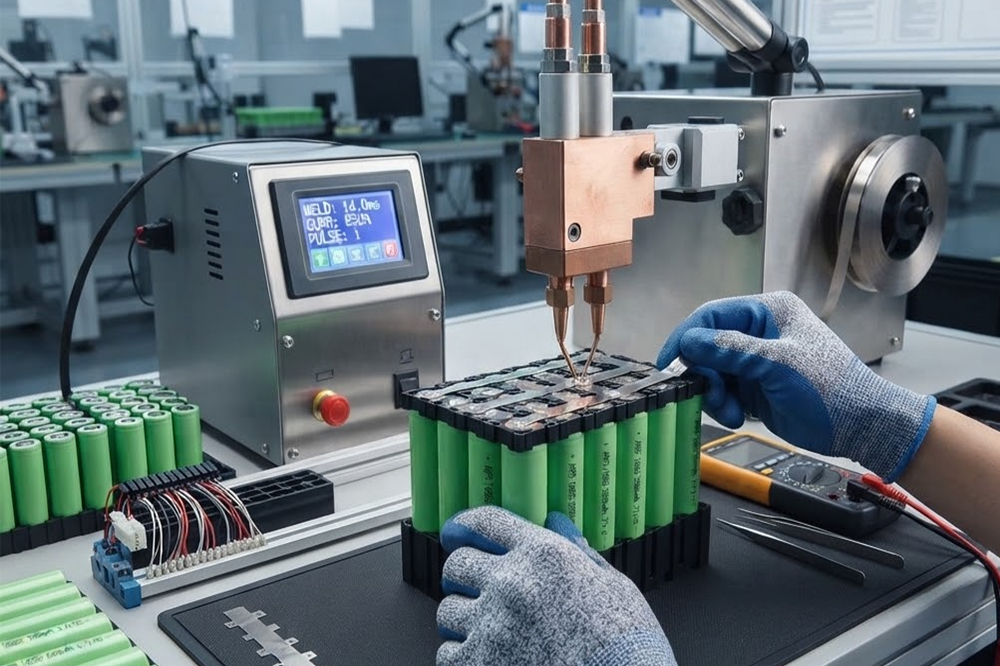
Spot welding is widely used to connect 18650 cells when building lithium-ion battery packs. The right welding method, nickel material, current, electrode pressure, insulation, and quality checks help create reliable connections without putting unnecessary heat into the cells.
What Is 18650 Battery Spot Welding?
When several 18650 cells are assembled into a battery pack, the cells need reliable electrical connections.
One common method is resistance spot welding.
Instead of heating the entire cell, a spot welder sends a controlled electrical pulse through the connection point. The resulting resistance heat creates a small weld between the metal strip and the cell terminal.
For 18650 battery packs, nickel strips are often used as the connection material.
The basic idea looks simple:
18650 cell → nickel strip → spot weld → cell group → BMS
In actual production, however, welding quality depends on several variables. Excessive energy can damage the cell or create weak insulation points, while insufficient energy may produce a connection that looks acceptable but fails under current.
That is why spot welding should be treated as part of the battery manufacturing process rather than simply another assembly step.
Why Spot Welding Is Commonly Used for 18650 Cells
The main advantage of spot welding is heat control.
Directly soldering a wire or metal conductor to 18650 cell can transfer significant heat into the cell. That is not ideal because lithium-ion cells are sensitive to excessive temperature during assembly.
A properly controlled spot-welding process concentrates heat around the small welding area.
This approach can provide:
- Fast assembly
- Consistent connection points
- Lower heat transfer to the cell
- Good mechanical strength
- Suitable electrical conductivity
- Better production efficiency
The actual result depends heavily on the welding equipment, materials, settings, and operator or automated process.

Nickel Strip Selection Matters
The metal strip is not just a piece of material connecting two cells.
Its thickness, width, material composition, and electrical resistance all affect the finished battery pack.
Pure nickel and nickel-plated steel are two materials that may appear similar during visual inspection, but they behave differently during welding and current conduction.
For battery pack applications, the material should be selected according to the current requirement and welding process.
A high-current battery pack may need a different connection design from a small portable electronic device.
Strip dimensions also matter. A thicker strip can carry more current, but it may require different welding energy to achieve a reliable connection.
How a Spot Welding Machine Works
A typical battery spot welder includes electrodes, a power supply, a control system, and welding parameters that determine the pulse delivered to the connection.
The electrodes press the nickel strip against the battery terminal.
A controlled electrical pulse then passes through the contact area. Resistance generates localized heat, forming the weld.
Several parameters influence the result:
- Welding current
- Pulse duration
- Electrode pressure
- Electrode condition
- Nickel strip thickness
- Number of pulses
- Distance between weld points
There is no universal setting that works for every 18650 cell and nickel strip.
The correct values need to be determined through testing with the actual cell, strip, and welding equipment.
Too Much Welding Energy Can Be a Problem
More welding power does not automatically mean a stronger battery pack.
Excessive current or pulse duration can create unnecessary heat. The cell terminal, insulation, or surrounding components may be affected if the process is poorly controlled.
Possible warning signs include:
- Excessive discoloration
- Deep marks on the terminal
- Damaged insulation
- Deformed cell components
- Excessive heat
- Burned nickel
- Unstable weld points
A good weld should provide the required mechanical and electrical connection without unnecessarily heating the cell.
This balance becomes particularly important during high-volume production.
Weak Welds Can Cause Problems Too
The opposite problem is an underpowered weld.
A weak weld may look fine during a quick visual inspection. The connection can still fail when the battery experiences vibration, high current, or repeated charging and discharging.
Typical causes include:
- Insufficient welding energy
- Poor electrode contact
- Contaminated surfaces
- Incorrect pressure
- Unsuitable nickel material
- Incorrect welding position
- Worn electrodes
Production teams should therefore perform mechanical and electrical checks rather than relying only on appearance.

How Many Weld Points Should an 18650 Cell Have?
There is no single number that applies to every battery pack.
The number and arrangement of weld points depend on the strip design, current requirement, cell terminal structure, mechanical requirements, and manufacturing process.
For a small battery pack, a simple connection may be sufficient. Higher-current applications often require a more robust connection path.
The goal is not to add as many weld points as possible. Instead, the welding pattern should provide reliable electrical contact and adequate mechanical strength without creating unnecessary heat or damaging the cell.
Cell Insulation Should Be Checked Before Welding
Before connecting cells, inspect the protective wrapping and positive terminal insulation.
The metal body of an 18650 cell is electrically conductive. If the insulation is damaged or incorrectly positioned, the finished pack can develop an unintended electrical path.
Common insulation materials used in battery pack assembly may include:
- Insulating rings
- Fish paper
- Insulation sheets
- Heat-shrink tubing
- Cell separators
The exact material depends on the pack design.
A small insulation problem during assembly can become a much larger safety problem after the cells are connected together.
Cell Arrangement Comes Before Welding
Spot welding should follow a defined battery layout.
Suppose the target pack is 4S2P. The eight cells need to be arranged into four series groups, with two cells in parallel within each group.
The welding sequence should follow the electrical design rather than simply connecting cells based on physical convenience.
This is where battery pack design and welding become closely connected.
Our guide to 18650 battery pack design explains how voltage, capacity, current, BMS selection, dimensions, and thermal requirements should be established before assembly begins.
Cell Matching Should Happen Before Assembly
Welding should not be the first time cells are evaluated.
Cells going into the same battery pack should have compatible characteristics. Depending on the production requirements, manufacturers may check:
- Cell voltage
- Capacity
- Internal resistance
- Cell model
- Production batch
- Physical condition
A group of cells with noticeably different characteristics may develop imbalance during operation.
The issue can become more significant in large packs with many cells.
Our article on 18650 battery internal resistance explains why resistance differences can affect voltage drop, heat generation, and cell matching.
Spot Welding and High-Current Battery Packs
High-current applications place additional demands on the connection system.
Consider a battery pack used in a power tool. The cells may need to deliver a high current during acceleration or heavy loading.
The cells are only one part of the current path.
The design also includes:
Cell → nickel strip → weld point → bus connection → BMS → wire → connector
Every section adds resistance.
A weak weld or undersized connection can create localized heating and voltage loss.
For this reason, high-drain cell selection should be combined with proper connection design. Our high-drain 18650 battery guide covers current capability, voltage sag, internal resistance, and cell selection in more detail.
Common 18650 Spot Welding Problems
1. Nickel strip does not weld properly
Check the welding current, pulse duration, electrode pressure, strip material, and contact surface.
2. Weld leaves deep marks
The welding energy may be too high, or electrode pressure may not be properly adjusted.
3. Nickel strip tears easily
The weld may be too weak, or the selected strip may not be suitable for the application.
4. Battery terminal becomes excessively hot
Review the welding parameters and contact condition. Excessive heat during assembly should not be ignored.
5. Weld quality changes during production
Worn electrodes, unstable power, inconsistent strip placement, or changing cell surfaces can cause variation.
6. Pack voltage is incorrect after welding
Check the welding sequence and electrical configuration. A single incorrect connection can change the expected series or parallel arrangement.
How to Check Spot Weld Quality
A professional production line should use more than visual inspection.
A practical quality-control process may include:
Visual inspection → Weld strength check → Electrical resistance check → Pack voltage check → Functional test
Visual inspection can identify obvious problems such as burned strips, damaged insulation, or poor positioning.
Mechanical testing helps determine whether the weld can withstand normal handling.
Electrical testing can reveal high-resistance connections that may become hot during operation.
The appropriate test method depends on the battery design and production volume.
Spot Welding vs. Soldering
Both methods can create electrical connections, but they are not interchangeable in every battery application.
| Factor | Spot Welding | Soldering |
|---|---|---|
| Heat exposure | Localized | Higher around the joint |
| Production speed | Fast | Usually slower |
| Automation | Easy to automate | More complex |
| Battery pack production | Widely used | Limited depending on design |
| Connection material | Nickel strips | Wires or solderable conductors |
| Process consistency | High with controlled equipment | Depends more on technique |
For mass battery pack production, spot welding is often preferred because it can provide repeatable connections with controlled heat input.
Can You Spot Weld 18650 Batteries at Home?
Small battery packs can look simple enough to assemble at home, but lithium-ion cells require careful handling.
A suitable spot welder, correct welding parameters, proper insulation, and battery testing equipment are important.
More importantly, the cells need to be suitable for the intended configuration.
A poor welding process can damage the cell even if the finished pack appears normal.
For commercial products, professional battery assembly is usually a better option because production can include cell matching, controlled welding, BMS installation, insulation, testing, and quality inspection.
Spot Welding in OEM Battery Pack Production
OEM battery production usually involves more than welding cells together.
A typical project may follow this sequence:
Requirement confirmation → Cell selection → Sample testing → Cell matching → Pack layout → Spot welding → BMS installation → Electrical testing → Final inspection
The exact process varies by product.
For example, a compact medical device may prioritize size and low heat, while a power tool battery may focus more heavily on current capability and mechanical strength.
That difference affects the cell, nickel strip, welding process, BMS, and enclosure design.
Final Thoughts
18650 battery spot welding looks straightforward from the outside. In production, however, small changes in current, pulse duration, electrode pressure, strip material, or cell condition can change the result.
A reliable process starts with the battery design. Cell selection, series and parallel configuration, current requirements, insulation, and BMS requirements should be established before welding begins.
Good welding then creates the physical and electrical connections needed to turn individual cells into a working battery pack.
For OEM and wholesale battery projects, it is worth evaluating the complete assembly process rather than focusing only on the price of individual 18650 cells. Consistent cell quality, controlled welding, proper testing, and repeatable production are all important when the same battery needs to be manufactured in quantity.
FAQs
1. Can 18650 batteries be spot welded?
Yes. Resistance spot welding is widely used to connect 18650 cells with nickel strips during battery pack assembly. The welding parameters need to be matched to the cell, strip material, and equipment.
2. Is spot welding safer than soldering 18650 batteries?
Spot welding can reduce heat transferred into the cell because the welding process concentrates heat around the connection point. The equipment and welding parameters still need to be properly controlled.
3. What nickel strip should be used for 18650 batteries?
The appropriate strip depends on the required current, welding equipment, pack design, and material properties. Pure nickel and nickel-plated materials have different electrical and welding characteristics.
4. Can I use the same welding settings for every 18650 battery?
No. Different cells, nickel strips, strip thicknesses, and welding machines can require different settings. Testing should be performed with the actual production materials.
5. How do you test an 18650 spot weld?
Visual inspection can identify obvious defects, while mechanical and electrical tests can provide additional information about weld strength and resistance. The appropriate test method depends on the battery design and production requirements.
-

12V 4400 mah Lithium ion 3S2P 18650 Battery Pack
-

18650 2000mAh 3.7 volt Lithium-ion Battery
-

18650 20V 3.0Ah Cordless Drill battery
-

18650 22.2V 7.8Ah 2600Mah 6S3P Rechargeable Battery Pack
-

18650 2600mAh Rechargeable Lithium-Ion Battery 3.7V
-

18650 3.7V 10Ah Li-Ion Power Battery Pack
-

18650 3.7V 3300mah Rechargeable Lithium ion Battery
-

18650 7S7P 24V 14Ah Lithium ion Electric Scooter Battery Pack
-

18650 battery 3.7V 1500mAh Lithium-Ion Battery
-

18650 Battery 3500 mah Rechargeable Battery Cells
-

18650 Electric Scooter 48V 13000mAh Lithium Battery
-

2600mAh 3S1P 11.1V 18650 Battery Packs
-

3.7V Li ion Rechargeable 3000mah 18650 Battery Cell
-

36V 5200mAh 10S2P 18650 Battery Pack
-

48v 4400mah 13S2P 18650 Rechargeable Battery Pack
-

7S2P 24V 18650 Lithium Battery Pack
-

Electric Scooter 36V 4400mAH 10S2P 18650 Battery Pack
-

ICR 18650 Battery 2200mah 3.7V
Leave a Reply